
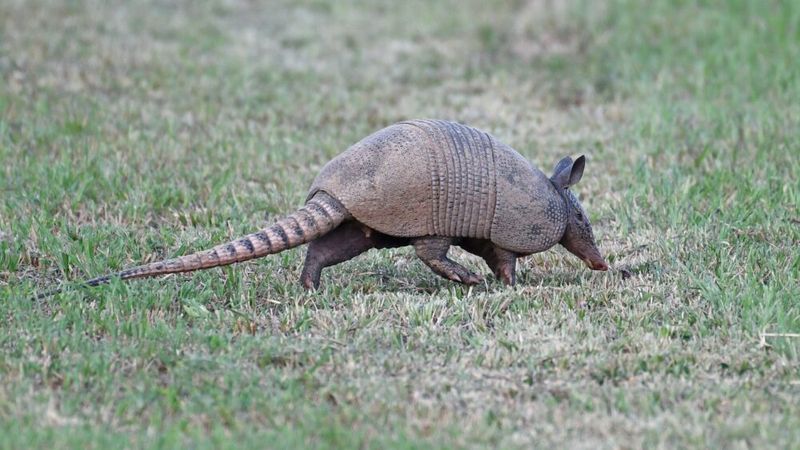
Step outside on a Central Texas morning and you might find a scattering of fresh, cone-shaped holes punched through your otherwise tidy lawn. A nine-banded armadillo likely paid a visit overnight, rooting through the root zone in search of something to eat.
Those craters are a real clue worth following up on, but they are not proof of a grub infestation on their own. A little digging, both literal and investigative, will tell you what is actually happening beneath the grass.
Those fresh craters are a clue, not a diagnosis
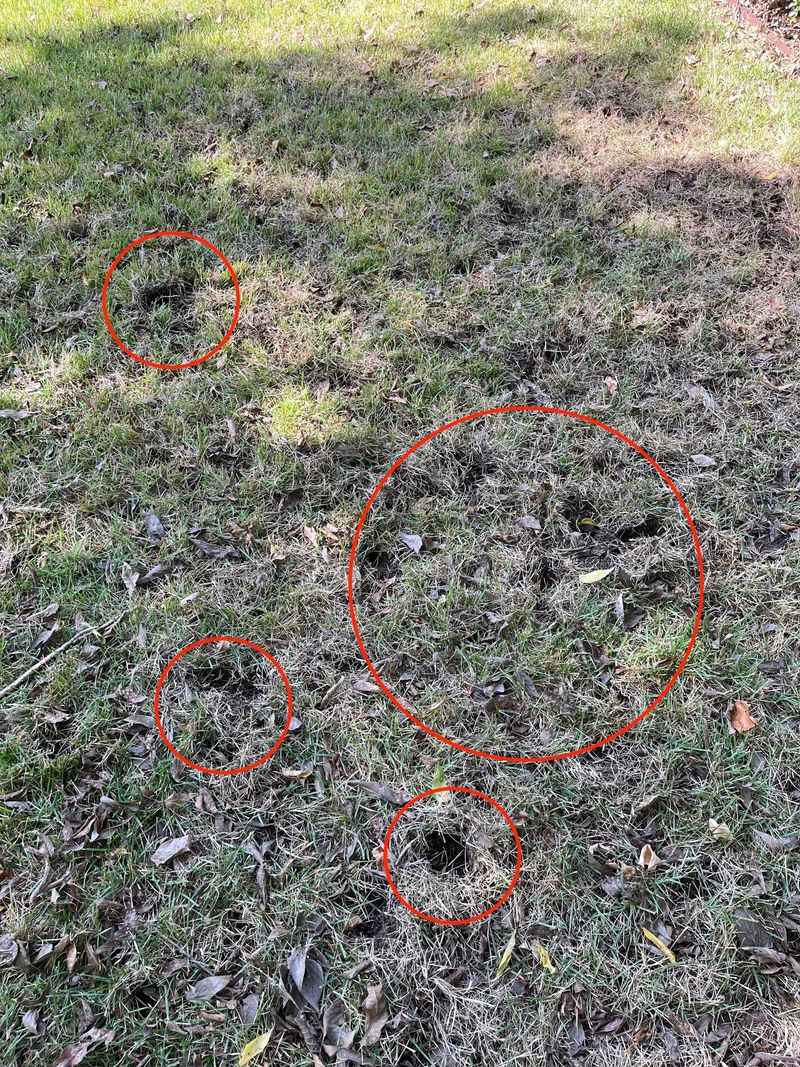
Nine-banded armadillos are powerful foragers with strong claws built for breaking through compacted soil. Texas Parks and Wildlife notes that the species is found throughout most of Texas, including Central Texas, and that its lawn digging is driven by an appetite for soil invertebrates, grubs among them.
When one works through your yard, it leaves behind a scattered pattern of shallow, inverted-cone-shaped holes that can look alarming by daybreak.
Those holes are a starting point for investigation, not a finished answer. University of Georgia Extension’s natural history profile of the nine-banded armadillo describes typical foraging holes as roughly 1 to 3 inches deep and 3 to 5 inches wide, but hole shape and size alone cannot tell you which food source the animal was after.
Earthworms, ants, beetles, and other soil invertebrates are all fair game for an armadillo on the hunt.
White grubs are beetle larvae that feed on grass roots and can genuinely weaken Central Texas turf. University of Georgia’s white grub turfgrass guide explains that heavy feeding reduces the root system that keeps grass anchored and healthy, which can add a second layer of damage beneath the visible holes an armadillo leaves.
The combined effect can make a lawn look far worse than either problem alone would produce.
Still, the craters do not confirm that grubs are present or that they were the target. Applying insecticide based only on visible holes skips the inspection step that actually determines whether a grub population is large enough to justify treatment.
The right move is to treat the holes as a prompt to check the soil rather than as a diagnosis that demands an immediate chemical response.
What may be happening beneath the turf?
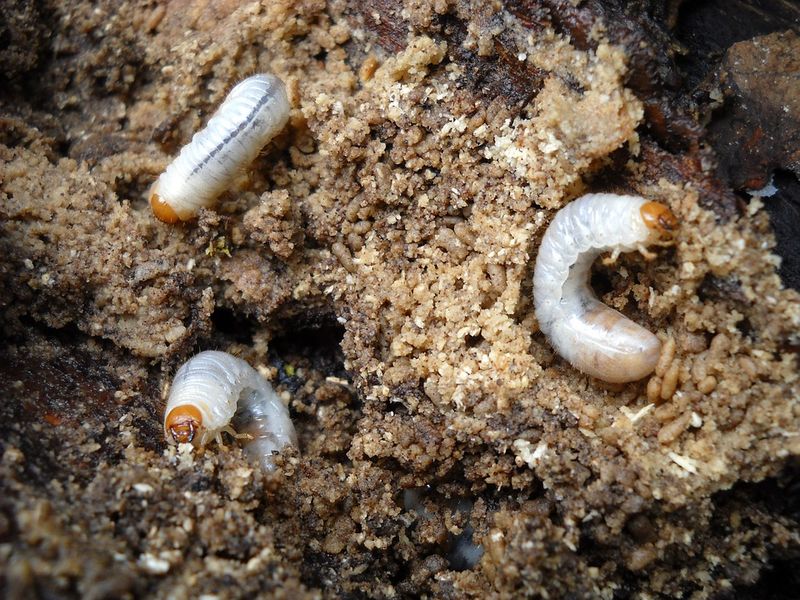
Beneath a healthy-looking Central Texas lawn, the root zone is a busy place. Beetle larvae, commonly called white grubs, spend weeks or months feeding on grass roots before they mature into adults.
UGA’s white grub guide describes how this root-feeding reduces the turf’s ability to take up water and nutrients, producing patches that look drought-stressed even when rainfall or irrigation has been adequate.
An armadillo searching that same root zone adds a second layer of disruption. The animal pulls back soil and roots while hunting, which can dislodge grass that grubs have already weakened.
But the two problems are separate, and one does not prove the other. “Grubs” is a broad homeowner term that covers the larvae of several beetle species with different life cycles, treatment windows, and susceptibility to control products, so the word alone does not pin down what is actually in your soil.
Armadillos eat a varied diet that extends well beyond lawn grubs. UGA Extension’s armadillo overview lists earthworms, ants, beetles, millipedes, centipedes, spiders, scorpions, and occasional plant material among the foods armadillos consume.
A diet study from Cumberland Island, Georgia, published by the Southeastern Association of Fish and Wildlife Agencies, confirmed that invertebrates dominate armadillo stomach contents but that the specific mix varies by season and habitat.
The practical takeaway is a simple causal model: holes may reveal that an armadillo was foraging, while turf symptoms and actual soil inspection determine whether grubs are involved. One piece of evidence points toward the other, but neither confirms the full picture on its own.
The lawn tells you whether the roots are suffering
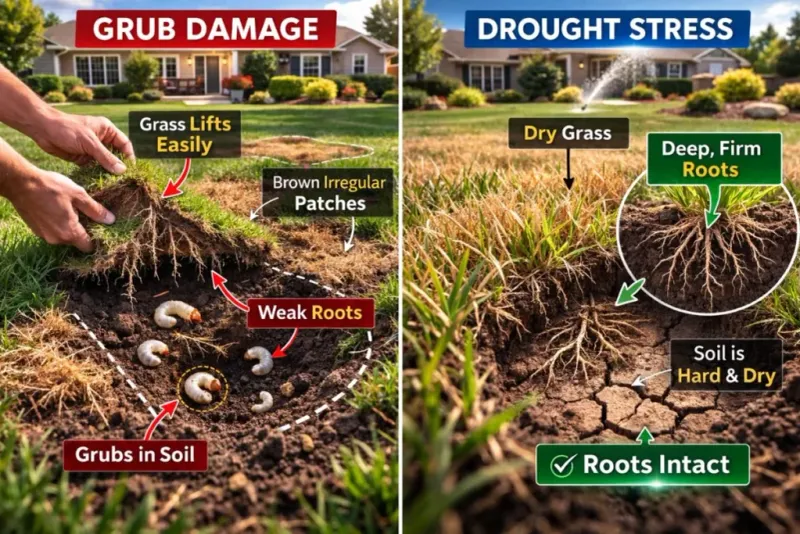
Before reaching for a shovel, walk the lawn and look for symptoms that support a grub investigation. Yellow or brown patches that appear despite adequate watering are one of the clearest warning signs, because grass losing its roots cannot pull moisture from the soil even when moisture is present.
UGA’s grub pest guide describes this drought-like stress as a hallmark of heavy root feeding, along with reduced root mass and spongy or loose turf underfoot.
Sod that lifts easily is another indicator worth noting. When grubs sever enough roots, the grass mat loses its grip on the soil and can sometimes be rolled back like a loose rug.
That kind of separation is a stronger signal than color change alone, because yellowing and browning have many possible causes in Central Texas, including turf disease, heat stress, and irrigation problems.
Texas A&M AgriLife Extension’s white grub guide specifically notes that Take-all Patch and other turf diseases can produce symptoms that closely resemble grub injury, which is one reason symptoms alone are not enough to confirm the problem. Treat color change and spongy turf as reasons to inspect the soil rather than as definitive proof that larvae are present.
Focus your visual assessment on the transition zone between discolored and healthy grass rather than on the craters themselves. Grub damage typically spreads outward from an active feeding area, so the boundary between affected and unaffected turf is usually where the evidence is freshest and most informative.
That boundary is also the best place to start your soil sampling.
Dig before you decide to treat
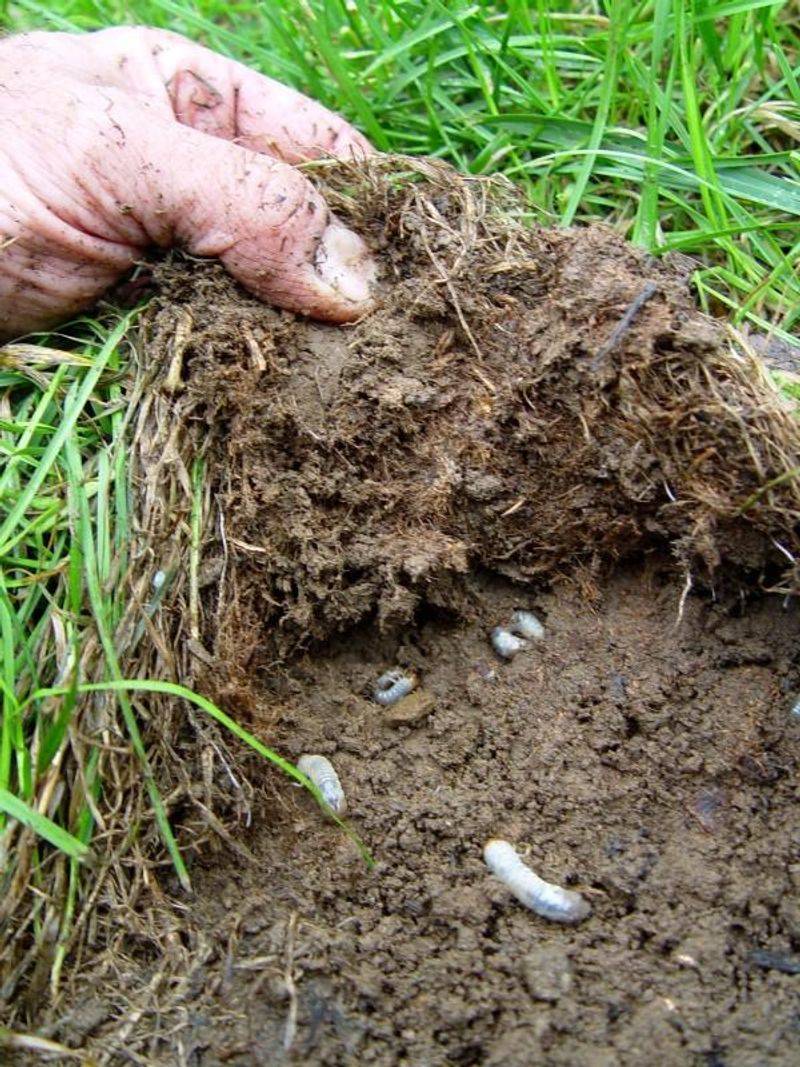
Soil inspection is the only reliable way to confirm whether white grubs are actually present and numerous enough to justify treatment. Texas A&M AgriLife Extension recommends examining several scattered samples, especially near the edge between damaged and healthy turf, rather than relying on a single spot or a single armadillo crater.
One sample from the worst-looking area can miss a patchy infestation entirely, so spread your inspection across several locations.
The sampling method itself is straightforward. Use a shovel or sharp knife to cut three sides of a small square of sod, then fold the flap back like a book cover.
Sift through the upper several inches of soil and the root zone with your hands or a trowel, looking for C-shaped, cream-colored larvae with a distinct brown head capsule. UGA Extension recommends sampling at least a one-square-foot section to get a reliable count per unit area.
Texas A&M’s guidance calls for inspecting sections at least 3 to 4 inches across and about 4 inches deep, with deeper sampling in sandy soils where grubs may move lower during dry or hot conditions. Count every live larva you find in each sample, replace the sod after each check, and water the area lightly to help it recover.
Keep a running tally across all your samples rather than averaging a single good or bad result.
Finding live larvae in multiple samples strengthens the case that grubs are contributing to the problem. Failing to find them in the inspected samples makes that explanation less supported, though it does not definitively rule out a localized or missed infestation if the lawn symptoms are still present and unexplained.
At that point, consulting your local Texas A&M AgriLife county Extension office can help you consider other possible causes before committing to any treatment.
Treatment depends on the count, timing, and label
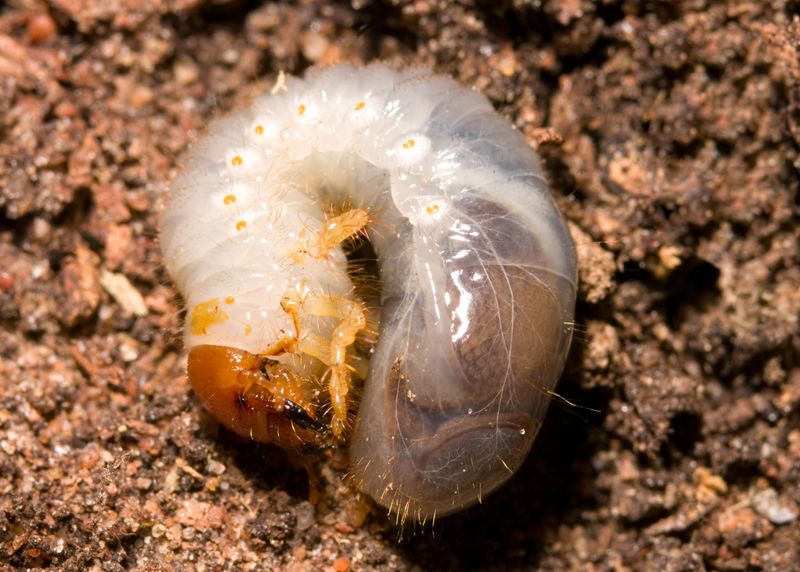
Inspection results, not visible holes or brown grass, should drive the treatment decision. Texas A&M AgriLife Extension’s grub management guide offers a general guideline that finding more than five white grubs per square foot may justify treatment in most Central Texas lawns.
That figure is a practical reference point, not a universal biological threshold; some lawns with higher counts show little visible damage, while others with lower counts may already show stress if the turf was weakened by other problems.
Timing matters as much as count. Texas A&M cites early to mid-July as the general preventive-treatment window for Central and North Texas, when young grubs are small and feeding near the surface.
That window shifts depending on the grub species present, the specific product chosen, and current label directions, so check with your local county Extension office before scheduling an application. Life stages and product registrations change, and local advisors have the most current guidance for your area.
Beneficial nematodes are a possible nonchemical option for confirmed grub populations. Texas A&M reports that commercially available nematodes can reduce grub numbers under favorable conditions, but their effectiveness depends on adequate soil moisture before and after application and on appropriate storage and handling of the product.
They are a reasonable consideration, not a guaranteed fix for every Central Texas lawn situation. One product that has been marketed as a biological grub control, Bacillus popilliae (milky spore), has not been shown effective against the white grub species that typically infest Texas turfgrass and is not a recommended option here.
If a labeled insecticide is the right choice after confirming a meaningful infestation, use only a product whose label specifically covers the lawn type and grub situation you have. EPA guidance makes clear that pesticide labels are legally enforceable documents, and using a product in a way that contradicts its label violates federal law.
Water the product in according to label directions, follow all safety precautions, and check EPA tips for reducing pesticide impacts on wildlife to minimize unintended effects on beneficial insects, earthworms, and nearby water.
Grub control may not stop the armadillo
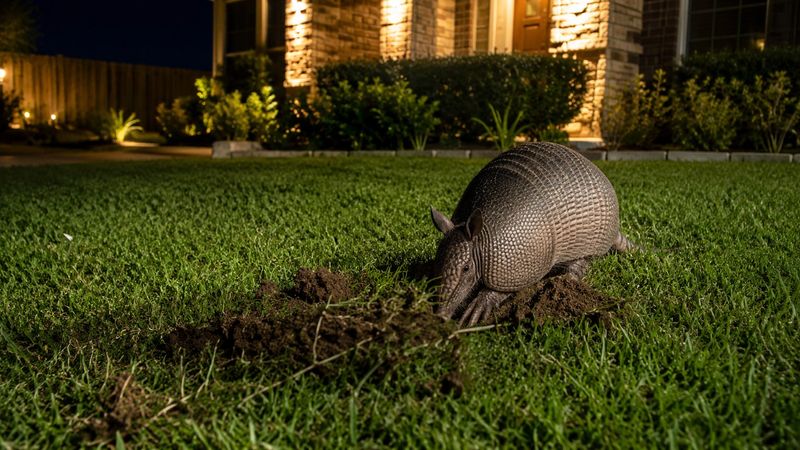
Managing a confirmed grub population addresses the root-feeding damage those larvae cause, but it does not come with a guarantee that the armadillo will leave. UGA Extension’s armadillo overview cautions that removing one food source with a lawn insecticide is unlikely to discourage foraging, because armadillos can simply shift their attention to earthworms, ants, beetles, and the many other invertebrates living in any active soil.
An animal that finds your yard productive will often keep searching even after one food source becomes scarce.
Watering practices are worth reviewing during this process, but not as a wildlife-control tactic. Moist soil increases surface activity by insects and other invertebrates, which can make a yard more attractive to a foraging armadillo.
UGA Extension’s nuisance wildlife guide notes that overwatering can increase the appeal of a yard to digging animals. Water according to your turf’s actual needs and any local restrictions rather than trying to use irrigation as a deterrent strategy.
Turf recovery after a combined grub-and-armadillo event depends on several factors. Texas A&M’s grub management guidance explains that confirmed grub control can address the root-feeding component of the damage, but the grass still needs adequate time and conditions to regrow roots and fill in bare areas.
Torn and disrupted turf from armadillo digging adds a separate physical recovery challenge that insecticide alone cannot resolve.
Any other underlying problems, including disease, compaction, or irrigation issues, will also need to be addressed before the lawn can fully recover. Grub management is one piece of the restoration picture, not the whole answer.
Handle the wildlife question by the rules
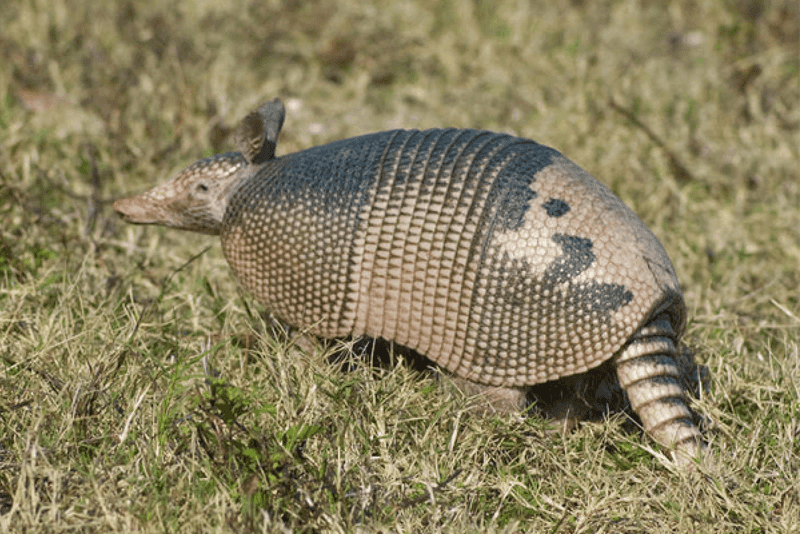
If the digging continues after you have investigated the lawn and addressed any confirmed grub problem, the armadillo itself becomes the question. Texas classifies the nine-banded armadillo as a nongame species, and Texas Parks and Wildlife Department’s nongame species regulations specify that a hunting license is required to take nongame animals, with additional restrictions on where and how wildlife may be taken.
Those rules apply to private property situations as well, and they change periodically, so checking current TPWD guidance or contacting a licensed wildlife-control professional is the right first step rather than acting on general internet advice.
Relocation is sometimes suggested as a simple solution, but it carries its own complications. Wildlife handling can be regulated, stressful to the animal, and ineffective at preventing a different armadillo from moving into the same territory.
A qualified wildlife-control operator will know the current legal requirements and the practical options available for your specific property situation.
A brief health note is appropriate here without overstating the risk. Some armadillos in the southern United States carry the bacterium that causes Hansen’s disease, commonly known as leprosy.
CDC guidance on Hansen’s disease describes the risk from armadillo encounters as very low for most people. The practical precautions are straightforward: do not handle or consume wild armadillos, use gloves and appropriate protective measures if you need to deal with a carcass or work in an area where an animal has been active, and leave professional control work to people equipped to do it safely.
Seeing an armadillo cross your yard does not create a likely health threat. Keeping a reasonable distance and following the rules is the right response.
Use the holes to ask the right lawn question
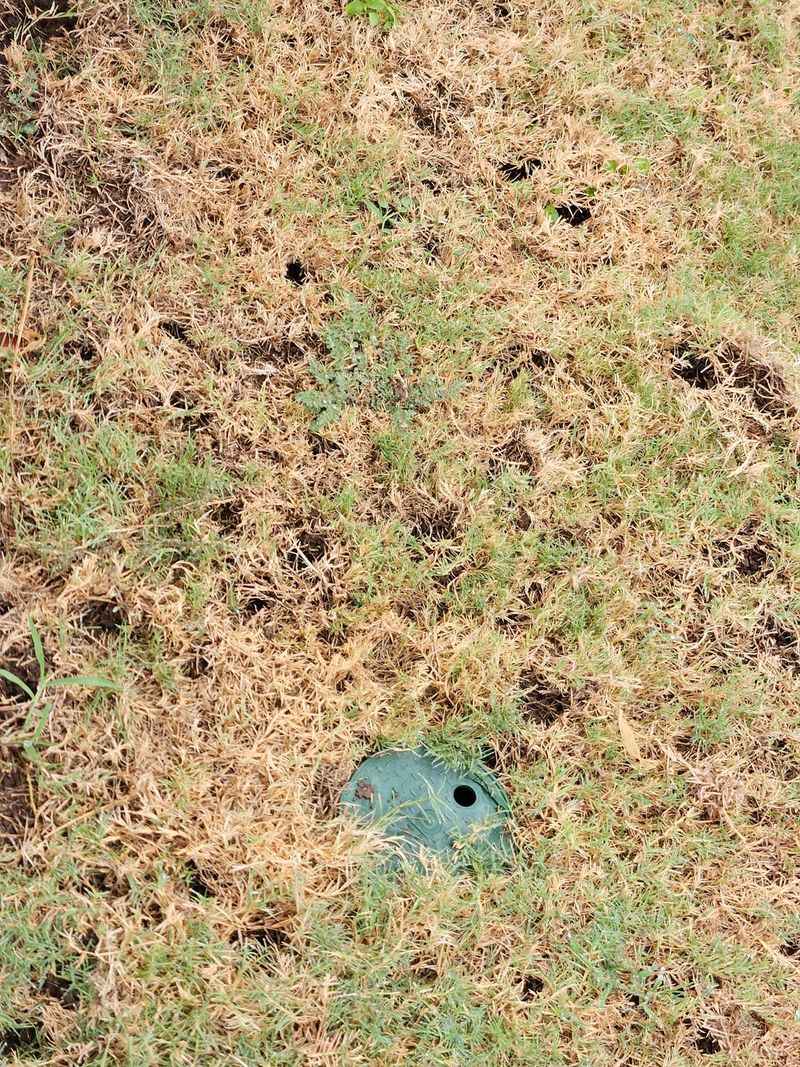
Fresh armadillo craters are worth taking seriously as a lawn signal, but the right response is a question, not a treatment. Start by photographing the holes and walking the turf to look for corroborating symptoms: yellowing or browning, drought-like stress despite recent watering, spongy areas, or sod that separates from the soil with light pressure.
Then dig several scattered samples near the edge of any damaged areas, count live grubs in each, and compare your results with Texas A&M AgriLife’s grub management thresholds and timing guidance before choosing any treatment.
Confirmed grub management can address the root-feeding component of the damage, but turf recovery depends on the extent of injury and any other contributing causes. UGA Extension’s armadillo overview is a useful reminder that the animal’s broader foraging behavior may require a separate, lawful response handled through Texas Parks and Wildlife or a qualified professional.
A hole in the lawn is the beginning of the investigation, not the end of it.