
Walk past a Texas mountain laurel in late summer and you might hear a faint rattling from the woody pods hanging among the branches. That sound comes from dry seeds shifting inside mature pods, and it has nothing to do with caterpillars.
What actually signals a Genista caterpillar problem is something you see, not hear: loose silk webbing tucked around the newest growth, with small yellowish-green or orange larvae feeding underneath. Knowing the difference keeps you from treating a perfectly healthy shrub while helping you catch a real infestation before serious leaf loss occurs.
The rattle comes from drying pods, not caterpillars
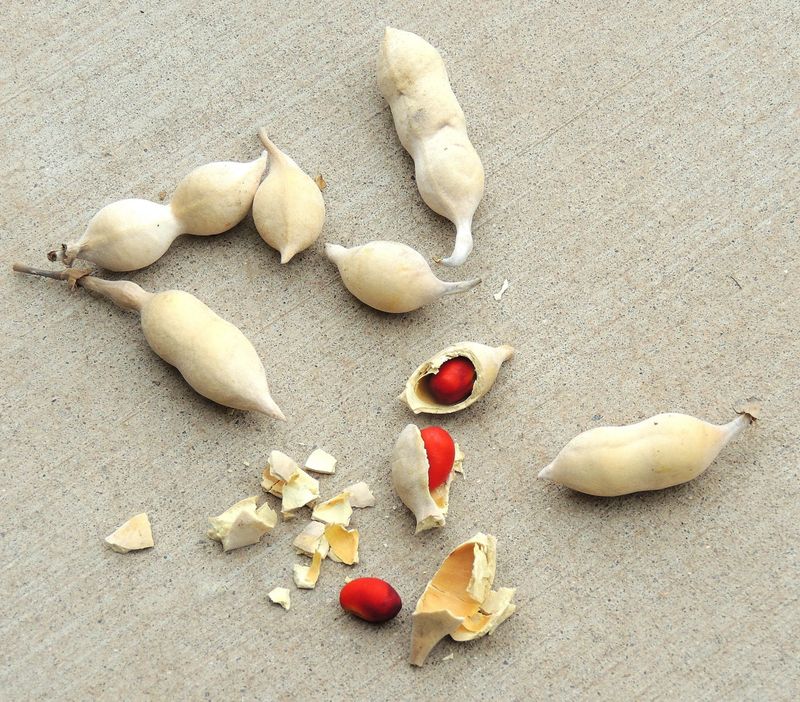
Mature Texas mountain laurel pods are hard and woody, and as they dry out through the season, the seeds inside can shift and rattle when the branch moves. That sound is simply the plant completing its seed cycle, not a distress signal of any kind.
Texas Parks and Wildlife documentation describes the plant’s distinctive pod and seed structure, confirming that mature, drying pods are a normal part of the shrub’s biology.
Neither the rattle nor the presence of pods tells you whether Genista caterpillars are feeding on the plant. Those are two entirely separate things.
The pods belong to the shrub’s reproductive process, while caterpillar activity shows up in the foliage, particularly on new growth where silk webbing and feeding damage become visible.
One caution worth stating plainly: the bright red seeds inside those pods contain toxic alkaloids. Poison Control guidance on mescal bean toxicity is clear that these seeds should not be eaten, and pods or loose seeds should be kept away from children and pets.
This applies year-round, not just during pest season.
Texas mountain laurel is formally known as Dermatophyllum secundiflorum. Older references may list it as Sophora secundiflora or Calia secundiflora, but it is not the same plant as eastern mountain laurel, Kalmia latifolia.
The NC Extension plant profile for Dermatophyllum secundiflorum notes this distinction and provides useful botanical context.
When the rattle catches your attention, treat it as a prompt to take a closer look at the shrub rather than a diagnosis. Walk up, inspect the newest growth, and look for the visual signs described in the next section.
The pods tell you the plant is maturing; the foliage tells you whether caterpillars are present.
Loose webbing on new growth points to Genista caterpillars
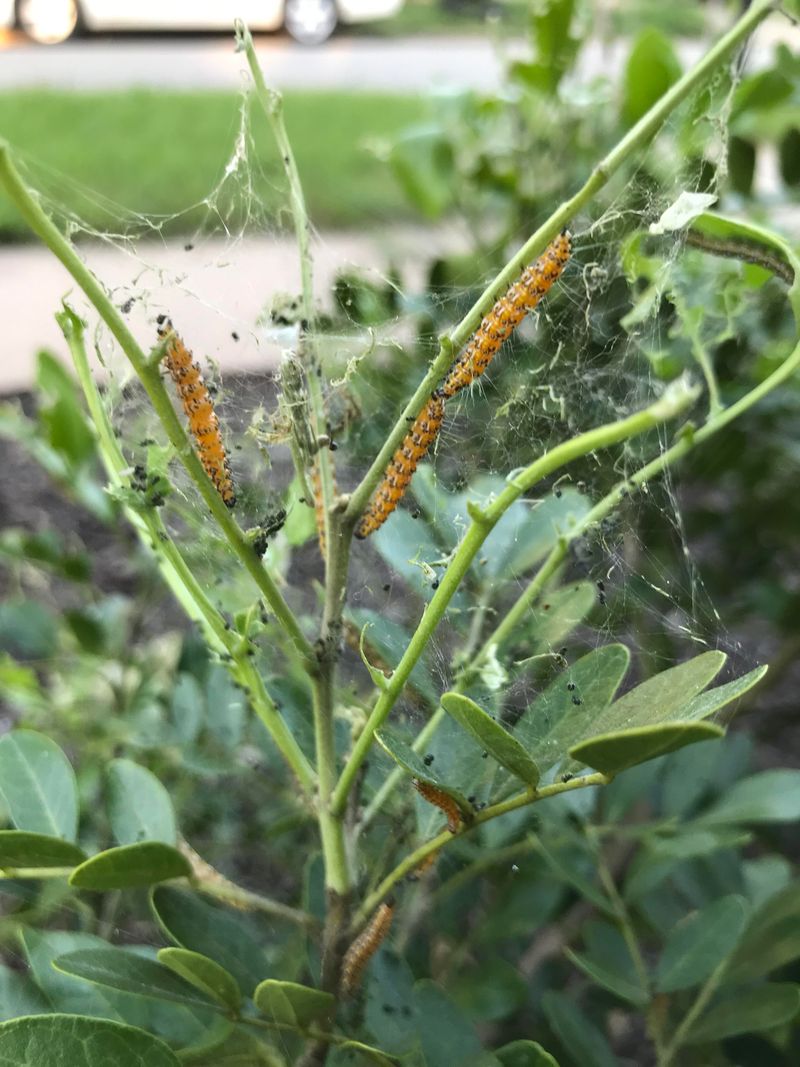
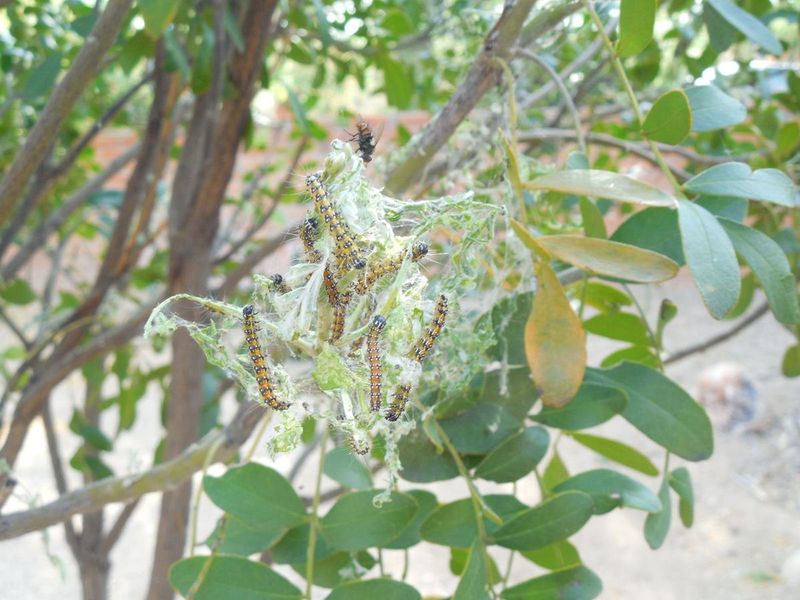
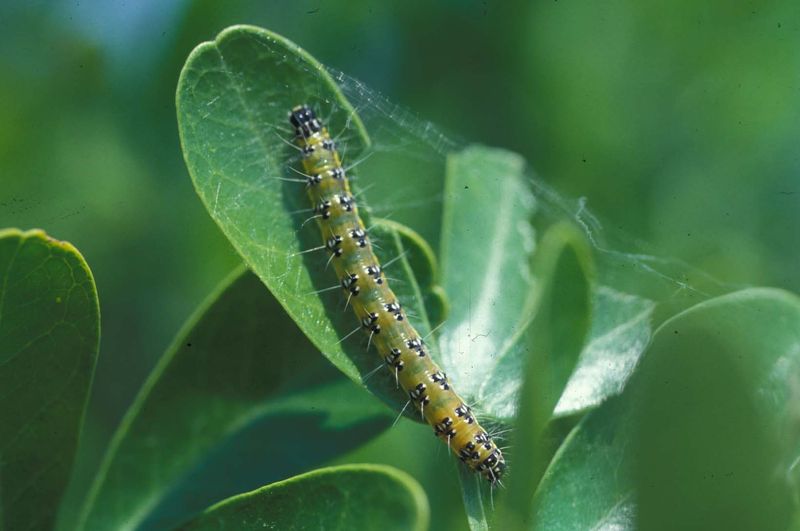
Spotting loose, silky threads wrapped around the newest branch tips of a Texas mountain laurel is a meaningful clue worth investigating further. The insect responsible is the Genista caterpillar, Uresiphita reversalis, the larval form of a small pyralid moth that commonly targets this shrub across Central Texas and the Gulf Coast.
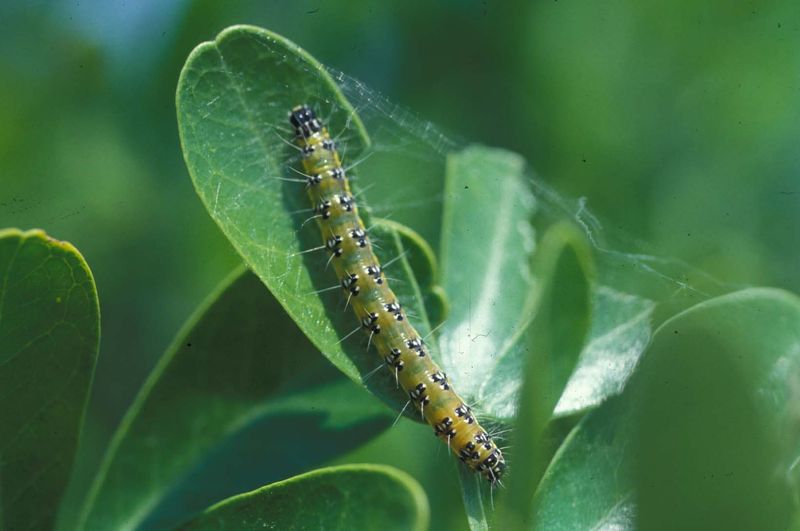
According to Texas A&M AgriLife Landscape IPM guidance on Genista caterpillars, the larvae feed inside loose silk webbing concentrated around fresh growth and can reach roughly one inch at maturity. Young caterpillars tend to be yellowish-green; older ones may shift toward orange.
Both color phases carry small black-and-white spots and a scattering of short hairs along the body.
The webbing itself is the first thing most gardeners notice, but it should not be treated as conclusive proof on its own. Other caterpillars also spin silk structures on landscape plants, so the webbing needs to be paired with a look at what is actually inside it.
Travis County AgriLife Extension coverage of the pest emphasizes examining the caterpillars directly to confirm the identification.
Fall webworms are the most common source of confusion. Their webs are generally larger, more conspicuous, and positioned at branch tips in a way that encloses significant amounts of foliage.
Genista caterpillar webbing is comparatively loose and localized, usually hugging the newest terminals rather than ballooning outward. Texas Standard reporting on the species reinforces that the combination of web placement, caterpillar color, and spot markings gives the strongest field diagnosis.
Gently open the webbing with a stick or gloved finger and look for the described larvae feeding on leaf tissue. If the caterpillars match the yellowish-green to orange coloration with black-and-white spots, and the webbing is confined to fresh growth, you have a reliable confirmation.
A web without visible larvae, or larvae that look very different, warrants a closer look before any response.
Look from spring through the warm months
Spring is when Genista caterpillar activity first becomes noticeable in Central Texas, and it does not stop there. Texas A&M AgriLife’s Landscape IPM resource describes adults emerging in early spring and several overlapping generations continuing through the warm months.
That means a shrub that looked clean in April can develop feeding activity again in June or July.
Travis County AgriLife Extension documentation specifically addresses spring feeding, which aligns with when Texas mountain laurels push new growth and give caterpillars a ready food source. Waiting for a single seasonal window will cause you to miss early rounds of feeding when intervention is easiest.
Late-summer and fall activity is also possible in some areas. University of Arizona Cooperative Extension material on Texas mountain laurel notes susceptibility during late summer and fall, suggesting that the pest’s timing can extend well beyond spring depending on local conditions.
The practical takeaway is to stay alert from the first flush of new growth in spring through the end of the warm season.
Focus your inspections on the newest growth, since that is where larvae prefer to feed. Check the undersides of leaves and look for loose webbing at branch terminals.
Egg masses may appear in overlapping clusters on foliage, but they can be difficult to spot, so caterpillars and webbing are usually the more reliable things to search for. A quick monthly walk-around during the growing season is enough to catch most infestations while larvae are still small and feeding is still limited.
The damage reaches leaves, terminals, and flower buds
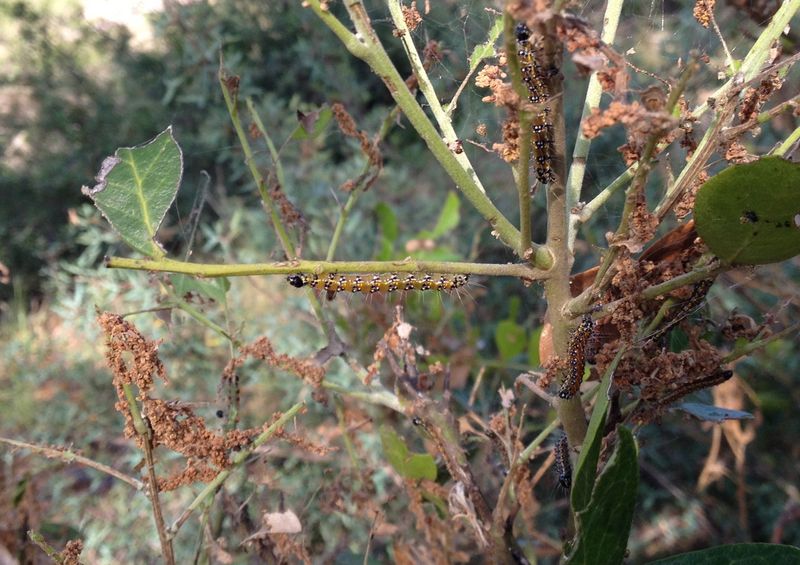
Genista caterpillars feed on leaf tissue, and they concentrate on the newest, most tender parts of the plant. A moderately infested mountain laurel can develop a ragged, thinned-out look at its branch tips, with chewed leaf margins and webbed terminals that turn brown as feeding progresses.
Flower buds are also at risk. When larvae consume developing buds before they can open, the following bloom season may produce noticeably fewer flowers.
Texas A&M AgriLife’s Genista caterpillar resource notes that feeding can remove both leaves and flower buds, and that severe defoliation can slow growth. For a shrub prized for its fragrant purple spring blooms, bud loss is a real concern worth factoring into any decision about whether to act.
That said, the damage picture is often more about appearance than plant survival. Ask Extension guidance on Genista caterpillars devouring mountain laurels and the Texas A&M IPM resource both characterize most infestations as primarily aesthetic, with plant health generally unaffected unless feeding becomes heavy.
A shrub with some chewed terminals is not necessarily in serious trouble.
Heavy defoliation changes that calculation. When repeated or severe feeding strips a significant portion of the foliage, growth can slow and the plant’s overall condition warrants closer monitoring going forward.
Travis County Extension coverage of the pest reinforces that the distinction between light cosmetic damage and genuinely heavy defoliation should guide how seriously a gardener responds. Routine caterpillar presence on a healthy, established mountain laurel is different from a large population stripping a young or stressed plant.
Inspect before you intervene
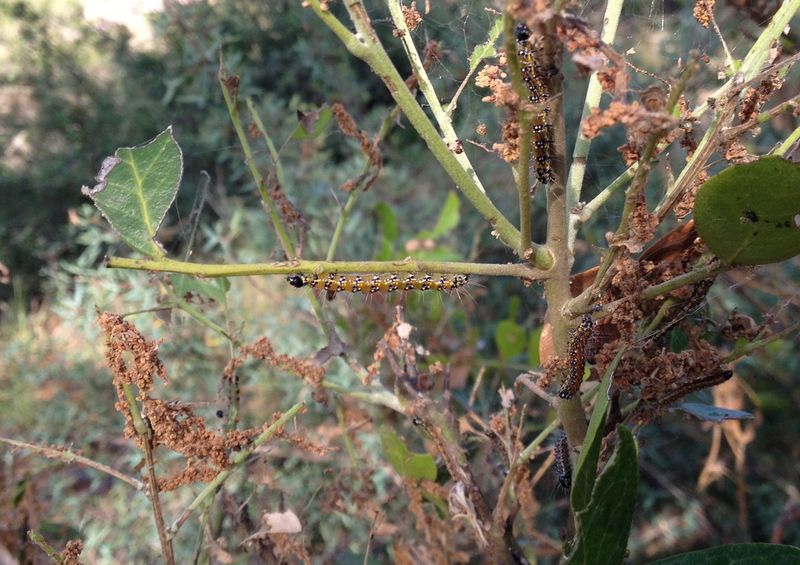
Before reaching for any control product, spend five minutes with the shrub. Fresh terminals and leaf undersides are where Genista caterpillars concentrate, so start there.
Use a stick or a gloved finger to gently open any loose webbing and look inside for the yellowish-green to orange larvae with black-and-white spots described in the identification section above.
Web size and placement matter when you are trying to tell caterpillar species apart. Genista caterpillar webbing is loose and relatively small, wrapped around new growth near branch tips.
Texas A&M Forest Service fall webworm information describes those structures as generally larger and more conspicuous, often enclosing substantial foliage at branch ends. If the web is big enough to be obvious from several feet away, fall webworms are a more likely culprit.
Tent caterpillars build silken tents at branch forks rather than at the tips, which is another visible distinction.
Texas A&M AgriLife Landscape IPM guidance frames the decision about whether to act around the actual condition of the plant and the extent of active feeding. A few larvae on a large, established shrub with minimal foliage loss is a different situation from a dense population actively stripping a young plant.
Consider the shrub’s age, its overall health, whether buds are being consumed, and how much the plant’s appearance matters in your landscape before committing to any treatment.
Silk threads without visible caterpillars may mean feeding has already finished for that generation, in which case the plant may not need any response right now. Confirm active feeding before acting, and revisit the shrub in two to three weeks since additional generations can follow.
A calm, methodical look at what is actually happening beats a reactive treatment applied to the wrong pest or the wrong timing.
Small infestations usually need hands-on control
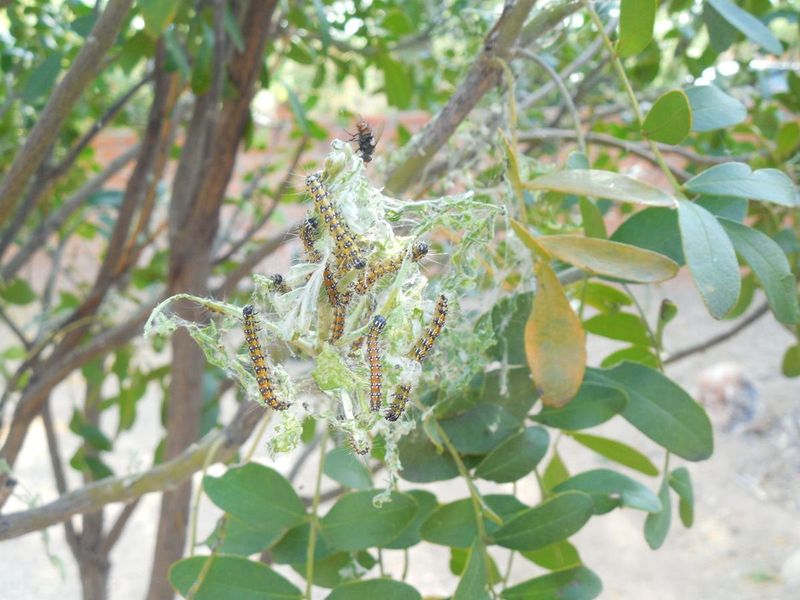
When the infestation is light and the plant is accessible, physical removal is a practical first response. Hand-pick caterpillars directly from the webbed terminals and drop them into a container of soapy water, which kills them quickly.
Pruning away infested branch tips is another option when the affected terminals are few and the cuts will not significantly alter the shrub’s shape.
A strong spray of water from a garden hose can dislodge larvae from the foliage. Texas A&M AgriLife Landscape IPM and Travis County AgriLife Extension both recommend this approach for smaller plants or lighter feeding pressure.
Caterpillars knocked to the ground are unlikely to climb back up immediately and face greater exposure to predators. Acting while larvae are present and actively feeding can reduce the amount of foliage lost before the generation completes, though it does not guarantee complete control or prevent another generation from appearing later.
One method that will not help here is diatomaceous earth. Ask Extension guidance on this specific pest explicitly states that diatomaceous earth will not work for Genista caterpillars.
Applying it would waste time and money without reducing feeding.
Physical removal also avoids any collateral effect on desirable caterpillars, pollinators, or other insects sharing the plant or nearby vegetation. Mountain laurels in bloom or near blooming plants attract bees and other visitors, so a targeted, hands-on approach keeps the response as narrow as possible.
If hand removal brings the population down noticeably and new webbing stops appearing, the shrub may not need anything further during that generation.
Use Bt early when heavier feeding justifies treatment
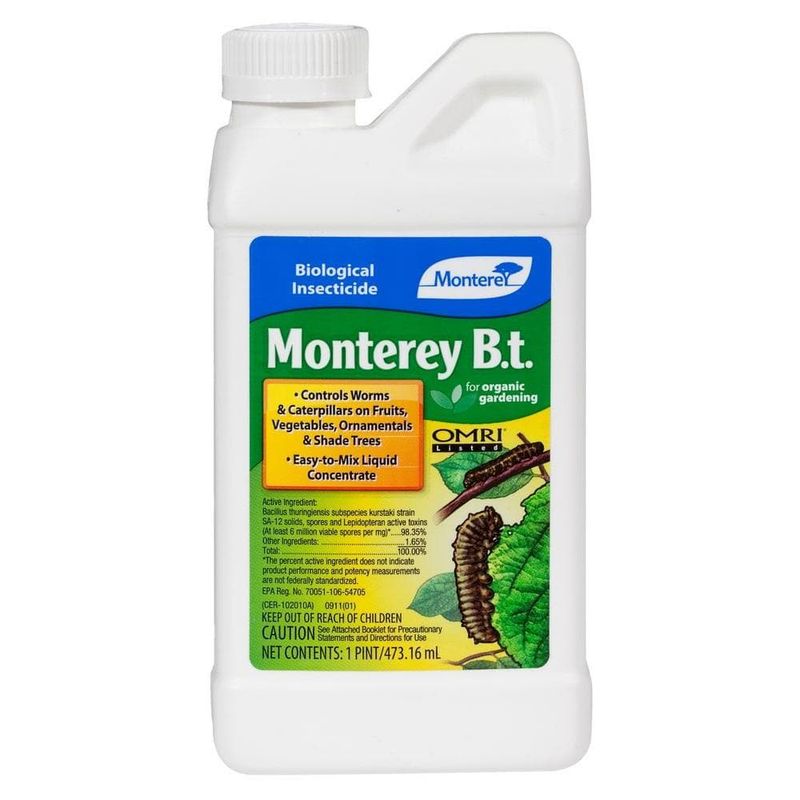
When physical removal is not enough and feeding is spreading across more of the shrub, Bacillus thuringiensis var. kurstaki, commonly called Bt, is a well-supported option. Timing is the most important factor in getting results.
Texas A&M AgriLife Landscape IPM recommends treating when small larvae first appear rather than waiting until larger caterpillars have already consumed much of the plant’s foliage. Bt works by being eaten, so it must coat the foliage thoroughly and reach actively feeding larvae to have any effect.
Young caterpillars, roughly one-half inch or smaller, are most vulnerable to Bt. Larger, more mature larvae are significantly less susceptible, which is why waiting until the infestation is visually dramatic usually means the window for effective treatment has already passed.
Early treatment can reduce feeding and limit defoliation before substantial foliage is lost, but it is not a guarantee of complete control and will not prevent another generation from appearing if adults lay eggs again later in the season.
Bt does not distinguish between pest caterpillars and desirable ones. Travis County AgriLife Extension coverage notes this clearly: any caterpillar that consumes Bt-treated foliage can be affected, including butterfly larvae or other species you may want to protect.
Check nearby host plants for desirable caterpillars before treating, and apply only to the infested shrub rather than broadcasting across the garden.
Some spinosad-based products may also control Genista caterpillars, but product registration varies. The EPA pesticide product label system allows you to look up specific registrations before purchasing.
Confirm that the exact product you plan to use is labeled for ornamental plants, lists caterpillars as a target pest, and specifies the site where you intend to apply it. Do not assume that because spinosad is an active ingredient, every product containing it is approved for this use.
Read and follow the full label before mixing or applying anything.
Act when damage, plant condition, or bud loss warrants it
Recurring Genista caterpillars on a Texas mountain laurel do not automatically mean the shrub is failing. Texas A&M AgriLife Landscape IPM characterizes most infestations as primarily aesthetic, and an established, otherwise healthy plant can tolerate moderate feeding without its long-term condition being seriously compromised.
The question is not whether caterpillars are present but whether the level of feeding justifies a response.
Heavier defoliation, a young or recently transplanted shrub, visible bud loss heading into bloom season, or a plant already dealing with drought or other stress are all legitimate reasons to act. Travis County AgriLife Extension frames the decision similarly, noting that appearance concerns and the plant’s overall situation should guide how much effort the response deserves.
Repeated or severe defoliation across multiple seasons warrants closer monitoring going forward, even if the plant looks stable in the short term.
After any removal or treatment, check the new growth every couple of weeks. A second or third generation can follow within the same warm season, and catching it early keeps the response manageable.
When a pesticide is involved, EPA guidance on pesticide labels makes clear that the label is legally enforceable: use only products approved for the plant and pest, follow all mixing and application directions, avoid drift onto neighboring plants, and observe any pollinator restrictions printed on the label. EPA pollinator protection guidance is a useful reference for understanding when and how to apply treatments with minimal risk to bees and other beneficial insects.
When you hear that faint rattle from the pods, glance over and enjoy the plant for what it is. Then walk up and check the newest growth.
The pods signal a healthy seed crop; the webbed terminals and visible larvae are what actually tell you whether caterpillars have moved in.