

Finding a shade tree that fits a small Central Texas lot without threatening your foundation feels like searching for something that does not exist. Most oaks grow wide and tall, and on Hill Country soils, that raises real questions about roots, clay, and cracking slabs.
Lacey oak offers a genuinely promising answer for homeowners who want native shade without planting a tree that will eventually dwarf their yard. It is not a magic fix, but with the right site and some planning, it is one of the better choices available in this region.
Lacey oak is a relatively compact native oak for Central Texas yards
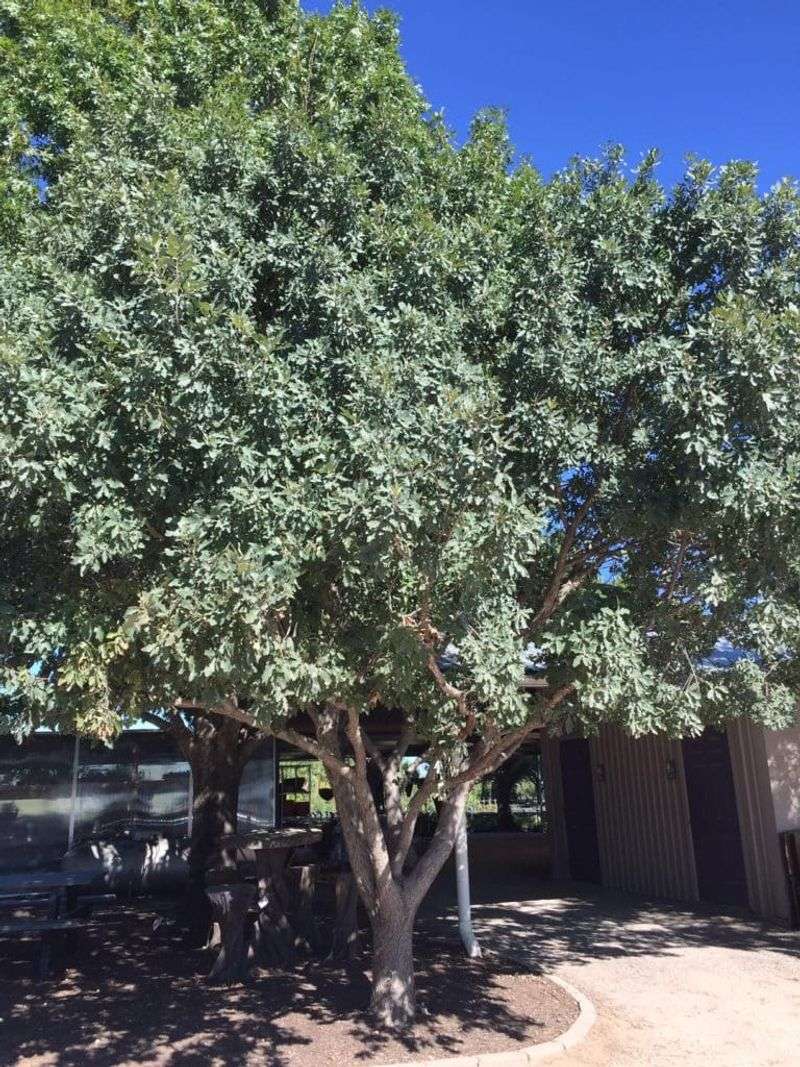
Quercus laceyi, commonly called Lacey oak, grows natively across the Texas Hill Country, where thin limestone soils and summer heat would stress most tree species. Austin’s official plant guide lists it as suitable for small urban yards, adapted to shallow limestone soils, very low-water once established, slow-growing, and resistant to oak wilt.
Those qualities together make it one of the more compelling native oak choices for a Central Texas homeowner working with a constrained lot.
The oak-wilt resistance is worth highlighting because oak wilt is a serious disease threat across the Hill Country and much of Central Texas. Resistance lowers one significant risk compared with more susceptible species, though it does not make Lacey oak immune to every disease or pest, and that distinction matters when you are planning a long-term landscape investment.
Slow growth is a real trade-off to understand before you buy. A newly planted nursery specimen will not shade a patio or west-facing wall anytime soon.
Lacey oak is deciduous, so even at maturity it delivers summer shade rather than year-round screening. The payoff comes over years, not seasons, but a mature Lacey oak can cast genuinely useful shade during the hottest months when you need it most.
What makes the recommendation credible is regional fit, not a claim that the tree is miniature or maintenance-free. Lacey oak is adapted to the conditions Central Texas homeowners actually face: alkaline limestone, thin topsoil, periodic drought, and triple-digit summer heat.
A tree that simply survives those conditions without constant intervention has a meaningful advantage on a small lot where time and water are limited.
Its mature canopy still needs more room than a foundation bed
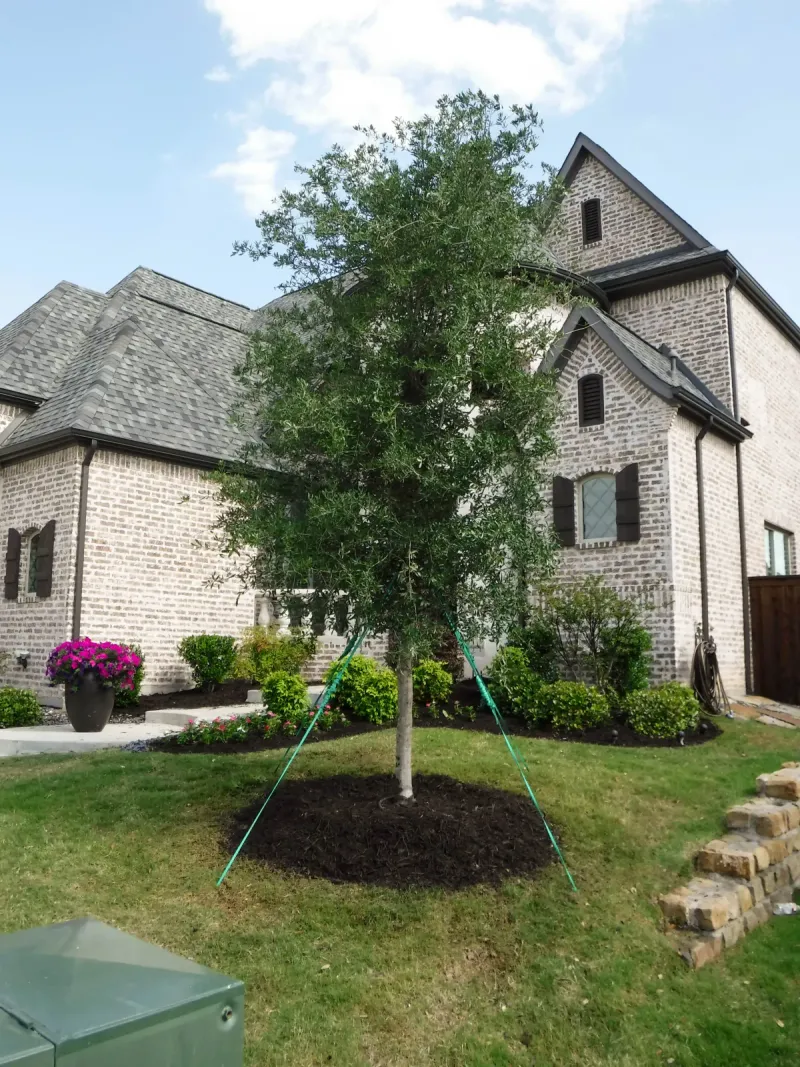
A mature Lacey oak carries a canopy spread of roughly 25 feet, and its eventual height is where the numbers get interesting. Austin’s plant guide lists a height range of 30 to more than 50 feet, while the city’s native tree growing guide for Central Texas puts it closer to 25 to 35 feet, and Austin Nature and Science Center exhibit information cites 15 to 25 feet.
The variation reflects real differences in site conditions, soil depth, and water availability across the region rather than a mistake in any single source.
The practical lesson from that range is to plan for the larger end of the estimate, not the smaller one. A tree that reaches 35 or 50 feet in height with a 25-foot canopy spread is not a foundation-bed plant.
It needs room to grow away from the house, clear of utility lines, and away from driveways, sidewalks, fences, and neighboring structures.
Before you purchase a tree, walk your lot and sketch where the canopy will sit in 20 or 30 years. Mark the locations of buried utilities, overhead wires, the edge of your slab, your driveway, and any outbuildings.
The City of Austin’s general tree guidance consistently emphasizes planning for mature height and spread before planting, and that advice is especially important on a small lot where room is already tight.
Calling Lacey oak a small-lot tree is accurate in relative terms: it is more restrained than a live oak or a pecan. However, “relatively compact” does not mean you can tuck it into a narrow strip between the foundation and a fence.
The tree deserves a real planting area with honest horizontal and vertical clearance, and the site you choose now determines how manageable the tree remains for decades.
On expansive clay, soil-moisture change may matter more than direct root pressure
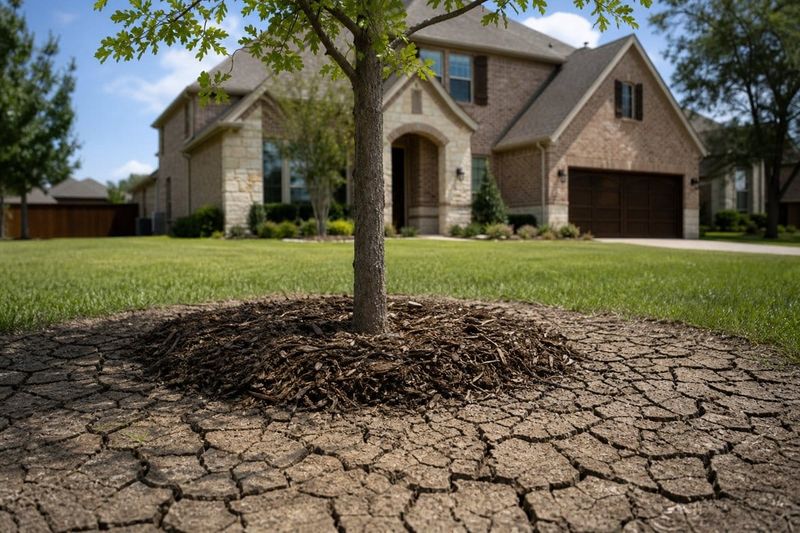
The popular image of a tree root physically pushing through a concrete slab is mostly misleading. Extension guidance on oak tree roots explains that roots generally do not continue pressing against an intact, sound foundation.
They more commonly grow around it or find their way into pre-existing cracks. A root exploiting a crack that already exists is a different problem than a root cracking solid concrete, and the distinction matters when you are evaluating risk.
On expansive clay, however, there is a separate and often more consequential pathway. Root barrier and foundation research from Extension explains that roots pull moisture from clay soil, and when clay dries significantly, it shrinks.
That shrinkage can cause settlement and cracking in a foundation sitting above it. The roots are not pushing the slab up; the drying soil is pulling support away from beneath it.
On a site with expansive clay, this moisture-depletion pathway may be more consequential than direct root contact.
Texas Department of Licensing and Regulation guidance on foundations on expansive soils identifies expansive soils as a common and serious source of foundation problems in Texas, noting that homeowners should manage drainage, plant choices, and irrigation practices to reduce soil-moisture swings near the structure. That guidance frames the problem as a soil-and-water issue, not simply a tree-species issue.
Central Texas is not uniformly one soil type. Shallow limestone, rocky fill, sandy loam, and expansive clay can all appear within a single neighborhood or even across a single lot.
That variability is exactly why a blanket planting-distance rule does not hold up: the risk on a rocky Hill Country limestone site is genuinely different from the risk on a deep black-clay site in the same general region. Foundation design, existing damage, drainage patterns, irrigation habits, and the tree’s position relative to the structure all contribute to the actual level of risk at any specific address.
Lacey oak can be a lower-risk choice when properly sited and managed, particularly because its slow growth and moderate mature size limit the extent of its root system compared with larger oaks. However, no tree species and no planting distance comes with a guarantee that a foundation will never experience problems.
The title of this article uses a phrase that no responsible source can fully back up, and readers deserve to know that the more accurate standard is lower risk with appropriate management, not zero risk.
A site assessment decides whether the tree belongs near this house
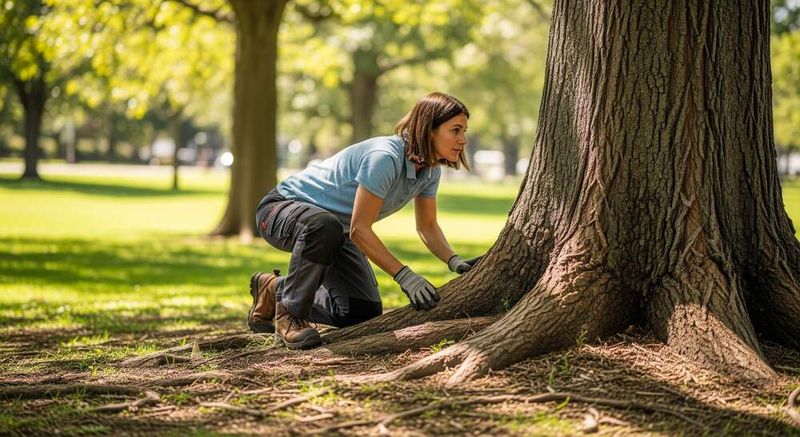
Before you visit a nursery, spend time walking your own yard with honest eyes. Look at the soil: does it crack noticeably during dry spells, which suggests expansive clay, or does water drain quickly through shallow rocky ground?
Both conditions exist across Central Texas, and each one creates a different context for planting a tree near a structure.
Check existing foundation cracks. Even small ones matter because roots can enlarge a crack that is already there, and a foundation that has already moved is more vulnerable to further soil-moisture swings than one that has remained stable.
Note where the ground slopes: drainage that moves water toward the house rather than away from it can worsen both wet-season saturation and dry-season shrinkage, compounding the risk that any nearby tree creates.
TDLR guidance on expansive soils recommends that homeowners preserve good drainage and pay attention to how plant choices and irrigation affect soil moisture near the foundation. That starts with knowing what you have before adding a tree to the equation.
Map overhead utilities, buried lines, irrigation pipes, driveways, sidewalks, and fences so you can identify where the canopy and roots will actually have room to grow.
Austin’s guidance on trees on residential property notes that critical-root-zone disturbance, soil compaction, and grade changes can seriously harm established trees. That same principle applies in reverse during the planning phase: if you anticipate construction, a driveway expansion, trenching for utilities, or any foundation repair work within the next several years, those projects could conflict directly with a newly planted tree’s developing root zone.
A site-specific assessment is more useful than any universal setback number, and a qualified arborist can evaluate your specific soil, drainage, and structural conditions before you commit to a planting location. The City of Austin’s tree species information reinforces that tree placement decisions should account for the full range of site variables rather than relying on a single distance rule.
Planting technique protects the roots and stabilizes the site
Timing your planting correctly gives Lacey oak its best chance at establishment. Austin’s native tree growing guide for Central Texas recommends planting during the cool season, roughly October through March, so roots can spread and anchor before the heat and drought of summer arrive.
A tree planted in spring or summer must establish its root system while simultaneously managing heat stress, which puts it at a disadvantage from day one.
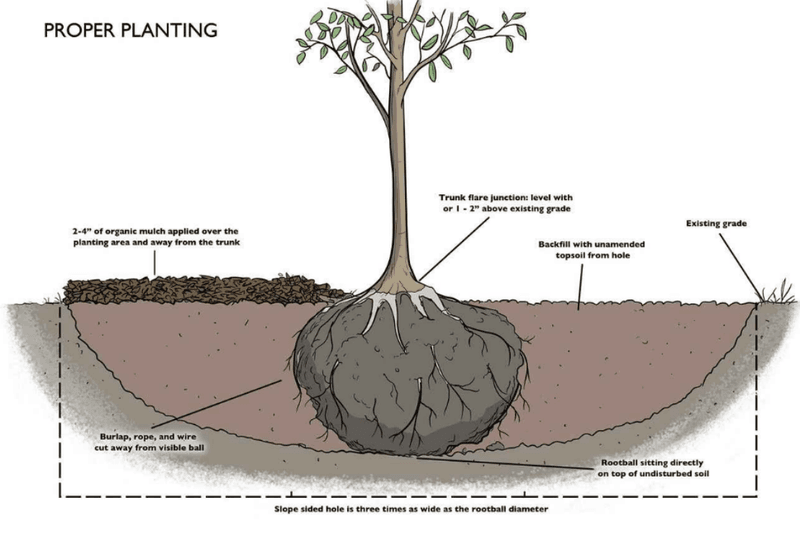
Dig the hole wider than the root ball but no deeper. The root flare, the point where the trunk begins to widen at its base, should sit at or just slightly above the surrounding soil grade.
Burying the root flare under extra soil or mulch reduces the oxygen available to surface roots and can promote decay at the base of the trunk. University of Minnesota Extension guidance on tree planting technique emphasizes that depth errors made at planting are difficult to correct later and frequently shorten a tree’s life.
Backfill with the soil you removed rather than filling the hole with heavily amended potting mix or compost. Penn State Extension’s planting guidance explains that creating a pocket of amended soil encourages roots to circle within the improved zone instead of spreading outward into the native soil, which limits long-term stability and drought tolerance.
Mulch placed correctly is one of the most useful things you can do for a newly planted tree. Spread a layer two to four inches deep in a wide ring around the tree, keeping it several inches away from the trunk itself.
Penn State Extension’s mulching guidance notes that mulch conserves soil moisture, moderates temperature, and reduces competition from grass and weeds. However, Penn State’s guidance on underplanting trees cautions that piling mulch or soil against the trunk, sometimes called a mulch volcano, reduces oxygen to the roots and can create chronic moisture and pest problems at the base of the tree.
Steady moisture and careful pruning preserve the tree’s advantages
Lacey oak’s adaptation to Central Texas conditions is real, but adaptation does not mean the tree takes care of itself from the moment you plant it. Newly planted trees need consistent irrigation through their establishment period, which can span two or more growing seasons depending on soil conditions, tree size, and summer severity.
Letting a young tree go through its first Central Texas summer without supplemental water is one of the fastest ways to lose it.
Once established, maintaining consistent soil moisture near the house matters for reasons beyond the tree’s health. TDLR’s foundation guidance identifies extreme wet-dry cycles in soil near a structure as a contributor to foundation movement on expansive clay sites.
Keeping irrigation steady and preserving drainage that moves water away from the house, rather than allowing long dry spells followed by heavy watering, helps reduce those swings for the soil beneath the foundation as well as for the tree’s root zone.
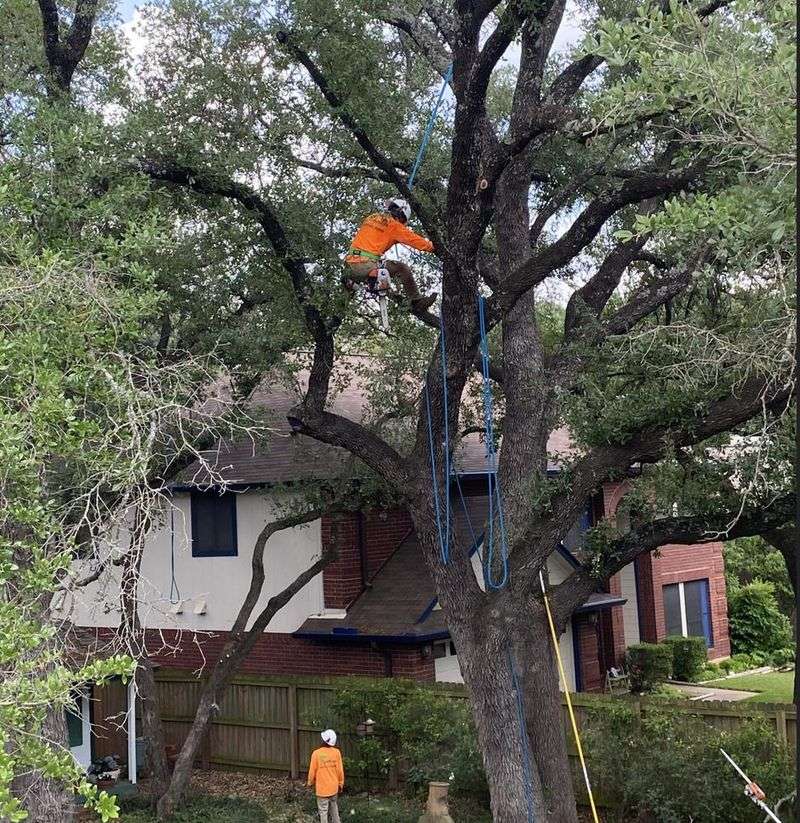
Oak wilt is the disease concern that shapes pruning timing in Central Texas. Texas A&M AgriLife Extension’s oak wilt management guidance advises avoiding unnecessary pruning wounds on oaks from February through June, when sap-feeding beetles that spread the fungus are most active.
When pruning is unavoidable, paint fresh cuts and any damaged surface roots immediately with pruning paint or shellac, regardless of the season, and use properly sanitized tools between trees.
Austin’s Oak Wilt 101 resource reinforces that even wound-resistant species benefit from careful handling during high-risk months. Austin’s Lacey oak plant guide notes the tree’s documented susceptibility to oak phylloxera, a small insect that feeds on leaf tissue and can cause cosmetic leaf distortion, particularly in wet springs.
Texas A&M’s oak disease guide provides broader context on oak disease management for homeowners who want to monitor their trees over time. Oak-wilt resistance is a genuine advantage, but it is one piece of a larger picture that includes pest monitoring, wound management, and consistent care through the establishment years and beyond.
Choose Lacey oak when the lot can accommodate a real tree
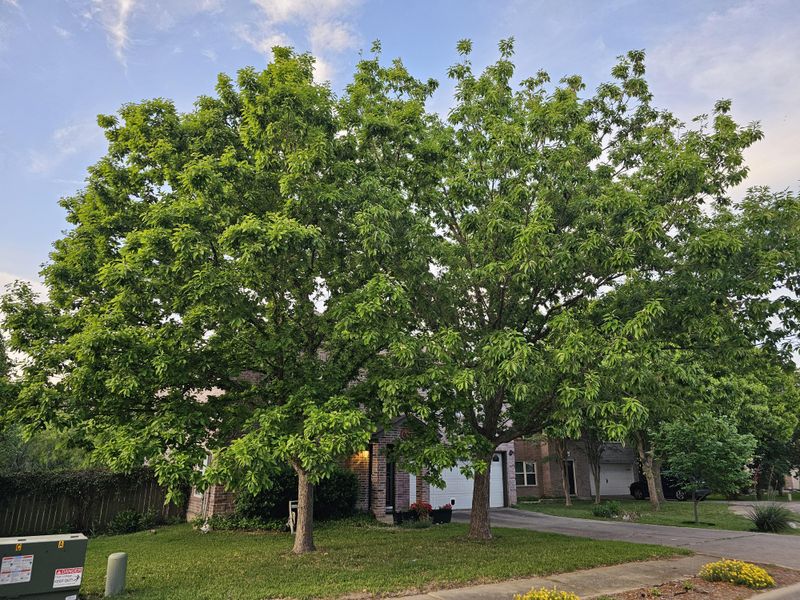
Lacey oak earns its place on a small Central Texas lot when the homeowner goes in with clear expectations. Room for roughly a 25-foot canopy spread, acceptance of deciduous behavior and slow growth, sound drainage, and a commitment to establishment care are the practical conditions that make this tree a strong candidate.
If those conditions exist on your property, Austin’s Lacey oak plant guide supports it as a well-matched native choice for the region.
The limiting conditions are equally important to state plainly. A very narrow strip between a foundation and a fence, an already damaged or actively moving foundation, or a site where soil type and drainage are genuinely uncertain are situations that call for professional advice before you plant anything.
TDLR’s expansive soil guidance and Austin’s residential tree resources both point toward site-specific evaluation rather than universal rules, and that is the honest standard to apply here.
The payoff for a homeowner who chooses the right site and plants correctly is meaningful: a native, low-water-adapted tree that can deliver genuine summer shade at maturity without the aggressive size of a live oak or the water demands of a non-native species. No tree guarantees a foundation will never experience problems, but a properly sited Lacey oak on a lot with adequate room and stable drainage is about as reasonable a choice as Central Texas has to offer.
A tree that has survived the Hill Country for thousands of years knows how to handle the climate; the homeowner’s job is simply to give it an honest place to grow.