
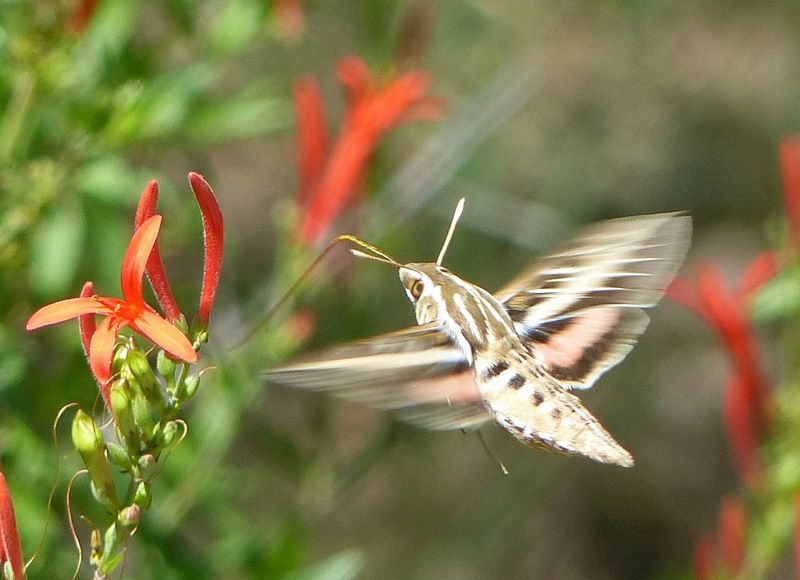
Something hovers over your garden flowers just as the sun goes down, and for a split second you are certain a tiny hummingbird found your yard. Look closer and you will notice wings beating so fast they blur, a long curling mouthpart probing each bloom, and a body that belongs firmly to the insect world.
That creature is most likely a sphinx moth, and what it is doing in your yard at dusk is simpler and more interesting than most gardeners expect. Understanding what the visit actually means can help you make smarter choices about your plants, your lights, and your pesticide cabinet.
The “tiny hummingbird” is usually a sphinx moth
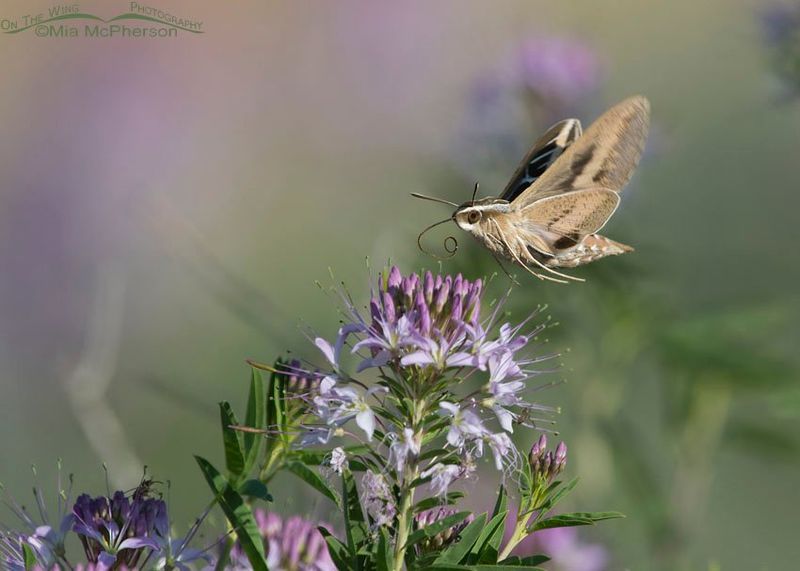
Sphinx moths go by several common names: hawk moths, hummingbird moths, and sometimes simply sphinxes. “Hummingbird moth” is a shared nickname that covers multiple species, not one single insect with a precise scientific name. Knowing that distinction matters when you try to figure out what just visited your garden.
California is home to at least 28 sphinx-moth species, according to UC IPM’s sphinx moth resource, so a reliable species-level identification really does require a photograph or a very detailed description. The strongest single candidate for a dusk-hovering moth in a California yard is the white-lined sphinx, Hyles lineata, which UC IPM describes as possibly the most common sphinx moth in the state.
That said, “likely” and “possibly” are the right words here until you have an image to confirm it.
Visually, the white-lined sphinx gives you several things to look for. Adults are roughly one to two inches long, with wingspans that can reach about four inches.
The forewings are brown and marked with prominent lengthwise white lines, while the hindwings show a warm pinkish-brown coloring that flashes briefly in flight. The body is stout and tapered, and the wings beat fast enough that the outline blurs just like a hummingbird’s.
That physical similarity is not a coincidence. Both animals evolved a hovering flight style suited to extracting nectar from tubular flowers, an example of convergent evolution where unrelated creatures land on the same solution to the same problem.
Sphinx moths are insects, though, and the behavioral and ecological details that follow from that fact are worth understanding before you decide what, if anything, to do about your visitor.
Why it hovers when the light starts to fade
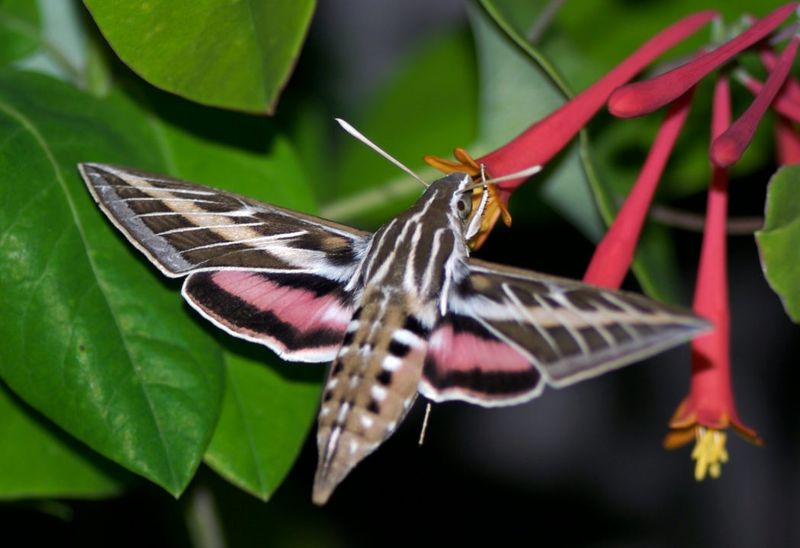
The hovering you see at twilight is not an optical trick caused by low light. Sphinx moths genuinely fly in place while feeding, using rapid wingbeats to hold position the way a helicopter holds altitude.
That flight behavior is what lets them probe tubular flowers without landing, extending a long, flexible mouthpart called a proboscis deep into a bloom to reach nectar that shorter-tongued insects cannot access.
Nectar is the main reason the moth is at your flowers at that hour. UC IPM notes that white-lined sphinx adults are active from late afternoon through dawn, which puts dusk squarely inside their natural foraging window.
Many flowers that sphinx moths visit also become more fragrant or produce more nectar during the cooler evening hours, so the timing of the moth’s appearance and the timing of flower accessibility tend to line up.
The energy stakes are real. Hovering flight burns calories quickly, and a moth that cannot refuel will not survive long enough to reproduce.
Research on post-mating sugar intake in female Hyles lineata found that continued nectar feeding after mating extended female lifespan and supported egg production, which shows just how directly food access connects to the moth’s fitness.
That life-cycle connection is worth keeping in proportion, though. Studies on how scent and nectar shape floral visitor behavior confirm that nectar foraging is the primary driver of adult sphinx-moth flower visits.
A moth hovering over your salvia is almost certainly there to eat, not to lay eggs. Egg-laying happens on larval host plants during the broader adult life cycle, and you cannot infer it from watching a moth feed at dusk.
A visit tells you less about your yard than you may think
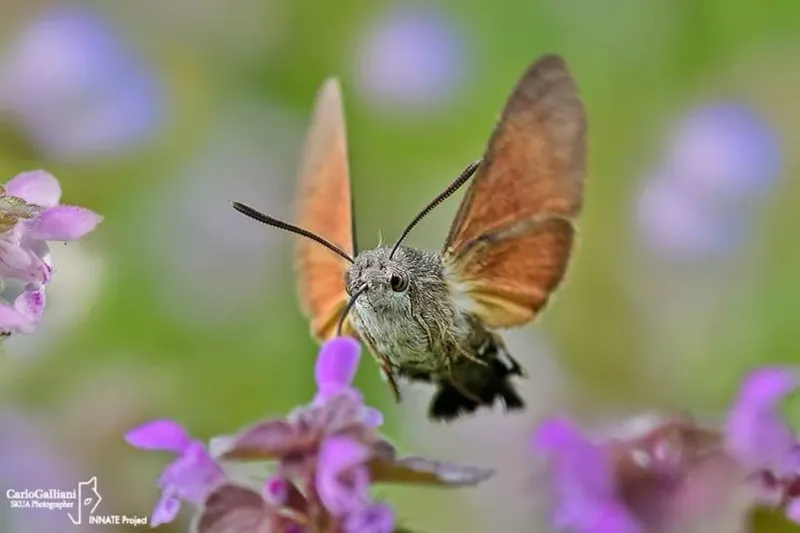
Spotting a sphinx moth over your flowers can feel like a discovery, and it is tempting to read the sighting as evidence that the moth lives in your yard, breeds nearby, or has chosen your garden as a permanent home. Most of the time, the evidence does not support that conclusion.
Adult sphinx moths can travel to find nectar, and the plants that feed an adult moth are not always the same plants its caterpillars need. The Xerces Society’s overview of moths as nocturnal pollinators makes this separation clear: a moth may visit one yard for nectar while its larvae are developing on host plants somewhere else entirely.
Your flowering salvia may be the adult’s restaurant, but the nursery could be blocks away.
What a sighting can reasonably tell you is narrower and more specific. Nectar is available in your garden right now, and conditions at that moment, temperature, light level, wind, flower accessibility, are suitable for foraging.
That is a meaningful and positive thing to know about your yard, but it is different from confirming that a local population is thriving, that reproduction is happening on your property, or that moth numbers are increasing.
UC IPM similarly notes that several sphinx-moth species are active at dusk, so “at dusk” alone does not narrow the identification down to one species or signal anything unusual about your garden’s ecology. One moth visiting one evening is a snapshot, not a population census.
Treating it as good evidence that your yard is working as habitat is reasonable.
Treating it as proof of a breeding colony or an incoming pest problem is not.
Adults feed on flowers, but caterpillars tell a different garden story
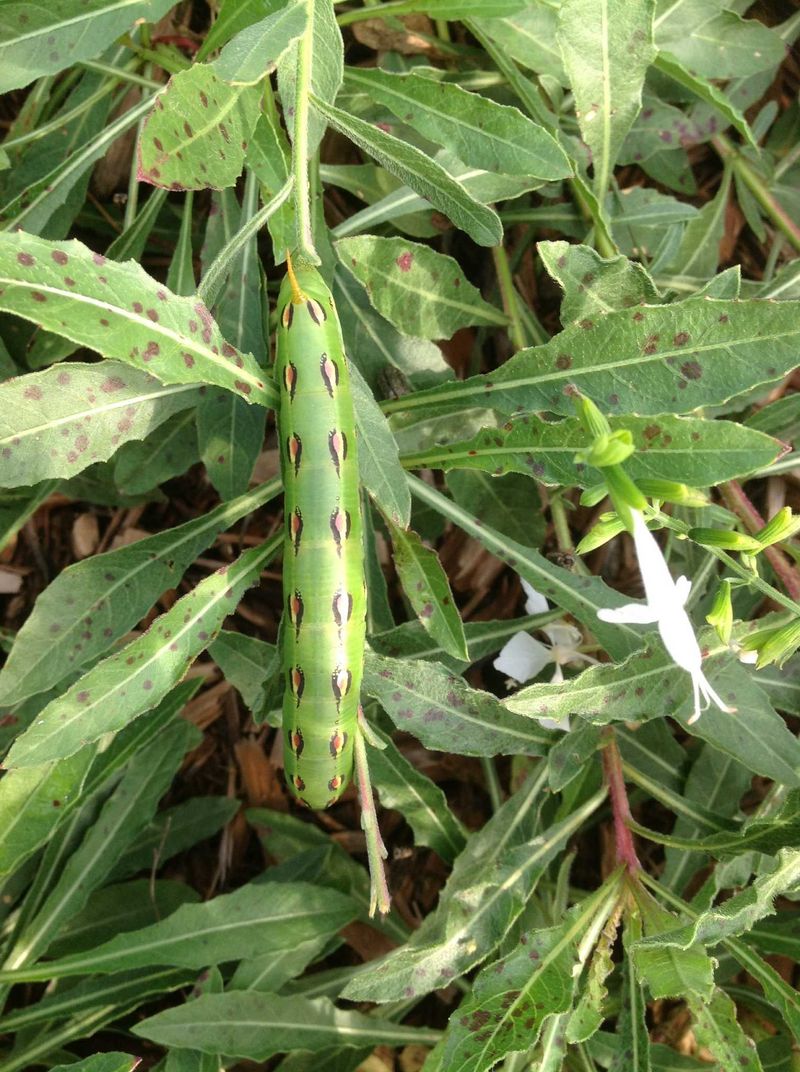
Watching a sphinx moth glide between flowers at dusk is genuinely pleasant, but the same moth’s offspring operate on a completely different set of rules. Adult sphinx moths drink nectar and can move pollen between flowers as they feed.
Caterpillars eat foliage, and the two life stages interact with your garden in ways that should not be conflated.
White-lined sphinx larvae feed on a wide range of plants. Evening primrose, grape, fuchsia, rose, elderberry, caneberries, and willowherbs are among the documented host plants, according to UC IPM’s sphinx moth guidance.
If you find a large, hornworm-style caterpillar on one of those plants, identification before removal is the right first step. Not every hornworm is a tomato or tobacco pest.
Sphinx larvae span many species with different host plants and very different levels of garden impact, and pulling the wrong one can eliminate a harmless or even ecologically useful insect.
The U.S. Forest Service’s guide to caterpillar identification reinforces that sphinx-moth larvae vary considerably in their biology and feeding habits.
A caterpillar feeding on evening primrose in your yard is behaving exactly as its species evolved to behave, and whether that rises to a problem depends on how much damage is actually occurring, not on the caterpillar’s presence alone.
UC IPM’s practical management conclusion is measured: sphinx-moth larvae are generally minor pests, though localized damage can occur on host plants. That framing suggests a proportionate response.
Assess how much actual defoliation you are seeing before acting. A few chewed leaves on a robust shrub is a different situation from a caterpillar population stripping a young grapevine.
Identification and honest damage assessment should come before any removal decision.
Support the moth without chasing a guarantee

Turning a sphinx-moth sighting into practical habitat support is worthwhile, but the approach should fit your specific California conditions rather than follow a one-size-fits-all plant list. Coastal gardens, inland valleys, desert edges, and fire-prone hillsides each have their own water budgets, soil types, and plant palettes, and those differences matter more than any general prescription.
Several documented nectar sources are worth considering if they suit your region. UC IPM lists salvias, columbine, honeysuckle, and larkspur as plants white-lined sphinx adults may visit, and UC Cooperative Extension material also mentions desert willow as a possible nectar source.
Evening primrose is a reasonable choice for supporting night-active moths because it opens in the evening and produces accessible nectar. Match any plant selection to your local water availability, especially given California’s ongoing drought conditions and water-use restrictions.
Xerces Society’s pollinator habitat guidance for yards and gardens emphasizes that supporting pollinators means providing food across a succession of bloom times, maintaining plant diversity, offering shelter, and protecting habitat from pesticides. No single plant species reliably “attracts hummingbird moths” on its own; moth activity depends on the species, season, weather, nectar concentration, light levels, and what else is available nearby.
Pale, fragrant flowers that open or intensify at dusk may be useful additions, but Xerces Society research on nocturnal moth ecology specifically notes that moth flower preferences are not fully understood. Color and scent are reasonable cues, not a formula.
A locally appropriate, diverse planting that blooms across the season will serve nighttime pollinators better than a narrow selection of plants chosen only for their evening appeal. For fire-zone homeowners, check whether any candidate plants appear on your jurisdiction’s defensible-space plant list before adding them to beds near the house.
The most helpful nighttime change may be what you stop doing
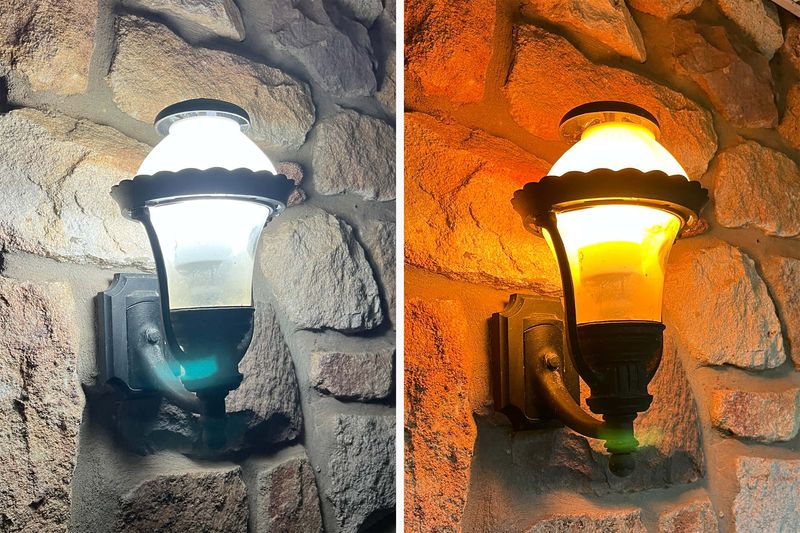
Two common homeowner habits can quietly undermine the nighttime garden activity you want to support: leaving unnecessary outdoor lights on and reaching for pesticides at the first sign of a pest. Both deserve a second look if your goal is to keep sphinx moths and other nocturnal pollinators active in your yard.
Artificial light disrupts moth movement, orientation, and behavior in ways that are not fully understood but are well enough documented to warrant caution. Xerces Society’s overview of moths as nocturnal pollinators summarizes research finding 62% fewer nocturnal flower visits in artificially illuminated plots compared with dark plots.
That figure comes from studies on nocturnal pollinator activity broadly, not from a controlled experiment on white-lined sphinx behavior in every California backyard, so it should be read as meaningful directional evidence rather than a precise prediction. The practical takeaway is still clear: reducing unnecessary outdoor lighting near your garden during evening hours is a low-cost, low-effort step that removes a known stressor for night-active insects.
Pesticide use requires more deliberate thinking. The idea that spraying after dark automatically protects moths is a myth worth correcting directly.
Night-active insects, including sphinx moths, visit flowers during the same hours when many homeowners assume it is safe to spray, and pesticide residues on foliage and blooms can persist well into the following night. Xerces Society’s pollinator garden guidance and California’s Managed Pollinator Protection Plan both advise confirming a real pest problem before treating, then choosing the least-toxic and most selective effective option, following the product label precisely, avoiding application to blooming plants whenever possible, and preventing pesticide drift to surrounding vegetation.
A general preventive spray is harder to justify when sphinx moths and other beneficial insects are actively using your garden at night.
What the hovering moth really means for your yard
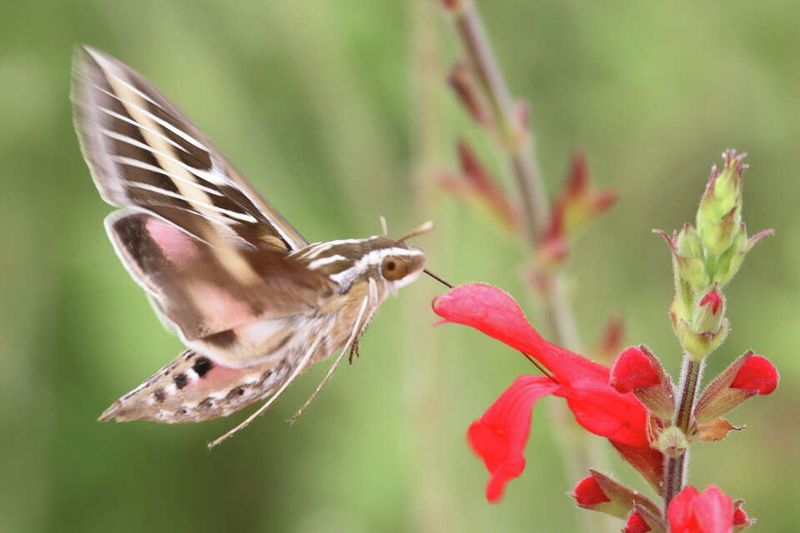
A moth hovering over your California flowers at dusk is most plausibly a nectar-feeding sphinx moth, with the white-lined sphinx as a common candidate. The sighting alone cannot confirm the exact species or prove that breeding is happening in your yard.
What it can confirm is that your garden has something worth visiting: accessible nectar at the right time of evening.
A proportionate response starts with observation rather than intervention. Watch before removing anything.
Provide diverse, locally appropriate flowers that suit your region’s water supply and fire-risk context. When a caterpillar appears, identify it before deciding it is a problem, and assess actual damage rather than reacting to presence alone.
UC IPM and Xerces Society both frame sphinx moths as insects that warrant attention without alarm.
Reduce unnecessary outdoor lights near the garden in the evening hours, and reserve pesticide use for confirmed problems handled with the most selective effective option available. Xerces Society’s yard and garden habitat guidance puts it plainly: supporting pollinators means removing threats as much as adding plants.
A yard that keeps its lights low, holds off on casual spraying, and offers a range of blooms across the season gives nocturnal visitors a real reason to return, no guarantee required.