
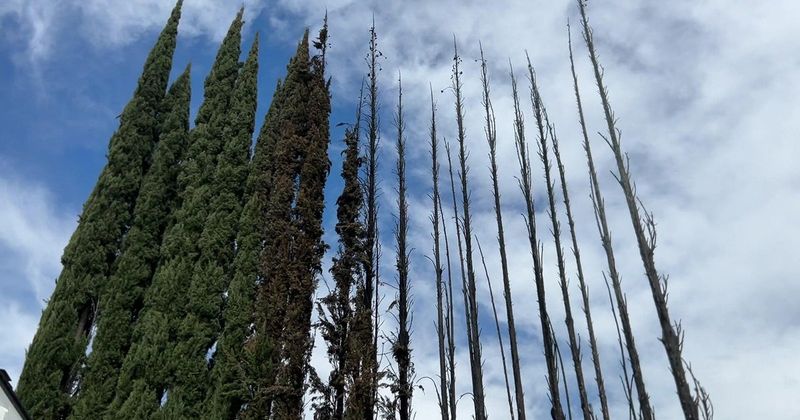
Tall, tidy, and planted by the millions across California neighborhoods, Italian cypress looks like a harmless privacy screen – until fire season arrives. What most homeowners never knew when they planted one is that this tree can quietly turn into a serious fuel problem when it grows close to a structure, dries out inside, or connects ground-level vegetation to the roofline.
Understanding exactly where and why this tree becomes a concern can help you make smarter decisions before the next fire season starts.
Why Italian cypress can become a serious concern near a California home
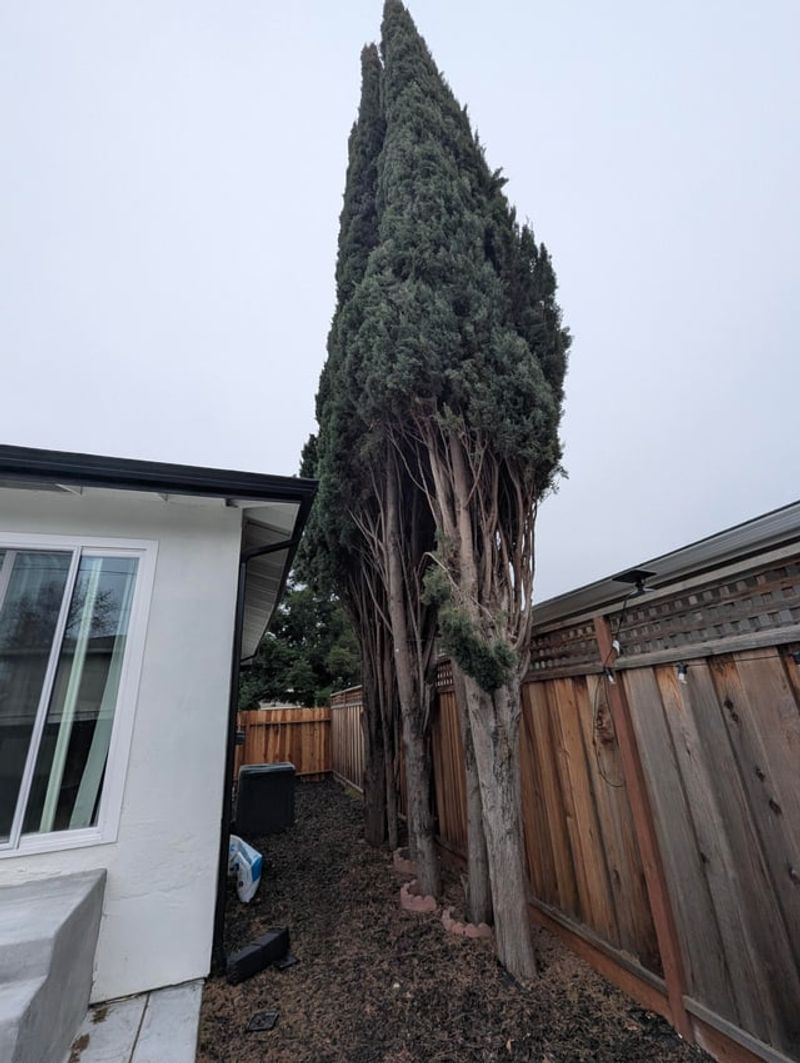
Italian cypress (Cupressus sempervirens) is one of California’s most recognizable ornamental trees. Its pencil-thin silhouette and fast growth made it a go-to choice for privacy screens along fences and driveways across the state.
The problem is not the tree’s appearance – it is what happens inside that narrow column of foliage as the tree matures and dries out in California’s long, rainless summers.
The tree’s dense, tightly packed form traps dead interior twigs, dry needles, and accumulated litter where they are hard to see and harder to remove. When the outer foliage stays green but the interior fills with dry, resinous material, the tree can become a concentrated fuel column sitting just a few feet from a house.
Drought stress, infrequent irrigation, and years of deferred maintenance all accelerate this buildup. The risk is not simply about the species – it is the combination of the tree’s growth habit, its placement near a structure, and the condition it is allowed to reach.
UC ANR guidance on minimizing fire hazards in landscapes emphasizes that all plants can burn under sufficiently hot, dry, or windy conditions, and that design, location, and maintenance often matter more than the species name alone. Still, fire agencies including American Canyon Fire and the Los Angeles County Fire Department’s defensible space guide specifically call out Italian cypress as a plant that creates hazardous fuel conditions near structures.
The UC Marin Master Gardeners fire-smart landscape planning resource reinforces that even plants labeled fire-resistant can carry fire when they are poorly located, under-irrigated, or loaded with dead material.
Dense rows of Italian cypress planted as a privacy wall compound the concern. A solid hedge carries fire horizontally along its length and can channel a fire front directly toward a home.
A single well-maintained tree in an open location away from the house presents a meaningfully different picture than a row of tightly spaced, drought-stressed trees running along a fence line toward the front door. The species itself is not the only variable – but it is a variable homeowners can control.
A fire ladder can carry flames from ground fuels into tree crowns
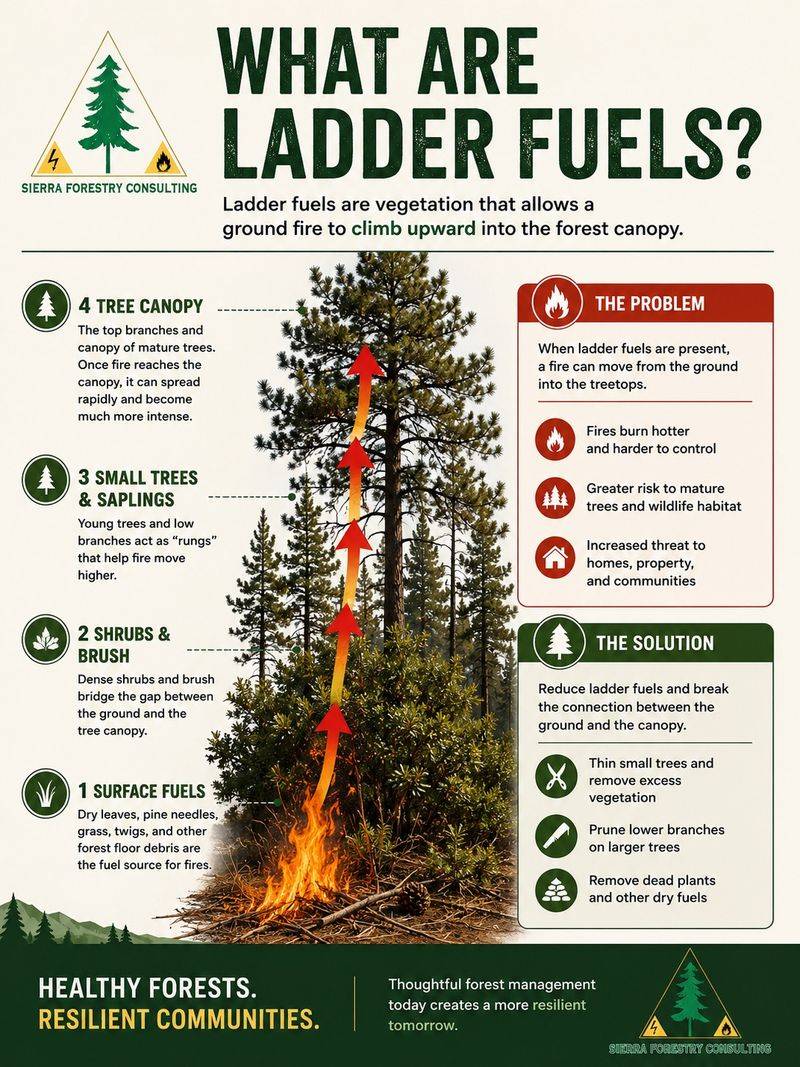
One of the most important concepts in California defensible-space planning is the fire ladder. The term describes what happens when there is no meaningful vertical gap between fuel layers in a yard.
Dry grass ignites first, then flames climb into nearby shrubs, then into low branches, and finally into the crowns of tall trees. Each fuel layer feeds the next, and the fire moves upward with increasing intensity.
CAL FIRE’s defensible space guidance explains this mechanism directly: inadequate vertical spacing between ground vegetation, shrubs, and tree branches allows fire to travel from the ground into the canopy and produce more intense burning closer to a home. CAL FIRE recommends removing tree branches at least 6 feet above the ground and maintaining additional clearance between the tops of shrubs and the lowest branches of trees.
When those gaps are missing, the vertical pathway stays open.
Italian cypress fits into this picture in a particular way. Its foliage runs nearly from ground level to the top of the tree, with little natural separation between the base and the crown.
There is no built-in gap the way a high-branching shade tree might provide. If grass or mulch grows up to the base of a cypress, and a shrub sits nearby, the vertical fuel connection can run almost continuously from the ground to 40 or 50 feet in the air.
That column of fuel, positioned near a house, can expose the structure to significantly more intense heat than a fire moving through shorter vegetation alone.
This mechanism is not unique to Italian cypress. Any combination of poorly separated grasses, shrubs, low branches, and tree crowns can create a similar vertical pathway.
The concern with Italian cypress near a California home is that its natural growth form makes it harder to break that ladder without removing the tree entirely. Pruning the lower foliage off a cypress changes its appearance dramatically and does not address the dry interior fuel that remains higher up.
Managing vertical separation is one of the clearest practical reasons why placement matters as much as species selection.
Which Italian cypress placements create the greatest concern?
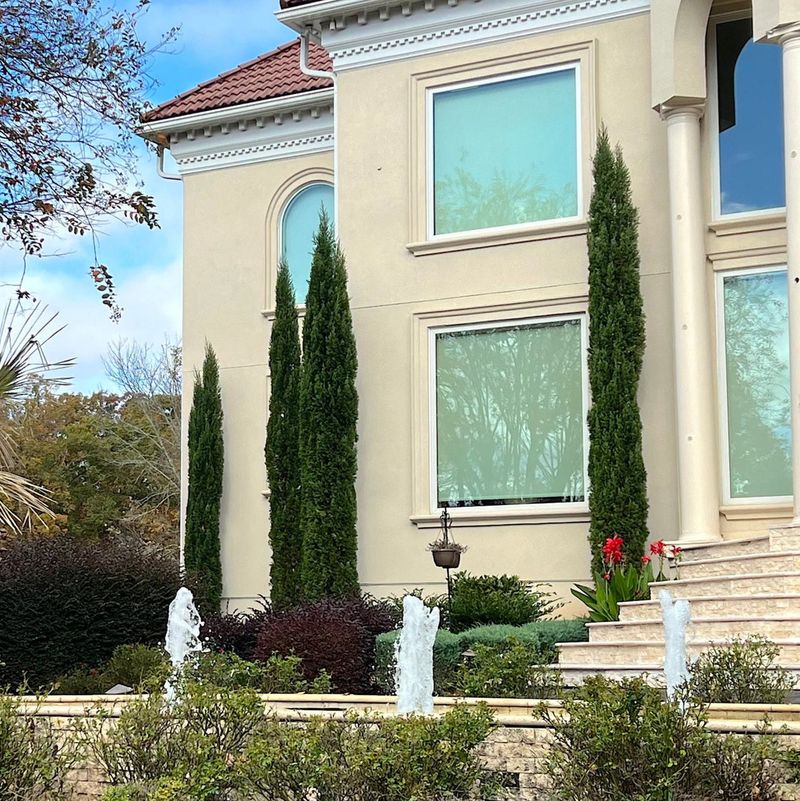
Not every Italian cypress in California is a crisis waiting to happen. Placement is the factor that turns a landscape tree into a meaningful defensible-space problem.
Some locations are clearly more hazardous than others, and knowing which ones to avoid is the most direct way to reduce risk.
The first 5 feet around any structure is where CAL FIRE places the greatest emphasis. Ready for Wildfire describes this as Zone 0, the area where non-combustible hardscape – gravel, pavers, concrete – is strongly preferred over any vegetation or combustible mulch.
The California Board of Forestry outlines the Zone 0 framework as CAL FIRE guidance rather than a universally applicable statewide legal requirement. Homeowners should check with their local fire agency, city, or county to understand what applies to their property.
Planting any tall, dense tree in this immediate zone is generally a poor choice, and Italian cypress in this location is a particularly poor one given its growth habit and fuel characteristics.
Beyond 5 feet, the Los Angeles County Fire Department’s guidance is the most specific available for this species. The Los Angeles County defensible space guide recommends removing Italian cypress when the center of the trunk is within 10 feet of a structure.
This is local guidance from one agency, not a statewide legal prohibition, but it reflects field experience with how the tree behaves near buildings. Homeowners in other counties should treat it as a useful benchmark while checking what their own fire protection district requires.
Dense privacy screens deserve separate attention. A row of Italian cypress planted close together along a fence or property line creates a nearly continuous fuel wall.
If that wall runs toward the house, it can channel fire directly at the structure. CAL FIRE’s Zone 1 guidance, which covers roughly 5 to 30 feet from a structure, calls for removing dead vegetation, separating plants horizontally, and keeping tree branches at least 10 feet away from other trees.
A tightly planted cypress screen violates most of those principles at once. Trees planted beneath a larger canopy tree, in narrow passages beside structures, or on slopes where wind can drive fire uphill toward the house also present elevated concern.
Slope and prevailing wind direction can significantly amplify how fast and how intensely a fire reaches a structure.
Inspect the tree and its surrounding fuels before deciding
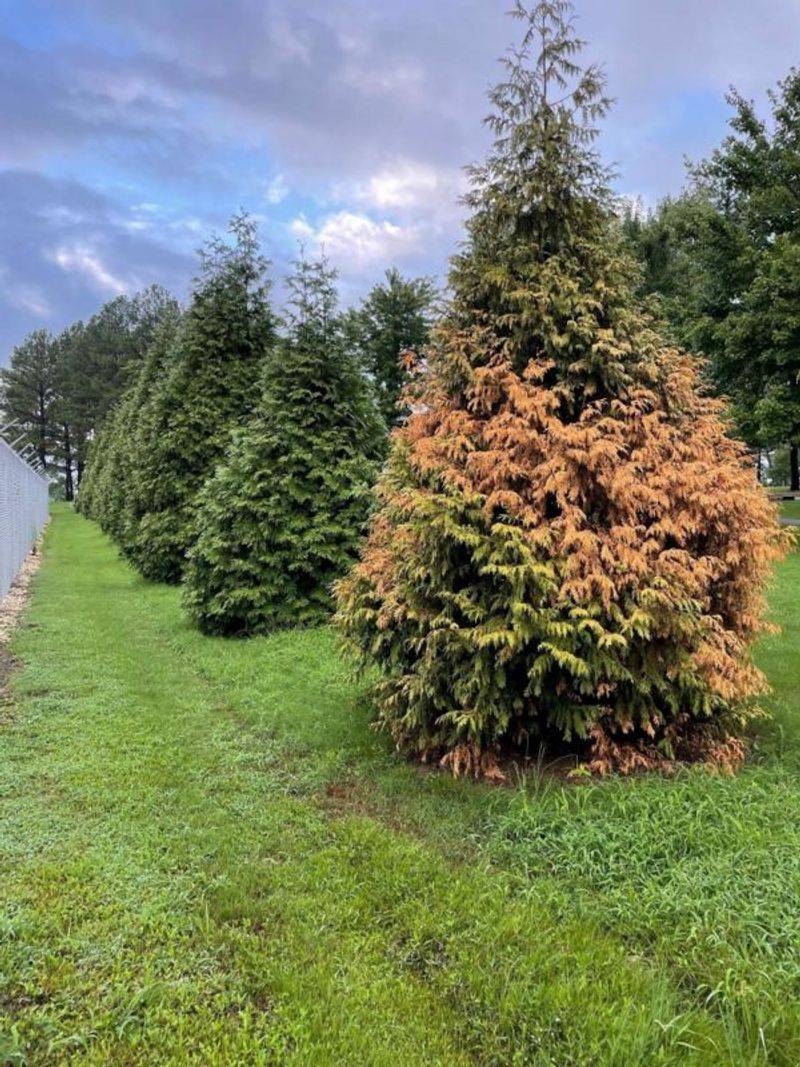
Before making any decision about an Italian cypress near your home, spend time looking at the actual tree and the ground around it rather than relying only on its species name. The outer canopy of a healthy, well-watered cypress can stay green while the interior accumulates years of dead twigs, dry foliage, and fallen needles that are invisible from the street.
Push gently into the lower foliage near the base and look at what is actually inside the tree.
American Canyon Fire’s defensible space guidance and the Los Angeles County Fire Department’s Ready, Set, Go program both identify accumulated dead material as a critical factor in how ornamental trees behave during a fire. A tree with significant interior dead fuel is a more serious concern than a well-maintained tree of the same species at the same distance.
Check for dry, brown interior twigs, dense needle litter at the base, signs of drought stress such as dull or faded outer foliage, and any contact between the tree’s branches and a fence, eave, or adjacent plant.
UC Marin’s fire-smart plant selection guidance reinforces that fuel condition and continuity often matter more than a species classification. A cypress hedge where the individual trees have grown together into a single dense mass presents a different level of fuel continuity than a single tree with open space around it.
Look at whether the tree connects to other vegetation, whether ground litter has built up beneath it, and whether any combustible material – mulch, wood fencing, a deck – sits within a few feet of the base.
Prioritize your assessment by starting with trees closest to the house, trees with obvious dead material or structural defects, and trees that form a continuous fuel bridge between the ground and other vegetation near the structure. UC ANR’s Right Plant, Right Place, Right Care framework makes clear that ongoing care – irrigation, litter removal, separation from other fuels – can reduce but not eliminate risk.
For any large or potentially unstable tree, get a qualified arborist to assess it before removal, particularly on slopes or near utilities where a falling tree creates its own hazards.
The tree is only one link in the ember and ignition chain
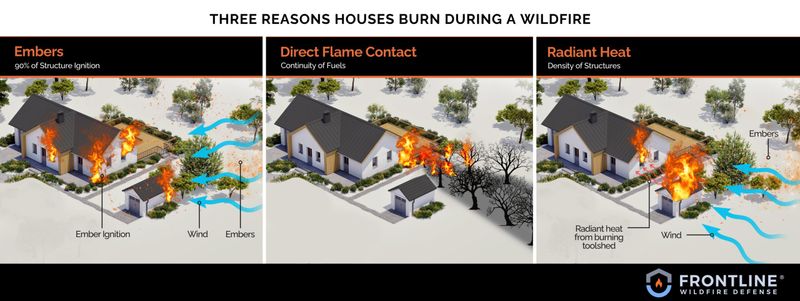
Removing an Italian cypress from beside your house is a meaningful step, but it is not a complete wildfire solution. The tree is one fuel source in a longer chain that can carry an ember from the air to your attic.
Treating it as the only problem leaves the rest of that chain intact.
Embers are the leading cause of home ignition during California wildfires. They travel ahead of the main fire front, sometimes for a mile or more, and land on anything that can catch: dry leaf litter in gutters, combustible mulch against the foundation, a wood fence running from a neighbor’s yard to your front door, an unscreened attic vent, a wood deck piled with furniture cushions.
CAL FIRE’s wildfire preparation guidance and Ready for Wildfire’s defensible space resources both emphasize that defensible space and home hardening address different vulnerabilities and work best together. Neither guarantees that a home will survive a major fire event.
CAL FIRE’s home hardening program covers the structural side of that equation: ember-resistant vents, multi-pane windows, fire-resistant roofing and siding, and enclosed eaves. These measures reduce how easily an ember can breach the building envelope even when defensible space is well maintained.
A homeowner who clears the cypress but leaves a wood shake roof, open foundation vents, and a combustible deck has addressed one link while leaving several others open.
Broaden your inspection beyond the tree’s canopy. Walk the full path between the nearest vegetation and the house and look for what an ember could land on.
Dry litter under a window, a wood fence attached to the structure, plastic patio furniture against the siding, and debris in gutters all matter. Addressing those ignition pathways alongside any landscape changes gives your home a meaningfully better chance during a fire event than either step alone.
What laboratory studies reveal—and what they cannot predict
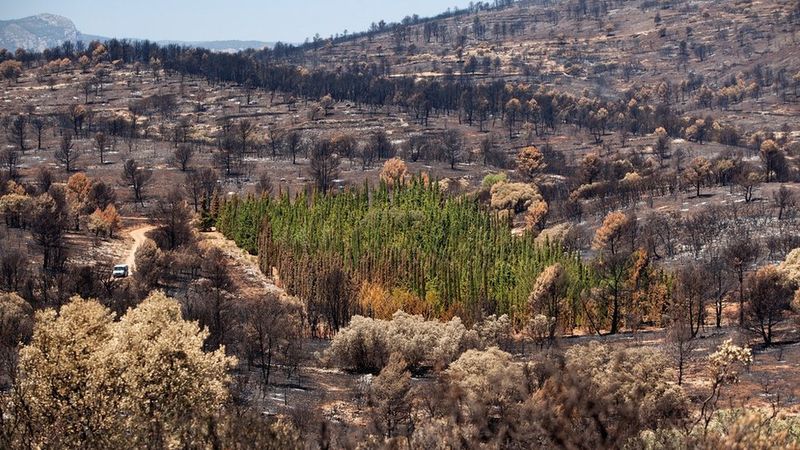
Two laboratory studies offer useful data on Italian cypress combustion behavior, and they point in different directions. Understanding both – and what each can and cannot tell you – matters before drawing firm conclusions about the tree’s behavior in a real California wildfire.
A 2015 study published in the Journal of Environmental Management, Della Rocca et al.’s laboratory analysis of common cypress fire behavior, reported that live Cupressus sempervirens foliage showed relatively low ignitability and high moisture retention under its controlled test conditions. Those findings led some European researchers to explore whether the species might serve as a landscape barrier in certain fire-risk settings.
The same study, however, also found that once burning began, the foliage showed high sustainability and combustibility – meaning the fire continued and spread readily once ignition occurred. The two findings coexist: harder to start, but not easy to stop once going.
A more recent comparison tells a different story. A 2025 study comparing ornamental plant combustion behavior found that Italian cypress had the highest peak heat-release rate and the longest flame duration among the ornamental species tested.
That result places it at the more hazardous end of the comparison group under those test conditions.
Neither result is a direct prediction of what a mature landscape tree will do in a California wildfire. Laboratory tests use small, standardized samples under controlled conditions.
A full-grown tree in a yard carries far more fuel, has variable moisture levels across its interior and exterior, and sits in a wind environment that no chamber can fully replicate. UC Marin’s fire-smart landscape guidance cautions that published fire-resistance plant lists are often not consistently science-based and that real-world behavior depends heavily on plant condition, irrigation, and location.
The studies together support treating Italian cypress as a meaningful concern in specific placements – particularly when dry interior fuel has accumulated – without claiming that every tree will behave identically or that the species is always the worst option in every yard.
Choose management or removal with the whole site in mind
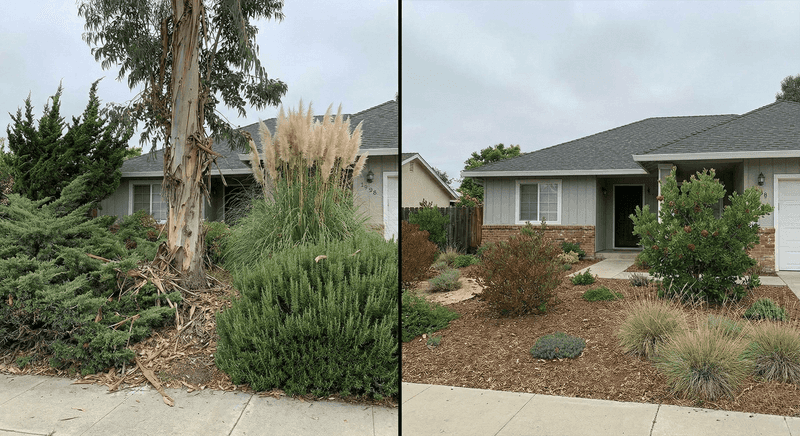
A blanket order to remove every Italian cypress in California is not supported by the evidence, and it is not the right starting point for most homeowners. The decision to manage, remove, or replace a tree should follow a clear look at the site, the tree’s condition, local requirements, and the full range of consequences that come with altering a large, established plant.
Before touching any mature cypress, check what your local fire agency, city, county, fire protection district, and insurance carrier require. The Los Angeles County Fire Department’s defensible space guidance recommends removing Italian cypress when the trunk center is within 10 feet of a structure – that is a local standard, not a statewide rule.
Other jurisdictions may have different thresholds or permit requirements for removing trees above a certain size. Slope stability, utility lines, wildlife habitat, and erosion potential all deserve consideration before a large tree comes down.
A certified arborist can identify structural defects, root conditions, and safe removal sequences that are not visible from the ground.
For trees that remain, CAL FIRE’s defensible space framework points to a set of practical maintenance steps: remove dead interior material, maintain climate-appropriate irrigation so the tree does not become drought-stressed, keep the tree separated from adjacent vegetation and structures, and avoid allowing it to grow into a continuous hedge or fuel wall pointing toward the home. Do not top the tree or apply heavy shearing as a fire-safety fix.
Topping creates weak regrowth and does not address the dry interior fuel or the placement problem. The Los Angeles County Ready, Set, Go program identifies the removal of hazardous ornamental plants as a defensible space priority, but the work needs to be done correctly.
When replacement is the right choice, resist the temptation to simply swap one species for another labeled fire-resistant. UC Marin’s fire-smart landscape planning guidance, UC Master Gardeners of San Mateo and San Francisco’s firewise landscaping resources, and UC Master Gardeners of San Luis Obispo’s landscaping for wildfire resilience guide all emphasize evaluating mature size, moisture content, litter production, growth form, available spacing, and local climate.
Lower-growing plants with higher moisture content, minimal dead material buildup, and less resinous foliage are generally preferred near a structure. No plant is fireproof – a poorly located, drought-stressed, or densely packed replacement can carry fire just as readily as the tree it replaced.
Put the decision in order before the next fire season
Getting ahead of this before fire season means working through a short, specific sequence rather than reacting to a general alarm. Start by measuring the distance from each cypress trunk center to the nearest wall, eave, or attached structure.
Any tree within 10 feet of a structure warrants immediate attention, and trees between 10 and 30 feet deserve a close look at their condition and fuel connections.
Next, inspect the interior of each tree and the ground beneath it for dead material, accumulated litter, and contact with adjacent plants or combustible surfaces. Identify whether any tree forms part of a continuous fuel path leading toward the house.
Then check your local fire agency’s requirements – county and district standards can exceed general CAL FIRE defensible space guidance, and permits may be required before removing mature trees.
Address the closest and most hazardous fuel first, pair any landscape work with ember-focused home hardening, and consult a certified arborist before removing large trees on slopes or near utilities. CAL FIRE is clear that defensible space improves a home’s chances but does not guarantee survival – the goal is to reduce every link in the ignition chain, not to find a single fix.
Italian cypress can be a poor privacy-screen choice near a California home in a fire-prone area, but a yard that is genuinely safer comes from addressing the whole site, not just the tree that is easiest to name.