
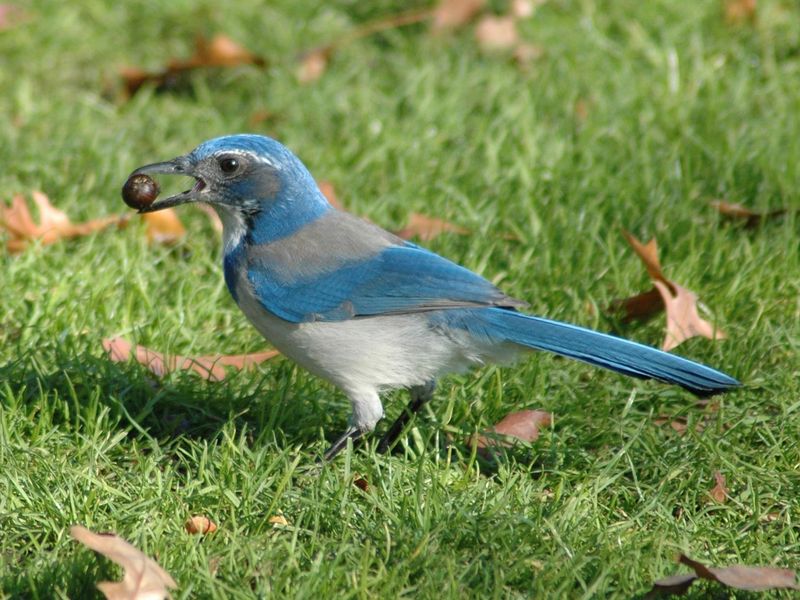
California Scrub Jays are loud, bold, and surprisingly useful birds that show up in backyards all across the state. They cache acorns in the soil and eat plenty of insects, which makes them easy to admire as natural helpers.
But some popular claims about what they do for your yard go further than the evidence supports, and believing those claims can lead to real pest-management mistakes. This article separates what jays actually do from what people wish they would do, and gives you a clearer plan for both supporting the birds and handling lawn pests on your own terms.
What California Scrub-Jays Actually Do in a Yard
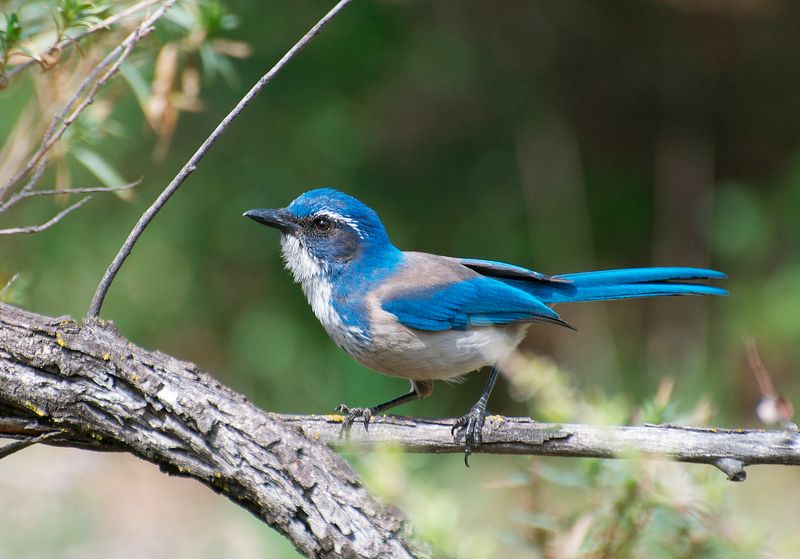
Walk past a mature oak in almost any California suburb and you have a decent chance of spotting a California Scrub Jay watching you right back. These birds are adaptable, confident omnivores that have made themselves at home in oak woodlands, chaparral, parks, and residential yards from the coast to the inland valleys.
Their tolerance for human activity is part of what makes them such a familiar backyard presence.
According to Cornell Lab’s California Scrub-Jay life history, their diet shifts with the seasons. Spring and summer bring a heavier focus on insects and fruit, while fall and winter tip toward acorns, nuts, seeds, and berries.
They also eat small lizards, bird eggs, and nestlings, which matters if you are hoping to attract multiple species to your yard at the same time.
The Audubon field guide to the California Scrub Jay confirms the same broad picture: an opportunistic bird that takes what is available and adjusts through the year. That flexibility is a strength, but it also means jays are not specialists in any one food type.
Acorn caching is real and well documented. Insect eating is real and well documented.
What the sources do not establish is that backyard jays find, collect, and store root-chewing grubs, or that they provide dependable control of white-grub populations in California lawns. Treating jays as a lawn pest solution rather than a wildlife neighbor can lead homeowners to skip the inspection and threshold-based management that actually works.
The rest of this article explains what the evidence does and does not support, and what you can do with that information.
Acorn Caching Can Help Oaks Without Being Intentional Tree Planting
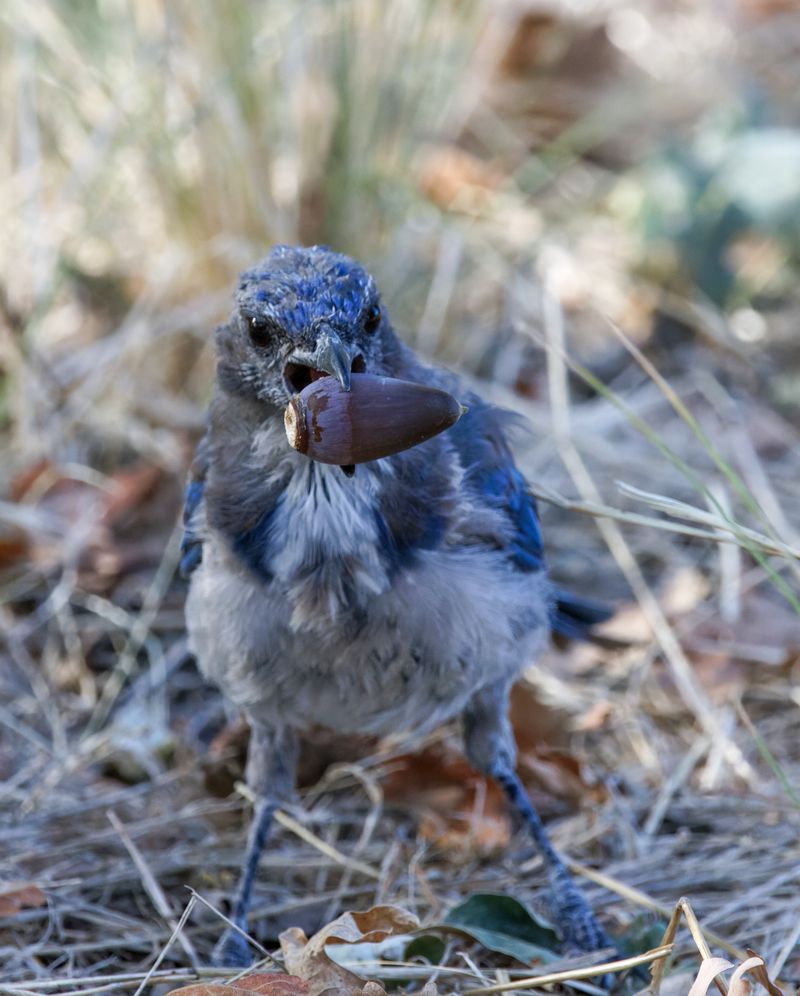
Every fall, California Scrub Jays get busy hiding food. A single bird can cache thousands of acorns in a season, tucking them into soil, under leaf litter, and in other spots it expects to return to later.
The behavior is driven by hunger management, not horticulture. Jays are storing calories for leaner months, not making a conscious decision to grow trees.
That said, the side effects can be ecologically meaningful. UC Agriculture and Natural Resources reports that jay-cached acorns sometimes germinate better than acorns that simply fall to the ground, because jays tend to bury them at a useful depth and in locations with better soil contact.
A U.S. Forest Service study on coast live oak seedling establishment found that jay caching behavior can contribute to oak regeneration across a landscape, particularly when jays carry acorns away from the parent tree and into open ground.
Homeowners should treat any oak seedling that sprouts in the yard as a possible outcome of caching rather than a guaranteed service. Many cached acorns are recovered and eaten later.
Others spoil in the ground, dry out, or land in spots where a seedling has no real chance of surviving foot traffic, irrigation patterns, or shade. The birds do not plan for germination; they plan for retrieval.
When retrieval fails and conditions happen to be right, a tree can result. That is a genuine ecological benefit worth appreciating, but it is not a landscaping service you can count on or schedule around.
If a small oak does sprout somewhere inconvenient, you can transplant it while it is young or simply remove it. Retaining a few natural seedlings in appropriate spots, especially in fire-safe zones with enough space to grow, is one low-effort way to support local oak canopy over time.
Insect-Eating Does Not Make Jays a Grub-Control Program
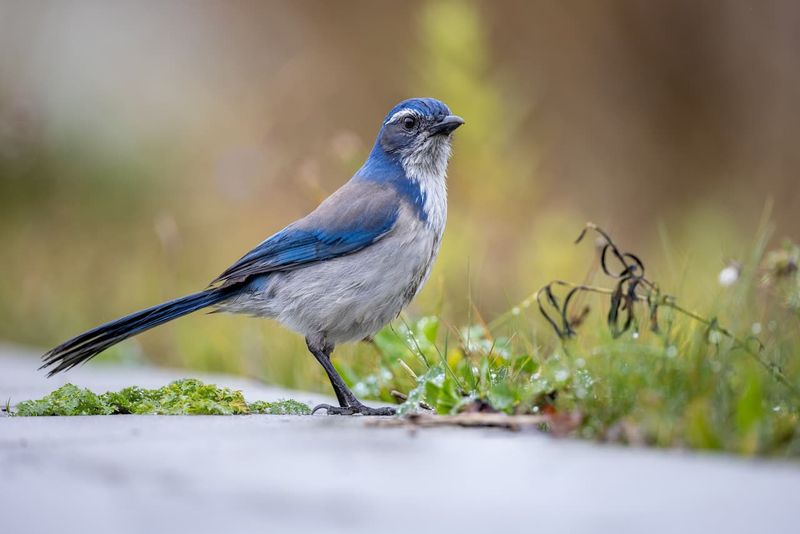
From late spring through summer, insects make up a large share of what California Scrub Jays eat and feed to their young. Caterpillars in particular can account for a substantial portion of the food delivered to nestlings during the breeding season.
Watching a jay work through a shrub or hop across a lawn picking up surface prey, it is easy to imagine the bird as a natural pest-control service.
The Cornell Lab’s California Scrub-Jay life history pages describe a bird that eats insects opportunistically across seasons, with the heaviest insect consumption in warmer months. That pattern does support calling jays insect-eating omnivores that may contribute to natural predation pressure on some pest species.
What it does not support is the more specific claim that jays routinely dig up, collect, or cache white grubs or other root-feeding larvae living beneath your lawn.
White grubs are the C-shaped larvae of scarab beetles. They live underground, chewing on grass roots, and they are not the kind of prey that a foraging jay encounters on the surface.
The documented caching behavior in California Scrub Jays involves acorns and occasionally other food items, not subterranean larvae. No authoritative source reviewed for this article establishes that jays reliably locate or extract grubs from turf at levels that would reduce root damage or replace any step in a proper pest-management approach.
The Audubon field guide’s overview of the California Scrub Jay’s feeding habits reinforces the picture of an opportunistic generalist rather than a grub specialist. Jays may occasionally eat a grub they find while foraging, the same way they might eat a lizard or a berry.
That occasional consumption is not the same as dependable population-level control. If your lawn has a white-grub problem, the birds in your yard are not the solution, and waiting for them to handle it will cost you the treatment window that actually matters.
No Single Yard Habit Has Been Shown to Scare Every Jay Away
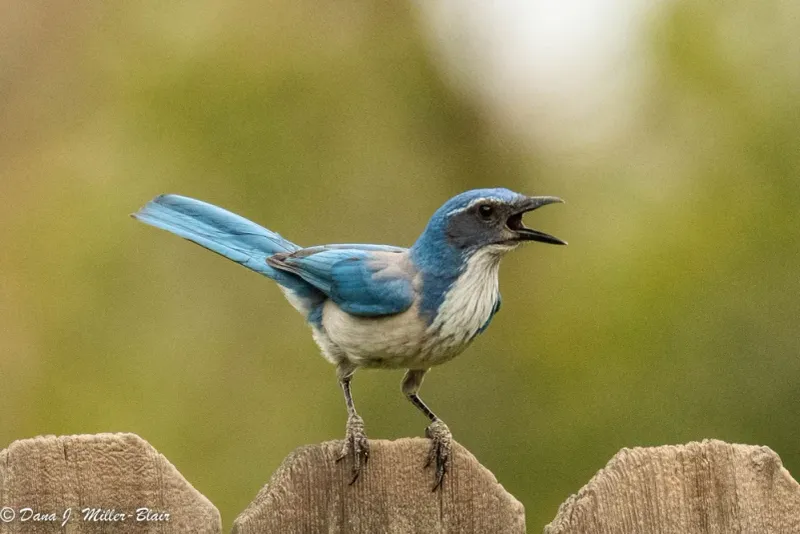
One of the more persistent ideas in backyard bird lore is that some ordinary homeowner routine, whether mowing, power washing, or running a leaf blower, reliably drives California Scrub Jays off a property. The birds are vocal and reactive, so it is easy to notice when they flush and assume the cause was whatever you were just doing.
The connection is usually coincidental.
Research on scrub jay populations, including density-sampling work published in Ornithological Applications, consistently shows that California Scrub Jays are well adapted to human-altered environments. They use parks, suburban neighborhoods, and fragmented oak habitat across California without showing the sensitivity to routine human activity that a truly shy species would.
A jay that flushes when you start the mower will typically return once you stop. Treating any common yard task as a proven repellent is not supported by the available evidence.
That said, some factors do carry real documented risk, and they deserve to be named accurately. Habitat removal is one: if you take out the mature oaks, native shrubs, and natural cover that jays use for foraging, nesting, and shelter, fewer jays will have reason to visit.
That is not a scare mechanism; it is simply a loss of usable resources. The distinction matters because it points toward a different solution, namely keeping appropriate native vegetation rather than modifying a behavior.
Outdoor cats present a more direct threat. Cornell Lab notes that cats are documented predators of adult and young California Scrub Jays.
This is not about startling the birds; it is about direct predation that removes individuals from the population. Keeping cats indoors is one of the most meaningful things a California homeowner can do for backyard bird welfare.
Feeders and birdbaths carry a third, separate risk. CDFW’s Wildlife Health Lab warns that concentrated feeding stations can facilitate disease transmission, including salmonellosis, mycoplasmosis, and trichomonosis, and can attract rodents.
These are not scare factors; they are health and sanitation concerns that affect the birds using the station. Each of these risks has its own mechanism and its own fix, and collapsing them into one vague warning about a single scary habit misses the point entirely.
Native Plants Support Jays With Fewer Feeder-Related Risks
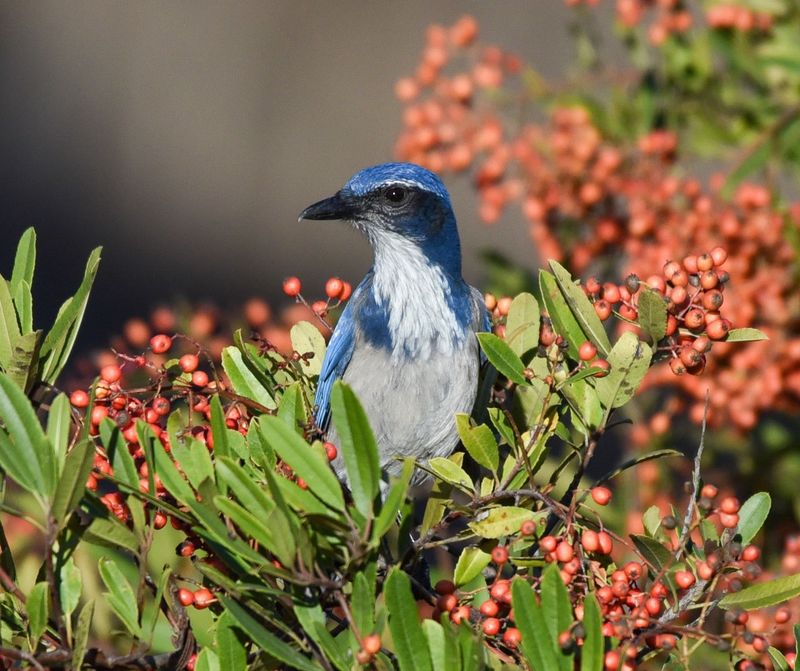
Before you set up a peanut feeder to attract California Scrub Jays, consider what your yard already offers, or could offer, with the right plants in place. Native oaks, toyon, coffeeberry, manzanita, native bunch grasses, and similar plants provide insects, berries, seeds, and cover through most of the year without requiring you to buy, fill, or sanitize anything.
Cornell Lab’s life history account places California Scrub Jays squarely in oak woodland and chaparral habitat, which means a yard that includes mature oaks and native shrubs is already speaking the bird’s language. A look at where jays are typically spotted confirms their preference for layered vegetation with some open ground nearby, the kind of structure that native California plantings naturally provide.
CDFW takes a clear position on artificial feeding. The department’s Wildlife Health Lab recommends native landscaping over feeders and birdbaths because concentrated food and water sources can spread disease among birds and attract rodents to the area.
Native plants can reduce some of those risks by distributing food sources across the yard and through the seasons, though they do not eliminate every risk. A dense shrub planting can still shelter a rat if conditions are right, and a birdbath left unchanged will still grow bacteria regardless of what is planted around it.
The practical approach is to prioritize native plants first, then layer in management decisions. Keep some fallen leaves and natural debris in areas where fire safety and trip hazards allow it, because ground cover provides foraging opportunities and nesting material.
Remove or manage seedlings that sprout in inconvenient spots. Balance any natural cover you retain against your site’s fire-safety requirements, especially if you live in a wildland-urban interface zone where defensible space rules apply.
Supporting jays through habitat is more durable than supporting them through a feeder, and it serves a wider range of native wildlife at the same time.
Inspect the Lawn Before You Treat Any Larva
Seeing a California Scrub Jay pecking at your lawn does not mean you have a grub infestation. Jays forage across turf for many reasons, including surface insects, seeds, and moisture.
Bird activity alone is not a reliable indicator of what is happening underground, and it is not a reason to apply insecticide.
If your lawn is showing actual damage, look for irregular brown patches that do not recover with watering, or turf that lifts away from the soil easily because the roots have been chewed through. Those symptoms warrant a hands-on inspection.
UC IPM’s turfgrass monitoring guidance describes how to do it: cut a one-square-foot section of sod about three inches deep, peel it back, and examine the soil and root zone directly. Repeat this in several spots across the damaged area.
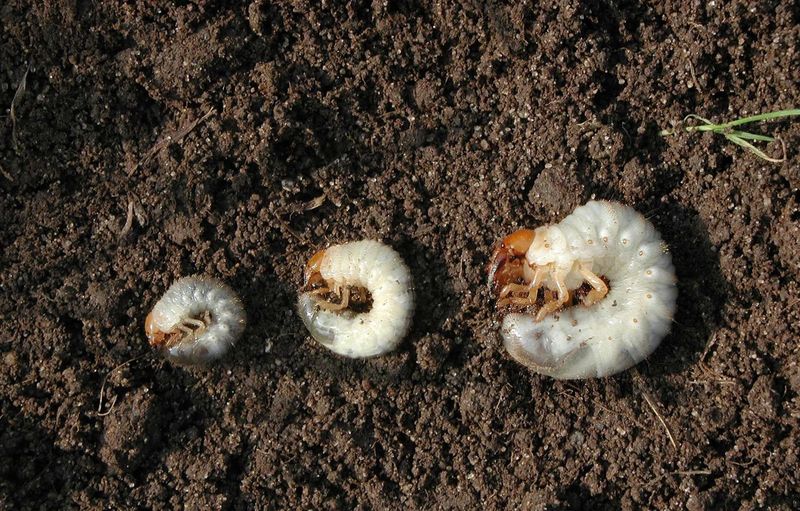
White grubs are C-shaped larvae with six legs near the head end and a soft, cream-colored body. They are the immature stage of scarab beetles, including masked chafers and Japanese beetles in areas where the latter have established.
Billbug larvae look quite different: they are legless, cream-colored, and smaller. The distinction matters because management strategies differ between these two pests, and treating for the wrong one wastes money and applies unnecessary chemistry to your soil.
UC IPM suggests a threshold of roughly six white grubs per square foot as a general guide for considering curative treatment in California turf. The UC IPM home lawn insects page notes that most California lawns have few insect problems that actually require treatment.
Even if you find grubs, the decision to treat should also account for the pest’s life stage, the time of year, the degree of visible damage, and current product guidance for your region. Treating in the wrong window, such as when larvae are too large to be affected by a given product, is ineffective regardless of what you apply.
Confirm the pest, count it, check the calendar, and then decide.
Support the Birds Without Expecting Them to Fix the Lawn
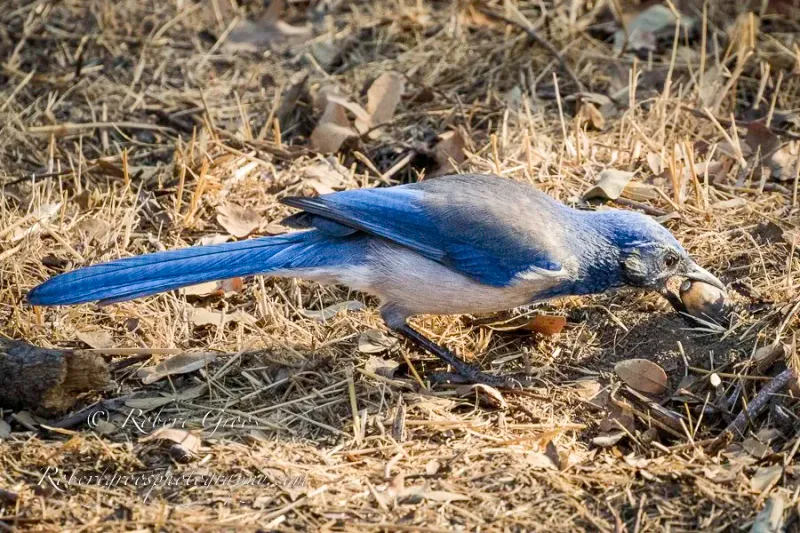
California Scrub Jays are worth having around. They cache acorns in ways that can occasionally help oak regeneration, they eat insects through the warm months, and they bring a level of activity and intelligence to a yard that most homeowners find genuinely enjoyable.
Building habitat for them through native oaks, shrubs, and natural cover is a reasonable stewardship investment that pays off in multiple directions at once.
What they are not is a lawn maintenance program. As UC ANR’s work on jay caching makes clear, the birds store acorns as food, not as a service to homeowners.
Their insect eating, documented by Cornell Lab’s life history research, reflects opportunistic foraging rather than targeted pest management. No published source establishes that attracting jays will reduce white grubs, prevent root damage, or replace the inspection and threshold process that California IPM recommends.
Keep cats indoors to reduce direct predation risk. If you use feeders despite CDFW’s cautions about disease and rodent attraction, clean them regularly, monitor for sick birds, and stop feeding during any reported outbreak in your area.
For lawn pests, inspect before you treat, confirm the pest identity and count, and follow UC IPM’s threshold-based guidance rather than responding to bird activity or gut feeling. A yard that gives jays what they actually need, native cover, natural food sources, and freedom from predation, is doing its job well.
Expecting more than that from a wild bird sets up both you and the bird to fall short.