
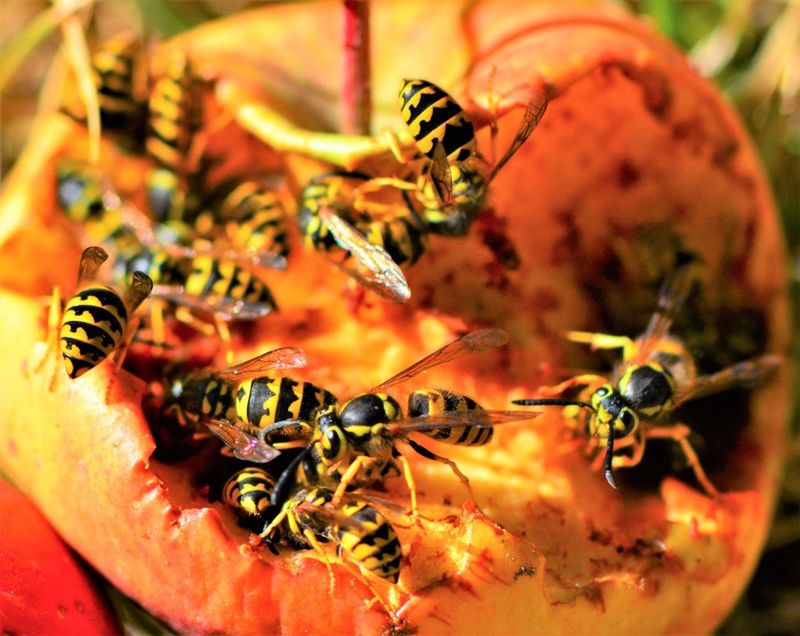
Every fall, North Carolina homeowners start noticing a lot more yellowjackets buzzing around picnic tables, garbage cans, and fruit trees, and it can feel like something went seriously wrong overnight. The good news is that a yard full of foraging yellowjackets usually signals a normal part of the insect’s annual life cycle, not a sudden disaster you caused.
Knowing why this happens, and what actually raises your risk, puts you in a much better position to protect your family, pets, and outdoor routine.
Why Fall Yellowjacket Activity Becomes More Noticeable
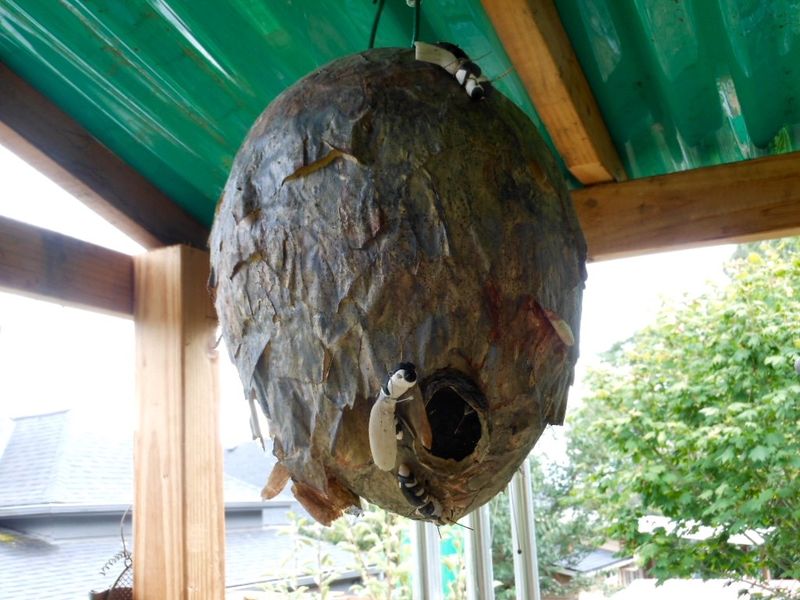
Yellowjacket colonies follow a predictable annual rhythm that most North Carolina homeowners never think about until late summer arrives. A colony begins each spring when a single overwintered queen starts building a nest and laying eggs.
Through spring and early summer, the workforce is small enough that most people barely register the insects at all.
As summer progresses, the colony keeps growing. NC State Extension guidance on stinging insects in North Carolina notes that colonies can reach 600 to 800 workers by fall, and that yellowjackets are most active during this late-summer and fall period.
That population size alone explains why encounters feel so sudden: the insects were always there, just fewer of them and focused more on collecting protein for developing larvae.
By late summer, the larval population in the nest begins to decline and workers shift their attention toward carbohydrate-rich foods to sustain themselves. Ripe and rotting fruit, sugary drinks left on a patio table, and open garbage cans all become prime targets.
This shift in diet pulls foragers into the same spaces where people spend time, making the activity feel like a surge.
Seeing foragers around your yard does not mean a nest is located directly beneath the spot where you see them. University of Georgia Cooperative Extension guidance on stinging and biting pests confirms that yellowjacket workers travel away from their nest to forage, sometimes a considerable distance.
The colony may be somewhere in the surrounding area, but the visible activity alone cannot tell you where.
A Homeowner’s “Swarm” May Be a Foraging Aggregation
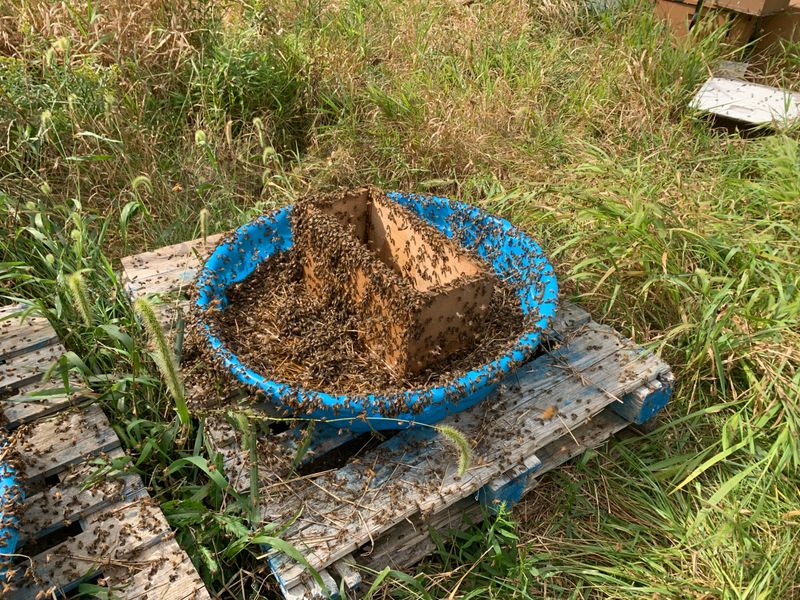
When a homeowner says yellowjackets are “swarming,” the word usually describes something different from what entomologists mean by a swarm. Honeybees swarm when a colony reproduces and a large group of bees leaves with a queen to establish a new nest.
Yellowjackets do not behave this way.
What most people are actually seeing is a foraging aggregation: a group of workers from a mature colony converging on an attractive food source. South Dakota State University Extension’s explanation of yellowjackets near decaying produce and garbage makes clear that this kind of clustering around food is a late-season feeding response, not a reproductive event or a sign that a new colony just moved in.
A large number of foragers around a fruit tree or trash can may suggest a colony exists somewhere nearby, but it cannot tell you where the nest is. The nest could be in the ground under a distant corner of the yard, inside a rotted log, in a wall void of a neighboring structure, or anywhere else that offers a protected cavity.
Watching where workers fly after they leave a food source can sometimes point toward a nest, but it is not a reliable method and should not lead anyone to start probing or digging.
NC State’s pollinator identification resource also reminds homeowners that not every buzzing insect is the same species. Yellowjackets defending a nest entrance behave very differently from foragers away from the nest.
Foragers are generally focused on food and less likely to sting unless handled or crushed.
The defensive response that causes multiple stings happens when something disturbs the nest itself.
Yard Attractants Can Increase Encounters
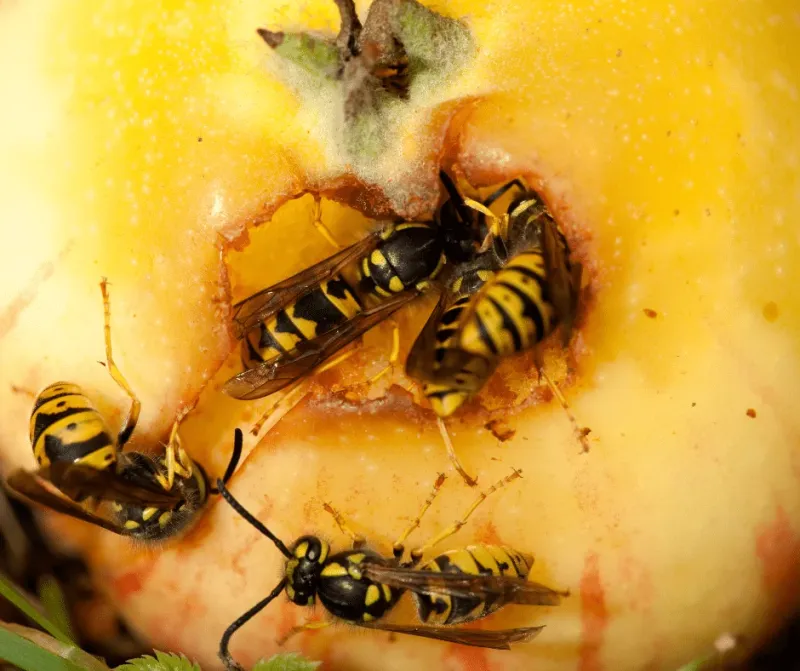
Fallen fruit is one of the most reliable yellowjacket magnets in a North Carolina yard. Apples, pears, figs, and persimmons that drop to the ground and begin fermenting release exactly the kind of sugary odor that draws late-season foragers from a wide area.
Picking up fallen fruit every day or two can make a meaningful difference in how many yellowjackets you see near the house.
Garbage and recycling containers are another major source of attraction. Soda cans, juice bottles, meat scraps, and sticky residue inside bins all give foragers a reason to linger close to where your family spends time.
NC State Extension’s stinging insect guidance and Purdue Extension’s social bees and wasps publication both recommend keeping lids tightly secured and rinsing containers before placing them in recycling.
Outdoor dining habits matter more than most homeowners realize. Sugary drinks in open cups, uncovered condiments, and plates of food left on a patio table can attract foragers within minutes.
Keeping food and drinks covered until the moment they are being consumed, and wiping down tables and grills after every use, removes the residue that draws insects back to the same spots repeatedly.
Hummingbird feeders are a less obvious culprit. A leaking feeder or one that drips after refilling leaves sugary liquid on the surface that yellowjackets find quickly.
Cleaning the feeder exterior after filling and using a drip-free design reduces this problem. If forager activity is already concentrated in one part of the yard, temporarily moving your outdoor eating area away from that zone gives you more comfortable space while you work on reducing the food sources driving the activity.
None of these steps necessarily eliminates the colony, but they can significantly cut the number of encounters your family has each day.
Find the Risk, Not Just the Insects
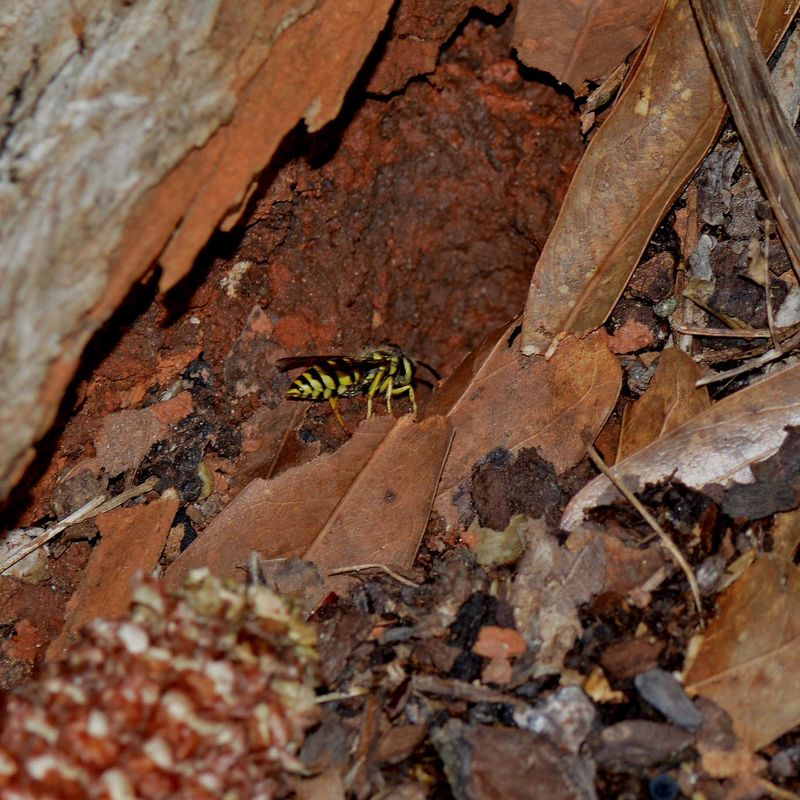
Yellowjackets in North Carolina nest in a variety of locations, and the spot where you see foraging activity is rarely where the nest actually is. Common nest sites include underground cavities and abandoned rodent burrows, rotted tree stumps, hollow logs, landscape timbers, wall voids inside homes and outbuildings, attics, and eaves.
Some species also build exposed paper nests under deck railings or inside dense shrubs.
The practical question is not “where are the yellowjackets?” but “how close is the nest to people, pets, and routine activities?” A colony tucked in a back corner of a wooded lot, far from foot traffic and mowing routes, poses a very different risk than one located under a front porch step or inside a wall adjacent to a frequently used door. NC State Extension’s turf pest guide frames the management threshold around exposure and proximity, not simply the presence of the insects.
Nests near play areas, doorways, regularly walked paths, mowing routes, or anywhere a pet roams deserve prompt attention. The risk increases considerably if anyone in the household has experienced a severe allergic reaction to a sting in the past, because the next reaction can be more serious than the last.
Before assuming the insects in your yard are yellowjackets, take a closer look at their size and behavior. NC State Extension’s cicada killer wasp resource explains that cicada killers are large, black-and-yellow solitary wasps that can appear in groups and are often mistaken for yellowjackets.
Unlike yellowjackets, cicada killers are solitary and generally do not defend their burrows aggressively against people who are simply walking nearby.
Correct identification matters before you decide whether any treatment is warranted.
Reduce Exposure Before You Disturb a Suspected Nest
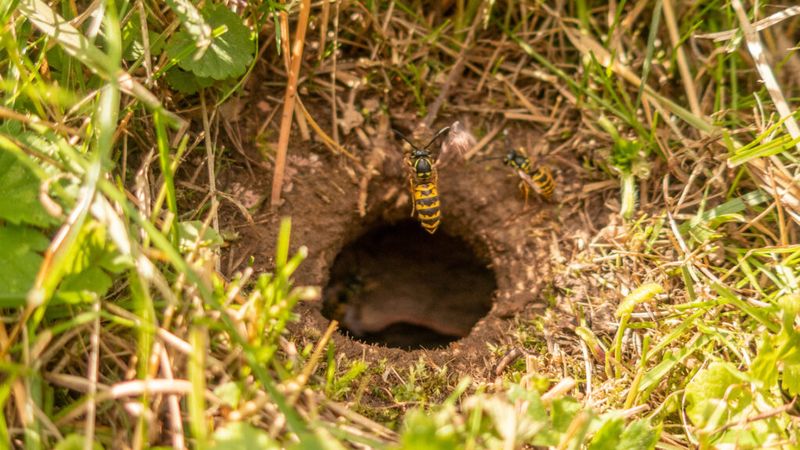
The single most important action after noticing heavy yellowjacket activity near a suspected nest is to stop doing things that could disturb it. Mowing over a ground nest, weed-eating around a suspected entrance, poking at a hole in the ground, moving a stack of wood near where you have been seeing activity, or digging close to any cavity can trigger an immediate and intense defensive response.
The colony can send out dozens of workers in seconds.
Keep people and pets away from the area where you suspect the nest might be, and move any outdoor dining or play activities to a part of the yard that is clearly away from concentrated yellowjacket activity. These steps cost nothing and immediately lower the chance of an accidental disturbance while you decide on next steps.
Penn State Extension’s guide to stinging insects and NC State Extension’s stinging insect publication both point out that a secluded nest can often be left alone. Yellowjacket colonies are annual: the original queen and workers do not normally survive winter, and existing nests are not reused the following spring.
If the nest is in a location that does not intersect with where your family, pets, or routine yard work happens, waiting out the season is a reasonable and low-risk option.
That said, “waiting for cold weather” is not a firm deadline you can count on. University of Georgia Extension’s stinging pest guidance notes that timing varies by species, nest location, microclimate, and local weather patterns.
A colony in a sheltered wall void or a south-facing ground burrow may remain active well into late fall.
Do not assume the nest has already died simply because temperatures have dropped a few degrees.
Use Professional Help or Label-Compliant Treatment
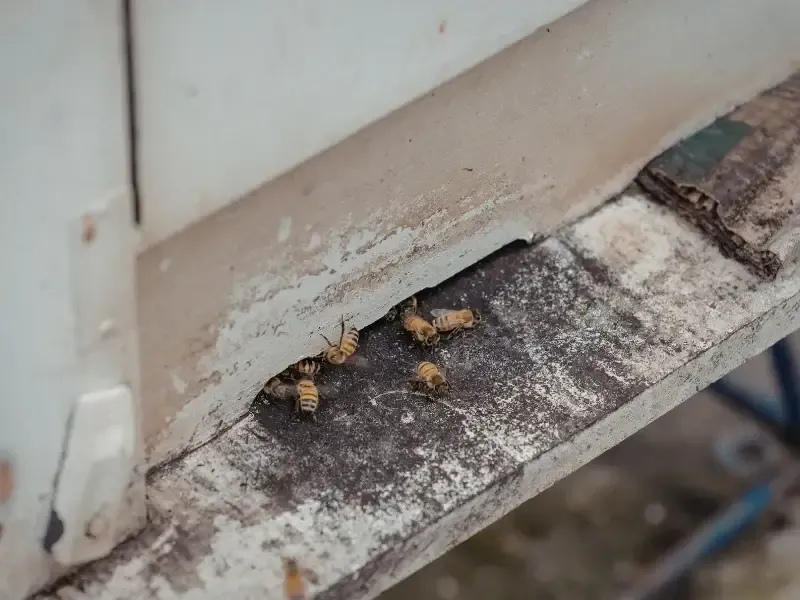
Some nest locations make professional help the clearly safer choice. A colony inside a wall void, an attic, a crawl space, or any enclosed part of a building is not a good candidate for do-it-yourself treatment.
Spraying an aerosol into a wall void without first eliminating the colony can push agitated wasps into living spaces through gaps in the wall. NC State Extension specifically cautions against plugging a nest entrance before the colony is eliminated, for exactly this reason.
Call a qualified pest management professional when the nest is inside a structure, when it is near a door, play area, or high-traffic path that cannot be avoided, or when anyone in the household has a documented severe sting allergy. A professional has the protective equipment, the correct products, and the experience to treat these situations without creating a secondary hazard.
For an accessible outdoor ground nest that is clearly away from occupied spaces, a homeowner may choose to treat it personally, but only with a product that is specifically labeled for yellowjacket nest treatment. EPA-registered wasp and hornet aerosol labels typically direct users to treat at night or at dawn when activity is lowest, stand at the distance specified on the label, avoid positioning themselves directly above or over a ground entrance, and keep people, pets, and aquatic environments protected as the label requires.
The label is a legal document, and following it is not optional. EPA integrated pest management guidance reinforces that label compliance protects both the applicator and the surrounding environment.
Never pour gasoline, kerosene, bleach, boiling water, or any other improvised liquid into a nest. NC State explicitly warns that gasoline is dangerous and damages the surrounding environment, and other improvised methods can cause fire, toxic exposure, or provoke a mass stinging event.
Regarding traps, Penn State Extension notes that traps may catch some foragers but are unlikely to solve the underlying problem, and NC State has found commercial traps have not shown reliable value for reducing yellowjacket pressure in the southeastern United States.
Treat traps as a minor nuisance-reduction tool at best, not a substitute for addressing the nest or its attractants.
What to Do After a Sting—and When to Call 911

Getting stung by a yellowjacket does not always cause a severe reaction, but it can. A serious allergic response can follow a single sting even in someone with no prior history of severe reactions, which is why knowing the warning signs matters for every member of the household.
The first step after a sting is to move away from the area calmly and quickly, without swatting. Swatting releases alarm pheromones and can draw additional stings from nearby workers.
Once you are clear of the area, check the sting site. Yellowjackets do not typically leave a stinger behind the way honeybees do, so there is usually nothing to remove.
MedlinePlus guidance on bee and wasp stings describes normal local reactions as pain, redness, and swelling at the sting site, which usually improve within a few hours. Washing the area, applying a cold pack, and taking an over-the-counter antihistamine or pain reliever can help manage mild symptoms.
Emergency symptoms are a different situation entirely. MedlinePlus anaphylaxis information and CDC guidance on insect stings identify the following as signs requiring an immediate call to 911: difficulty breathing, swelling of the lips, tongue, or throat, dizziness or fainting, hives spreading beyond the sting site, vomiting, or any other sign of shock.
If the person has a prescribed epinephrine auto-injector, it should be used according to their emergency plan without waiting to see whether symptoms improve on their own.
Do not drive someone with a suspected anaphylactic reaction to the emergency room yourself if 911 can reach you faster.
Match the Response to the Colony’s Location and Risk
Late-season yellowjacket activity in a North Carolina yard is almost always the predictable result of a mature annual colony whose workers are foraging for carbohydrate-rich foods as the season winds down. NC State Extension and Purdue Extension’s social wasp publication both support this picture of normal seasonal biology rather than a mysterious yard failure.
The practical decision process follows a clear sequence. Remove or secure whatever is drawing foragers close to people: fallen fruit, open trash, uncovered food and drinks, sticky outdoor surfaces, and leaking feeders.
Keep people and pets away from any area where you suspect a nest entrance, and stop all ground disturbance near that spot. If the nest is in a secluded location that does not intersect with daily yard use, waiting for the colony to decline naturally with cooler weather is a reasonable option.
If the nest is near a door, walkway, play area, mowing route, or occupied building, or if anyone in the household has a severe sting allergy, professional control is the appropriate step.
NC State’s turf pest guide notes that yellowjackets do provide real ecological value as predators of flies, caterpillars, and other insects. That value is worth acknowledging, but proximity and sting risk to people and pets are what determine whether a colony needs to be managed.
A yellowjacket colony minding its own business far from foot traffic is a very different problem from one directly under a swing set.
Matching your response to the actual risk, rather than the number of insects you can see, is the most useful thing you can do.