
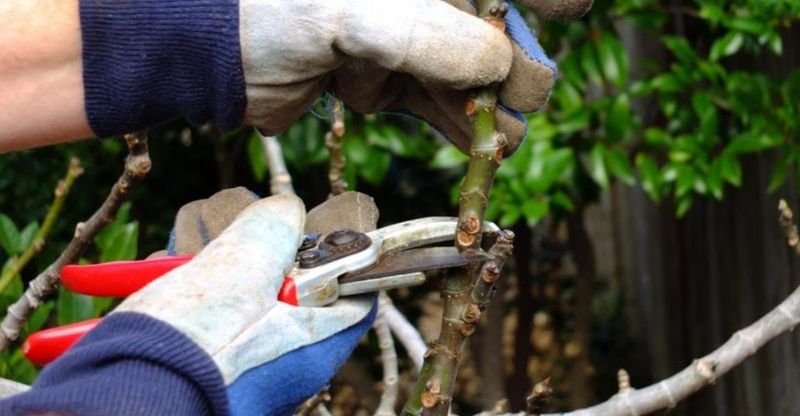
Fig trees in North Carolina can grow into a tangled thicket fast, especially after a mild winter, and most of that new growth does nothing useful for your fruit. The difference between a wild, hard-to-reach bush and a manageable tree with bigger figs often comes down to a few deliberate cuts made at the right time of year.
Knowing when to prune, what to remove, and which wood to leave behind can shift your plant from producing a tangle of shoots to producing fruit worth reaching for.
Late winter is the North Carolina pruning window
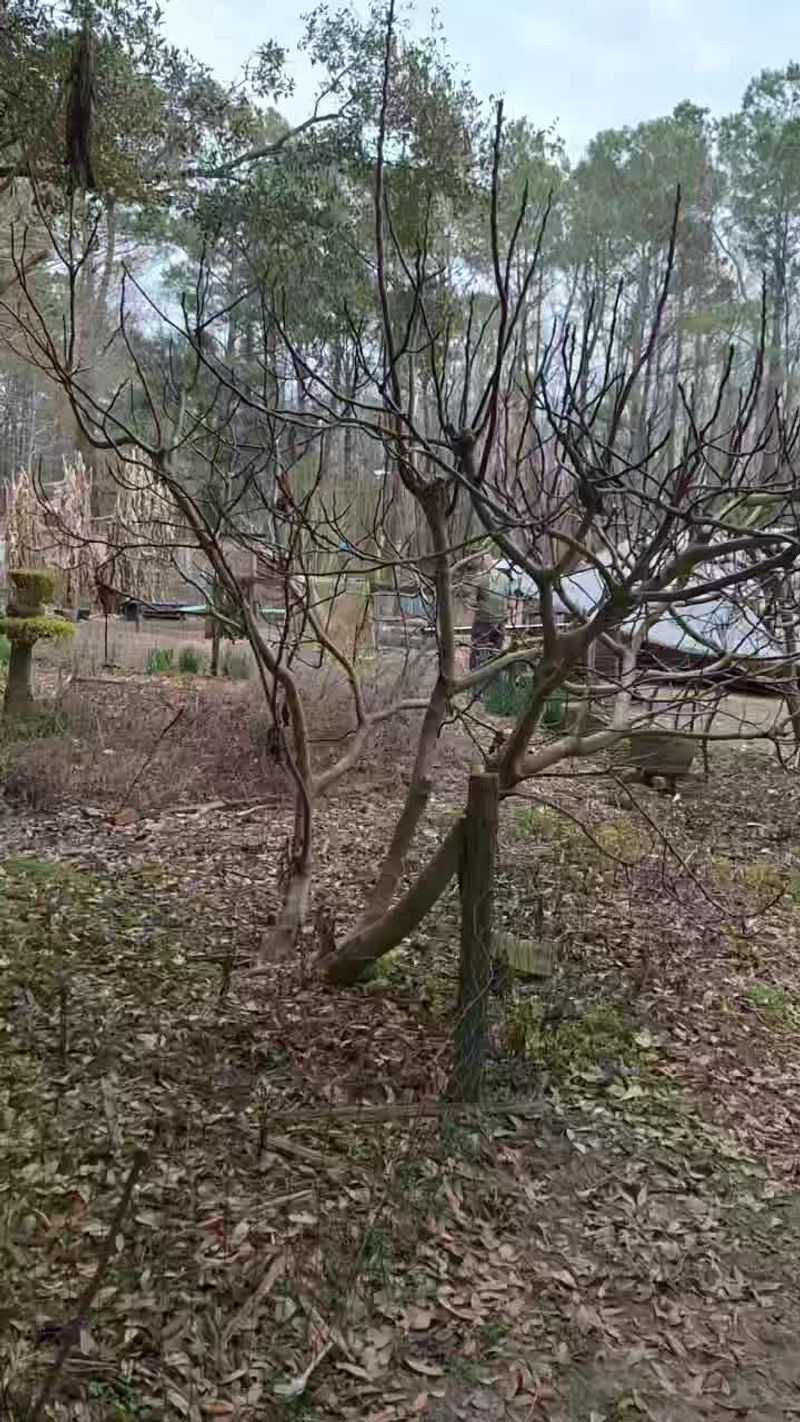
Established fig trees in North Carolina respond best to pruning done in late winter, shortly before new growth begins. That window gives gardeners two advantages at once: the plant is still dormant, so cuts do not immediately push tender new shoots into cold air, and enough of winter has passed that cold damage is visible and easier to assess.
NC State Extension’s fig culture guidance recommends this late-winter timing for established figs as the general standard for North Carolina home gardens.
Pruning too early in winter, before you can tell which wood survived and which did not, risks removing healthy branches you would have kept, or keeping dead ones you should have cut. Waiting until late winter lets you see where bark has shriveled, where buds have failed to swell, and where the wood has turned brown or hollow inside.
You can then cut with confidence rather than guessing.
Late-season pruning, meaning cuts made in late summer or fall, carries a different risk. NC State’s general pruning guidance advises against late-season cuts that stimulate poorly hardened growth, which enters winter more vulnerable to cold injury.
For figs in the Piedmont and mountains especially, that vulnerability can set back a plant significantly.
North Carolina’s timing advice is not universal. In Florida, where winters are warmer and some cultivars hold next year’s flower buds on wood that could be removed by a hard winter pruning, UF/IFAS recommends pruning after harvest and warns that heavy winter pruning can eliminate the following year’s crop.
If you garden in North Carolina, follow the late-winter window rather than advice written for Florida conditions.
The goal is an open plant, not a smaller tangle
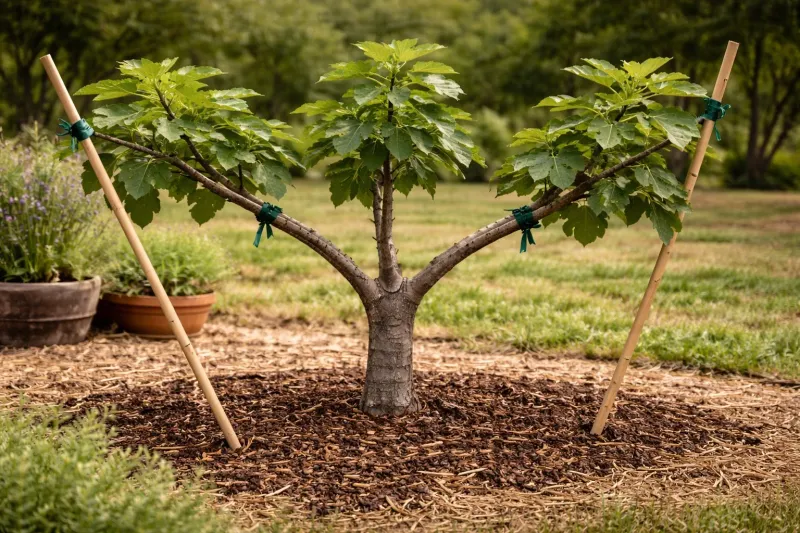
Shearing a fig to a uniform shape or cutting every branch back to the same height might look tidy for a week, but it creates exactly the problem you were trying to fix: a dense cluster of new shoots competing for the same light and space. Selective thinning and reduction cuts work differently.
Instead of flattening the top, you remove specific branches, the ones that are crossing, crowded, drooping, or pointing in an unhelpful direction, while leaving the framework that supports good fruiting wood.
NC State Extension reports that opening the bush, controlling vigor, and improving picking access can produce larger fruit. That claim reflects the practical benefit of better canopy management: when light reaches more of the plant and each remaining shoot has more resources, the fruit that does develop has a better chance of sizing up.
What pruning does not do is guarantee a larger total harvest. A more open plant with well-distributed fruiting wood may carry fewer but better figs, or it may carry a similar number in a more accessible form.
Research on fig tree growth interactions shows that yield depends on the relationship between vegetative growth, fruiting wood, and the timing of two possible crops, not on pruning alone. Removing too much productive wood in the name of size control can shift the balance away from fruiting and toward vigorous but unproductive shoot growth.
Oregon State University Extension’s fig pruning guidance reinforces this: the aim is a well-structured plant where you can reach the fruit, light can reach the leaves, and the tree’s energy goes into developing figs rather than maintaining a wall of crowded branches. Think of each cut as a decision about which wood earns its place, not as a way to reduce the plant’s overall size.
Decide which crop you want to protect
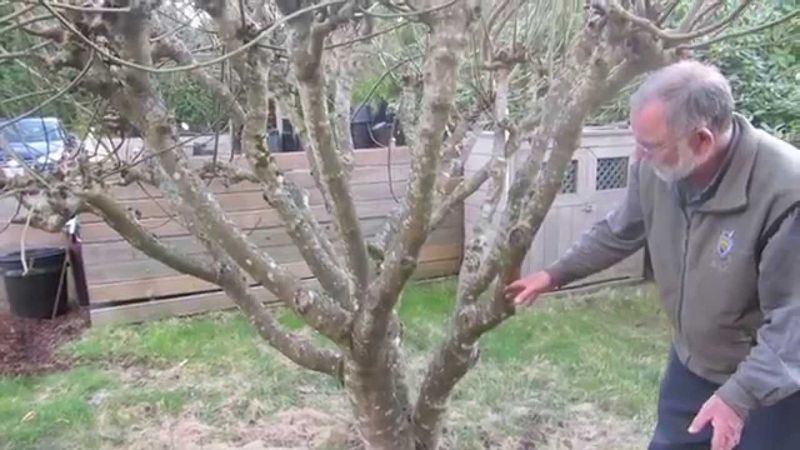
Before you make your first cut, you need to know which crop you are pruning for. Figs can produce two separate crops in a season, and each one forms on a different type of wood.
The main crop, which is the larger and more reliable of the two for most North Carolina gardeners, develops on shoots that grow during the current season. The breba crop, an earlier flush of fruit that ripens before the main crop, forms on healthy wood from the previous season when the cultivar produces it at all.
That distinction matters the moment you pick up your pruners. Oregon State Extension’s fig guidance explains that retaining some vigorous previous-season wood is important if you want breba fruit, while maintaining a sound framework with room for new shoot growth is what sets up the main crop.
Removing all older wood to stimulate fresh regrowth is a reasonable choice if your cultivar produces little or no useful breba crop, but it is not the right move if early figs are part of what you value from the plant.
Published research on fig crop interactions confirms that the two crops compete for the plant’s resources, so the balance between older and newer wood has real consequences for what ripens and when. Cultivar behavior varies considerably.
Some figs produce a generous breba crop; others produce so few early figs that the wood supporting them is not worth protecting at the expense of a cleaner structure for the main crop.
If you are not sure which type your tree produces, extension guidance on fig pruning suggests observing for a full season before making aggressive cuts. In the meantime, preserve some well-placed previous-season wood, keep the framework open for new growth, and use what you learn about your cultivar’s habits to refine the approach in future years.
UF/IFAS also notes that heavy removal of older wood can eliminate the following year’s crop in cultivars that depend on it for early fruiting, which is one more reason to make these decisions deliberately rather than by default.
Start with wood the tree cannot use
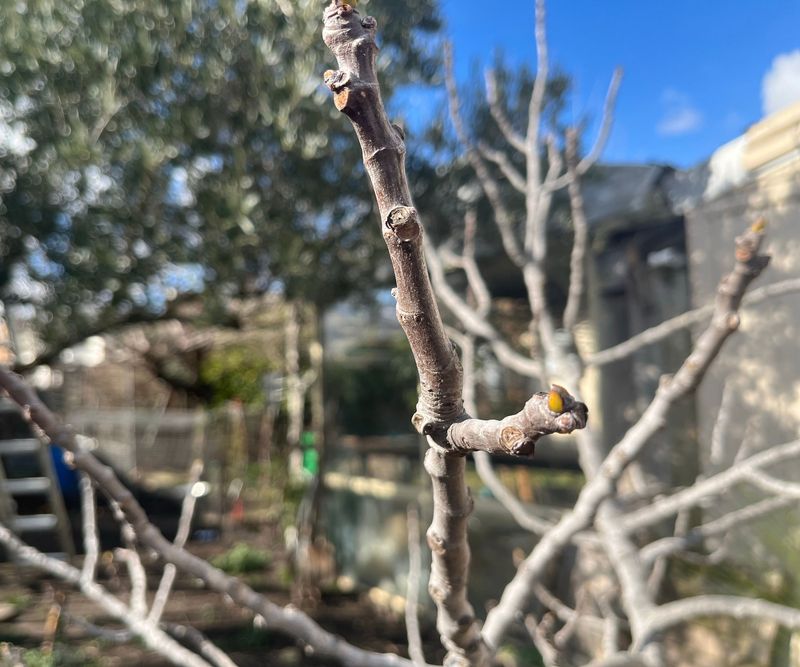
The most productive first pass through a fig is also the most straightforward: remove everything the plant cannot use. Dead branches, broken limbs, wood that was killed or damaged by cold, diseased stems, and branches that cross and rub against each other are all candidates for removal before you touch a single piece of healthy live growth.
Getting this material out of the plant first gives you a clearer picture of what you actually have to work with.
NC State Extension recommends pruning out killed and injured branches in early spring, after cold damage can be evaluated. The key is patience with the assessment.
A branch that looks bare in late winter is not necessarily dead. Scratch the bark lightly with a fingernail or knife tip: green or cream-colored tissue underneath means the wood is alive; brown or dry tissue means it is not.
Work your way down from the tip of a suspicious branch until you reach healthy tissue, then make your cut just above a live bud or lateral branch.
Diseased wood deserves its own attention. NC State’s fig disease guidance identifies several problems, including fig rust and souring, that can affect fruit quality and plant appearance.
Removing diseased material and cutting back dead wood reduces the sources of infection present in the plant and supports basic sanitation. Pruning does not eliminate disease, however.
Problems caused by drainage, nematodes, drought, or cold injury require their own solutions, and no amount of pruning substitutes for addressing those underlying conditions.
Once the dead, damaged, and diseased wood is out, the remaining framework is usually more legible than it looked before you started. That clarity makes the next decisions, about which live branches to keep, reduce, or remove entirely, considerably easier to make.
Thin the framework until harvest becomes easy
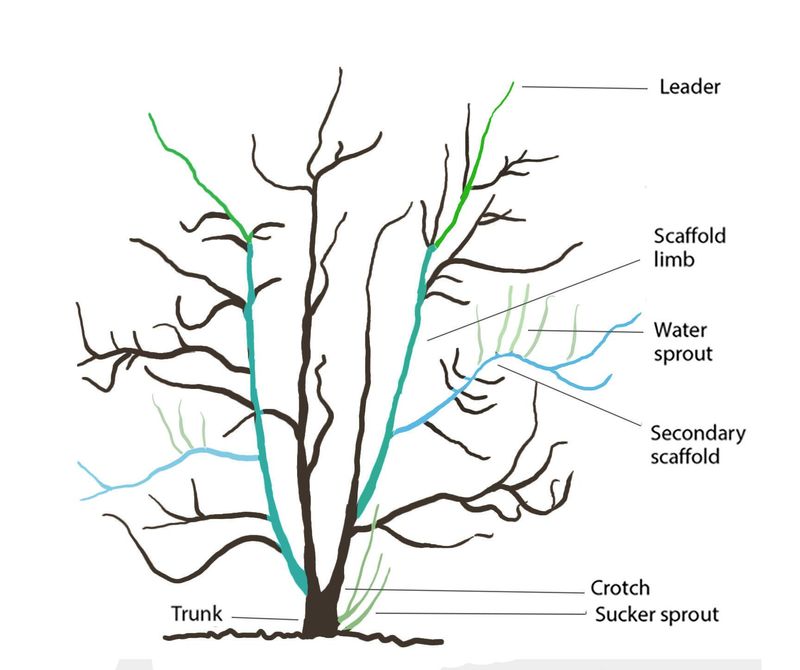
After the dead and damaged wood is gone, the next job is shaping what remains into a plant you can actually harvest. For most North Carolina home gardeners, that means a multi-stemmed bush with several well-spaced main stems, open enough in the center that you can reach fruit without fighting the plant.
Getting there requires three types of selective removal: suckers, drooping or oversized branches, and crowded interior growth.
Suckers are shoots that arise from the root area, the base of the trunk, or the lower main branches. Most of the time they are unwanted: they compete with the established framework, crowd the base of the plant, and rarely develop into productive stems quickly.
Remove them as close to their point of origin as practical. The exception is when cold has killed the main stems and you need replacement shoots to rebuild the plant’s framework, a situation covered more fully in the winter-injury section of this guide.
NC State’s fig culture guidance recommends cutting back drooping branches and opening the bush as part of the standard pruning approach. Branches that droop to the ground collect moisture, become harder to mow around, and bear fruit that is difficult to pick cleanly.
Reduce them back to a lateral that faces a more useful direction, or remove them entirely if a better-positioned branch is already doing the job.
University of Georgia Cooperative Extension’s home fig guidance describes a practical homeowner approach: keep several well-spaced main stems, remove the weakest or most crowded growth, lower branches that are too tall to harvest comfortably, and preserve enough suitable shoots to support the desired crop. The exact number of stems is not fixed.
A gardener who values breba fruit will want to keep more well-placed previous-season wood; a gardener focused on the main crop and overall plant structure can be more aggressive about thinning.
UF/IFAS and Oregon State Extension both note that figs in many regions naturally take a multi-stemmed bush form, partly because cold can kill upper wood and force regrowth from lower stems. Working with that natural habit, rather than against it, typically produces a more manageable plant than trying to force a single-trunk tree form in a climate where hard winters are a recurring reality.
Make clean cuts and protect the gardener
Where you place each cut matters almost as much as which branch you choose to remove. The target is just outside the branch collar, the slightly swollen ring of tissue where a branch meets a larger stem or the trunk.
Cutting there, without leaving a stub, allows the plant’s natural wound-response tissue to close over the cut more effectively. Leaving a long stub invites decay organisms to move in before that closure can happen.
Equally, cutting too flush with the parent stem removes the collar tissue itself, creating a larger wound than necessary. Oregon State Extension’s home orchard pruning guide and UGA’s fig guidance both recommend clean cuts just outside the collar as the standard technique.
For smaller branches, a sharp bypass pruner makes a clean cut in one motion; for larger wood, loppers or a pruning saw give you more control without tearing the bark.
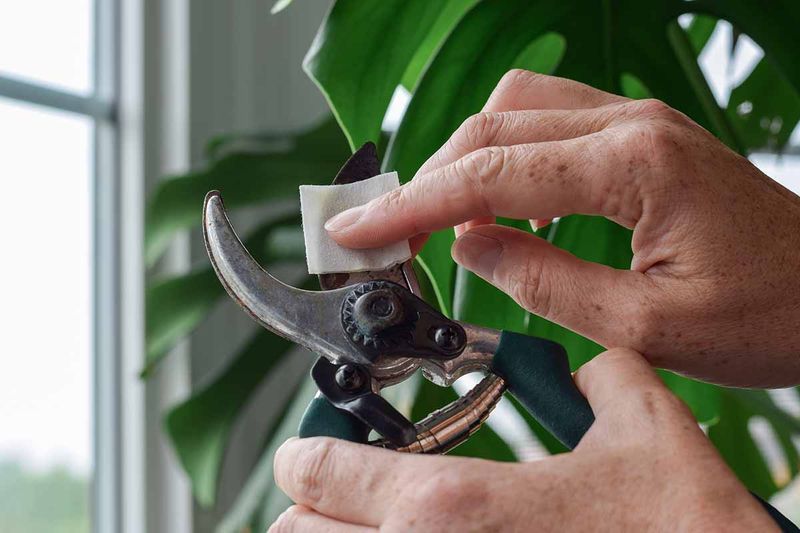
Tool sanitation is a step that is easy to skip but worth building into your routine. When moving between plants, or whenever you suspect disease on the wood you have been cutting, wipe blades with 70-percent isopropyl alcohol or a properly diluted bleach solution.
University of Maryland Extension’s pruning tool guidance and Iowa State University Extension’s shear-sanitation advice both note that bleach solutions can corrode metal over time, so rinse and dry tools after use if you go that route.
Wear gloves throughout the job. Fig trees produce a milky latex sap that can irritate sensitive skin.
NC State notes that sensitive individuals can react to fig latex during harvest, and the same risk applies when pruning. A pair of snug-fitting work gloves protects your hands from the sap and from any rough bark or tool edges as you work through the plant.
Winter injury changes the shape of the job
Not every fig tree in North Carolina arrives at late winter looking the same. In the coastal plain and warmer parts of the Piedmont, an established fig may come through winter with most of its framework intact, needing only the standard selective thinning described above.
In colder Piedmont locations and especially in the mountains, the same plant might lose most of its above-ground wood to a hard freeze, leaving only a cluster of new shoots emerging from the base come spring.
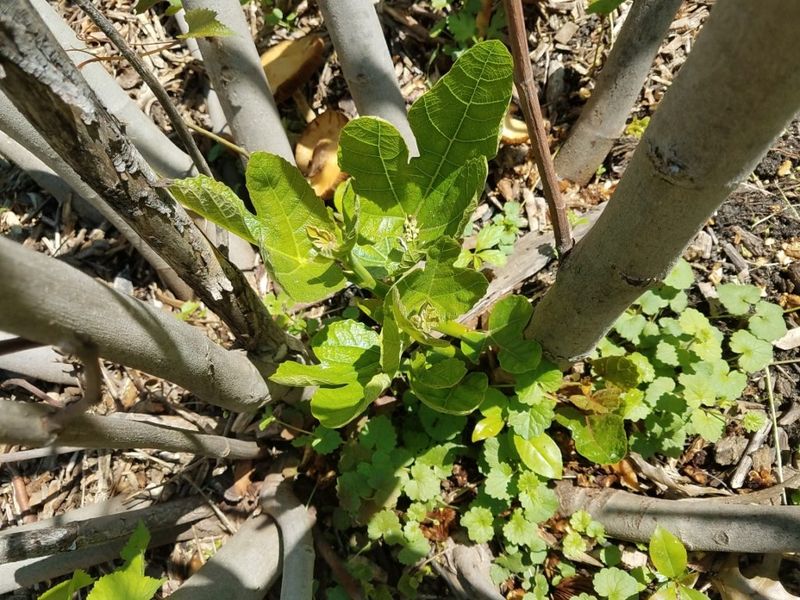
NC State’s fig culture guidance acknowledges that figs are more reliably grown in eastern North Carolina and the Piedmont, with cold injury presenting a greater challenge at higher elevations and in colder inland areas. When a freeze kills the main stems back to or near the ground, the plant’s response is typically a flush of sucker shoots from the root zone.
Those shoots are the raw material for rebuilding.
Managing a freeze-damaged fig means choosing which replacement shoots to keep and which to remove. Select three to five of the most vigorous, well-spaced shoots from the base and remove the rest.
This keeps the plant from becoming an impenetrable thicket of weak stems while directing energy into the framework you are trying to re-establish. Do not expect a full crop in the first season after a hard freeze: the plant is rebuilding, and fruiting will resume as new shoots mature and the framework fills in.
NC State’s fig disease guidance notes that cold-injured tissue can become an entry point for pathogens, so removing dead wood promptly and cleanly is especially important after a damaging winter. The job after a freeze is not a standard pruning session; it is a triage and reconstruction exercise, and the standard advice about preserving breba-bearing wood takes a back seat until the plant has enough healthy framework to work with again.
More cutting does not guarantee more figs
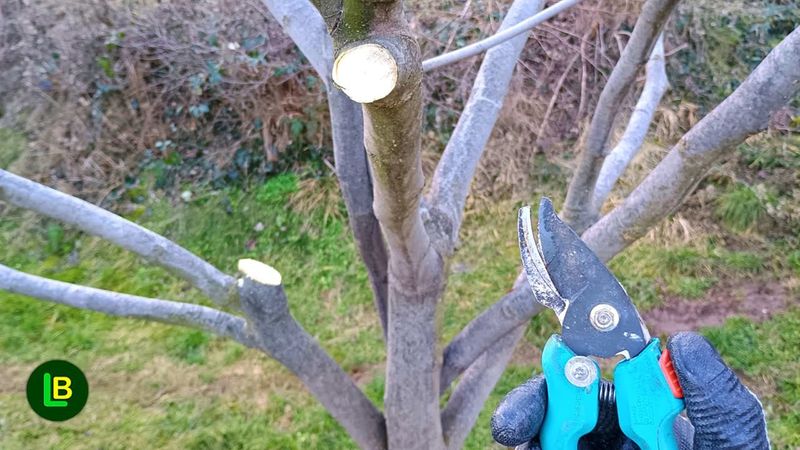
Heavy pruning can send a fig tree into vigorous regrowth mode without producing a proportionally larger harvest. When too much productive previous-season wood is removed, the breba crop disappears.
When the cuts are so severe that the plant’s energy goes into rebuilding shoot mass rather than sizing fruit, the main crop may be smaller or later than expected. Research on fig growth interactions confirms that the relationship between vegetative growth and fruiting is not linear: more cutting does not automatically translate to more or better fruit.
Factors beyond pruning also shape the result. Cultivar, sunlight, water supply, soil fertility, crop load, plant age, and winter injury all affect how many figs a tree produces and how large they get.
UF/IFAS notes that a heavily pruned fig may push vigorous vegetative growth without delivering a crop proportional to that effort, particularly when productive wood was removed in the process.
Fertilizer is not a substitute for sound pruning decisions. NC State associates excessive nitrogen with lush late-season growth, light fruiting, fruit splitting, souring, and increased vulnerability to winter injury.
Pushing the plant harder with fertilizer after an overly aggressive pruning session compounds the problem rather than correcting it.
The practical decision rule is straightforward: prune in late winter, open the plant selectively, preserve wood according to whether you want breba fruit or are focused on the main crop, and judge the result by a better-structured, more manageable, easier-to-harvest plant with improved fruit potential. A fig tree that fits its space, lets light reach the interior, and keeps its fruit within reach is a better outcome than one that has simply been cut hard and told to perform.