
Something is wrong with a lot of Central Texas oaks this fall, and homeowners are right to pay attention. Early browning, thinning canopies, and branches going bare ahead of schedule can signal several different problems, and guessing wrong can cost you a tree you did not need to lose.
A wood-boring beetle called the two-lined chestnut borer is real, it does attack Texas oaks, but it is not a newly arrived invasive pest sweeping through the region. Understanding what is actually happening beneath that bark, and what else might explain the same symptoms, is the first step toward making a good decision.
The suspected beetle is real, but the invasive-outbreak claim is not
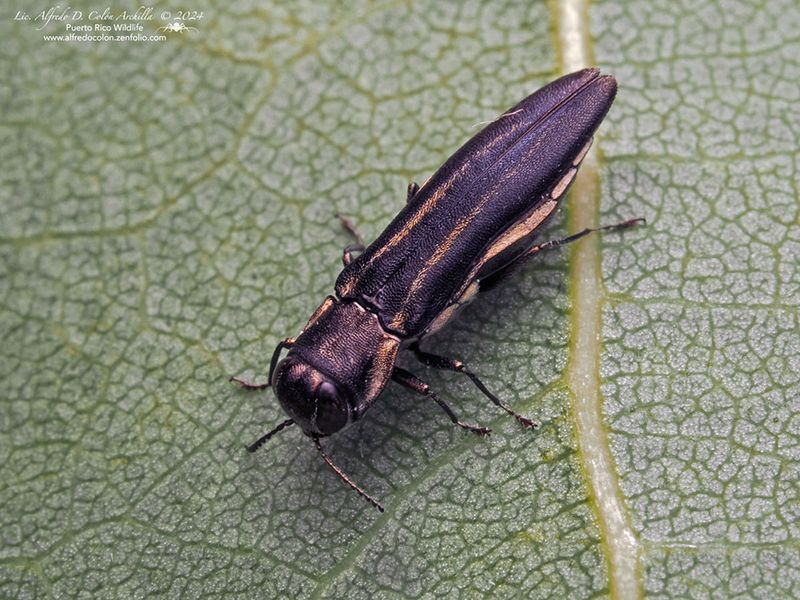
A beetle called the two-lined chestnut borer, Agrilus bilineatus, does occur in Texas and does attack oaks. Social media posts and neighborhood alerts have framed it as a new invasive species spreading rapidly through Central Texas and killing healthy trees before owners realize anything is wrong.
That framing is not accurate, and acting on it could lead to unnecessary tree removal or wasted pesticide applications.
The two-lined chestnut borer is native to North America, not a foreign invader. Morton Arboretum’s species profile places its range broadly across North America, and EPPO’s published assessment of Agrilus bilineatus confirms it extends into Texas and Florida.
Calling it an invasive Texas newcomer would mislead any homeowner trying to figure out what is happening to their tree.
The more important distinction is what this beetle actually does. Texas A&M AgriLife Extension’s guide to wood-boring insects describes most flatheaded borers, the group that includes the two-lined chestnut borer, as secondary invaders.
That means they generally move into trees that are already weakened, damaged, diseased, or dying. Spotting beetle galleries or exit holes in your oak’s bark shows that borer activity happened, but it does not confirm the beetle initiated the tree’s decline or that it is the primary reason the tree is struggling.
One more clarification worth making: the emerald ash borer is a genuine invasive wood-boring beetle confirmed in Texas, but it attacks ash trees, not oaks. If you have read about the emerald ash borer and assumed it threatens your live oak or red oak, that concern is misplaced.
The pest relevant to Texas oaks is the native two-lined chestnut borer, and even then, the tree’s underlying condition matters far more than the beetle’s presence alone.
Why weakened oaks become vulnerable
Healthy oaks produce resins and other chemical defenses that can repel or kill boring insects before larvae establish themselves beneath the bark. When a tree loses that defensive capacity, borers find it much easier to move in and complete their life cycle.
The question worth asking is not just whether a beetle is present, but what wore the tree down enough to let it in.
Texas A&M Forest Service’s tree decline guidance identifies a range of stressors that can reduce an oak’s ability to defend itself: prolonged drought, extreme heat, soil compaction, grade changes, root-zone construction, trenching, lawn equipment strikes, and previous disease or injury. Central Texas has experienced stretches of severe drought in recent years, and many mature oaks have been quietly running down their reserves even when the canopy still looked acceptable from the street.
Once larvae tunnel beneath the bark, they feed on the cambium and phloem, the thin layers of tissue responsible for moving water and nutrients between roots and leaves. Enough larval feeding can disrupt that flow and contribute to canopy dieback.
But as a U.S. Forest Service study examining borers in oak-wilt-infected Texas trees concluded, beetles found in declining oaks are frequently attacking trees already weakened by other problems.
The borer may be accelerating a decline that something else started.
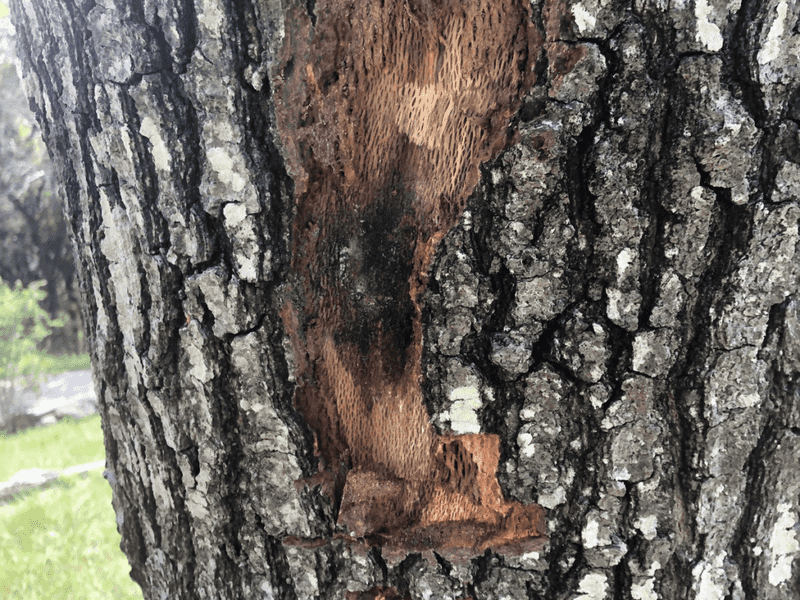
Hypoxylon canker adds another layer of complexity. AgriLife Extension’s Hypoxylon canker fact sheet explains that this fungal pathogen commonly colonizes oaks already stressed by drought or other factors, producing silvery to gray crusty patches under loosened bark.
A tree showing borer holes alongside Hypoxylon canker likely has multiple problems layered on top of one another, not a single beetle outbreak to treat with a spray.
Oak wilt and drought are important alternative explanations for fall symptoms
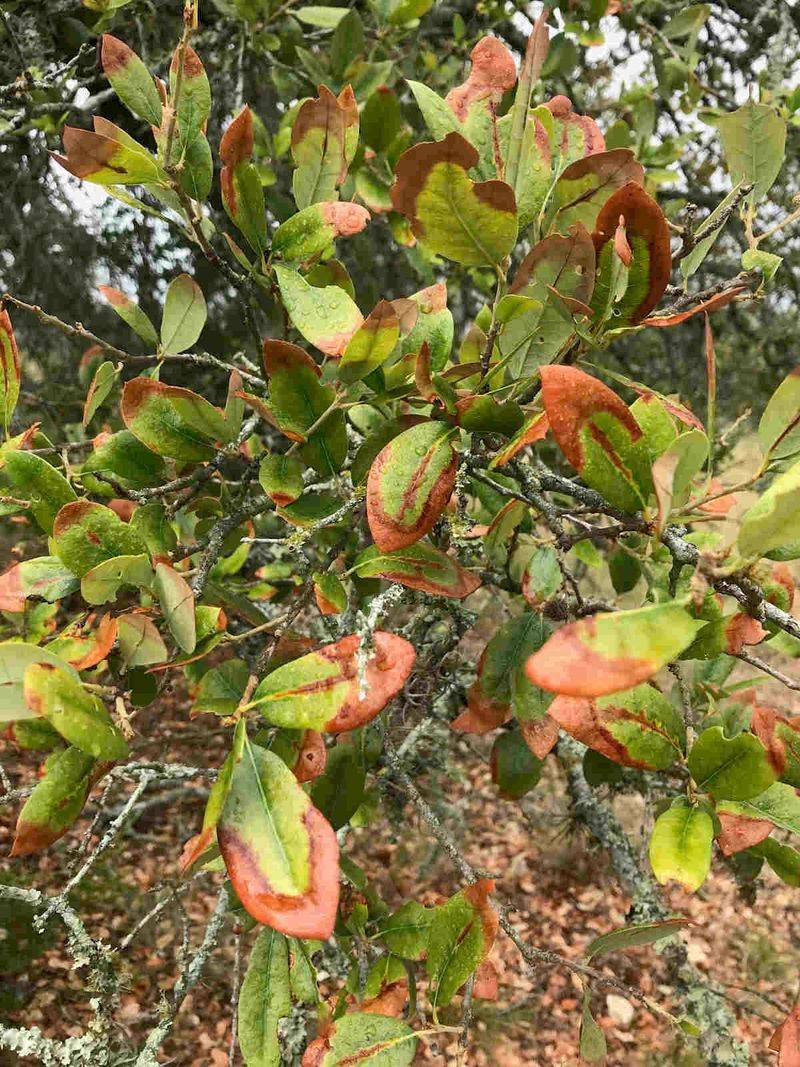
Fall canopy changes in Central Texas oaks can come from several directions at once, and the visual symptoms overlap enough that a single observation rarely tells the whole story. Oak wilt, drought stress, Hypoxylon canker, construction damage, and borer activity can each produce browning, thinning foliage, branch dieback, and early leaf drop.
Assuming one cause without ruling out the others is how homeowners end up treating the wrong problem.
Oak wilt deserves particular attention because of how it spreads and how quickly it can move through a neighborhood. Texas A&M Forest Service’s oak wilt overview describes it as a fungal disease caused by Bretziella fagacearum that can travel through interconnected root systems among live oaks and through fresh wounds contaminated by sap-feeding beetles.
Those sap-feeding beetles are disease vectors carrying fungal spores to open wounds, and they are a different group of insects from the wood-boring beetles that tunnel beneath bark. Mixing up the two beetle types leads to confused diagnosis and misdirected treatment.
Texas A&M Forest Service’s oak wilt prevention guidance emphasizes that fresh wounds on oaks, whether from pruning, storms, string trimmers, or construction equipment, can serve as entry points for oak-wilt spores delivered by sap-feeding beetles. This is one reason wound management and pruning timing matter so much for oaks in Texas.
Drought and extreme heat are also driving visible symptoms right now. A September 2026 Texas A&M Forest Service report specifically linked premature fall-like coloration, leaf scorch, dieback, and early leaf drop in some Central and East Texas oaks to prolonged drought and extreme heat.
Those symptoms can look nearly identical to disease or insect damage, which is exactly why a qualified diagnosis matters more than a confident guess from the yard.
AgriLife’s Hypoxylon canker resource rounds out the picture by noting that this stress-related fungal pathogen can produce symptoms including bark sloughing and canopy decline that may initially be attributed to borers or drought alone. None of these explanations automatically outranks the others.
The goal is to identify which one, or which combination, is actually at work in your tree.
What should homeowners inspect beneath the canopy?
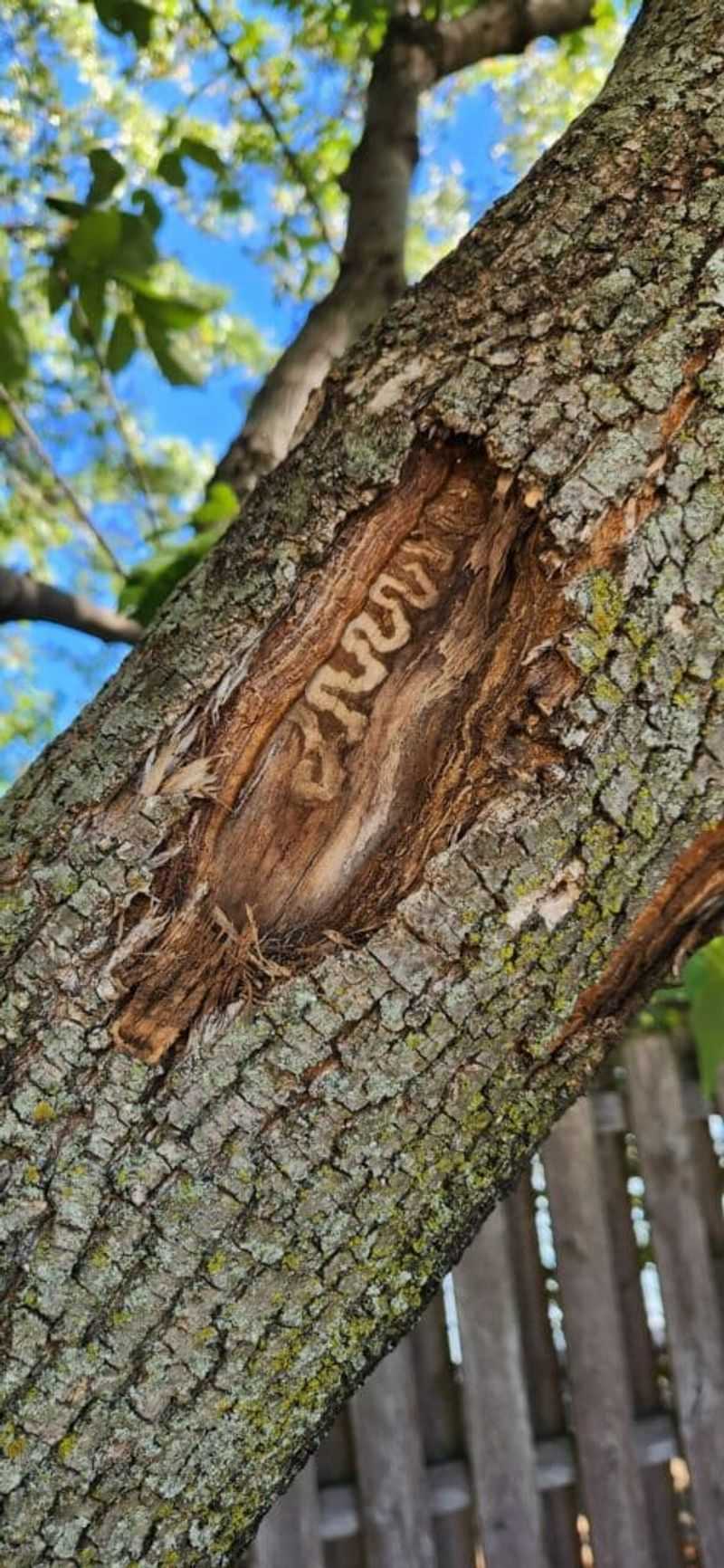
A productive inspection covers the whole tree from the soil line to the outermost branch tips, not just the symptom that first caught your eye. Before you call anyone or reach for a product, spend thirty minutes walking around the tree and recording what you find.
That information will be genuinely useful to any professional you contact later.
Start at the ground. Look for soil disturbance, grade changes, compacted areas, or signs of recent trenching or construction within the root zone, which can extend well beyond the canopy edge.
Wounds from lawn equipment or string trimmers near the base are worth noting because they can serve as entry points for oak-wilt spores. Then move up the trunk and check for bark loss, soft or sunken areas, fresh resin flow, and any crusty gray or silver patches that could indicate Hypoxylon canker.
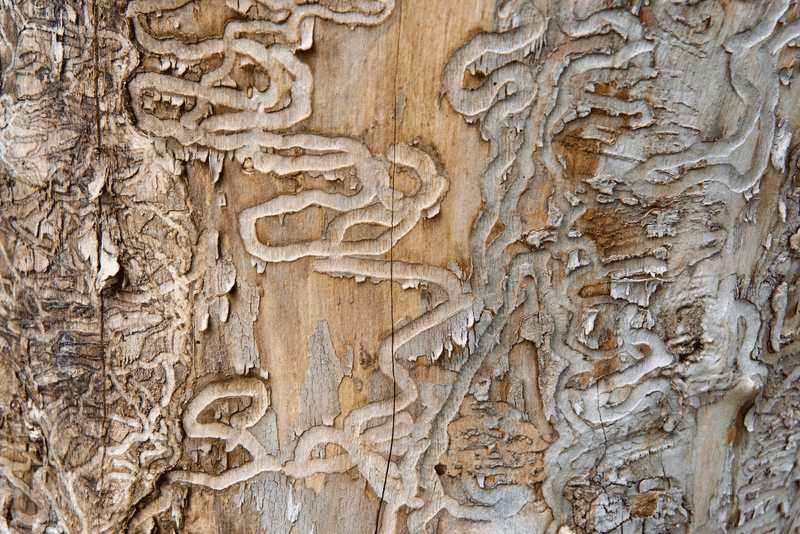
Peel back any loose or separated bark sections. Galleries, the winding tunnels left by borer larvae, look like shallow carved channels in the wood just beneath the bark surface.
Their presence confirms that borer activity occurred, but as AgriLife Extension’s wood-boring insect guide makes clear, galleries in stressed or declining wood do not prove the beetle caused the decline.
Move into the canopy next. Texas Oak Wilt’s identification guide describes live-oak oak-wilt symptoms as including yellow or brown leaf veins, a pattern called vein banding, marginal scorch, and branch-by-branch browning moving through the canopy.
Red oaks may show sudden full-canopy browning or reddening and can decline rapidly. Drought-stressed oaks, as noted in the 2026 Texas A&M Forest Service drought report, may show scorched leaf margins, early leaf drop, and generalized thinning without the specific vein-banding pattern associated with oak wilt.
Write down the tree species, which branches are affected, the direction the decline seems to be moving, any recent drought periods or irrigation gaps, storm damage, pruning, construction nearby, and whether neighboring oaks are also showing symptoms. AgriLife’s Hypoxylon canker guidance also suggests noting whether bark is sloughing and whether the wood beneath looks discolored.
That documented history gives a diagnostician something to work with rather than a single symptom described from memory.
Suspected oak wilt warrants prompt professional assessment
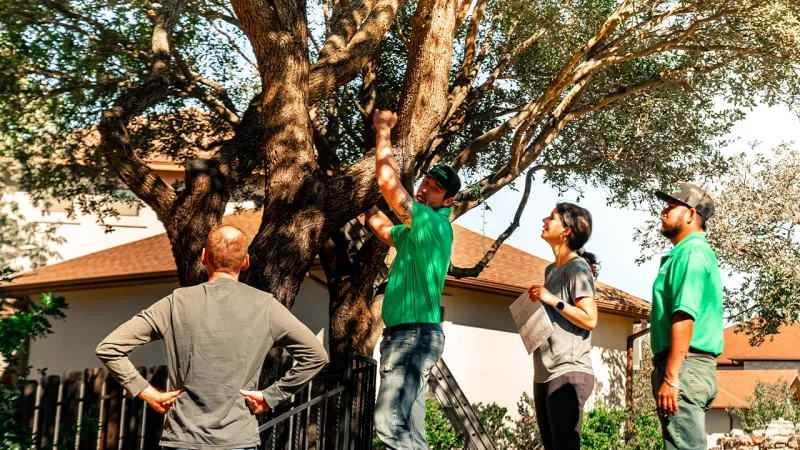
Oak wilt moves through root connections among live oaks and through fresh wounds, which means a single infected tree can threaten others nearby before visible symptoms appear on the neighbors. When multiple connected oaks are declining together, or when a red oak is showing rapid full-canopy browning, getting a qualified professional involved quickly is a reasonable response, not an overreaction.
Texas Oak Wilt’s identification resource notes that red oaks often decline and die within four to six weeks after symptoms first appear, while many live oaks show a slower progression over three to six months, with some persisting longer. Those are general patterns based on observed cases, not a guaranteed timeline for any individual tree.
The takeaway is that waiting several weeks before contacting anyone when a red oak is rapidly browning is a riskier choice than acting promptly.
For live oaks where the pattern is slower or less clear, prompt assessment still matters because laboratory confirmation is often needed to distinguish oak wilt from drought stress, Hypoxylon canker, or borer damage. Symptoms alone are not always enough.
Texas A&M Forest Service’s oak wilt prevention page lists the Texas Plant Disease Diagnostic Laboratory as a resource for confirmation when field diagnosis is uncertain.
Qualified evaluators to contact include Texas A&M Forest Service foresters, county AgriLife Extension agents, Texas Oak Wilt Qualified ISA arborists, and the Texas Plant Disease Diagnostic Laboratory. Each brings a different set of tools and local knowledge, and any of them can help you move from a worrying observation to an informed decision.
One specific concern applies to recently killed red oaks suspected of oak wilt: they may develop fungal mats beneath the bark that can attract sap-feeding beetles, which then carry spores to fresh wounds on nearby trees. Texas Oak Wilt’s pruning FAQ addresses this handling concern directly.
Dead live oaks do not carry the same disease-spread risk, but any dead tree should still be evaluated for structural hazards before deciding whether and how to remove it.
Protect the tree while the diagnosis remains uncertain
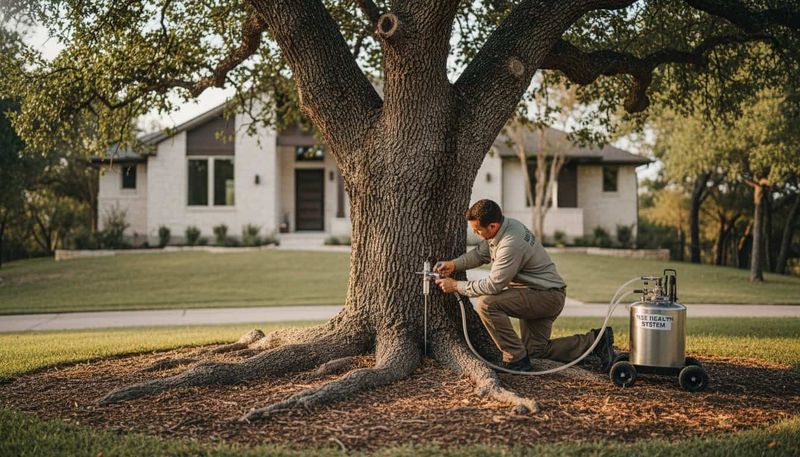
Waiting for a diagnosis does not mean doing nothing. Several low-regret steps can reduce additional stress on a declining oak without requiring certainty about the cause.
None of them will cure oak wilt or eliminate an active borer infestation, but they can stop you from making things worse while you gather better information.
Water is the most immediate lever most homeowners can pull. During drought, mature oaks benefit from slow, deep watering that reaches the full root zone rather than frequent shallow irrigation.
Texas A&M Forest Service’s tree decline guidance identifies adequate moisture as one of the core factors in maintaining tree vigor, and a tree running a water deficit is more vulnerable to secondary problems of every kind. Avoid watering so heavily that soil stays saturated, which creates its own root problems.
Protect the root zone from additional stress. Keep foot traffic, vehicles, and equipment out of the area beneath the canopy.
Avoid any soil grading, trenching, or construction that could sever or compact roots. AgriLife’s Hypoxylon canker fact sheet reinforces that reducing site stress is a meaningful protective measure even when a specific pathogen is involved.
Pruning and wound timing require precision. Texas A&M Forest Service’s oak wilt prevention guidance and Texas Oak Wilt’s pruning FAQ both recommend avoiding pruning or wounding oaks from February through June when possible, because sap-feeding beetle activity and oak-wilt spore availability peak during that period.
Fresh wounds should be painted immediately year-round, not just during high-risk months. Keep wound paint on hand so any cut, storm break, or equipment strike gets sealed before beetles find it.
Emergency pruning for safety reasons takes priority over the seasonal calendar. Texas A&M Forest Service’s emergency tree care guidance acknowledges that safety work sometimes cannot wait.
When that happens, use a qualified professional when feasible and paint wounds immediately after any cut.
Why blanket spraying or premature removal may be inappropriate
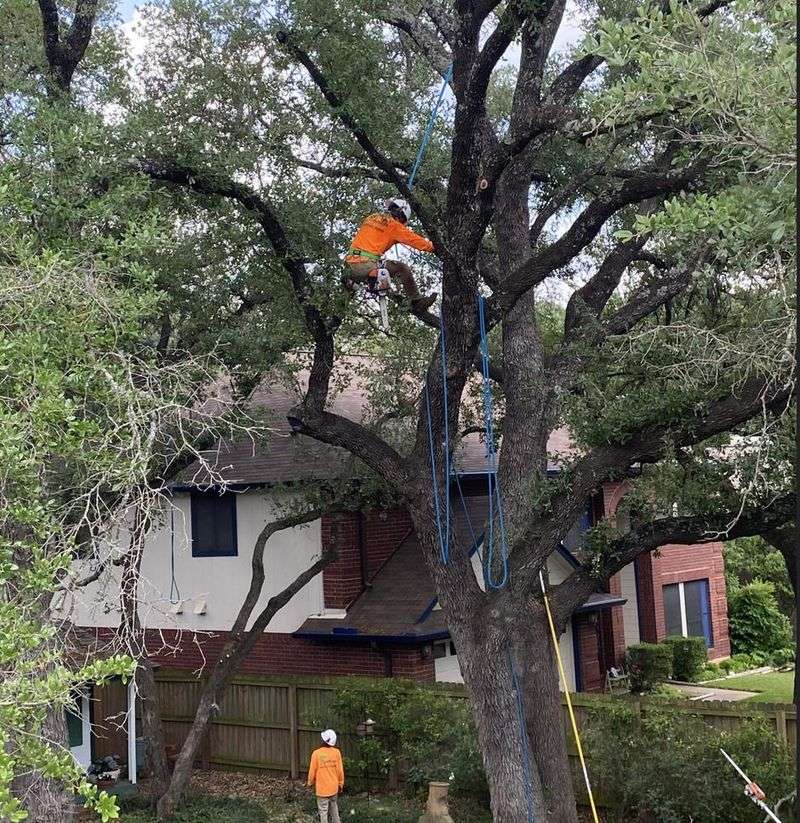
Two overreactions show up repeatedly when homeowners find holes in bark, sawdust near the base, or one beetle crawling on a limb. The first is grabbing an insecticide and spraying the trunk.
The second is calling for the tree to come down immediately. Both decisions can be premature, and either one can cause harm or waste money without solving the actual problem.
Pesticide applications should follow positive identification of the target pest, a confirmed need for treatment, and a labeled product appropriate for that use. EPA pesticide safety guidance is clear that pesticides should be used only for labeled pests and according to label directions.
Bark holes and sawdust can come from several different insects, and applying a product intended for one species may accomplish nothing against another while creating unnecessary chemical exposure in your yard and soil. EPA guidance on selecting a pest control service recommends working with a qualified professional who can make a confirmed identification before any treatment begins.
Removal decisions deserve the same careful approach. AgriLife Extension’s wood-boring insect guide and the U.S.
Forest Service study on borers in oak-wilt-infected Texas trees both point toward borers as secondary participants in many cases. A tree showing borer activity may have been declining for reasons unrelated to the beetle, and removing it does not necessarily address those underlying conditions if other nearby oaks share root connections or face the same stressors.
Removal is appropriate when a tree poses a structural safety hazard, when oak wilt is confirmed and the situation warrants it under professional guidance, or when the tree is clearly beyond recovery. Those decisions should come from a qualified assessment, not from the presence of exit holes alone.
Acting on incomplete information is how homeowners lose trees they could have saved, or spend money treating problems that were never there.
Investigate the oak instead of blaming the beetle
A beetle in the bark is a data point, not a verdict. The two-lined chestnut borer is a real insect that occurs in Texas and can contribute to the decline of weakened oaks, but there is no verified invasive outbreak sweeping through Central Texas this fall.
AgriLife Extension’s wood-boring insect guide consistently frames these beetles as secondary invaders, meaning the tree’s condition before the beetle arrived is usually the more important story.
The practical path this fall is straightforward. Walk the tree, document what you find, note the species, the pattern of decline, any drought gaps, nearby construction, recent wounds, and whether neighboring oaks are struggling.
If oak wilt seems possible, especially in a red oak or where multiple connected trees are declining, contact a Texas A&M Forest Service forester, a county AgriLife Extension agent, a Texas Oak Wilt Qualified ISA arborist, or the Texas Plant Disease Diagnostic Laboratory. Texas Oak Wilt’s identification resource and the 2026 Texas A&M Forest Service drought stress report both reinforce that symptoms need context, not just a quick visual match to a pest photo.
Act this fall with clear eyes: inspect carefully, avoid unnecessary wounding, keep the root zone protected, and get a qualified opinion before spending money on treatments or removal. The oaks worth saving are the ones whose real problem gets identified first.