
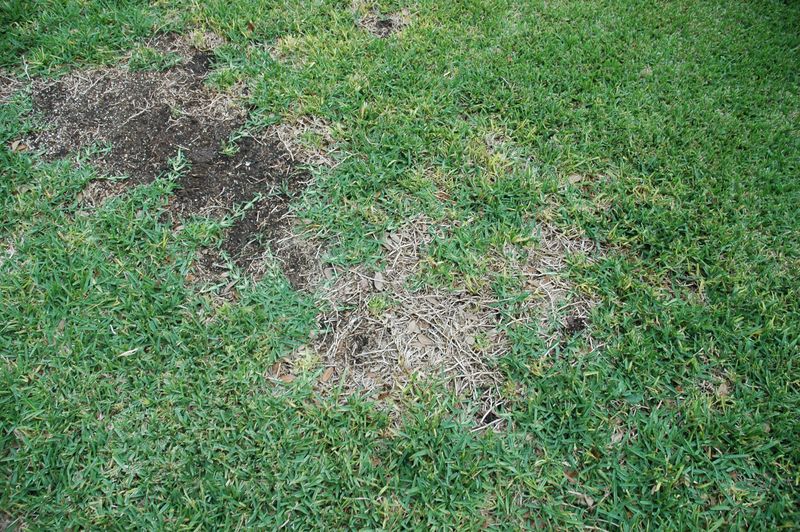
Tan, bronze, or spreading patches in a Central Texas lawn can stop a homeowner cold on a July morning, especially when the grass looked fine just two weeks ago. Those rings may point to take-all root rot, a soil-associated disease that quietly destroys warm-season grass roots before the surface shows any sign of trouble.
But drought stress, chinch bugs, large patch, and a few other problems leave marks that look nearly identical. Checking moisture, inspecting roots, and ruling out look-alikes before you water or spray can save your lawn – and your wallet.
Tan rings are a clue, not a diagnosis
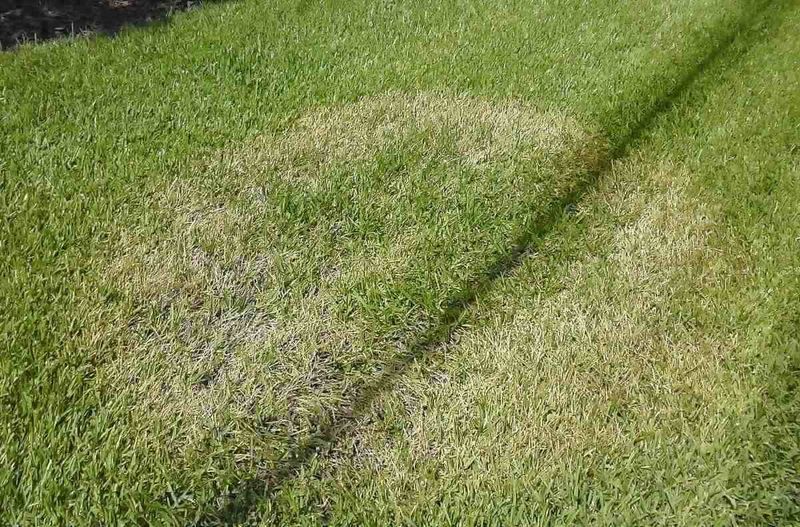
Brown, tan, or bronze rings spreading through a St. Augustinegrass or bermudagrass lawn during a Central Texas summer are worth taking seriously – but they are a starting point for investigation, not a final answer. Texas A&M AgriLife’s take-all root rot guidance notes that the disease is easily mistaken for large patch and chinch-bug injury, two problems that show up in the same grass during the same season.
Overlapping symptoms mean that color and shape alone cannot tell you which problem you have.
Take-all root rot is a credible possibility in Central Texas warm-season lawns, particularly St. Augustinegrass and bermudagrass. Patches may start as yellowing or wilting turf and expand into irregular or roughly circular areas of tan, brown, or bronze grass.
The advancing edge, where living turf meets damaged turf, often holds the most useful clues – but even that zone cannot confirm a diagnosis by sight alone.
Several other common lawn problems produce nearly identical patterns. Drought stress can cause broad browning or dormancy in areas that are not receiving enough water.
Chinch bugs favor hot, dry St. Augustinegrass and create expanding dead zones that look a great deal like root disease damage. Large patch can produce circular or ring-shaped areas with a distinct slimy lesion at the leaf base.
White grubs feed on roots underground and cause irregular dead patches that appear without obvious above-ground warning. Irrigation failures and chemical injury round out the list of credible explanations.
As UC IPM’s lawn disorder diagnostic guidance makes clear, brown patches have many possible causes, and misidentifying the problem leads directly to the wrong treatment. The practical decision in front of you is straightforward: assess moisture, inspect roots at the advancing edge, and screen for insects and large patch before you add water or apply any pesticide.
What take-all root rot does below the turf
Most lawn diseases attack leaves or stems, but take-all root rot works from the ground up. The disease is a soil-associated complex involving multiple organisms – not a single universally responsible fungus – that colonize and destroy the root system of warm-season grasses.
NC State Turf Pathology describes take-all root rot as a complex disease with multiple closely related organisms and genera associated with its symptoms, which is why no single product or amendment reliably cures every case.
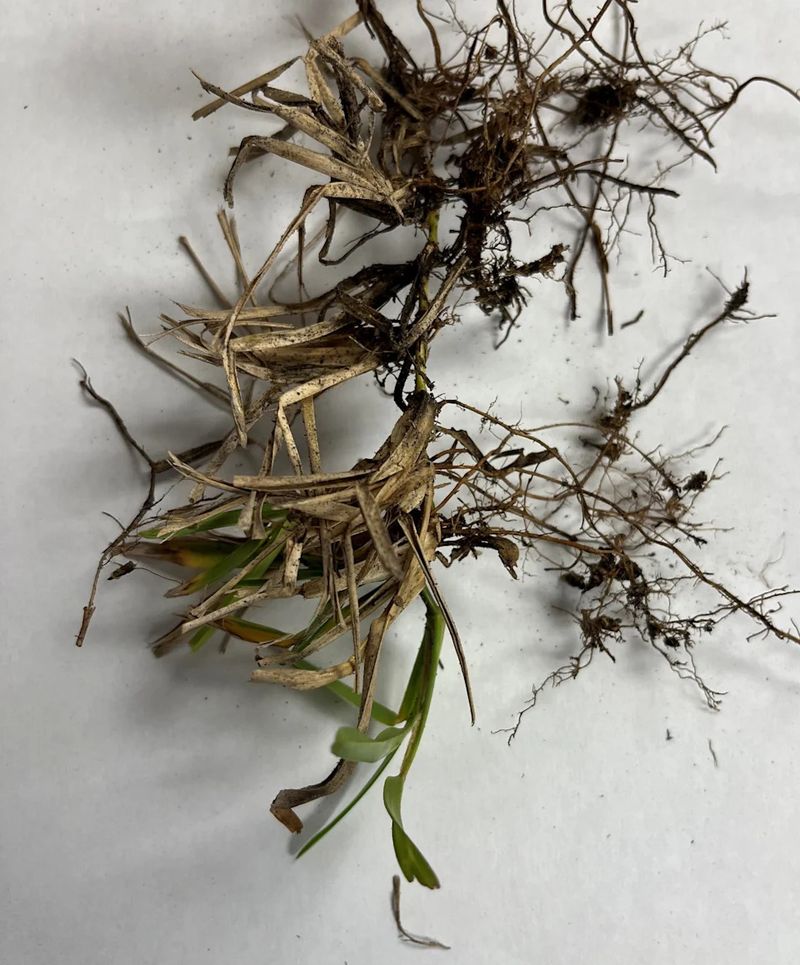
Below the surface, the disease shortens and darkens the roots. Healthy St. Augustinegrass or bermudagrass roots are white or light tan and extend several inches into the soil.
Roots affected by take-all root rot become short, dark brown to black, and rotten. The turf may feel loose or spongy and can sometimes be lifted from the soil with little resistance because the root system holding it in place has decayed.
Research on Gaeumannomyces species associated with take-all root rot in Texas confirms that multiple related organisms have been recovered from symptomatic turf across the state.
Above ground, the progression typically begins with patches of yellowing, chlorotic, or wilted grass. Those areas then brown out and expand, sometimes forming rough circles or irregular shapes ranging from a foot or two across to much larger areas.
The surface appearance can look almost identical to drought stress, which is where many homeowners make their first wrong turn.
Hot, dry Central Texas summers reveal existing root damage rather than cause it. When roots are already compromised, the grass cannot pull enough water from the soil to stay healthy, and the turf collapses under heat stress faster than neighboring plants with intact roots.
The Texas Plant Disease Diagnostic Laboratory explains that drought stress and root disease can occur at the same time, which is exactly why watering more without checking the roots first can be a costly mistake.
Inspect the advancing edge for useful evidence
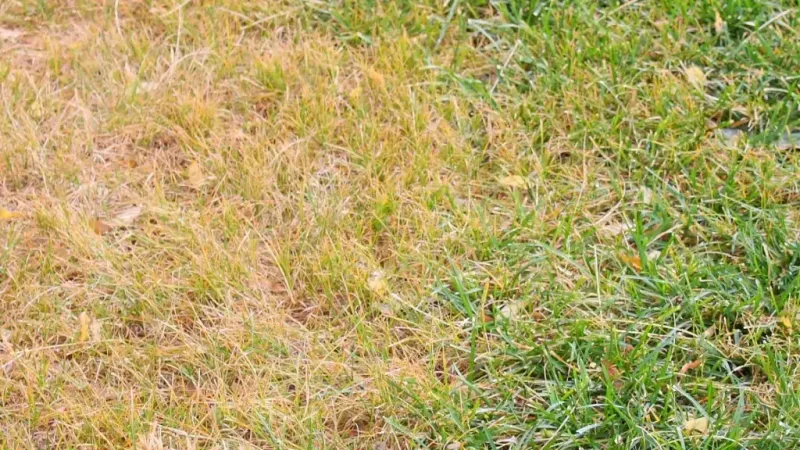
Fully dead grass in the center of a patch tells you very little that is useful for diagnosis. The real information is at the advancing edge, the transition zone where living green turf meets the discolored or damaged area.
That margin is where the disease, insect, or stress condition is most active, and it is where you are most likely to find evidence that points toward one explanation over another.
Start by gently grasping a few stems at the edge of the damaged area and pulling upward with light pressure. Grass affected by take-all root rot often releases from the soil more easily than healthy turf because the roots have rotted away.
Then use a hand trowel or sturdy knife to cut a small plug – about four to six inches deep – from the transition zone. Pull the plug out and compare the roots with a similar plug taken from healthy green turf nearby.
Healthy roots should be white or light tan and extend several inches into the soil profile. Roots supporting a take-all root rot diagnosis will be short, dark brown to black, and soft or rotten, with little of the white healthy tissue you see in the comparison plug.
Keep in mind that this inspection narrows the possibilities rather than closing the case. Short, dark roots are consistent with take-all root rot, but root damage can also follow from other causes including drought, chemical injury, or grub feeding.
Texas A&M AgriLife’s St. Augustinegrass management guidance recommends examining the transition area rather than relying on dead tissue at the center of the patch.
If the root inspection raises your concern level, collecting a proper sample for laboratory testing is the next step. Texas Plant Disease Diagnostic Laboratory sampling instructions direct you to include living symptomatic tissue from the transition zone: leaves, stolons, runners, and roots together.
Do not send only dried, dead grass clippings from the center of the patch – that material is often too far gone to culture or identify. Wrap the fresh sample in dry paper, not plastic, place it in a bag, and submit it promptly to avoid deterioration.
The lab’s FAQ page covers current submission fees, turnaround times, and mailing instructions.
Compare drought, insects, and large patch
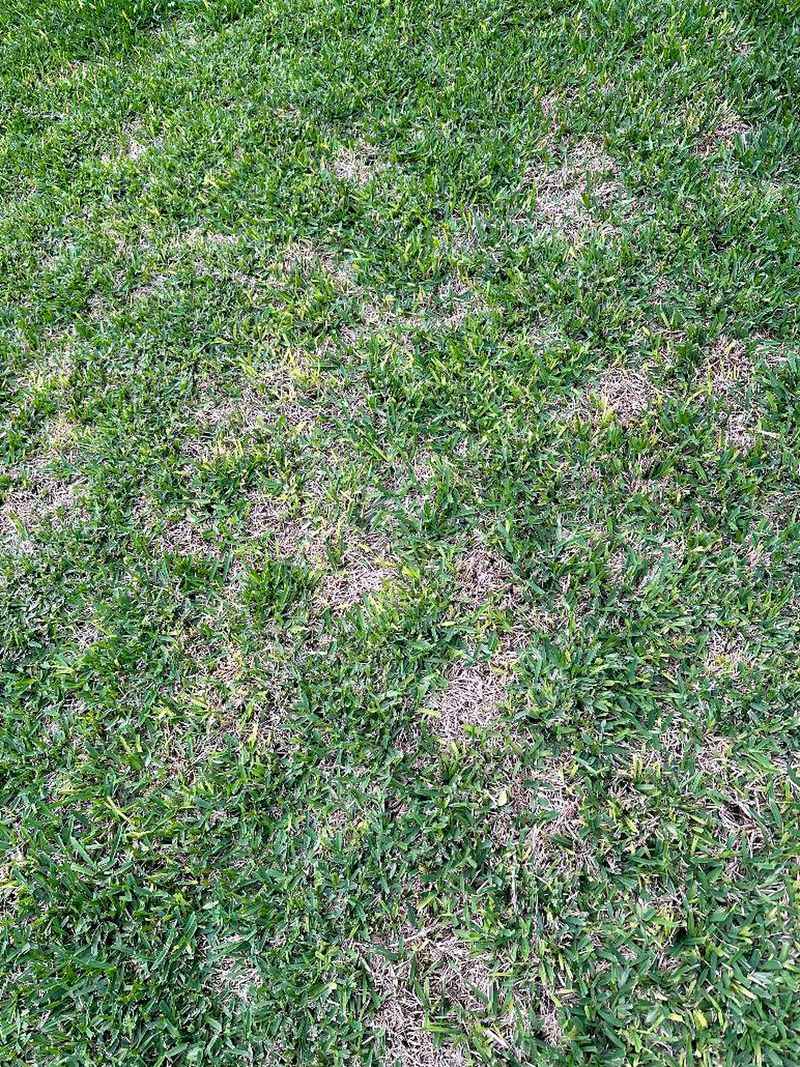
Four problems account for the vast majority of tan, brown, and ring-shaped lawn damage in Central Texas during hot weather: drought stress, chinch bugs, large patch, and white grubs. Each one leaves clues that, taken together, can help you decide what to check next – though none of these clues is a guaranteed identification on its own.
Drought stress usually affects areas that are genuinely not receiving enough water. Look for a blue-gray cast to the turf before it browns, footprints that stay pressed into the grass for several seconds after you walk across it, and damage that tracks with areas your irrigation system may be missing.
Texas A&M AgriLife recommends watering established turf deeply and infrequently – generally one to two times per week during warm weather when the turf actually needs it – rather than automatically adding water every time you see browning. Drought damage tends to recover with appropriate irrigation once the soil dries out; rotten roots do not.
Chinch bugs are a major concern for St. Augustinegrass during hot, dry Central Texas summers. They feed by sucking plant juices and injecting a toxin that causes yellow, then brown, expanding patches that look remarkably similar to root disease.
Texas A&M’s take-all root rot publication recommends a detergent drench to screen for chinch bugs: mix one to two tablespoons of liquid dish detergent in one gallon of water, pour it over about one square yard at the edge of the damaged area, and watch for tiny black-and-white insects emerging from the turf within a few minutes. Confirm their presence before reaching for an insecticide, and use only a product registered for chinch bugs in St. Augustinegrass in Texas, following the complete current label.
Large patch can produce circular or ring-shaped areas that expand outward, sometimes leaving green grass in the center as the outer ring dies. On affected St. Augustinegrass, the leaves pull easily from the stolon and show a slimy, dark lesion at the base – a detail that differs from the root-focused damage pattern expected with take-all root rot.
White grubs feed on roots below the soil surface and create irregular dead patches that may not respond to watering. Texas A&M’s white grub guidance recommends examining several soil sections to confirm grubs are actually present before applying any insecticide, since treating based on symptoms alone wastes money and can harm turf or the surrounding environment.
Check moisture before changing your watering
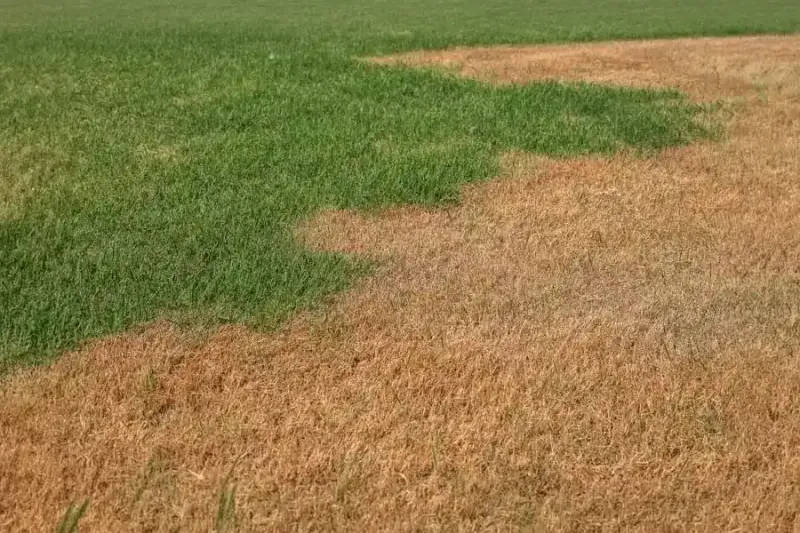
Before you add a single gallon of water to a patchy lawn, spend five minutes checking whether the soil actually needs it. Push a screwdriver or a six-inch wooden dowel into the soil at the edge of the damaged area.
If it slides in easily, the soil has moisture. If it stops at one or two inches, the area is genuinely dry and may benefit from irrigation.
Then check the healthy turf nearby using the same test – a meaningful difference in penetration depth suggests the damaged area is receiving less water than the rest of the lawn.
Walk your irrigation system through a full cycle and watch each zone run. Rotary and spray heads can clog, tilt, or lose pressure over time, leaving dry spots that look identical to disease damage.
Check for heads that are blocked by overgrown grass or shrubs, and look for areas where one zone overlaps another versus areas with obvious gaps in coverage. A single malfunctioning head can create a dry patch that expands week by week in a pattern that mimics a spreading fungal disease.
Texas A&M AgriLife’s St. Augustinegrass lawn management guide recommends watering deeply and infrequently when turf shows signs of actual stress, such as the blue-gray color or slow footprint recovery mentioned in the previous section. Frequent shallow watering keeps the top inch of soil moist and encourages shallow roots, which makes turf more vulnerable to both drought and disease in the long run.
Water can relieve genuine drought stress, but it cannot repair rotten roots or reverse a disease that has already damaged the root system. Increasing irrigation in a lawn with poor drainage or take-all root rot can worsen the conditions that favor disease in the first place.
Texas A&M’s bermudagrass management calendar reinforces the principle of watering based on turf need rather than on a fixed schedule, a habit that pays off regardless of which problem turns out to be responsible for the patches.
Correct the conditions that keep turf weak
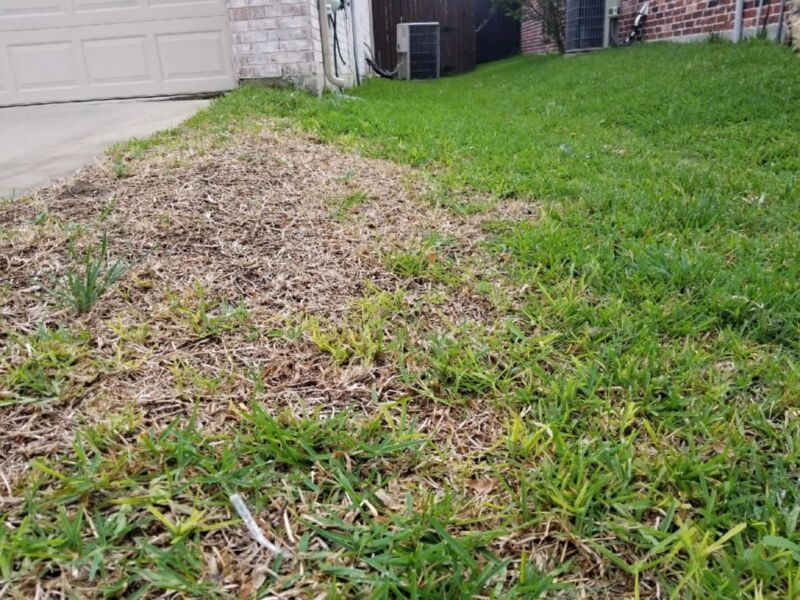
Fungicides and pesticides address symptoms, but the conditions that allow take-all root rot to persist – poor drainage, compaction, excessive thatch, irregular irrigation, and unbalanced fertility – will keep producing weak turf until they are corrected. Cultural practices are the foundation of any lasting recovery, and most of them cost less than a single fungicide application.
Drainage and compaction matter more than most homeowners realize. Water that pools or sits in the root zone after rain or irrigation creates the saturated soil conditions that favor root disease.
Core aeration, typically done in spring or early summer for warm-season grasses, opens compacted soil, improves water movement, and helps roots grow deeper. Thatch – the layer of partially decomposed stems and organic matter between the soil surface and the green canopy – becomes a problem when it exceeds roughly half an inch.
Heavy thatch holds moisture, restricts air movement, and can harbor disease organisms. University of Arkansas Extension’s take-all root rot guidance identifies thatch management as a key cultural step in reducing disease pressure.
Nitrogen fertilization needs to match what the soil and turf actually require. Excessive nitrogen pushes fast, lush top growth that the weakened root system cannot support, and it can worsen disease pressure.
Texas A&M AgriLife’s fertilizing guidance recommends basing applications on a soil test rather than a generic schedule. A soil test also tells you whether your pH needs adjustment – and that matters because take-all root rot is generally associated with higher soil pH.
Many Central Texas soils are naturally alkaline, and some homeowners mistakenly reach for lime when they hear the word pH. Lime raises pH and would worsen conditions associated with the disease.
Texas A&M’s soil testing resource explains how to collect and submit a sample and how to interpret the results before applying any amendment.
Sulfur can lower pH in some situations, but it works slowly in alkaline Texas soils and is not practical in every case. Do not apply sulfur, lime, or corrective fertilizer without a current soil test confirming the need.
Texas A&M’s turfgrass establishment guide notes that soil chemistry in Texas varies significantly by location, which makes testing essential before any corrective action.
Use treatment only after confirmation and label checks
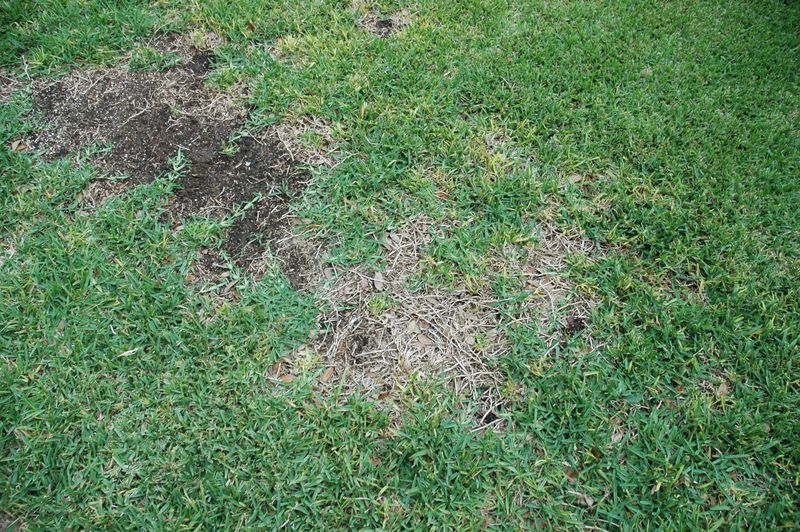
Fungicides are not a reliable cure for take-all root rot damage that is already visible. By the time tan or brown patches appear at the surface, the root system may already be extensively damaged, and applying a fungicide to dead or dying roots will not restore them.
University of Arkansas Extension’s take-all root rot publication states that fungicide efficacy may be questionable or insufficient for control once symptoms are established, and that cultural practices should be the primary management approach.
Some fungicides may help suppress disease activity or protect healthy turf from further infection when applied preventively, before symptoms develop or at the earliest signs of stress. Research on fungicide sensitivity of Gaeumannomyces species in Texas found that many tested isolates showed sensitivity to certain active ingredients in laboratory assays, but the authors explicitly state that field validation is still needed before those findings translate into reliable treatment recommendations.
A laboratory result does not equal a proven field outcome, especially in the variable soils and conditions of Central Texas.
Selecting a product by active ingredient name alone is not safe or sufficient. A given active ingredient may appear in multiple formulations, and not every formulation is registered for every turf species, disease, or site type.
The EPA’s pesticide label guidance is clear: the label is the law. Use only a product registered for the intended use in your state, and follow the complete current label including turf species, disease, site, rate, timing, protective equipment, and any state or local restrictions before mixing or applying anything.
When symptoms overlap or the lawn is large enough to warrant professional confirmation, submit a properly collected sample to the Texas Plant Disease Diagnostic Laboratory. Follow the lab’s sampling instructions and include living symptomatic tissue from the transition zone – leaves, stolons, runners, and roots together – not dried or dead material from the center of the patch.
Your county Extension office can also help interpret symptoms, recommend locally appropriate practices, and connect you with professional resources if the problem persists after cultural corrections are in place.
Check moisture and roots before changing your watering
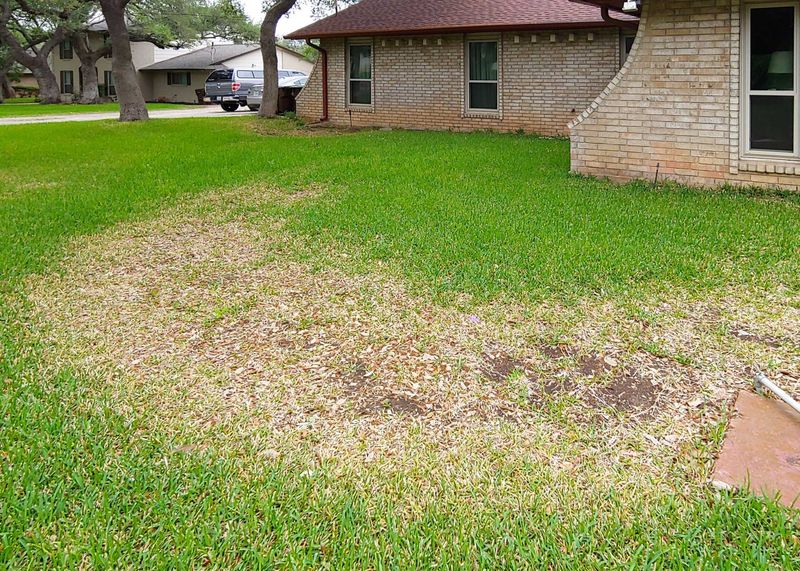
A tan ring in your Central Texas lawn deserves a methodical look, not an immediate reaction. Start by identifying your grass – St. Augustinegrass and bermudagrass are the most common warm-season turf types in the region and both are susceptible to take-all root rot.
Then check actual soil moisture and run your irrigation system through a full cycle to confirm coverage before assuming the patches need more water.
Move to the advancing edge of the damaged area and inspect the roots. Short, dark brown to black, rotten roots support take-all root rot as a possibility, but they do not rule out grub damage, drought, or chemical injury.
Screen for chinch bugs with a detergent drench and look at the base of leaves for the slimy lesions associated with large patch. Texas A&M AgriLife’s take-all root rot publication and the Texas Plant Disease Diagnostic Laboratory’s sampling guide are your two most useful regional resources when the answer is not clear from the yard alone.
Color and shape are a starting point. Roots, moisture, and competing explanations are what actually determine whether you water, treat, renovate, or call for professional help – and getting that sequence right is what gives your lawn the best chance of recovering.