
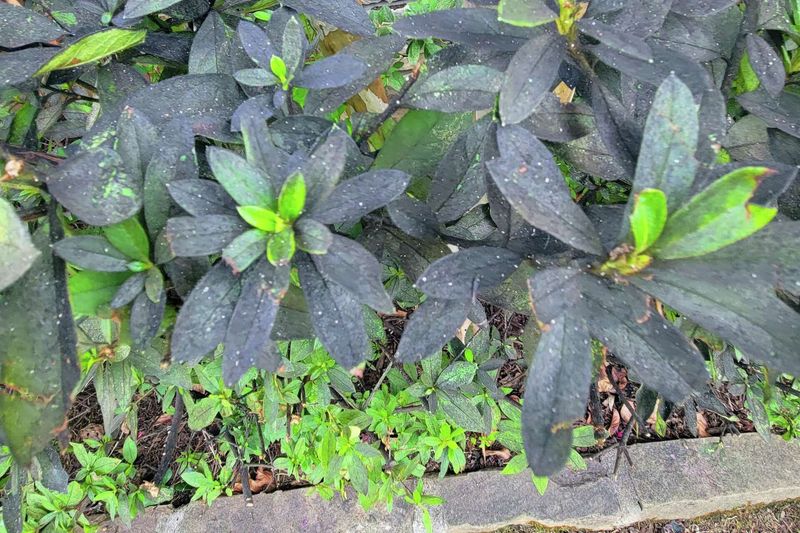
If your crape myrtle leaves are coated in black and the branches feel sticky to the touch, you are not alone – this is one of the most common summer complaints from North Carolina homeowners. The black coating is almost always sooty mold, a fungus that grows on sugary honeydew left behind by sap-feeding insects.
Getting rid of the mess means targeting the insects producing that honeydew, then cleaning up what they left behind. Understanding the two-step process makes the difference between a tree that recovers and one that keeps getting worse.
Black, sticky foliage usually signals a honeydew problem
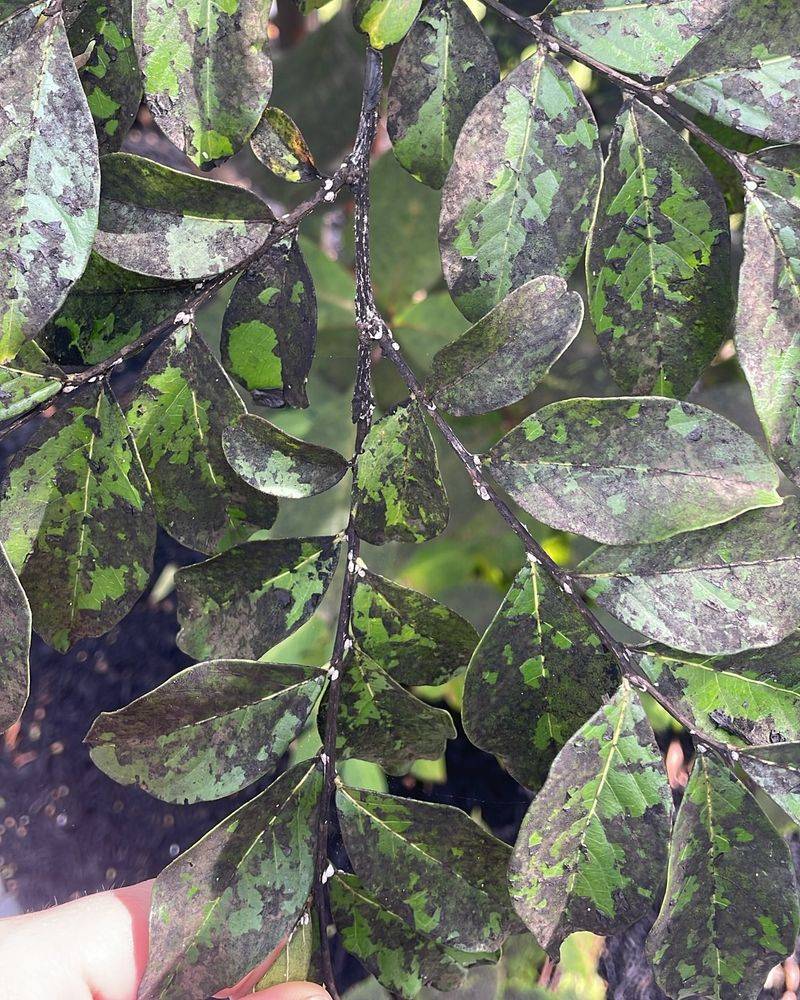
Sooty mold is not a disease that attacks plant tissue from the inside. According to UC IPM’s sooty mold guidance, the fungus grows on the surface of leaves and stems, feeding on the sugary honeydew that sap-sucking insects excrete as waste.
On crape myrtles in North Carolina, the most common culprit is the crape myrtle aphid, though scale insects, whiteflies, and mealybugs can also flood a tree with honeydew during a hot summer.
The stickiness readers notice on leaves, branches, patio furniture, and car hoods comes directly from that honeydew dripping down from wherever insects are feeding above. Once the sugary film coats a surface, airborne sooty mold spores land and colonize it quickly.
The result is the black, grimy layer that looks alarming but is technically sitting on top of the plant rather than growing through it.
Most cases of sooty mold are primarily a cosmetic problem. The tree is not being directly infected.
However, NC State Extension’s pest guide for crape myrtles notes that heavy aphid feeding and the resulting mold can reduce the amount of light reaching leaves, which can cut into photosynthesis and gradually reduce the tree’s vigor over a season.
The practical takeaway is that spraying the mold itself accomplishes very little. Fungicide is not a broadly useful solution here because the mold will return as long as insects keep producing honeydew.
The real target is the insect population feeding on the tree. Reduce the honeydew source, and the mold stops spreading.
University of Minnesota Extension’s aphid resource confirms that honeydew can drip onto any surface below an active infestation, which explains why patios, sidewalks, and parked cars end up in the mess too.
Wiping the leaf can point toward a surface coating
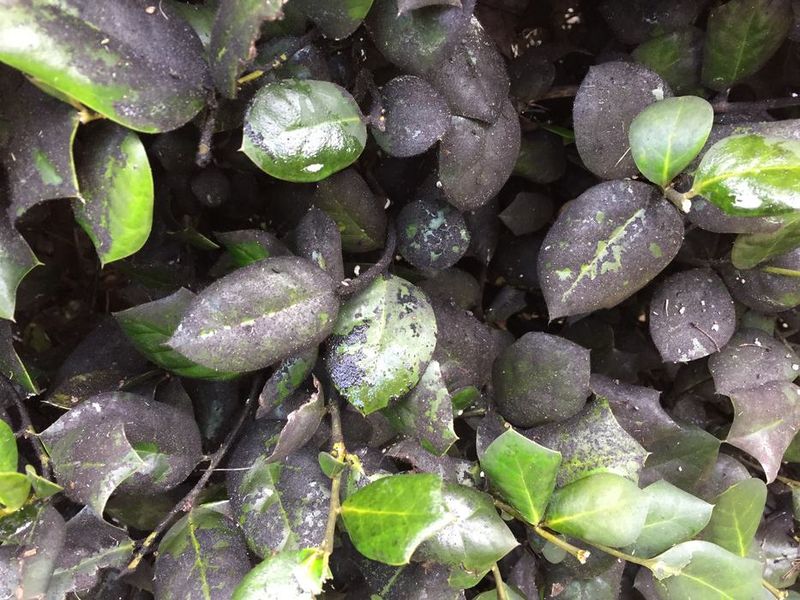
A quick finger test or a swipe with a damp cloth gives you useful information before you spend money on any product. Run your finger across a blackened leaf or press a moistened cloth against the surface.
If the dark material smears or transfers onto your finger or cloth, you are most likely looking at a removable sooty mold coating sitting on top of the leaf rather than damage that has worked its way into the tissue.
University of Georgia Cooperative Extension’s crape myrtle culture guide describes this kind of surface coating as distinct from embedded leaf disease. When spots stay fixed in the tissue, show yellow halos around dark centers, or are accompanied by progressive yellowing and early leaf drop, the problem may be something other than sooty mold.
Cercospora leaf spot, for example, causes dark spots and premature defoliation during warm, humid weather, and it does not wipe away.
The wipe test is a helpful starting point, not a complete diagnosis. A coating that comes off on your cloth supports the sooty mold explanation, but it does not tell you which insect is producing the honeydew, how severe the infestation is, or whether the tree has other problems developing at the same time.
Think of it as narrowing the field rather than closing the case.
If the black material does not wipe off at all, or if you notice embedded spots, distorted new growth, significant yellowing, or a pattern of leaves dropping well ahead of fall, those are signals to look more carefully and possibly consult your local NC State Cooperative Extension office for a broader diagnosis. Sooty mold is common, but it is not the only reason crape myrtle foliage can turn dark.
Inspect leaves for aphids and bark for scale
Once you suspect sooty mold, the next step is finding out which insect is behind the honeydew. Start by flipping a few leaves over.
Crape myrtle aphids are small, pale yellowish-green insects that cluster on the undersides of leaves and on tender new growth. NC State Extension’s crape myrtle pest publication identifies these aphids as a primary honeydew producer on the tree, capable of generating enough sticky waste during a summer season to coat leaves, branches, and everything below the canopy.
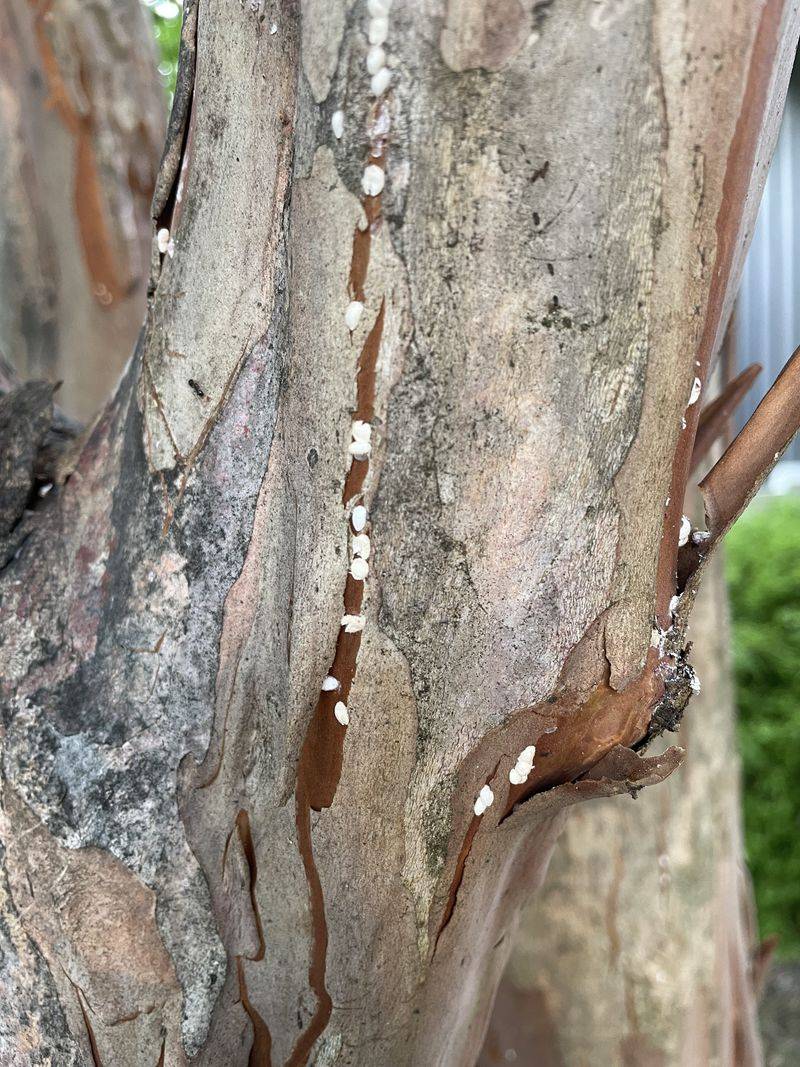
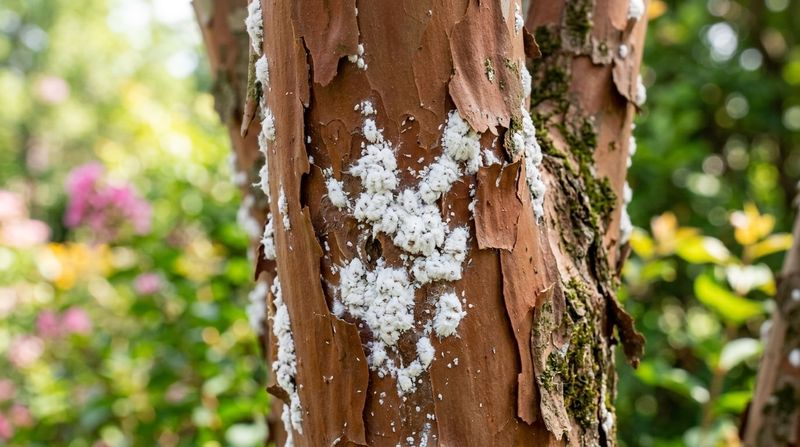
After checking the leaves, shift your attention to the trunk and main branches. Crapemyrtle bark scale appears as white to gray waxy or cottony material pressed against the bark, often concentrated in branch crotches and rough bark areas.
This pest is established in North Carolina and should be considered a real possibility, especially when blackening is heaviest on the trunk and branches rather than on the leaves. NC State’s bark scale management publication for nurseries notes that heavy infestations can weaken trees, reduce flowering, and cause dieback over time.
Aphids and bark scale are separate problems that require separate approaches. Do not treat them as the same pest just because both produce honeydew and both lead to sooty mold.
NC State’s dedicated crapemyrtle bark scale page provides specific guidance for managing that pest on established landscape trees, which differs from aphid management in important ways, particularly around timing.
Ants are another clue worth following. If you notice trails of ants moving up and down the trunk or across branches, they are almost certainly harvesting honeydew.
Ants sometimes actively protect aphids and scale insects from their natural predators, which can allow infestations to grow larger than they otherwise would. The ants are not producing the honeydew themselves – they are benefiting from it.
UC IPM’s sooty mold resource notes that ant activity is a reliable sign that honeydew-producing insects are present and active somewhere on the plant above.
Use water as a low-impact first response
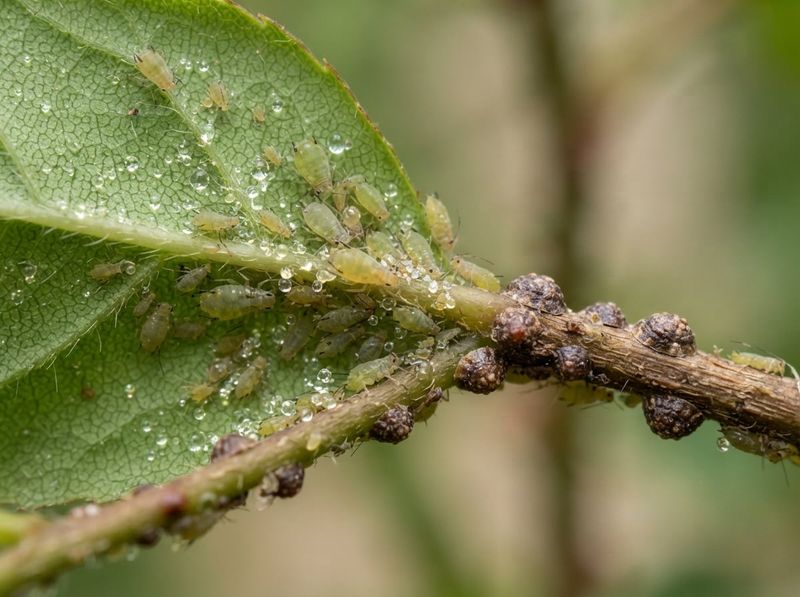
For an active aphid infestation, a firm stream of water from a garden hose is often the first and most sensible response. Aim the spray at the undersides of leaves where aphids cluster, working through the canopy methodically.
University of Minnesota Extension’s aphid guide confirms that a strong water stream can knock aphids off foliage and also rinse away some of the honeydew and visible sooty mold at the same time. Two benefits from one action, without any chemical involved.
Keep the pressure firm but not so aggressive that you shred tender new growth or break small branches. Early morning is a good time for this task because it allows foliage to dry before evening, which reduces conditions favorable to other fungal issues.
Repeat the treatment over several days if aphid numbers are high, since a single rinse rarely removes every insect.
Water alone cannot permanently solve an active infestation. Aphids that remain on the tree or migrate back from nearby plants will continue producing honeydew, and sooty mold will continue to grow wherever that honeydew lands.
Think of the hose as a way to reduce the immediate pest load and wash away some of the visible mess, not as a standalone cure. UC IPM notes that managing sooty mold requires reducing the honeydew-producing insect population, not just rinsing the surface.
If a branch or section of the tree is heavily infested and practical to remove without harming the tree’s structure, careful pruning of that portion can reduce the pest load. Avoid treating severe pruning as a default response to any pest problem – cutting back large portions of a crape myrtle does more harm than good in most situations and does not address the underlying infestation.
Remove only what makes sense given the tree’s size, shape, and the location of the heaviest pest concentration.
Treat the identified pest with a labeled product
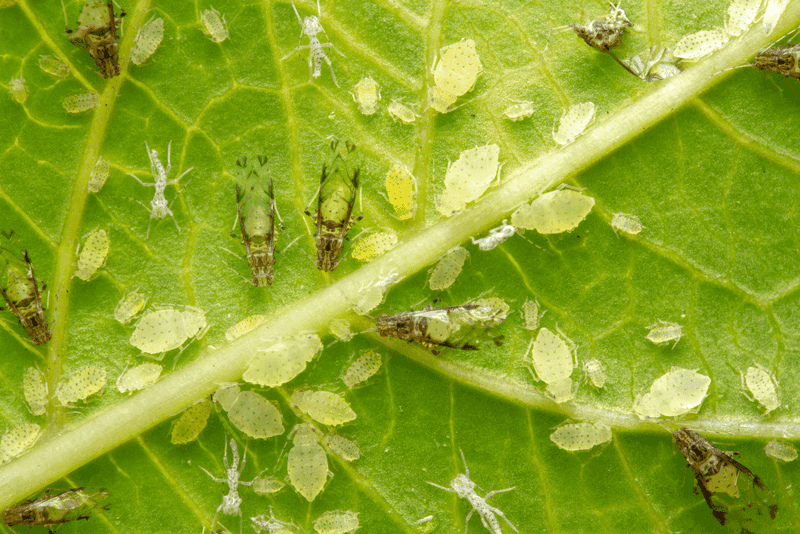
When water and physical removal are not enough to bring the pest population down, a commercially labeled insecticidal soap or horticultural oil may be appropriate for the specific plant and pest you have identified. NC State Extension’s biological control guide for home gardeners explains that these contact products work by directly coating the pest, which means thorough application coverage is essential.
Spraying only the tops of leaves while skipping the undersides – where aphids actually feed – leaves most of the infestation untouched.
For aphids, coat leaf undersides, tender shoot tips, and any bark surfaces where you have seen insect activity. Work slowly and completely.
A rushed, partial application wastes product and may not meaningfully reduce the pest population. Follow the label for the correct dilution rate, application interval, and any restrictions around temperature or plant condition.
Do not substitute household dish soap for a labeled insecticidal soap product. NC State distinguishes these clearly: ordinary dish detergents can damage plant tissue, especially during heat or drought stress, and they are not formulated or tested for this use.
Bark scale requires a different timing strategy. NC State’s crapemyrtle bark scale resource identifies newly hatched crawlers as the most vulnerable life stage and points to late spring and late summer as important residential treatment windows.
Waxy adult scale coverings are harder to penetrate, so targeting the crawler stage with horticultural oil or soap gives you the best chance of meaningful control. If you miss the crawler window, results from contact sprays will be less predictable.
NC State’s organic gardening handbook chapter makes a point that applies to every product in this category: natural or organic does not mean automatically harmless. Insecticidal soaps and horticultural oils can injure plants if applied at the wrong rate, in the wrong weather, or to a tree already stressed by heat or drought.
NC State’s pesticide safety appendix requires following the product label as a legal and practical baseline. Never apply any pesticide to blooming flowers or when pollinators are actively foraging, and take steps to prevent spray drift onto non-target plants, surfaces, or water.
Protect natural enemies and pollinators
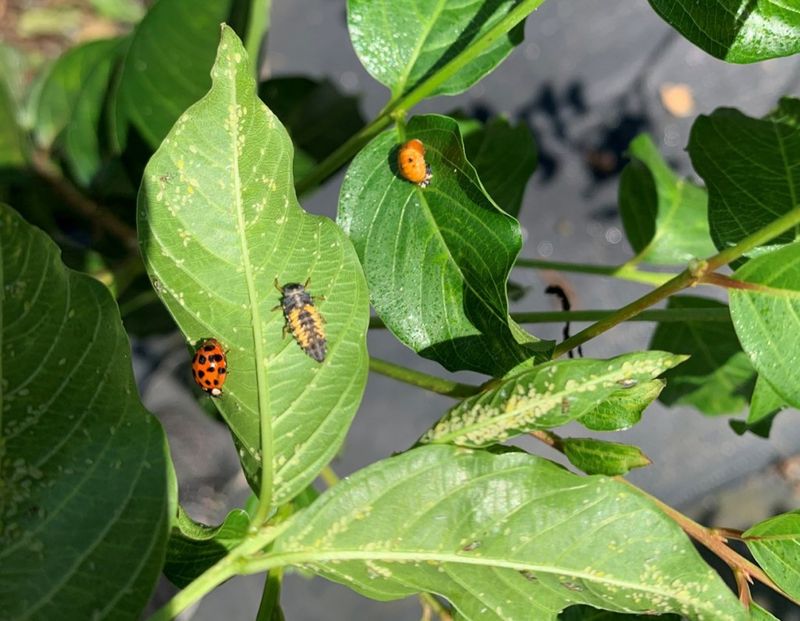
Before reaching for any insecticide, spend a few minutes looking at the insects already on your crape myrtle. Lady beetles, lacewings, syrphid fly larvae, and parasitic wasps all feed on aphids and can significantly reduce a population on their own when given the chance.
NC State Extension’s biological control guide explains that these natural enemies are often present in home landscapes and provide meaningful pest suppression without any product cost or application risk.
Reaching for a broad-spectrum insecticide before checking for beneficial insects can remove the very organisms that would otherwise bring the aphid infestation under control. Once natural enemies are killed off, aphid populations can rebound rapidly with less biological resistance.
This is one reason why restraint in pesticide use often produces better long-term results on ornamental trees than aggressive spraying.
NC State Entomology’s crape myrtle aphid page specifically flags that pyrethroid insecticides used in mosquito-abatement spraying can kill natural enemies and contribute to aphid outbreaks on nearby plants. This is a documented risk pattern, not a guarantee that every mosquito spray in a neighborhood causes a crape myrtle aphid problem – but it is a real consideration for homeowners who notice aphid flare-ups following broad-spectrum applications in or around their yard.
Pollinator protection deserves equal attention. EPA guidance on protecting pollinators emphasizes avoiding pesticide applications to blooming plants or when bees and other foraging insects are active.
Crape myrtles bloom heavily through summer, which is exactly when aphid pressure peaks in North Carolina. If treatment is necessary, apply products in the early morning or evening when pollinators are less active, and never spray open flowers directly.
NC State’s pesticide safety guidelines also require preventing drift onto adjacent plants and water bodies, accounting for heat and drought stress that can increase the chance of plant injury, and reading the full label before every application. NC State’s organic gardening chapter reinforces that no product category, including organics, comes with a blanket safety guarantee.
Clean the soot after honeydew production declines
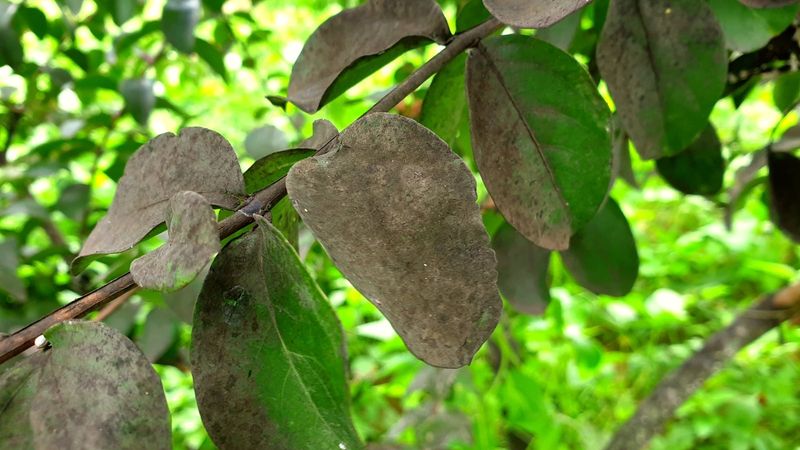
Cleanup makes the most sense after you have addressed the pest, not before. Washing away sooty mold while active insects continue producing honeydew is a temporary improvement at best – the mold will return as fast as you remove it.
Once the pest population has declined and honeydew production slows, the remaining soot and sticky residue become much easier to manage. UC IPM’s sooty mold guidance explains that mold will naturally decline and can be washed away once the honeydew source is gone.
For the tree itself, a firm stream of water from a garden hose is usually enough to rinse away loosened sooty mold from leaves and branches over a few sessions. Do not expect every trace to disappear immediately.
Residue that has been sitting on bark for weeks may take more than one rinse to fully dislodge, and some previously coated leaves may still yellow or drop even after the mold is gone. That is a normal part of recovery, not a sign that the treatment failed.
Patios, sidewalks, and outdoor furniture can typically be cleaned with water and, where appropriate, a mild soap solution. For cars and other painted surfaces, University of Minnesota Extension’s aphid resource recommends testing any detergent or tar-removal product on a small, inconspicuous area before applying it broadly.
Stronger cleaners can damage automotive paint or clear coats, so a cautious test patch first saves a costly mistake.
Nearby plants that collected honeydew drip can also be rinsed with water. Check them for their own pest activity as well, since aphids and other honeydew producers sometimes spread to adjacent plants during a heavy infestation season.
Break the cycle instead of chasing one perfect spray
Recovering from a sooty mold problem on a crape myrtle follows a sequence, not a single product. Start with the wipe test to determine whether the coating is a removable surface residue or something embedded in the leaf tissue.
Then inspect leaf undersides for aphids and trunks and branches for the white or gray waxy material of crapemyrtle bark scale. Identify which pest is present before choosing any response.
From there, reduce the active pest population using the least disruptive approach that fits the situation – water first, then a commercially labeled soap or oil if needed, always with full label compliance and pollinator awareness. Protect the natural enemies already working in your yard by avoiding broad-spectrum products unless the situation clearly calls for them.
NC State Extension’s crape myrtle pest guide supports this stepped approach over reactive blanket spraying.
Seek further help if the coating does not wipe away, if you see embedded spots with yellow halos, if significant early leaf drop develops, or if bark scale persists and the tree shows signs of declining health. Your local NC State Cooperative Extension office can help with a more specific diagnosis.
UGA Cooperative Extension’s crape myrtle culture guide also distinguishes sooty mold from other conditions that require different management entirely.
Once honeydew production drops, UC IPM confirms that existing sooty mold gradually dries and can be washed away. Stop the honeydew, and you stop feeding the mold – that is the cycle worth breaking.