
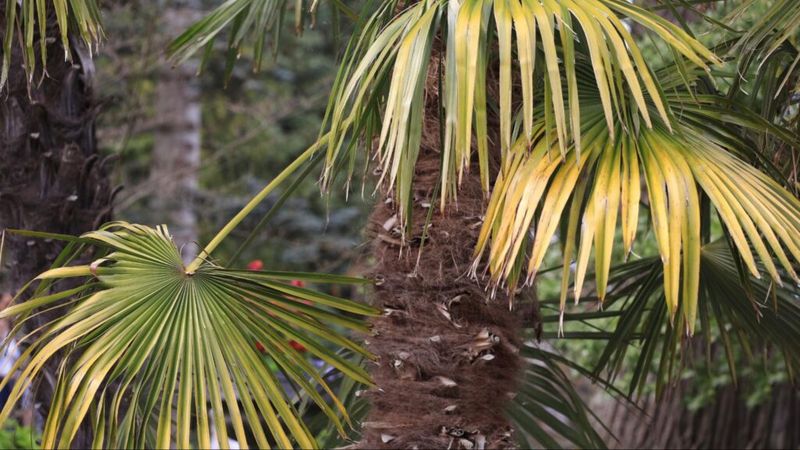
Look up at almost any Florida cabbage palm and you’ll notice a rough, almost armored texture covering the trunk. Those jagged ridges aren’t damaged bark or signs of a sick tree.
They’re old leaf bases, called boots, and understanding what they are can save you from making a common and costly mistake in your yard. Knowing when to leave them alone and when a little cleanup is safe puts you firmly in control of your palm’s health.
Palm boots are old leaf bases, not bark or junk
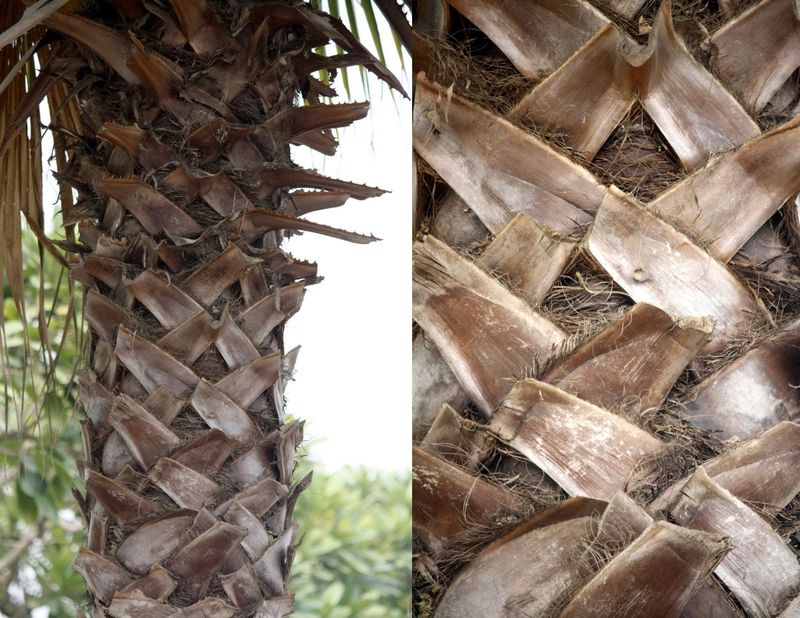
Every palm leaf you see growing from the top of a trunk is anchored through a wide, flared base called a leaf base or petiole base. When that leaf eventually dies or gets cut off, the base doesn’t just fall away cleanly like a deciduous tree leaf would.
Instead, it stays wrapped around the trunk, drying and hardening into what most Florida homeowners recognize as the rough, almost corky texture that gives cabbage palms their distinctive look.
According to UF/IFAS guidance on palm leaf structure, each palm frond attaches to the trunk through this enlarged base, and in many species those bases remain after the frond is gone, stacking up over time into a patterned or skirt-like covering. The result can look like layered scales, rough bark, or even a woven texture depending on the species and how many years of growth have accumulated.
A rough trunk does not automatically signal neglect, poor maintenance, or a struggling tree. As UF/IFAS research on normal palm abnormalities makes clear, retained boots are a normal structural feature, not evidence that something went wrong.
Some palms with perfectly smooth trunks simply had their boots removed manually at some point, which says nothing about whether the tree is healthier than a booted neighbor standing beside it.
Thinking of boots as junk or overgrowth is the first misunderstanding that leads Florida homeowners toward unnecessary and sometimes damaging cleanup. The rough material is part of the palm, not something attached to it from outside.
Species and age determine whether a palm keeps its boots
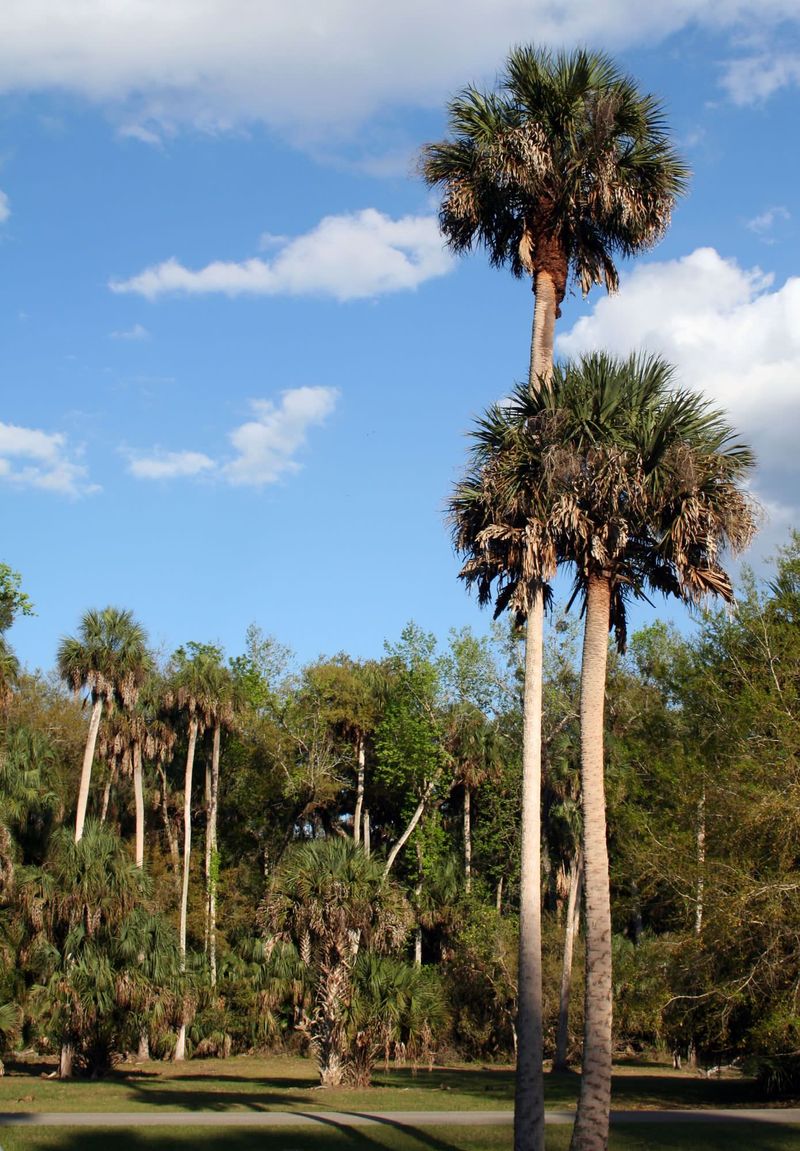
Not every palm in your yard behaves the same way when it comes to shedding old leaf bases, and that difference is mostly written into the tree’s genetics and species identity rather than how well it’s been maintained. Florida’s most iconic native palm, the cabbage palm (Sabal palmetto), is a good example of the retaining end of the spectrum.
UF/IFAS documentation on normal palm abnormalities notes that some cabbage palms hold their boots for many years or even decades, while others on the same street shed them naturally over time. That difference may come down to genetics within the species, or it may reflect whether the boots were manually removed early in the tree’s life.
Once boots are stripped, the palm often loses the ability to retain new ones in the same pattern.
Mexican fan palms (Washingtonia robusta) follow a different arc. Young specimens typically hold onto old leaf bases and may develop a shaggy skirt of hanging dead fronds, but many become largely self-cleaning as they mature, often around 30 feet tall or after roughly 10 to 15 years of Florida growth.
The transition happens gradually, so a young Mexican fan palm covered in old material is not necessarily a problem waiting to be fixed.
Crownshaft palms, including royal palms and many queen palms, operate differently still. Their smooth, often green or silvery crownshaft naturally releases old fronds cleanly, so retained boots are rarely a concern with those species.
UF/IFAS guidance on ornamental palms for South Florida reinforces that leaf retention and shedding patterns vary meaningfully across species, which is why identifying your palm before deciding on any cleanup is a genuinely useful first step.
A smooth trunk tells you the palm either sheds naturally or had its boots removed at some point. It does not tell you the tree is thriving compared to a booted one nearby.
Leave a firmly attached boot alone
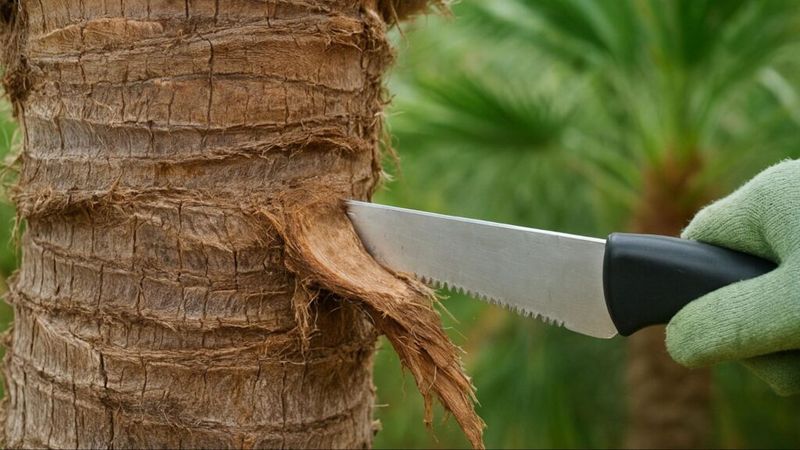
The single most useful rule for any Florida homeowner standing next to a booted palm is straightforward: if the material doesn’t come away on its own, leave it where it is. Firmly attached boots are not a cosmetic problem requiring a fix.
They are part of the trunk, and pulling or cutting them away can cause real, lasting damage.
When you tug hard on a boot that isn’t ready to release, you risk tearing away a strip of living trunk tissue along with it. Palm trunks do not heal the way a hardwood tree’s bark does.
A wound in the trunk stays open, and that opening can allow rot organisms to enter and work their way through tissue that has no practical way to compartmentalize the damage. UF/IFAS palm pruning standards are direct on this point: attached material should not be forcibly removed, and any cutting or gouging into trunk tissue should be avoided entirely.
The practical test is simple. Grasp the boot or dead frond base and apply gentle, steady pressure in the natural direction it would fall.
If it releases cleanly without tearing or resistance, it has already exfoliated enough that removing it for appearance or clearance is reasonable. If it holds, walk away.
That resistance is the palm telling you the base is still connected to living tissue.
Some landscape contracts and nursery operations do remove naturally exfoliating boots as part of installation or routine maintenance. That practice is not inherently wrong when the material is already loose.
The critical line is whether removal requires force. UF/IFAS research on regenerated sabal palms notes that for transplanted or stressed palms especially, retained bases can help reduce moisture loss from the trunk during establishment, adding another reason to leave attached material in place on recently moved trees.
Wanting a smoother trunk is understandable, but the palm’s long-term health is worth more than a tidier silhouette.
Prune completely dead fronds, not a living canopy
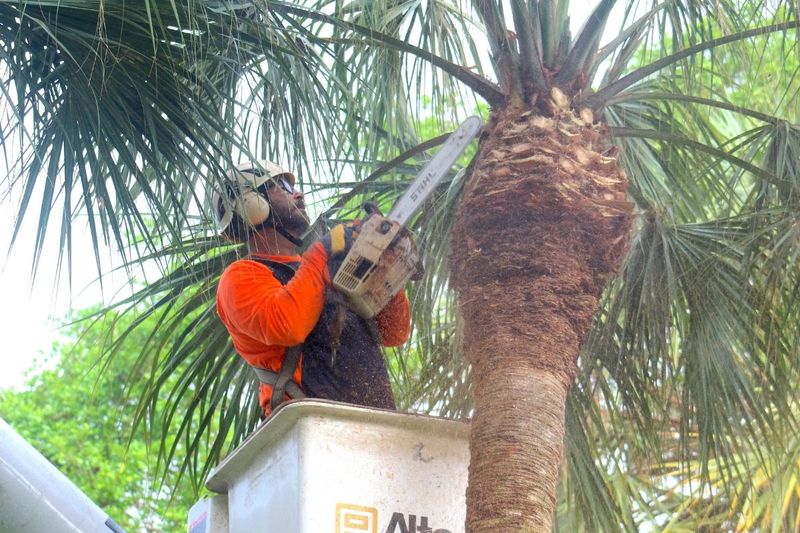
Boots and dead fronds are related but separate decisions. A boot is what remains after a frond is already gone.
A dead frond is the whole leaf, still hanging from the canopy or pressed against the trunk, that has turned completely brown. Removing a fully dead frond is reasonable routine maintenance.
Everything else in the canopy generally deserves a closer look before any tool comes out.
The guiding rule from UF/IFAS palm pruning guidance is to remove only completely dead fronds. Green fronds are actively photosynthesizing and feeding the tree.
Partly yellow or browning fronds may still be contributing nutrients, and removing them prematurely cuts off a resource the palm is still using. Persistent discoloration that lingers for weeks or months, rather than the rapid green-to-brown transition of normal senescence, can indicate a potassium deficiency or another nutritional problem.
Pruning those fronds away before getting a diagnosis removes the symptom without addressing the cause.
When a frond is completely dead and ready to come off, cut close to the trunk without cutting into it. Leave a short stub rather than flush-cutting into trunk tissue, and never gouge or chisel out the boot that remains.
A machete, chainsaw, or any tool used to scrape or cut the trunk surface creates the same wound risk as forcibly pulling a boot.
One of the most common and harmful practices in Florida is the “hurricane cut,” where most of the canopy is removed before storm season on the theory that a bare palm is more wind-resistant. UF/IFAS pruning standards describe this as harmful: severely pruned palms can have reduced vigor, and overpruned trees may actually perform worse in high winds, not better.
A useful visual benchmark is to retain all fronds that fall within the 9-o’clock-to-3-o’clock arc of the canopy. Fronds above the horizontal plane should stay.
Palms with documented nutritional sensitivities, such as queen palms and some date palms, are particularly vulnerable to over-pruning because they cannot recover lost canopy area the way branching trees can. When in doubt, leave the frond and get a second opinion from a certified arborist or UF/IFAS extension agent before cutting.
Inspect the palm and its surroundings before cleanup
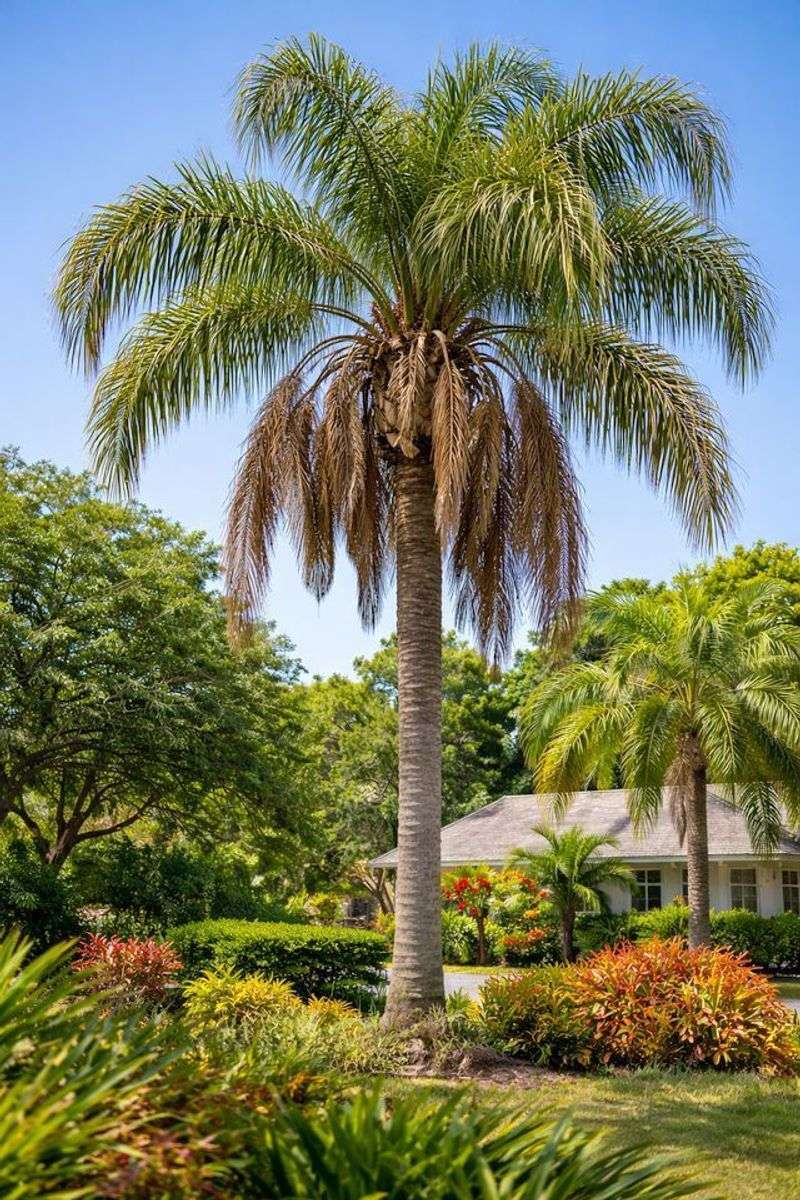
Before touching anything on a palm, a ground-level inspection takes only a few minutes and can prevent both unnecessary work and accidental damage. Start by trying to identify the species if you can.
Knowing whether you have a cabbage palm, a Mexican fan palm, or a crownshaft species helps you understand what the trunk is supposed to look like and whether any retained material is normal for that tree.
Next, scan the canopy for fronds that are completely brown all the way to the base, not just tipped or partly discolored. Those are the only candidates for routine homeowner pruning.
Then look at the trunk itself. Run your hand along the boots at a reachable height and note whether any material shifts or releases with very light pressure.
Anything that holds firm stays. UF/IFAS palm care guidance supports this hands-on test as the practical way to distinguish exfoliating material from attached structure.
Check the surroundings as carefully as you check the tree. How close is the palm to a building, a walkway, or a fence?
Old leaf skirts and retained boots can sometimes conceal pests or animals near structures. UF/IFAS research on normal palm features acknowledges that old skirts may provide cover for rats, snakes, scorpions, and similar animals.
That’s a reason to assess the specific situation, not a reason to strip every palm in the yard.
On the other side of that coin, hanging dead fronds and retained boots can also provide potential shelter or roosting structure for wildlife. University of Georgia Extension palm management guidance notes that old frond material can serve as habitat.
Whether that matters to you depends on the setting. A palm overhanging a roofline near a soffit gap calls for a different assessment than one standing alone in the middle of a lawn.
Finish the inspection by noting the height of any material you might want to address. Anything above comfortable arm’s reach from the ground is a job for a professional, not a homeowner on a ladder.
Stop the inspection, make your notes, and decide from the ground what, if anything, actually needs to happen.
Height, power lines, and resistance require a professional
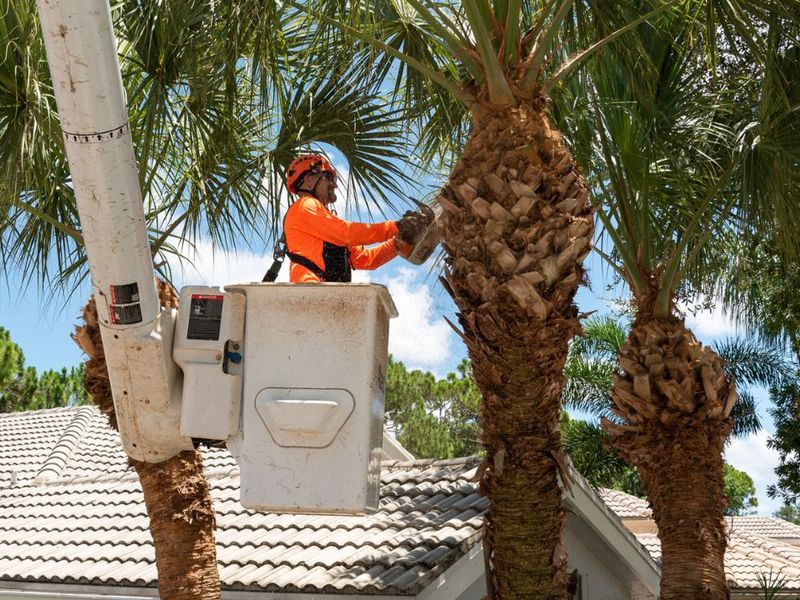
There is a clear line between what a homeowner can safely do at ground level and what belongs to a trained professional with the right equipment. Palm work above comfortable arm’s reach crosses that line, and the hazards involved are serious enough that they deserve a direct explanation rather than a gentle suggestion.
Climbing a tall palm without proper fall-arrest equipment creates fall risk, falling-object risk for anyone below, and puncture risk from the rough boot surfaces themselves. OSHA guidance on tree care hazards treats elevated tree work as professional work requiring training, fall protection, and hazard controls that most homeowners do not have.
Adding a ladder to the equation increases instability rather than solving it.
Climbing spikes are particularly harmful on palms and should never be used for footing on a trunk you intend to keep healthy. Spikes wound the trunk with every step, and those wounds accumulate.
UF/IFAS Pinellas County extension guidance on proper palm pruning warns specifically against spike use on palms for this reason. A professional working on your palm should be using aerial lift equipment or a bucket truck, not spikes.
Power lines near a palm make the situation immediately more dangerous. Any frond, boot, or tool that contacts an energized line creates an electrocution hazard.
Do not attempt any work on a palm that is near overhead utility lines, and do not assume the lines are insulated or de-energized. That work belongs to a line-clearance professional coordinated with the utility.
When pruning is appropriate, UF/IFAS palm pruning standards also recommend disinfecting pruning tools between palms, especially when disease is suspected or when working near palms vulnerable to Fusarium wilt and other vascular diseases. A 10 percent bleach solution or a registered disinfectant applied to blades between cuts is a simple step that reduces the chance of spreading pathogens from one tree to another.
Hire a qualified palm or tree-care professional – ideally one certified by the International Society of Arboriculture – for any work that is elevated, near utilities or structures, potentially occupied by wildlife, or resistant to removal without force.
Judge success by an uninjured palm, not a smooth trunk
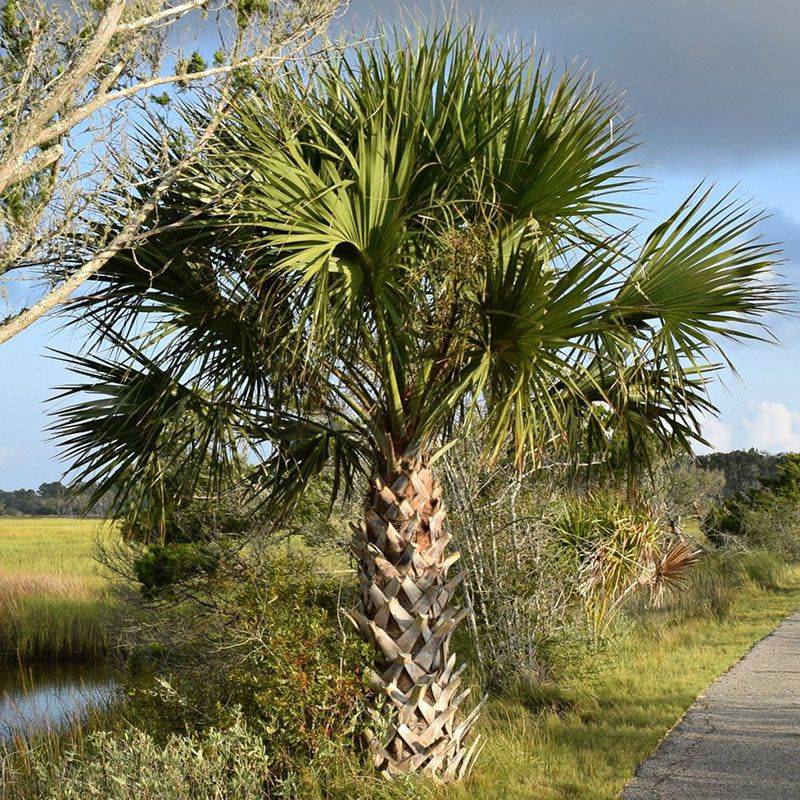
A quick checklist before any palm cleanup keeps the priorities straight. Boots are normal old leaf bases, not bark, trash, or a maintenance failure.
Firmly attached material stays put. Completely dead fronds can be pruned carefully by cutting close to but not into the trunk.
Loose, already-exfoliating material may come away for appearance or clearance when it releases without resistance. Anything elevated, near power lines, resistant to gentle pressure, or potentially occupied by wildlife goes on a list for a qualified professional.
The smooth-trunk standard that many Florida homeowners hold in their heads is largely a cosmetic preference, not a health benchmark. UF/IFAS research on normal palm features is clear that a rough, booted trunk may simply reflect the species and its natural growth pattern, while a smooth trunk may reflect earlier manual removal rather than superior tree health.
Judging a palm by its trunk texture is a bit like judging a person’s health by their haircut.
The more useful standard is an uninjured palm with an appropriate canopy: no trunk gouges, no stripped wounds, no over-pruned crown, and no evidence of forced removal. UF/IFAS palm pruning guidance frames good palm care around what you leave intact rather than what you take away.
A well-maintained Florida palm doesn’t need to look like it came from a resort lobby to be genuinely healthy. The best-kept palms in most Florida yards are often the ones their owners had the patience to leave mostly alone.