
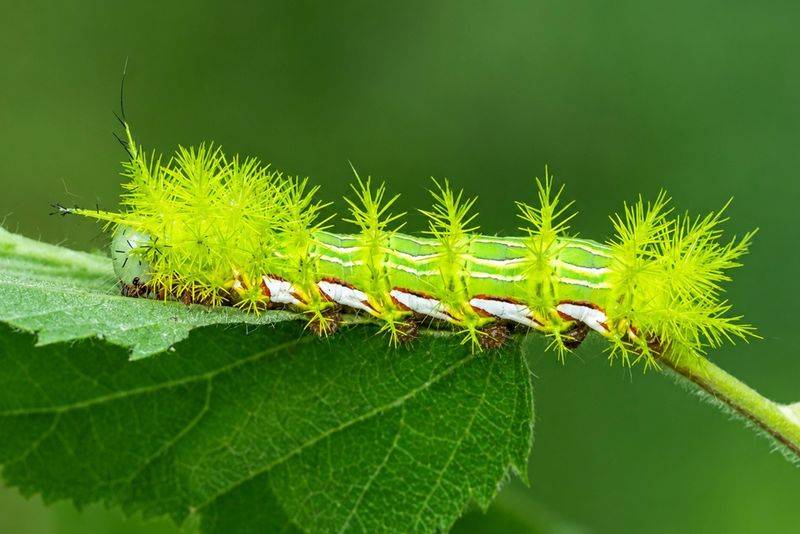
Florida gardeners are finding a startling surprise on their landscape plants: a bright green caterpillar covered in sharp, spine-tipped bristles that can cause an instant, painful sting on contact. The Io moth caterpillar is an established Florida resident, and during the long warm season it can cycle through several generations, making a backyard encounter more likely than many gardeners expect.
Knowing what to look for and how to protect yourself can turn a potentially painful moment into a simple, calm observation.
The green body and black-tipped spines provide the main clues
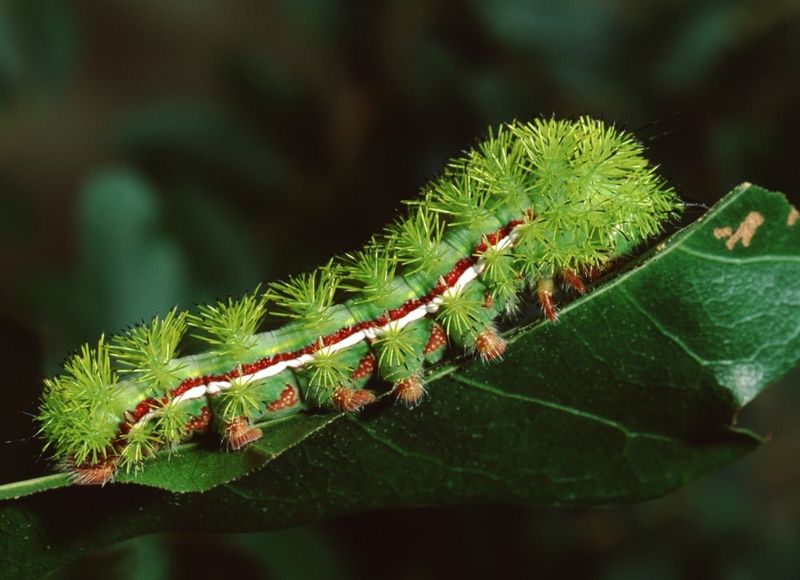
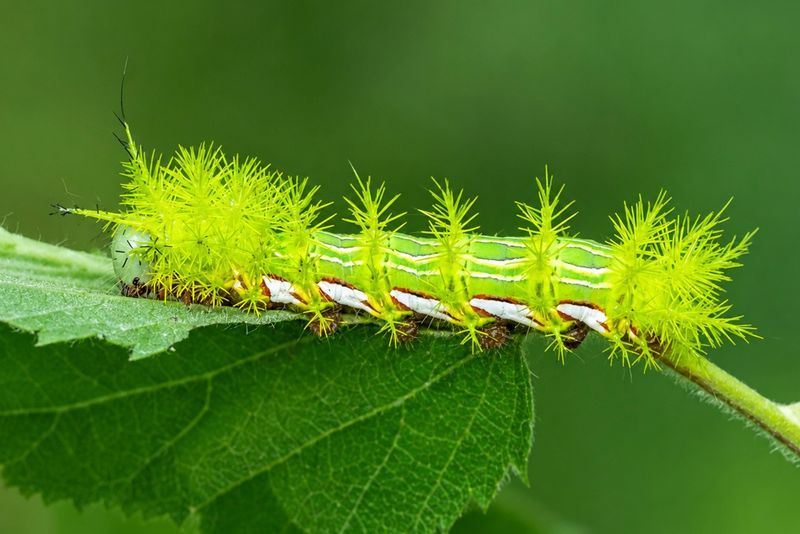
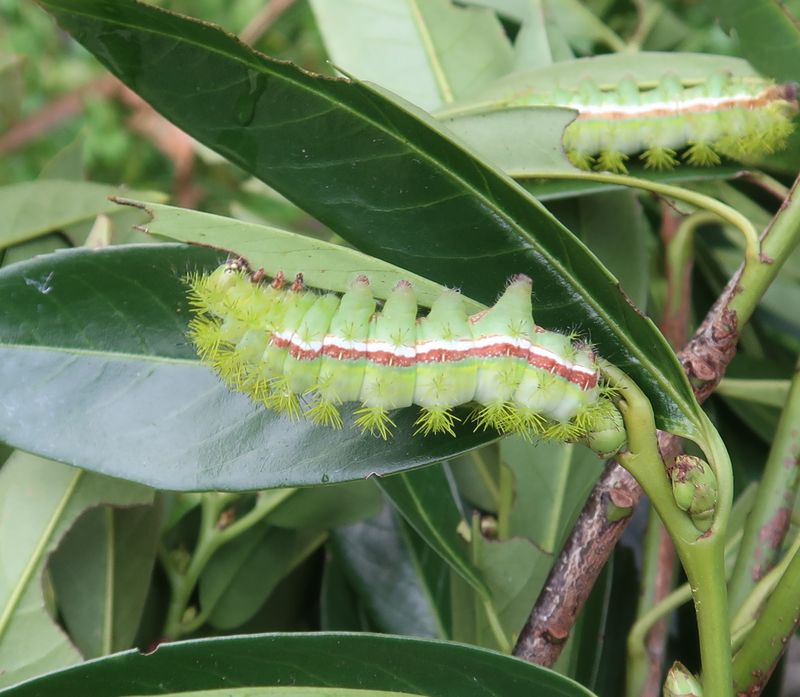
Spotting an unfamiliar caterpillar on a garden plant can be unsettling, but a few specific visual details set the Io moth caterpillar apart from the dozens of other larvae you might encounter in a Florida yard. Mature larvae are green, roughly 6.5 centimeters long, and carry a pale or yellow-white lateral stripe edged with a reddish border that runs along each side of the body.
Rows of conspicuous, black-tipped spines radiate outward from the body in clusters, and those spines are the part that matters most for your safety.
According to UF/IFAS guidance on stinging caterpillars of the Southeast, all larval stages of the Io moth can sting, not just the fully grown caterpillar. Younger instars are darker and can look quite different from the mature green form, so any spiny caterpillar of unknown identity on a Florida plant deserves the same caution you would give the adult stage.
Not every fuzzy, colorful, or bristled caterpillar in Florida is dangerous. As Poison Control notes, many caterpillars are entirely harmless, though brightly colored, spiny, or hairy ones should be treated cautiously when identification is uncertain.
The Io moth caterpillar’s combination of green body, striped side, and prominent black-tipped spines is fairly distinctive, but if a caterpillar does not match those specific clues, do not assume it is an Io moth.
The adult Io moth looks completely different. UF/IFAS Gardening Solutions describes it as a nocturnal, non-feeding moth with striking hind-wing eyespots.
The adult does not carry the caterpillar’s prominent stinging spines, but that does not make it safe to handle. Avoid picking up or disturbing any wild moth or caterpillar unnecessarily.
When you see a spiny green caterpillar on a plant and cannot confirm its identity, treat it as a contact hazard and keep your bare hands away.
Why a Florida plant may host an Io moth caterpillar now
Florida’s climate gives the Io moth (Automeris io) a longer active season than nearly any other state in the country. UF/IFAS research on the Io moth describes how southern Florida populations can produce four or five generations without a winter diapause, while central and northern Florida populations also complete multiple generations each year.
That reproductive pace means larvae can appear repeatedly on landscape plants throughout the warm months rather than just once in a predictable window.
The species feeds on a wide range of host plants, including hibiscus, elm, maple, wisteria, and willow. Finding a caterpillar on a plant not included in a short list does not rule out Io moth identity; the UF/IFAS species profile describes the larva as feeding on a large variety of hosts.
A gardener tending ornamentals in any part of Florida can reasonably encounter one during the long warm season, particularly in late summer and fall when successive generations have had time to build up.
Local or seasonal sightings are entirely plausible given those biology facts, but there is no authoritative statewide monitoring source confirming a widespread surge at any single point in time. Think of encounters as locally possible rather than part of a statewide outbreak.
When you notice feeding damage on leaves, ragged holes along leaf margins, or groups of small caterpillars clustered along silk trails, take a closer look at the underside of nearby leaves before reaching in with bare hands. Eggs are commonly laid on leaf undersides, and early larvae sometimes move together before spreading out as they grow.
Protective clothing makes routine garden work safer
Routine pruning, weeding, and harvesting carry a small but real risk of brushing against a caterpillar hidden on foliage. Before reaching into dense plantings or working close to ornamental shrubs and trees, pull on a pair of sturdy gloves and long sleeves.
UF/IFAS guidance on stinging and venomous insects recommends protective clothing when working around plants where stinging caterpillars may be present, and a hat adds useful coverage if you need to reach overhead into branches where a caterpillar could fall onto your face or neck.
Slow, deliberate inspection of foliage before you grab or cut anything is one of the most practical habits you can develop. Turn leaves over and look at the undersides, where eggs and young larvae often cluster.
Scan stems and branch junctions before gripping them. Good lighting, either from the sun or a handheld lamp on a shaded porch, makes spotting small caterpillars much easier and reduces the chance of a surprise contact.
When you do spot an unfamiliar spiny caterpillar, resist the instinct to shake the branch, sweep it off with your hand, or crush it. UF/IFAS stinging caterpillar guidance and Poison Control both caution against bare-hand contact with any unidentified spiny larva.
Shaking a branch can dislodge a caterpillar onto your arm or face, and crushing one can drive spines directly into your fingers. Use a stick, trowel, or another tool to move it if you need to clear a work area, and keep your skin covered throughout the task.
After contact, remove spines before treating the irritation
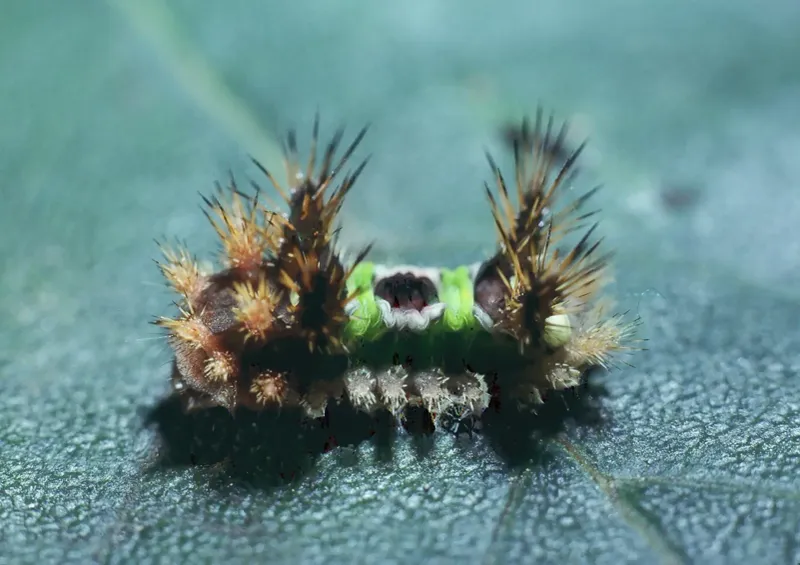
A caterpillar that lands on bare skin or brushes against an arm needs to come off without making the situation worse. Use a stick, the edge of a garden tool, or any nearby object to coax the caterpillar away from your skin.
Grabbing it with your fingers to flick it off will push additional spines into your hand, so keep bare skin away from the insect even during removal.
Poison Control recommends a tape method for removing embedded hairs or spines: press a piece of tape sticky-side down firmly over the affected area, then lift it away in one smooth motion. Use a fresh strip each time and repeat until no more spines are visible or the skin stops catching on the tape.
Follow that step with gentle washing using soap and water. Avoid scrubbing hard, which can drive remaining spines deeper into the skin.
Burning and stinging are the most immediate sensations after contact, and redness, itching, swelling, welts, and sometimes blistering can follow. The UF/IFAS stinging caterpillar fact sheet notes that pain from an Io moth sting may begin to ease after a few hours and swelling may decline around the eight-hour mark for some people, but individual reactions vary considerably.
Do not count on a fixed recovery timeline.
Symptom-relief options such as a baking-soda paste or an over-the-counter hydrocortisone cream may offer some comfort, but these are not guaranteed treatments. Poison Control mentions them as possibilities alongside medical-grade options, and the same source advises professional medical attention when blistering is severe or symptoms feel significant.
Treat household remedies as comfort measures rather than cures, and keep an eye on how the affected area looks and feels over the next several hours.
Know when a reaction needs urgent medical help
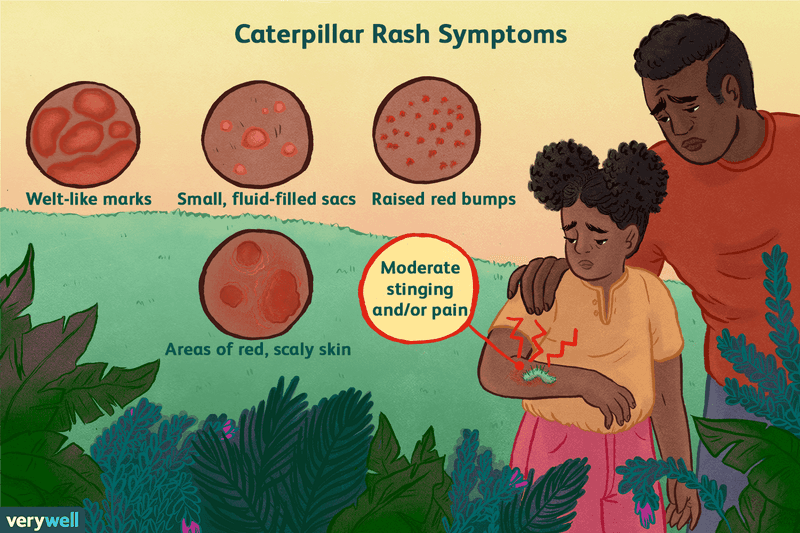
Most Io moth caterpillar stings produce local discomfort that stays confined to the contact area. A burning patch of skin, some redness, and mild swelling are unpleasant but generally manageable at home.
The situation changes when symptoms move beyond local irritation or appear in places far from the original contact point.
Seek urgent medical care right away for any of the following: trouble breathing, difficulty swallowing, a severe or rapidly spreading reaction, significant eye exposure, or large areas of blistering. Poison Control’s caterpillar guidance and Florida DACS pesticide-exposure guidance both direct people to call 911 for emergencies.
For questions that do not require emergency services, Poison Control is available around the clock at 1-800-222-1222 anywhere in the United States.
Pain and swelling may ease over several hours for many people, but that general pattern does not apply to everyone. Individual immune responses differ, and some people react more strongly to caterpillar venom than others.
Children, older adults, and anyone with a history of severe allergic reactions deserve extra caution. If a reaction feels disproportionate to the size of the contact area, or if symptoms are not improving after several hours, a call to Poison Control or a visit to an urgent care clinic is a reasonable next step rather than waiting it out.
Leave an isolated caterpillar alone when the risk stays low
Finding one Io moth caterpillar on a plant at the back of the yard is a very different situation from finding several clustered beside a frequently used walkway or on a shrub next to the back door. Before reaching for any control product, take a moment to weigh whether this caterpillar actually poses a meaningful risk where it currently sits.
UF/IFAS notes that Io moth caterpillars are native wildlife, and a single individual feeding on a plant away from high-contact areas may not justify broad insecticide use, especially when the plant itself shows no notable damage. Penn State Extension’s moth ecology resource points out that moth larvae play roles in food webs that benefit birds, bats, and other wildlife.
Removing every caterpillar automatically can disrupt those connections without delivering a meaningful garden benefit.
Careful avoidance and no-touch observation are valid responses when the caterpillar is not causing significant damage and is not in a spot where people or pets are likely to brush against it. Confirm your identification using the visual clues described earlier before deciding on any next step.
If you are not certain the caterpillar is an Io moth, reach out to your local UF/IFAS Extension office for help with identification rather than acting on a guess. UF/IFAS guidance on natural pest management consistently ties control decisions to confirmed identification and actual evidence of a problem rather than precautionary spraying.
Choose targeted control and follow the pesticide label
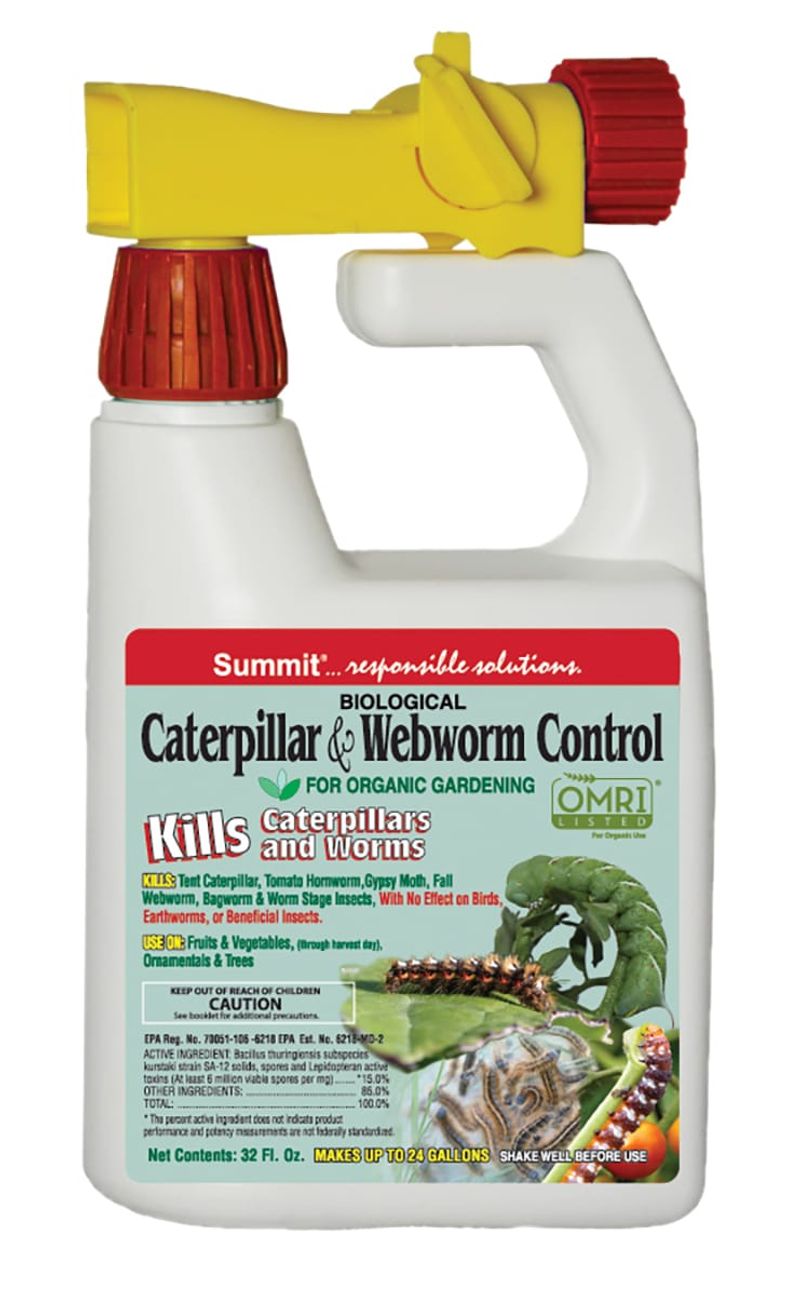
When confirmed identification, repeated encounters in a high-contact area, or meaningful feeding damage tip the decision toward control, one option with solid research support is Bacillus thuringiensis var. kurstaki, commonly called Bt-k. UF/IFAS guidance on natural pest management products lists Bt-k as effective against Io moth caterpillar stages.
The product works as a stomach poison that affects caterpillars after they consume treated foliage, so timing and coverage on the plant matter for good results.
Bt-k targets the caterpillar stage, not adult moths. Treating a plant will not repel future egg-laying adults or prevent all subsequent generations from appearing.
Set realistic expectations: Bt-k can reduce the caterpillar population currently feeding on a plant, but it is not a permanent barrier against the species.
Before applying any product, read the label completely. The EPA’s pesticide safety guidance and EPA’s label-reading resource both emphasize that the pesticide label is a legal document: use only the labeled amount, apply only to the sites and pests named on the label, and follow all restrictions regarding people, pets, drift, and reentry intervals.
Never substitute an unlabeled product, mix your own pesticide formula, or apply more than the label directs in hopes of stronger results.
A practical decision rule: focus protective treatment on plants in high-contact spots such as entryways, play areas, or frequently used garden paths where the risk of accidental contact is genuinely elevated. Plants in low-traffic corners of the yard with minor feeding damage rarely justify chemical intervention.
Protect where people are, and give isolated populations in quiet corners space to be part of the yard’s broader ecology.
Recognition and distance provide the safest plan
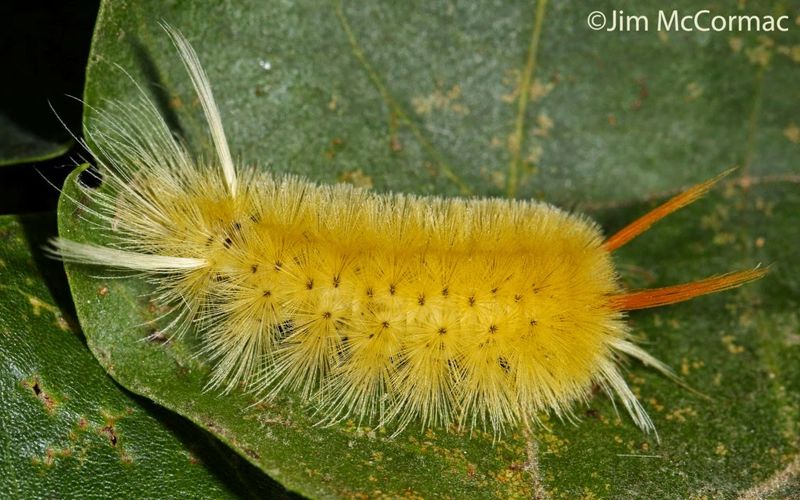
The safest approach to Io moth caterpillars in a Florida yard comes down to two habits practiced together: know what you are looking at before you touch anything, and keep bare skin away from spiny caterpillars of any kind. Wear gloves and long sleeves around suspect plants, inspect leaf undersides before grabbing stems, and use a tool rather than your fingers if a caterpillar needs to be moved.
When contact does happen, use the tape method to lift embedded spines, wash the area gently with soap and water, and watch for symptoms that go beyond local irritation. Poison Control at 1-800-222-1222 is available around the clock for guidance, and 911 is the right call for any breathing difficulty, severe spreading reaction, or significant eye exposure.
Local or seasonal encounters with this caterpillar are plausible given Florida’s long warm season and the species’ ability to produce multiple generations, but a single sighting in your yard is not a signal to eliminate every caterpillar on the property. Confirm identification, weigh the actual contact risk, and reserve targeted control with a labeled product for situations where people or pets are regularly at risk or meaningful plant damage is occurring.
Recognizing a native caterpillar for what it is, and giving it a respectful distance, is usually the most practical outcome a Florida gardener can reach.