
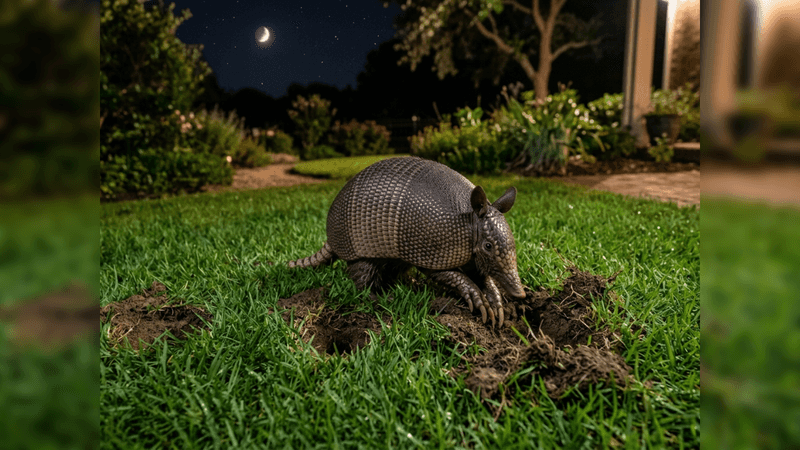
If you have noticed fresh shallow pits scattered across your lawn or garden beds several mornings in a row, an armadillo has likely found something worth coming back for. Understanding what draws the animal in repeatedly is the first step toward doing something useful about it.
Texas yards can unknowingly offer a reliable combination of food, soft soil, and easy travel routes that make one property a regular stop on a wider nightly circuit.
Start with the damage, not the assumption
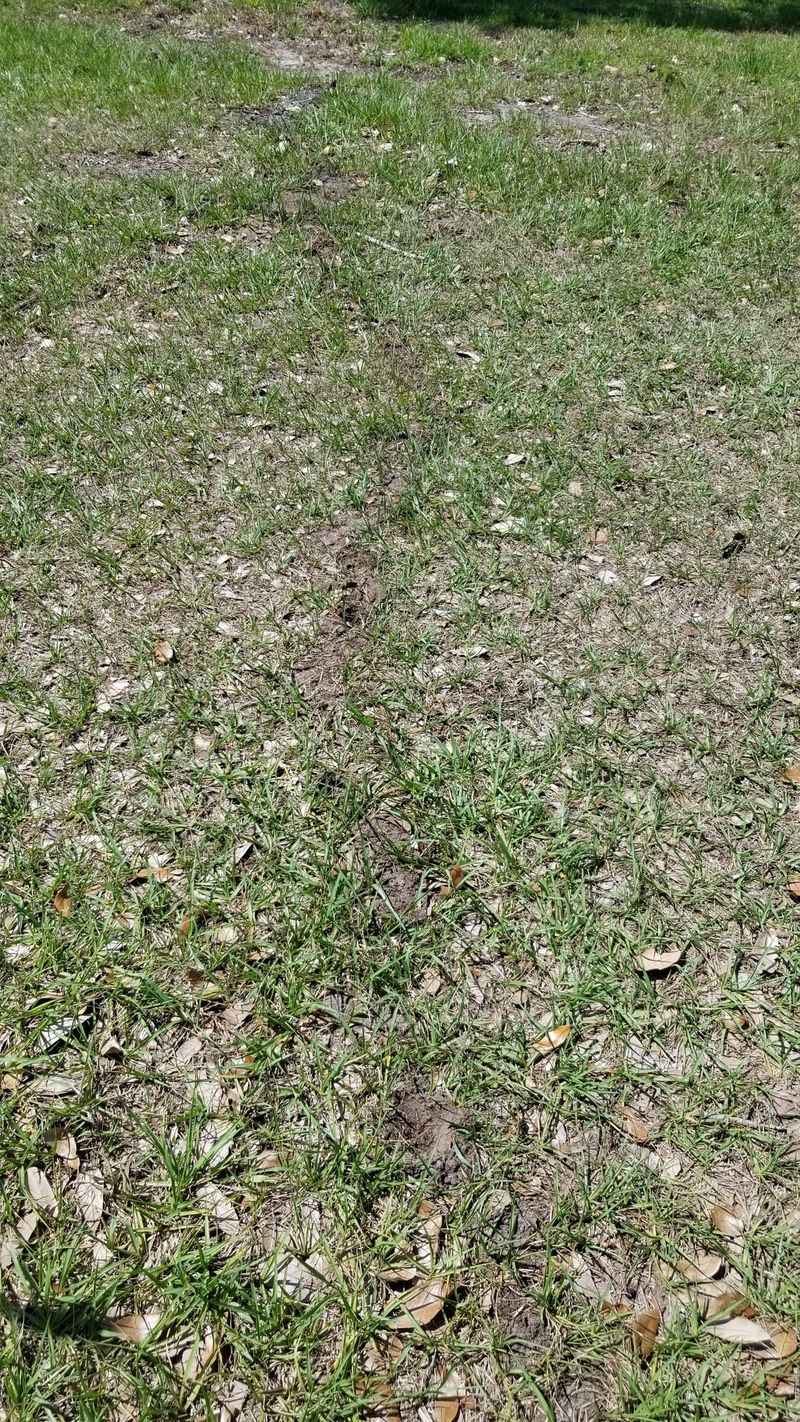
Scattered shallow pits turning up across a lawn or garden bed are the most common sign that a nine-banded armadillo has been working the area. UF/IFAS guidance on the nine-banded armadillo describes typical feeding pits as roughly 1 to 3 inches deep and 3 to 5 inches wide, though the actual size varies with soil type and moisture.
A round burrow entrance is substantially larger, closer to 7 or 8 inches across, and the two features serve different purposes.
Feeding pits show up wherever the animal was searching for food. They can appear in turf, planting beds, along root lines, or near paved edges.
Repeated digging in the same general area can loosen soil around shallow roots, displace transplants, and create uneven ground that is awkward to mow or walk across.
A visible burrow is a separate matter. Texas Parks and Wildlife Department notes that nine-banded armadillos occur across most of Texas, with distribution shaped largely by whether the soil is diggable enough for burrowing.
Finding a burrow entrance near a fence line, slope, or structure does not automatically mean the animal lives there full time, and it does not prove that every feeding pit in the yard came from that single opening.
Keeping these two types of evidence separate matters before deciding on a response. A yard can receive repeated feeding visits from an armadillo that burrows somewhere else entirely.
Identifying what kind of activity is present helps homeowners focus on the right part of the yard rather than reacting to every disturbed patch as though it represents a permanent den.
Why repeated visits happen
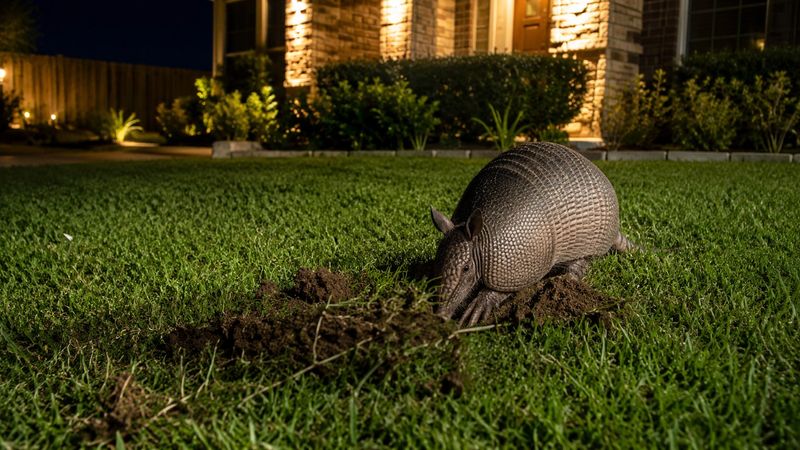
An armadillo returning to the same yard on multiple nights is not necessarily singling out one property as a preferred destination. The UF/IFAS armadillo factsheet explains that nine-banded armadillos maintain home ranges that may include multiple burrow sites and recurring foraging routes.
When one yard reliably offers accessible food or workable soil, it becomes a productive stop within that larger circuit, not a place the animal has consciously chosen to call home.
Home ranges can overlap with several neighboring properties, and the same animal may use a yard on some nights but skip it on others depending on what it found elsewhere. If surrounding areas have harder soil or fewer prey items, a well-irrigated Texas yard can stand out as an easier place to feed.
That efficiency, rather than any attachment to the space, is what drives the pattern.
TPWD’s armadillo natural history materials note that armadillos are often most active at night during warm conditions, but temperature, cloud cover, and rain can shift that timing. On cooler or overcast days, activity may occur in daylight hours.
Framing the problem as strictly “night after night” captures a common pattern among repeat visitors, but it is not a universal rule that holds regardless of season or weather.
This distinction has a practical payoff. Florida FWC’s wildlife conflict guidance cautions that removing one animal may simply open the habitat to another if the yard remains attractive.
Asking what makes the property productive, rather than focusing only on which individual animal is visiting, leads to more durable solutions.
Moist soil brings prey within reach
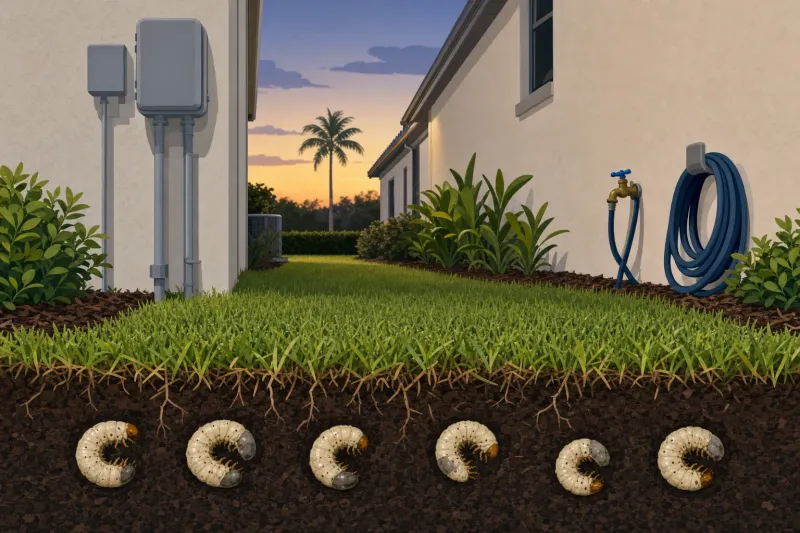
Among the yard-level factors that can draw repeated armadillo visits, moist and biologically active soil ranks near the top. Irrigation and dense, fertilized turf growth can support higher concentrations of earthworms, beetle larvae, ants, and other invertebrates near the surface, making a maintained lawn an efficient place to forage.
UF/IFAS research on the nine-banded armadillo identifies this combination of moist, invertebrate-rich soil as one of the strongest associations with repeated armadillo activity in managed yards.
Watering alone does not explain every visit. Prey abundance, soil texture, surrounding habitat, and weather all contribute to whether a yard becomes a regular stop.
A yard with sandy or well-drained soil may still attract armadillos if it hosts enough surface-accessible invertebrates after rain. The point is not that irrigation is the problem, but that unnecessary or poorly timed watering can raise the yard’s appeal by keeping the upper soil layer soft and biologically productive when the animals are most active.
White grubs are one prey item, but armadillos eat a broad range of invertebrates. Georgia Extension’s armadillo dilemma resource warns that treating a lawn for grubs with insecticide may not stop the digging and could actually increase it as the animal searches harder for alternatives.
Earthworms, ants, beetles, and other larvae remain available even in grub-free turf, so eliminating one prey type does not reliably remove the attraction.
Fertilizer deserves a clear-eyed look here too. There is no strong evidence that armadillos follow the smell of fertilizer directly.
What lush, heavily fertilized growth can do is support a denser prey community closer to the surface. Texas A&M AgriLife Extension’s white grub guidance also cautions against routine preventative insecticide applications, noting risks to birds, aquatic life, and other beneficial organisms if products are misapplied.
The practical takeaway is that soil moisture and invertebrate density work together to make a yard productive for foraging, and reducing unnecessary moisture is a more targeted first step than reaching for insecticide.
Look for food, shelter, and easy routes
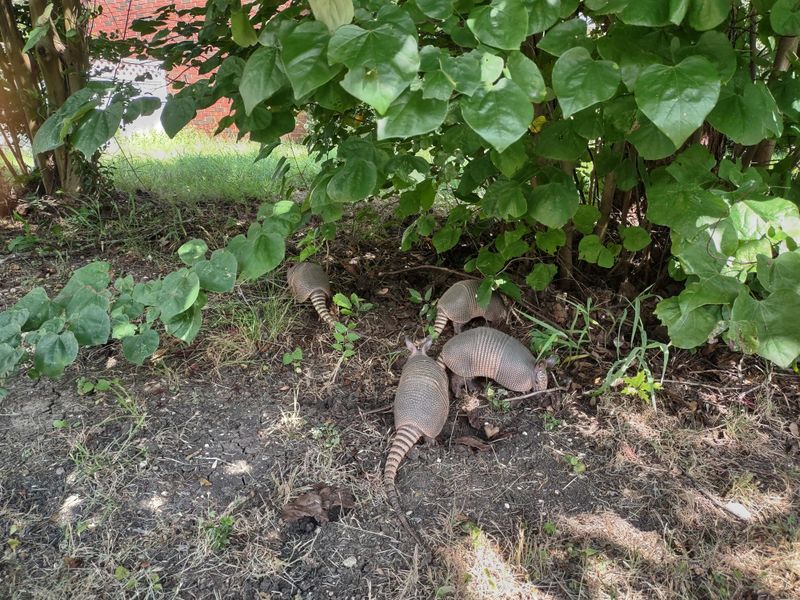
Beyond soil moisture and prey, several other yard features can make a property more useful to an armadillo moving through its home range. Fallen or fermenting fruit is one worth checking.
Florida FWC’s armadillo profile specifically identifies fermenting fruit as an attractant, and any Texas yard with citrus, fig, persimmon, or other fruit-bearing trees can accumulate drops that add to the yard’s appeal.
Loose or sloped soil near fence lines, exposed tree roots, pavement edges, and the bases of structures can offer both workable ground and potential shelter. UF/IFAS guidance notes that armadillo burrows frequently appear near roots, slopes, and hard edges that provide overhead cover or a natural starting point for digging.
A burrow in one of these spots does not guarantee the animal feeds only in that immediate area, but it does suggest a likely zone of repeated activity.
Travel routes also matter. The UF/IFAS armadillo factsheet describes armadillos as following recurring paths within their home range.
Fence lines, low gaps under gates, drainage channels, and vegetated edges along property borders can all function as corridors that guide an animal into and out of a yard. A property that sits along a natural travel path between wooded areas, a creek, or undeveloped land may see visits simply because the route passes through it.
Inspecting the yard with these categories in mind, food sources, workable ground, and entry points, gives a more complete picture than focusing only on where the digging appeared. TPWD’s species profile reinforces that soil suitability for digging is a primary factor shaping where armadillos are found across Texas, which means any part of the yard with consistently soft or moist ground is worth including in the inspection.
Inspect the productive problem zone
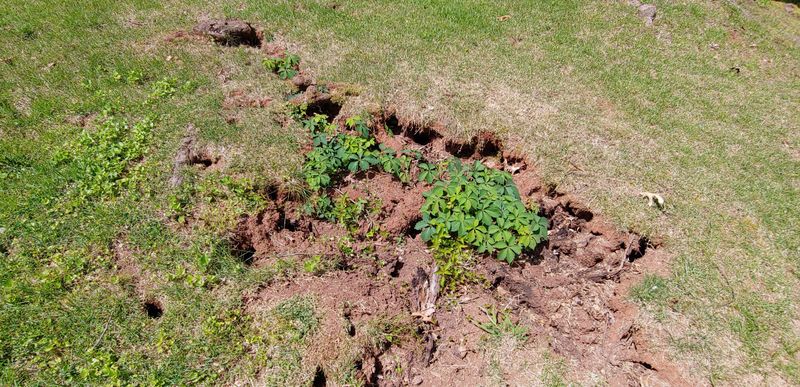
Before changing irrigation schedules or installing fencing across the whole yard, it pays to narrow down where the activity is actually concentrated. Fresh pits have loose, moist-looking soil and clean edges.
Older disturbances tend to have dried, compacted edges and may show grass beginning to recover. Comparing the two helps identify whether visits are ongoing or trailing off on their own.
UF/IFAS armadillo guidance uses pit dimensions as identification clues rather than definitive proof, since soil type and moisture affect the size and shape of each hole. A cluster of fresh, shallow pits in an irrigated bed or turf section is more informative than a single isolated hole.
Repeated digging in the same general zone, especially near a fence line, fruit tree, or low-lying area, suggests a recurring route or feeding patch rather than random exploration.
Fruit drop is easy to check: walk the yard after dark or early in the morning and look for soft, fermenting fruit on the ground near trees or shrubs. Loose soil along slopes, root zones, and pavement edges is worth probing lightly with a finger or trowel to assess how easily it gives way.
An area that stays damp after irrigation dries elsewhere is a candidate for attention.
TPWD’s armadillo natural history materials note that activity often occurs at night during warm weather but can shift to daytime during cooler or overcast periods. If the yard shows fresh damage but no nighttime sightings, checking during early morning or on cloudy afternoons may confirm the pattern.
Mapping the damage zone, fruit sources, moist patches, and likely entry points together gives a clearer target for the practical steps that follow.
Reduce unnecessary appeal and protect priorities
Once the active zone is identified, a few targeted adjustments can reduce how productive the yard is for a foraging armadillo without forcing plants into drought stress or eliminating beneficial soil life. UF/IFAS nuisance wildlife deterrent guidance recommends moving irrigation to the morning when practical.
Morning watering gives the soil surface time to dry before the hours when armadillos are most likely to be active, reducing the window when the ground is both soft and accessible.
Avoiding unnecessary watering and fertilization is a reasonable companion step. The goal is not to deprive established plants of what they need, but to avoid keeping soil consistently moist or supporting unusually dense prey populations in areas where armadillo activity is already a problem.
Picking up ripe and fallen fruit regularly removes another food source that can add to a yard’s appeal. Florida FWC specifically flags fermenting fruit as an attractant, and the same logic applies in Texas yards with citrus, figs, or other fruit-bearing trees.
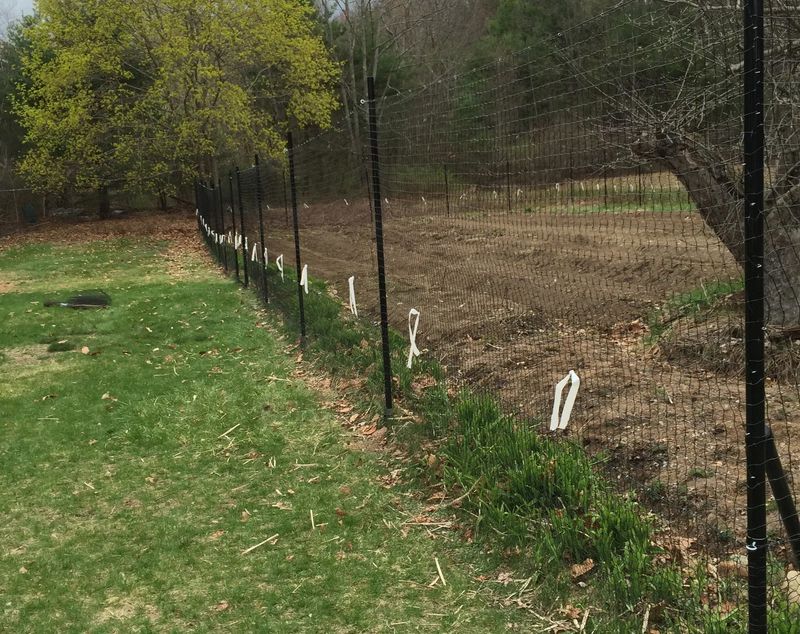
For a vegetable bed, a planting pocket, or any other high-value area that needs reliable protection, exclusion fencing is the most direct option. UF/IFAS armadillo guidance recommends fencing approximately 2 feet above ground with the lower portion buried roughly 18 inches, and the fence may be angled outward at the top to discourage an animal from pushing under or over it.
Hardware cloth or sheet metal is appropriate for this purpose. A shallow ornamental border a few inches deep does not provide meaningful exclusion because armadillos can dig underneath it without much effort.
These steps may reduce repeat visits by making the yard less productive as a feeding site, but results depend on prey availability in the surrounding area, soil conditions, weather, and the animal’s broader home range. FWC’s armadillo profile reinforces that habitat modification often addresses the underlying attraction more directly than removal alone, whose effects can be temporary if the yard remains suitable after one animal is gone.
Treat trapping and relocation as regulated choices
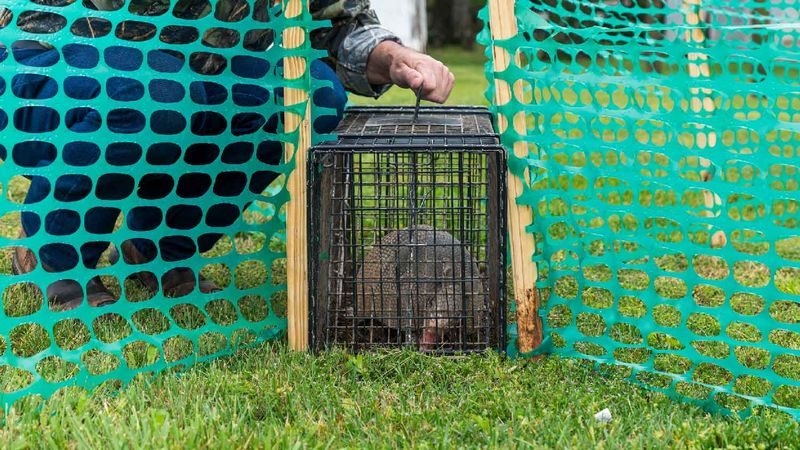
Removing an armadillo from the yard can feel like the most direct solution, but it works best when paired with habitat changes. Wildlife agencies caution that another animal may move into the same space if the yard remains attractive after removal.
Trapping is also harder than it looks. A UGA Cooperative Extension study evaluating attractants for live-trapping nine-banded armadillos found no meaningful advantage from tested baits, including fruit, worms, and commercial lures, compared with unbaited traps.
Placement near an active burrow entrance or along a natural barrier such as a fence line or wall mattered far more than what was placed inside the trap.
Mothballs, poisons, fumigants, and improvised repellents should be set aside entirely. UGA’s nine-banded armadillo natural history publication states that no repellents, toxicants, or fumigants are registered for armadillo control, and UF/IFAS specifically warns that mothballs should not be used outdoors.
These products do not reliably deter armadillos and can harm other wildlife, pets, and soil organisms.
Texas homeowners face specific legal requirements before trapping or relocating. TPWD’s nongame species regulations list armadillos among nongame animals and indicate that a valid hunting license is required to take nongame species, with no closed season or bag limit on private property under the listed rules.
Relocation is a separate matter. TPWD’s nuisance fur-bearing animal rules restrict live relocation and require department authorization in certain situations.
These rules can change, so confirming current requirements with TPWD directly or consulting a licensed wildlife professional before setting a trap is the responsible path.
When a burrow sits under a structure, near a foundation, or in a location that creates a safety hazard, a qualified wildlife professional is the better first call. They can assess the situation, handle the animal legally, and advise on whether habitat changes or exclusion work should follow removal.
Protect people while choosing a proportionate response
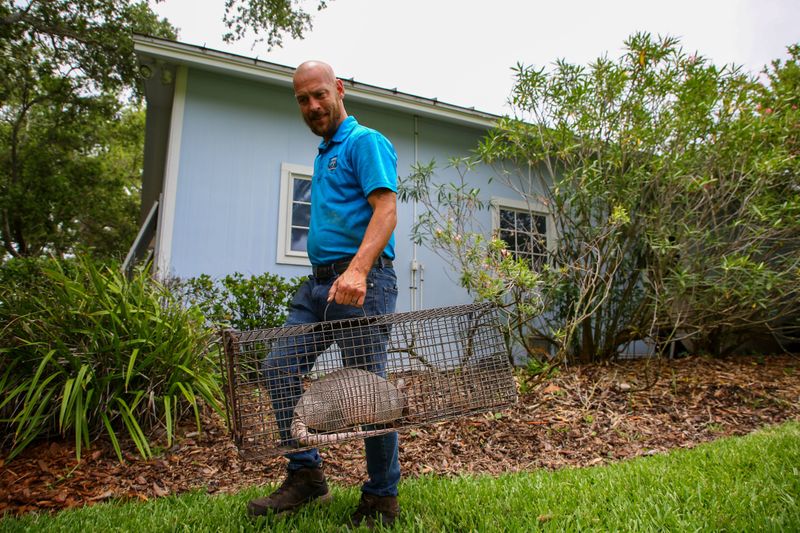
Spotting an armadillo crossing the yard carries very low health risk for most people. CDC guidance on leprosy (Hansen’s disease) notes that some southern U.S. armadillos carry the bacterium responsible for the disease, but most people who encounter armadillos are unlikely to contract it.
Risk is more relevant to repeated direct handling, hunting, butchering, or consuming armadillo than to simply observing one outdoors. Wearing gloves when gardening in soil that may have been disturbed by an armadillo or contaminated by animal waste is a sensible precaution, and avoiding direct contact with any wild animal is always reasonable.
Professional help is worth seeking when an armadillo is trapped in an enclosed space, a burrow is undermining a structure, or a situation requires capture and the homeowner is uncertain about the legal requirements. FWC’s wildlife conflict guidance recommends contacting a wildlife professional for situations involving hazardous locations or animals that cannot be safely handled by a resident.
Armadillos do have an ecological upside worth acknowledging. UF/IFAS armadillo research points out that the animals consume large numbers of invertebrates and that their abandoned burrows can be used by other wildlife.
Recognizing that does not minimize real damage to lawn, beds, or foundations, but it does support a proportionate response: reduce unnecessary attractants, protect the areas that matter most with proper exclusion, and bring in professional help when the situation calls for it. Results will vary with prey availability, soil conditions, weather, and what the surrounding landscape offers.
A yard that becomes genuinely less productive for foraging is one that an armadillo is less likely to keep visiting, which is a more durable outcome than removal alone can usually deliver.