
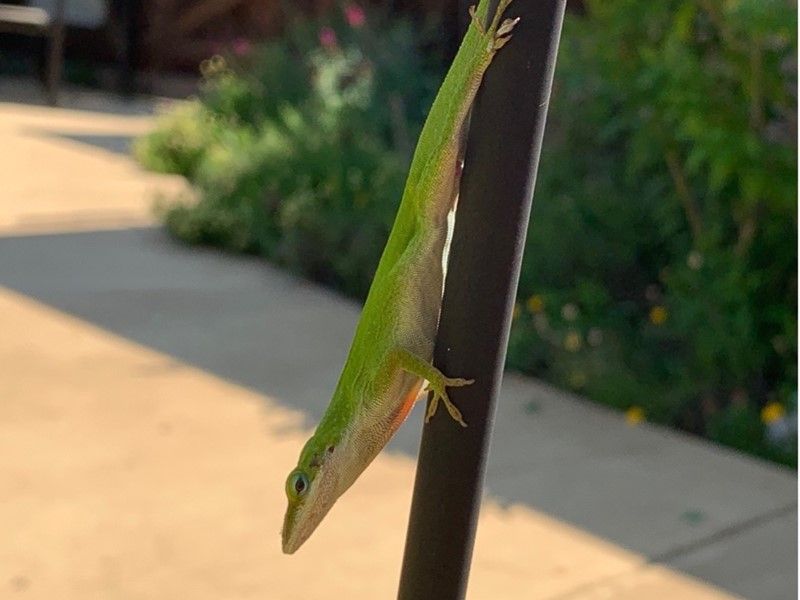
A small lizard keeps turning up near your front door, and you start to wonder why. In Austin and eastern Central Texas, anoles are familiar porch neighbors, even as the weather cools.
Their visits can say a little about the spot where you live, but not as much as people often guess. Here is what a repeat sighting can and cannot tell you.
Why might an anole be on a porch wall in fall?
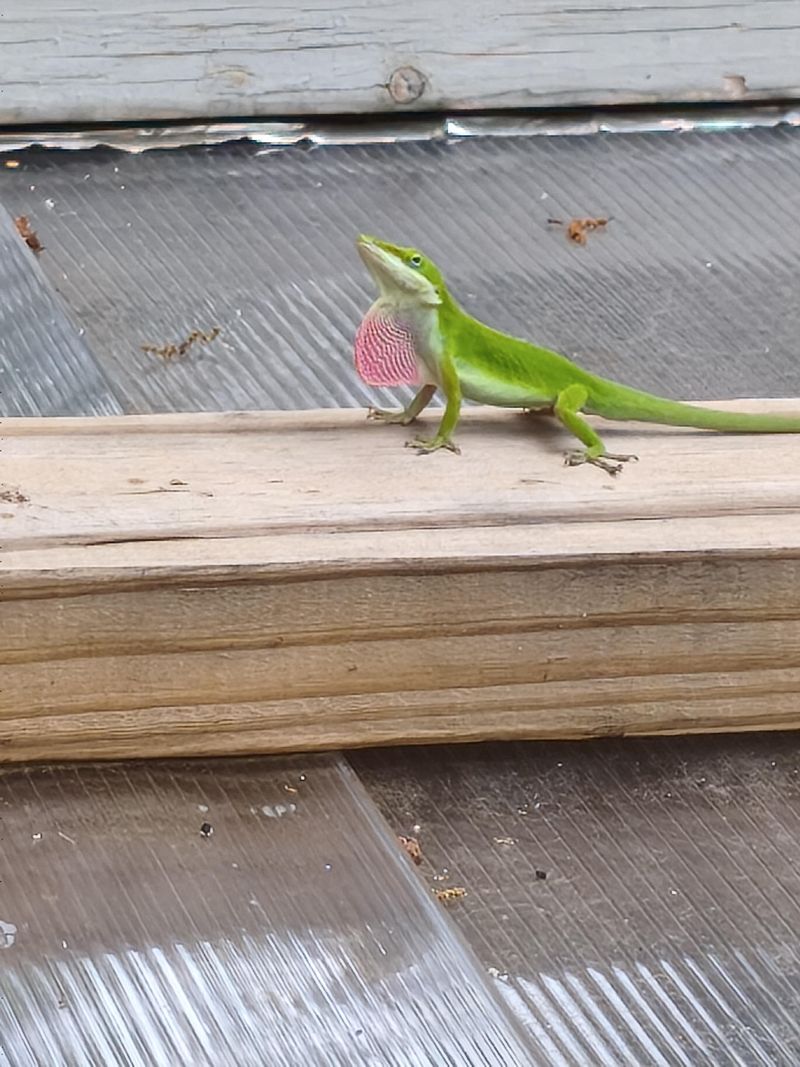
Cooler weather slows lizards down. A peer-reviewed review of green anole biology describes them as relatively inactive in autumn and winter, though they may bask on warm days.
So a lizard out on a mild October afternoon is not a surprise.
Anoles are also not picky about the surface they perch on. Texas Parks and Wildlife says they prefer trees or shrubs but also use walls and fences.
A porch wall, a railing, or a fence post beside the steps can all work as a lookout.
Put those two facts side by side and a fall porch sighting makes sense. Warm days bring lizards out, and walls are among the places they climb.
That is as far as the facts go, though.
Nobody has shown that a warm wall pulled a particular lizard to your porch. It might have been following a sunny patch, hunting a snack, or simply crossing from a nearby shrub.
Treat wall warmth as one possible reason, not the answer.
A useful habit is to jot down the time of day and the weather when you spot it. If the lizard shows up on bright, mild afternoons and vanishes on cold mornings, you have noticed something real about your own porch without needing to explain it.
A porch edge can offer cover and perches
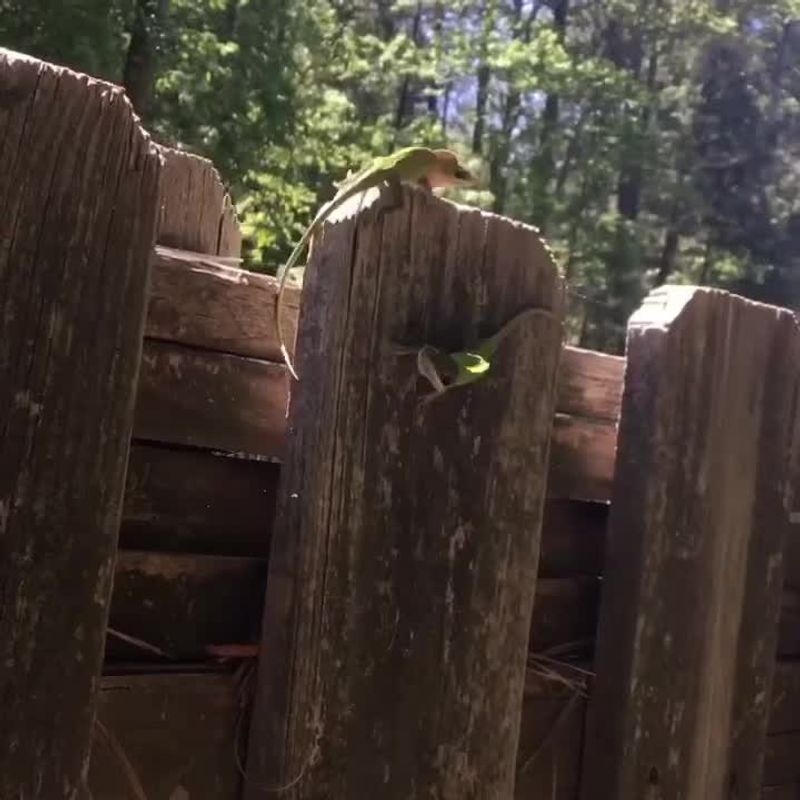
Walk the edge of your porch and look at it the way a lizard might. You will probably see leaves, a few stems at different heights, a wall, maybe a fence or railing.
That mix is exactly the kind of setup anoles use.
Texas Parks and Wildlife describes green anole habitat as greenery with occasional shade and moisture. The agency also notes that anoles favor trees or shrubs but will use walls and fences.
A porch bordered by foundation shrubs, a climbing vine, or a few potted plants can offer several of those features in a small space.
Varied perches matter because an anole likes a place to watch from. A twig, a trellis, a fence rail, and a wall each give a different height and a different amount of sun.
Leafy cover nearby gives it somewhere to slip away when a cat or bird passes.
Shade and moisture can come from ordinary things, like the north side of a shrub or the damp ground under thick leaves. You do not need to add anything.
Nobody needs to set out a dish or run a mister to bring lizards in, and doing so just for that purpose is not a good idea.
One caution: seeing an anole does not mean your porch is ideal habitat. It means the lizard found something usable there.
Other spots on the street might offer just as much.
What does an anole tell you about insects?
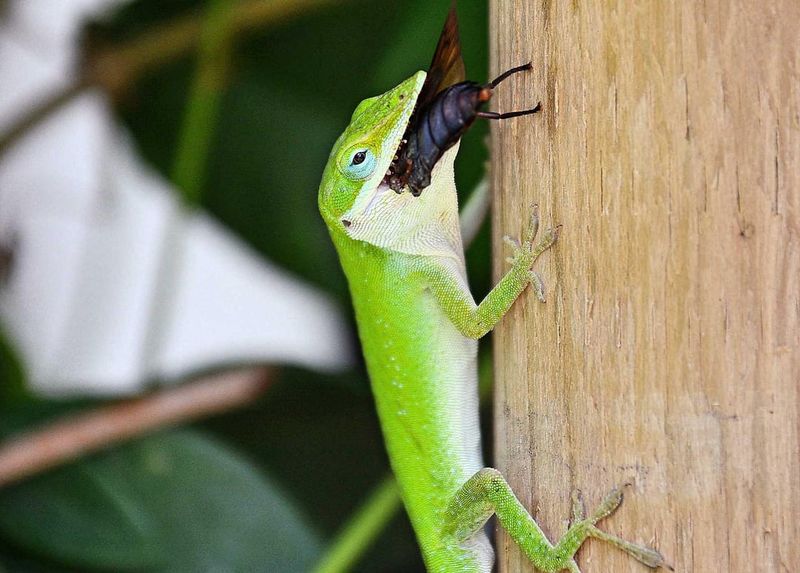
Anoles are hunters of small things. The National Park Service notes that they eat insects and other small invertebrates.
Spiders are on the menu too, a point also covered in a Texas A&M AgriLife Extension article.
So what can you reasonably take from a sighting? Small prey of some kind is part of that lizard’s surroundings.
A lizard sitting on your wall is near the sort of bugs and spiders it eats.
That is a narrow clue. One anole cannot tell you whether your porch has a handful of insects or thousands.
It cannot tell you whether those insects are helpful ones, harmful ones, or a mix, and it says nothing about how many different kinds live nearby.
It also is not a pest-control promise. Sources describe a broad diet, not a reliable habit of clearing out mosquitoes, roaches, or any other named pest.
If a particular insect is bothering you, an anole will not solve the problem.
Think of the lizard the way you might think of a bird at a feeder. It shows that something it wants is around, but it does not give you a count.
A lizard sighting is not a yard-health score
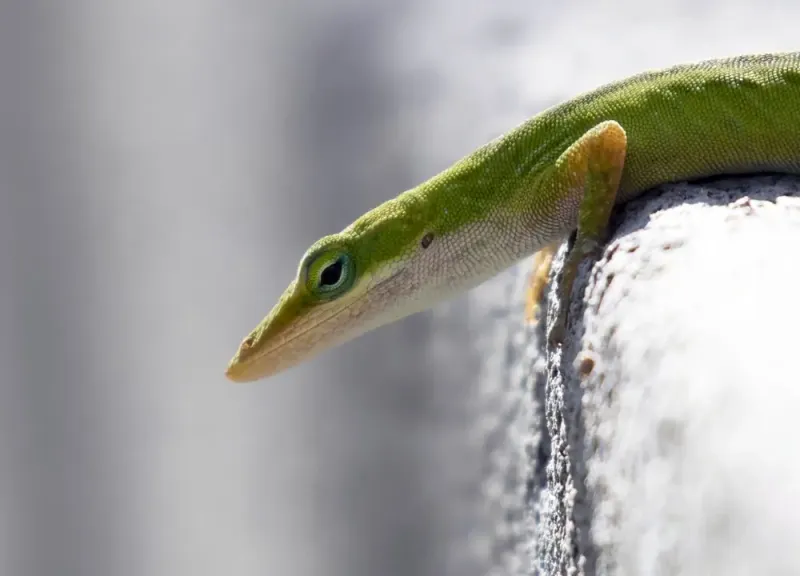
It is tempting to read a lizard as a report card. More lizards, healthier yard.
Real field work shows why that shortcut falls apart.
Researchers studying green anoles in Texas, including at Palmetto State Park, compared land use, insect and spider measures, and lizard condition. In the 2013 study by Battles and colleagues, prey availability and lizard body condition did not follow a simple direct pattern across the plots studied.
More prey did not neatly mean fatter, healthier lizards.
That result applies to those plots. It is not a universal rule, and it does not mean prey never matters.
It simply shows that the link between bugs and lizards is more tangled than a single number.
For your porch, the lesson is practical. Repeated sightings may reflect good cover, handy perches, some prey, mild weather, or just a spot where you happen to look often.
You may notice the lizard more because your porch is where you sit.
Repeat visits also do not prove that anole numbers are rising. You might be seeing the same animal day after day.
And a sighting cannot confirm rich biodiversity, since a single species says little about everything else living in the yard.
Use the lizard as a nudge to look closer at your plantings and perches, not as a grade for your whole yard.
Color alone cannot identify the porch visitor
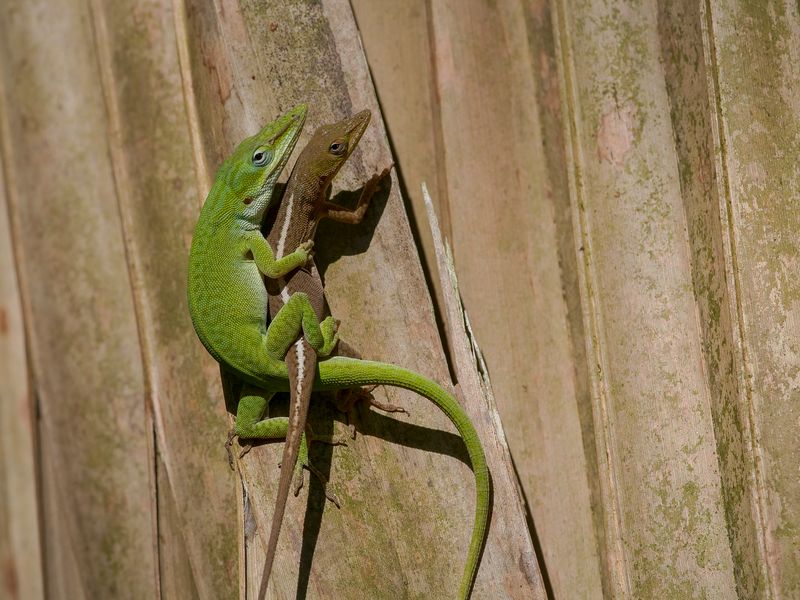
Green does not always mean green anole, and brown does not always mean something else. Texas Parks and Wildlife notes that green anoles can be brown as well as green.
The University of Texas at Austin Biodiversity Center adds that color change has several possible causes and is not just a matter of matching the surface under the lizard.
Location helps narrow things down. Green anoles are native to the Southeast and occur in eastern Texas, and a Texas A&M AgriLife Extension article places their western range as far as Austin.
That is why this article sticks to Austin and eastern Central Texas rather than every porch in the middle of the state.
Brown anoles are a second possibility. They are introduced in Texas, as described in the AgriLife piece, and University of Florida IFAS Extension covers the species in detail.
A brown lizard on your wall could be either kind.
So look past color. Check markings and body features, and compare them with photos from the sources above.
If you cannot tell, call it an anole and leave it there.
A clear photo taken from a respectful distance can settle the question later. Snap it, check it against a reliable guide, and let the lizard carry on.
Keep the porch edge welcoming without overcorrecting

Good news: helping anoles mostly means not tidying everything. Keep some leafy cover near the porch, such as a shrub or a vine, rather than clearing the edge down to bare wall and mulch.
Mix in different perches, like a trellis, a fence rail, or a sturdy branch, so there are options at several heights.
Skip the extras. Texas Parks and Wildlife describes habitat as greenery with occasional shade and moisture, and nothing suggests you should add water or release insects just because a lizard appeared.
Existing plants and shade usually do the job.
Pesticides deserve a careful look. The EPA says wildlife can be affected unintentionally by pesticides, including through contaminated food or water, and it advises following label directions.
In practice, that means spraying only where and when you have a real problem, using the product the label allows for that use, and avoiding broad coverage of plants and walls. Spot treatment beats a blanket spray.
None of this says that a treatment on your porch harmed any lizard. It is simply a reason to be deliberate.
Before you reach for a sprayer, ask whether the problem is big enough to need one.
Treat the sighting as a clue, not a verdict
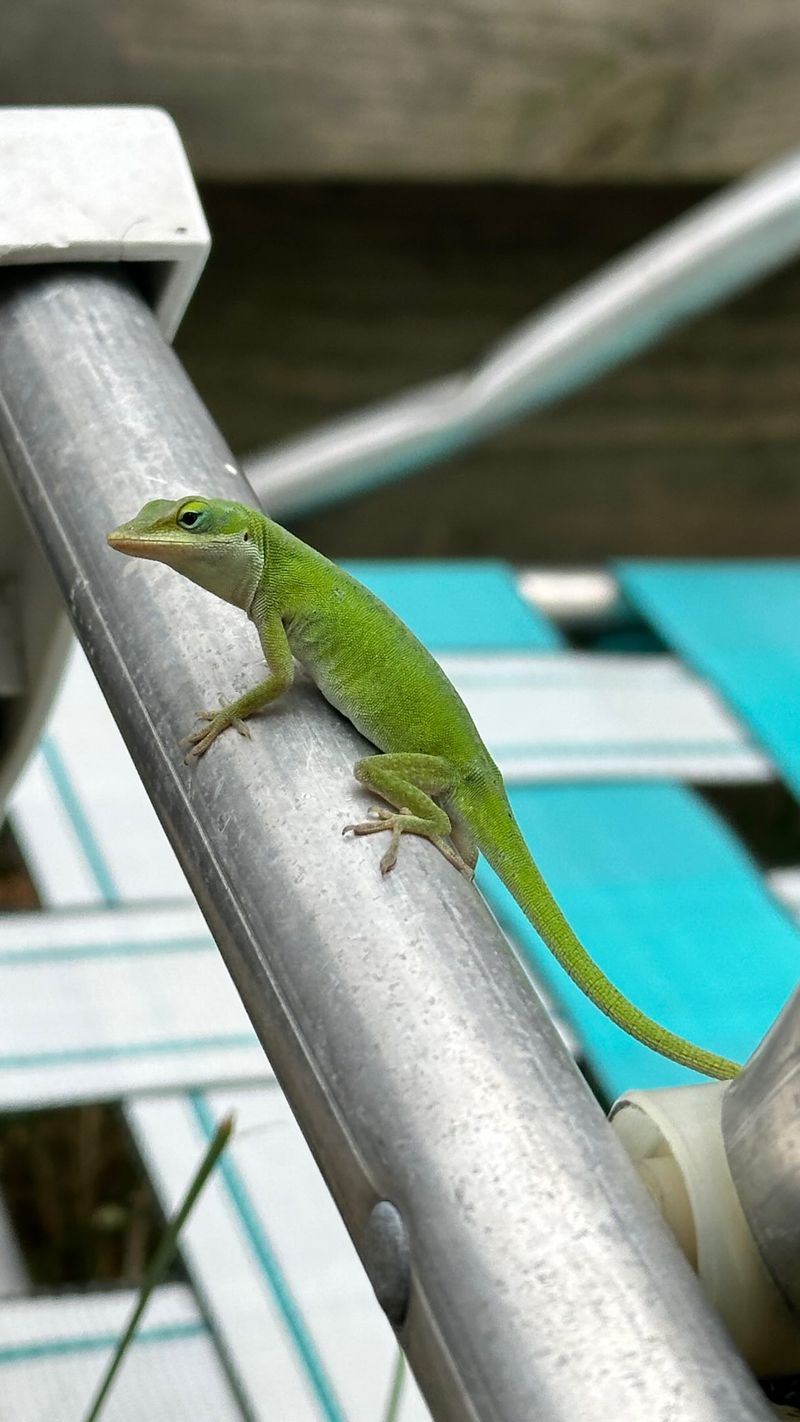
A repeat anole may fit a porch edge with usable cover, perches, and small prey nearby, as Texas Parks and Wildlife describes. Fall basking is plausible, since anoles may bask on warm days, but it is not a proven reason for any one wall visit.
And a Texas field study warns against turning lizards into a scorecard.
Your next step is simple: look at the leaves and perches around the porch and keep a few of them. The lizard is a small neighbor, not a pest crew or an inspector.