

A cucumber vine that was green last week can suddenly look dusted with flour. In Texas and Florida fall beds, that pale coating sends many growers hunting for answers.
It may be powdery mildew, but a few other problems can look similar. A careful look now can help you protect the leaves that keep the vine producing.
Do the white patches match powdery mildew?
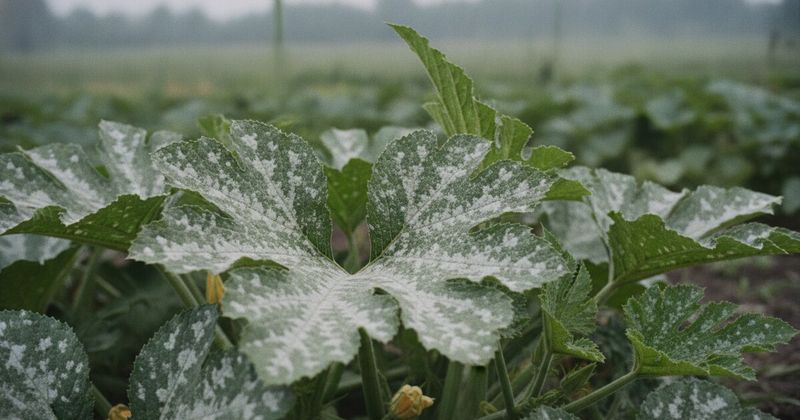
Start with a close look at the leaf. Powdery mildew often begins as small white spots, then spreads into larger patches that can show up on both leaf surfaces, stems, or petioles.
University of Minnesota Extension notes that it commonly appears first on older leaves.
Do not judge by one pale mark. Check both sides of several leaves, including older ones near the base and newer ones near the tips.
Texas A&M describes the growth as white and powdery, with badly affected leaves turning brown and papery.
Downy mildew is a different disease that can look similar from a distance. It more often causes angular yellow patches on top of the leaf, bounded by veins, with grayish or purplish growth underneath in moist conditions, according to UC IPM.
These clues can guide a home assessment, but white-looking growth alone does not confirm the disease.
Mild fall conditions can favor powdery mildew
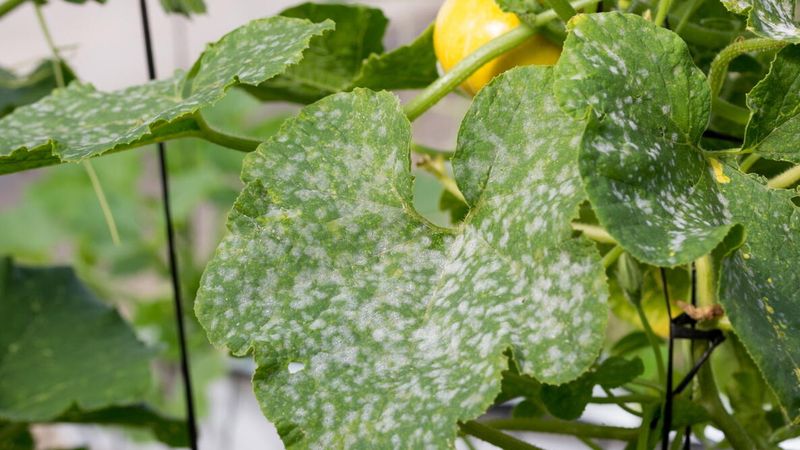
Mild weather can fit the powdery mildew disease cycle, but the picture is more layered than dry days alone. The Texas Plant Disease Handbook lists powdery mildew on cucurbits and says cool, dry weather favors it.
Other extension guidance adds detail. University of Minnesota Extension points to moderate temperatures and humid or dewy periods as important for infection, while warm, dry conditions can help spores form and spread.
So a dry afternoon is only one piece.
Florida research fits the same pattern in a narrow way. A UF/IFAS squash production guide describes recurring powdery mildew and dry-weather activity in south Florida cucurbits.
These sources describe favorable conditions, not a November forecast. Texas and Florida each hold many climates, and not every cucumber bed will develop mildew.
Your own bed, your local weather, and what you see on the leaves matter most.
Healthy foliage supports and shields the crop
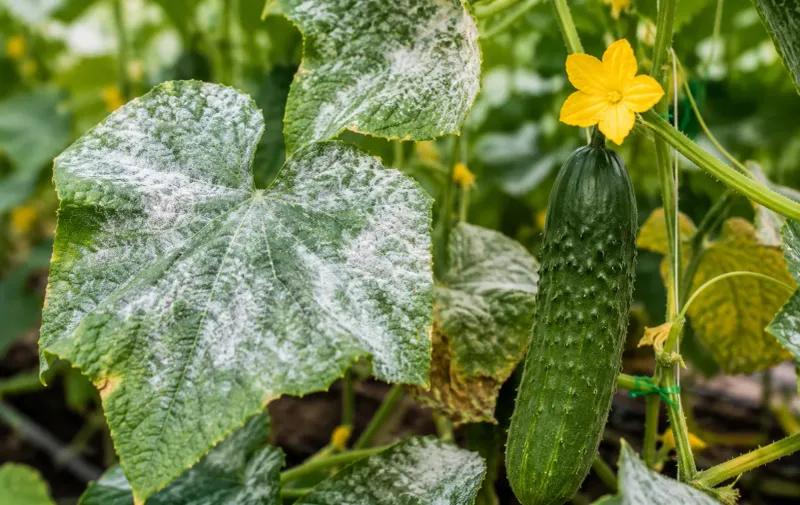
Powdery mildew mainly goes after leaves. As infected leaves yellow and die, the plant has less green surface to make the energy it needs, and fruit production can decline, as the UF/IFAS guide describes.
Leaves also act like shade cloth. When too many are lost, cucumbers can be exposed to direct sun and may sunscald.
That is why healthy foliage is worth protecting.
Fruit already hanging on the vine is not necessarily ruined. UF/IFAS says the disease does not directly infect squash fruit, and University of Minnesota Extension notes that cucumber fruit infection is only occasional.
The bigger risk is indirect: a weakened, thinning canopy. Keep that in mind as you decide how much to cut, because the goal is to limit avoidable leaf loss.
Remove affected leaves selectively
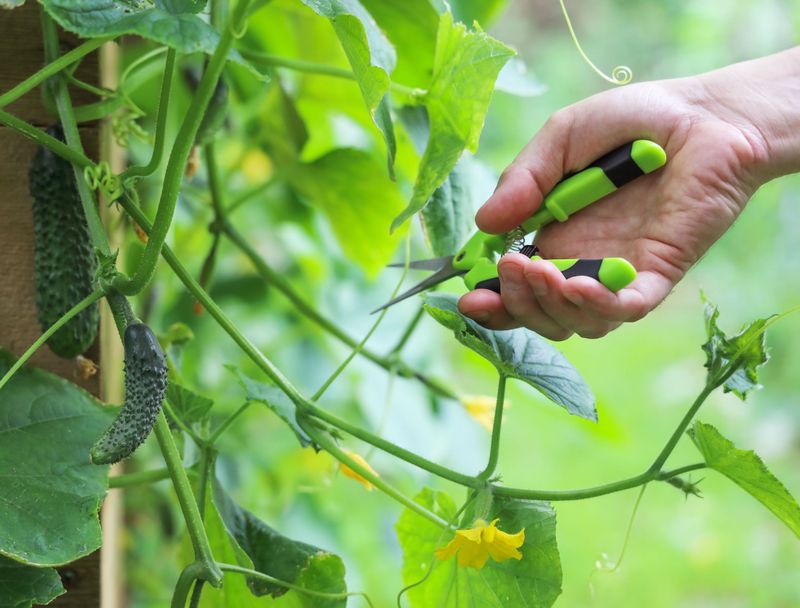
If only a few leaves are affected, cut those off and discard them in the trash rather than leaving them in the bed. Wait until the foliage is dry before working among the plants, since moving through wet vines can spread disease.
Wipe or clean your pruning tools afterward.
Resist the urge to strip the vine. General University of Minnesota home-garden guidance says never to remove more than one-third of a plant’s leaves at once.
Cutting off every spotted leaf would leave fruit exposed and the plant short on working leaves.
A practical rule is to take the worst few and leave the rest. Oklahoma State University Extension also covers powdery mildew management for gardeners.
Pruning may help limit how much disease is around, but it does not cure an established infection or guarantee a final picking.
Improve airflow without promising a cure

Bed layout can change how humid and crowded the canopy gets. Training vines up a trellis or other support lifts leaves into moving air and makes it easier to see problems early.
Clear weeds and crowded plants that block airflow around the vines. Go easy on nitrogen fertilizer, since too much can push dense, lush growth that holds a thicker, more sheltered canopy.
UC IPM lists these kinds of cultural steps for powdery mildew on vegetables.
Spacing and support are worth doing, but they are not a cure. University of Minnesota Extension also stresses managing the crop, not expecting one fix.
Think of airflow as lowering the odds, not stopping the disease. Even a well-spaced bed can still show white patches if conditions line up.
Check the cucumber label before using a fungicide

A fungicide is a possible option for a severe or worsening problem, not a required step. Before buying anything, read the label.
The product should say it can be used on cucumbers and for the disease you are dealing with, which the EPA’s labeling guidance explains is part of using a pesticide legally and safely.
Follow every direction, including the preharvest interval, which tells you how long to wait before picking. If your last cucumbers are close to ready, that timing matters.
Be wary of claims that sulfur, oils, neem, or baking-soda mixtures always work or are always safe. UC IPM notes that heat injury, plant sensitivity, and interactions between products such as sulfur and oils can cause trouble.
Confirm the diagnosis first, since powdery and downy mildew differ. A spray is only one tool, and the label is the final word.