
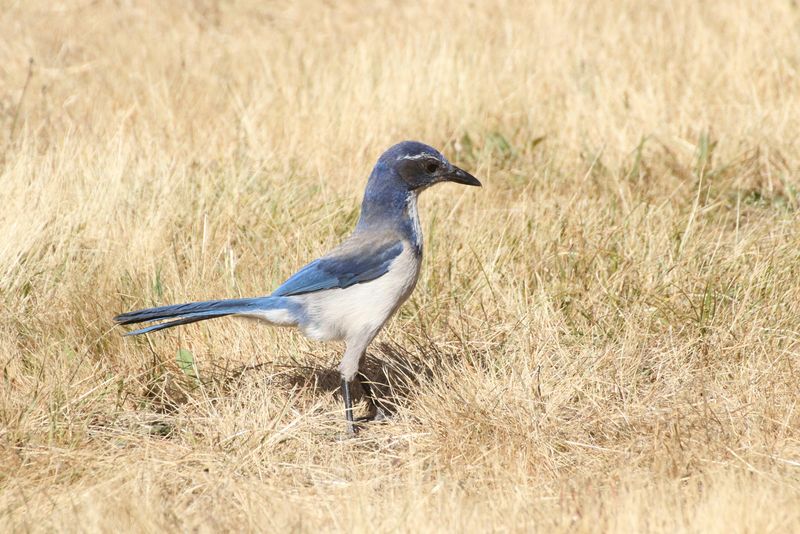
That noisy blue bird digging in your lawn may be doing more than making a mess. California scrub-jays carry acorns away from oak trees and hide them in the ground to eat later.
Some of those acorns get left behind, and a few may sprout. Here is what the research says, and what you can do in your own yard.
A scrub-jay stores acorns as food
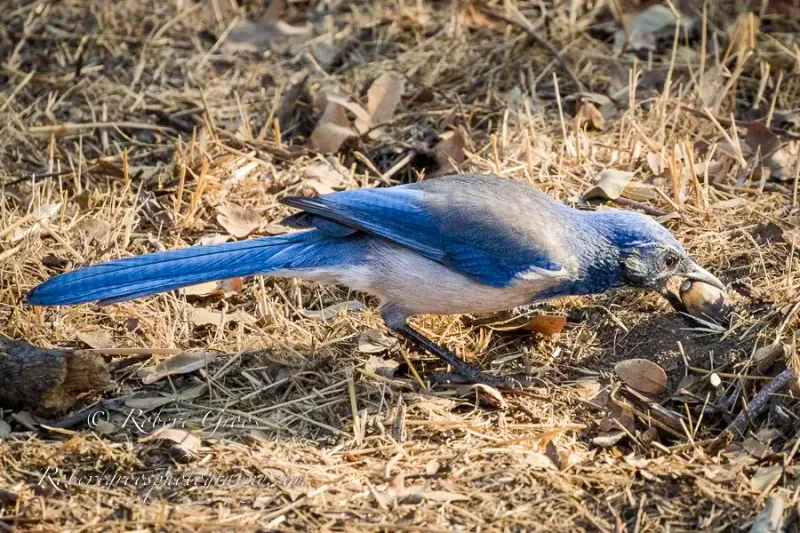
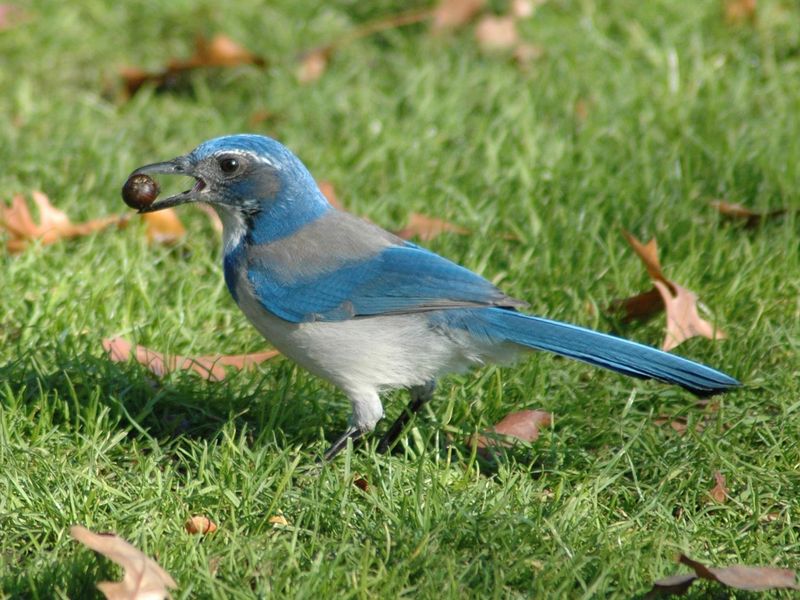
Watch a California Scrub-Jay near an oak in fall and you may see a pattern. The bird grabs an acorn, flies off, and pushes it into soil, mulch, or turf.
Then it often covers the spot and heads back for more.
That behavior is food storage. Jays hide acorns so they can eat them when other food gets scarce.
They are not gardening for you, and they are not picking out a good spot for a future tree.
Still, carrying acorns away from the parent tree can spread seeds. A study of urban Sacramento jays documented acorn transport and caching, which shows how these birds can move oak seeds beyond the shade of the source tree.
A jay that stores an acorn and never comes back for it leaves that seed in the ground, and an unclaimed acorn has a chance to sprout.
That chance comes with plenty of limits. Not every cache gets forgotten, and a jay may dig up what it buried.
Not every jay stores acorns, and not every hiding spot will suit an oak. A cache in a flower bed, beside a foundation, or under a power line is a poor place for a tree that may grow large.
So the next time a jay scolds you from the fence and then hops across the lawn with an acorn, you are seeing a bird do its own chores. Whether that acorn ever becomes an oak is a separate question, and the next sections sort it out.
What urban research shows about acorn travel

Sacramento gives us a useful look at city jays. In a two-season study, researcher Joseph Airola watched jays at two urban sites and wrote up what he saw in Western Birds.
Jays moved acorns for at least 117 days.
The recorded trips from acorn sources to cache areas averaged 160 meters, about the length of one and a half football fields. The longest reached 670 meters.
That means acorns ended up well away from the trees that produced them.
The study also estimated how many acorns were cached. The figures were about 6,800 at one site and 11,000 at the other.
Those are estimates built from observations and assumptions. The researcher did not track every bird or every cache.
Keep the numbers in perspective. They describe two study sites, not a typical yard, and they are not a count of trees.
A bird in your neighborhood could move more acorns, fewer acorns, or none at all. City jays may also rely on acorns less than jays living in woodland.
The practical meaning is simple. Urban jays can carry acorns beyond the parent tree and hide them in the ground.
What happens to those acorns afterward is a different story.
A dispersed acorn is not a guaranteed oak

Moving an acorn and growing a tree are two very different things. Earlier work at Hastings Reservation, described in a U.S.
Forest Service proceedings paper, reported jays caching thousands of acorns per bird in a year. The jays recovered most of them, with a 95% recovery estimate attributed to that earlier work.
That figure is not a rule for every bird, year, or yard. Some unrecovered acorns were seen germinating.
Plenty can go wrong after that. A jay may come back for the acorn.
The site may be too dry or too shady. Drought, gophers, and other animals can kill a seedling before it gets going.
One coast live oak experiment showed how rough the odds can be. The U.S.
Forest Service study found that 9% to 30.6% of acorns were established seedlings by October, depending on treatment. It ran for just one season with unusual spring rain, so those numbers are not typical yard results.
Drought and gopher losses mattered.
The Sacramento work did not follow caches through germination. That study did not measure how many acorns became seedlings or mature oaks.
Think of a jay as a seed mover that sometimes leaves an acorn behind. Seeing one bury an acorn is a reason to watch the spot, not a promise of a tree.
Decide whether to leave a cache undisturbed
If you spot a jay burying an acorn where an oak could fit, the easiest choice is to leave it alone. Skip the digging and the relocating.
Mark the area in your mind, or with a small stake, and check it in the months ahead.
This is a low-effort option based on what is documented. The Sacramento research shows jays cache acorns away from source trees, and earlier Hastings Reservation observations include unrecovered acorns that germinated.
Nobody has tested it as a way to produce a tree, so treat it as a no-cost gamble.
You do not have to keep every seedling that appears. If a sprout comes up in a spot that will not work, you can decide what to do then.
Part of the point of waiting is that it keeps your options open.
As for chasing jays off, the law is more nuanced than a simple yes or no. Standing at the window watching is fine. Harassing birds or disturbing an active nest with eggs is another matter, so check with the California Department of Fish and Wildlife if you are unsure.
In the meantime, a bird doing its usual routine in a corner of your yard is not a problem to fix.
Check whether an oak fits the location
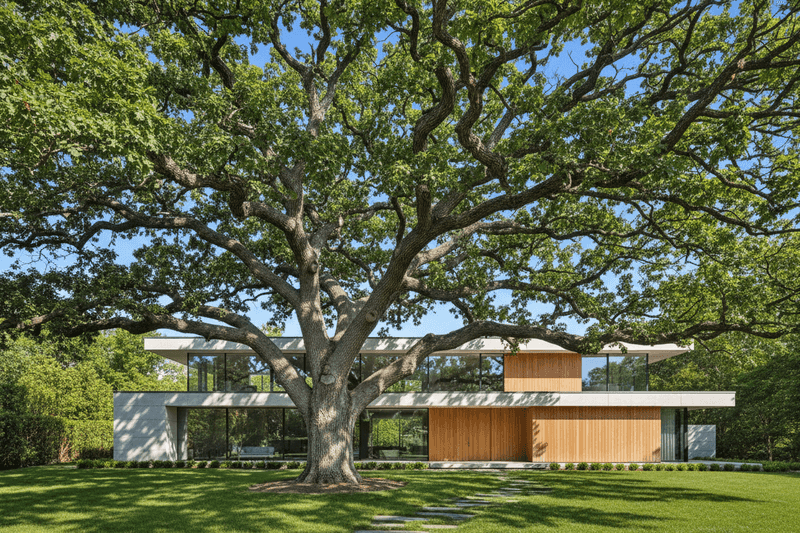
Before you cheer for a seedling, picture the tree at full size. Oaks can grow big, and a spot that looks roomy now may feel tight in thirty years.
Think about the house, fences, pipes, sidewalks, and power lines.
Species matters too. California has several native oaks, and each has its own mature size and needs.
Find out which one you have before you decide.
Roots are the next check. UC Master Gardeners of San Luis Obispo County note that native oaks have extensive roots, and they advise avoiding soil disturbance around established trees.
If a seedling sits near an older oak, think about how digging or changes to the soil could affect the larger tree.
Water habits deserve a look as well. The same guidance cautions against frequent summer irrigation around established oaks, so a lawn sprinkler that soaks the area every week could cause trouble.
A young oak is different, and a newly planted one may need establishment watering. Do not apply mature-oak rules to a seedling without thinking it through.
If the spot passes the test, you can let the seedling grow and keep an eye on it. If it does not, you can choose a better location and plant on purpose, which the last section covers.
Plant an acorn deliberately for more control
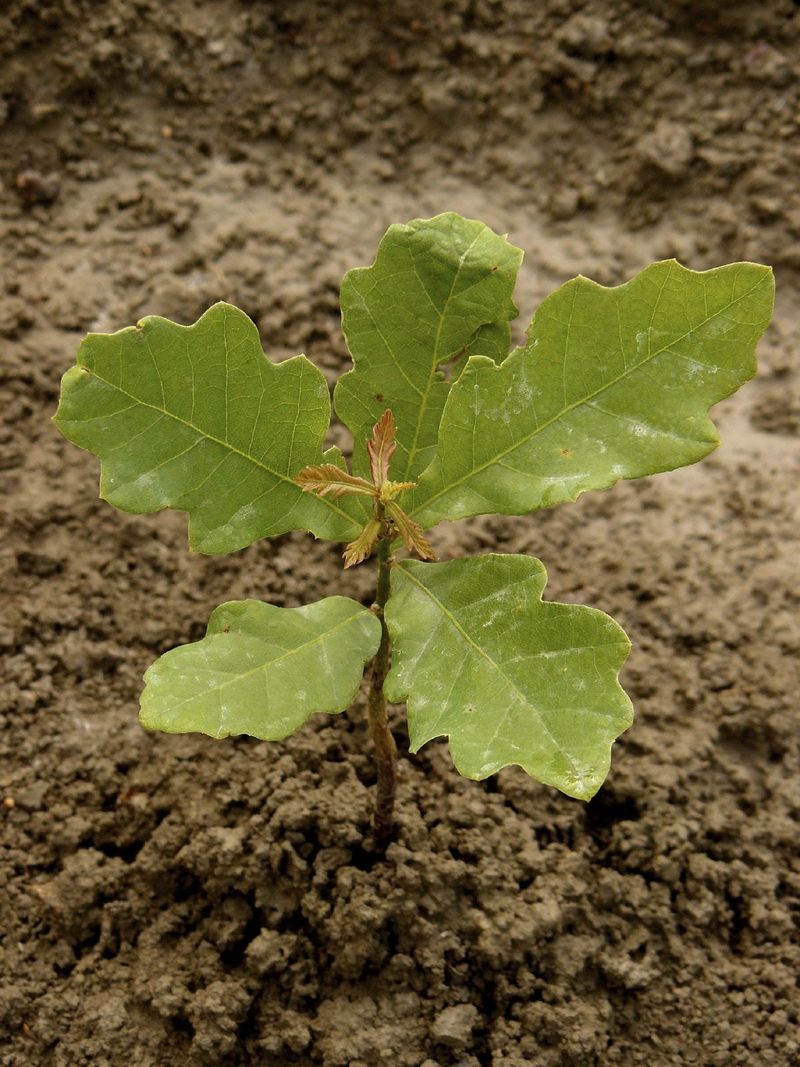
If you want an oak and want to pick the spot, you can plant one yourself. UC guidance on living among the oaks says to plant after fall rains have moistened the soil.
Place the acorn on its side, about 0.5 to 1 inch deep.
Timing matters because acorns dry out and lose viability. Do not leave collected acorns sitting around in a warm garage or on a dry porch.
Get them into moist soil promptly.
Those directions are for direct planting. They are not a description of how deep or in what position a jay hides its acorns.
A bird’s cache follows its own habits.
Picking the spot yourself means you can pass over the corners where an oak would crowd a wall or a pipe. You can also pick a place where the future root zone and canopy have room.
A planted acorn still faces drought and hungry animals, so check on it as it grows.
So the choice is yours. Leave a cache where an oak can fit, or choose a planting site and do it yourself.
Either way, the jay will keep burying acorns whether or not you are watching.