
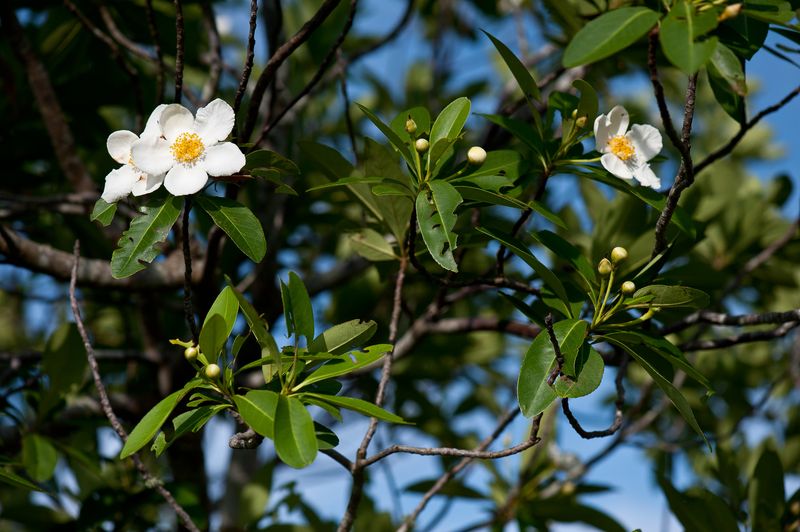
Most North Carolina gardeners looking to help pollinators reach for the usual suspects: coneflowers, black-eyed Susans, or a dogwood by the driveway. What rarely comes up is a native tree growing quietly in the Coastal Plain that opens fragrant, camellia-like white flowers right through the heat of summer, when many ornamental plants have already gone quiet.
Loblolly bay (Gordonia lasianthus) is that overlooked option, and for homeowners in the right region with the right soil, it can fill a real gap in the summer nectar calendar. Getting the most from it means understanding where it thrives, what it honestly delivers, and how to pair it with other native plants for coverage across the whole growing season.
Meet the Coastal Plain native behind the corrected recommendation
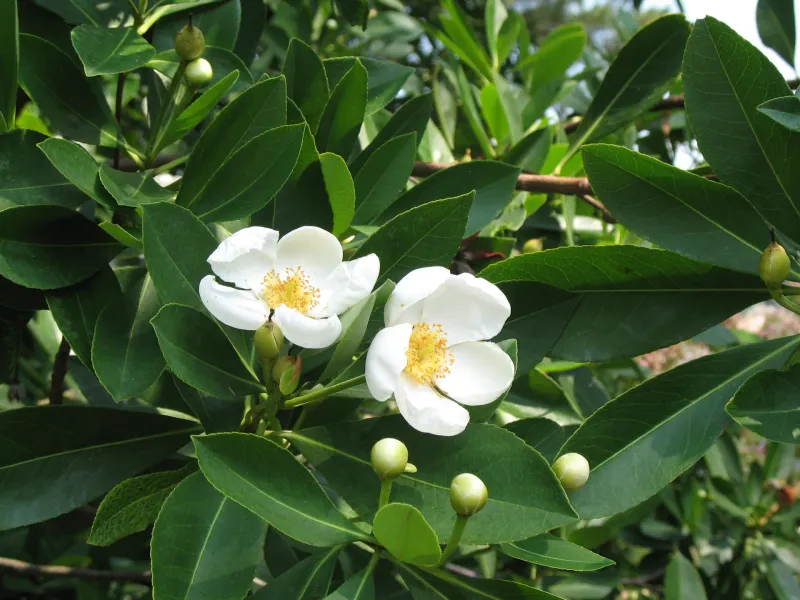
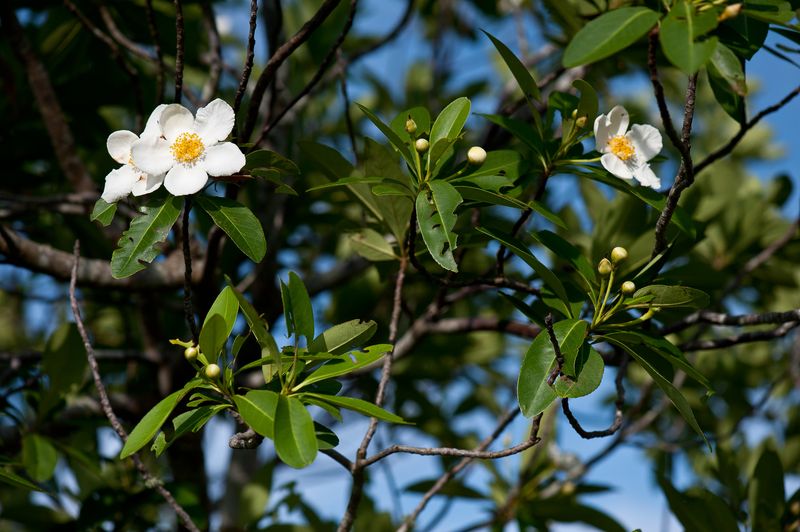
Gordonia lasianthus goes by several names, but most North Carolina gardeners know it as loblolly bay, a reference to the low, boggy “bays” and pocosins where it naturally grows across the Coastal Plain and southern Tidewater. It is not a bay laurel and not a true magnolia, though its flowers could fool you at first glance.
The white blooms are rounded, five-petaled, and fragrant, with a resemblance to camellia that makes them stand out among native trees.
The tree is evergreen or broadly evergreen, holding glossy foliage through most of the year. In its natural range, you find it in bayheads, wet pine savannas, acidic swamp forests, and pocosin edges, places defined by moist, acidic soils and open to partly shaded canopies.
NC State Extension’s plant profile confirms its native status in North Carolina and lists bees, hummingbirds, and other pollinating insects among the documented visitors to its nectar-producing flowers.
What earns loblolly bay a second look is not a single dramatic quality but a combination: extended summer flowering, evergreen structure, and wildlife value, all from a tree most Coastal Plain nurseries rarely stock. The honest framing is that it can extend summer nectar availability on a suitable site, not that it is the best or most broadly useful native tree statewide.
Piedmont and mountain gardeners are working with different soils, different moisture regimes, and a different native plant palette, and loblolly bay is not a reliable fit for those conditions. For Coastal Plain homeowners with acidic, moist ground and room for a tree that may reach 30 to 75 feet, the case for a closer look is real.
Its flower succession can extend summer nectar
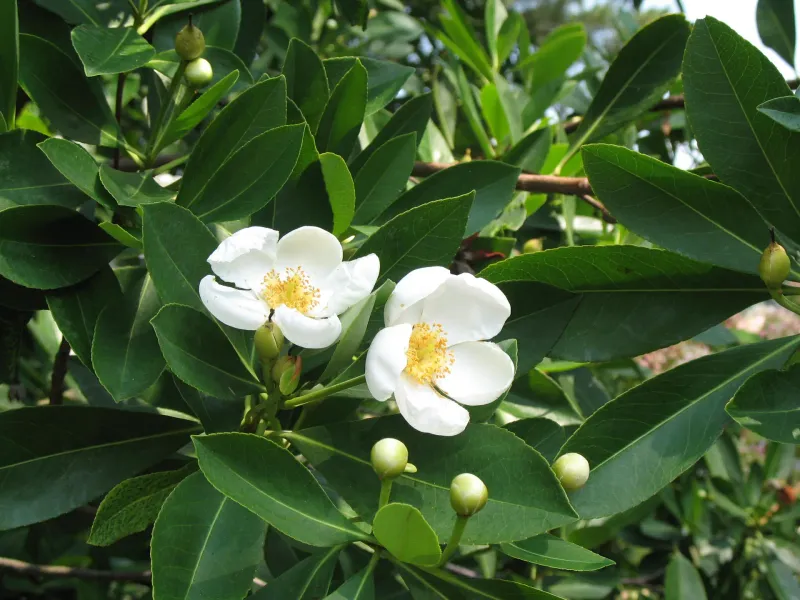
A common question about loblolly bay is how a tree can bloom for weeks or months when each individual flower lasts only one or two days. The answer is succession.
Rather than opening all its buds at once, the tree staggers flowering across its canopy over an extended period, so new blooms keep appearing as older ones drop. U.S.
Forest Service silvics data for loblolly bay documents this pattern and lists bumble bees, flies, thrips, and hummingbirds among the recorded visitors, alongside other pollinating insects.
The tricky part is pinning down exactly when that succession runs. Published sources give different windows.
A USDA conservation cover technical guide lists loblolly bay as blooming from May through November, which would make it one of the longest-running native tree bloomers in the region. Forest Service field observations from the Carolinas, however, place the main flowering period in late June or early July through mid-August.
NC State’s profile describes it as a summer bloomer that may continue until frost in some years.
Those three windows do not fully agree, and that disagreement matters for anyone planning a pollinator garden around specific months. Bloom timing is shaped by site conditions, local climate, and individual tree variation, so what holds for one yard in Brunswick County may differ from a tree planted an hour north.
The defensible conclusion is that loblolly bay can provide extended summer nectar, with the heaviest flowering likely concentrated between late June and mid-August in the Carolinas. Counting on it as a verified, dependable spring-through-fall nectar source is a stretch the available evidence does not support.
For a Coastal Plain homeowner trying to fill the mid-summer gap when spring bloomers are finished and fall asters have not yet opened, that summer window is genuinely useful. It is just not the same as a continuous, season-spanning supply.
The tree adds cover and seasonal structure beyond nectar
Nectar is only one way a tree earns its place in a wildlife-friendly yard. Loblolly bay contributes in other ways that are worth naming separately rather than lumping together under a general “wildlife value” label.
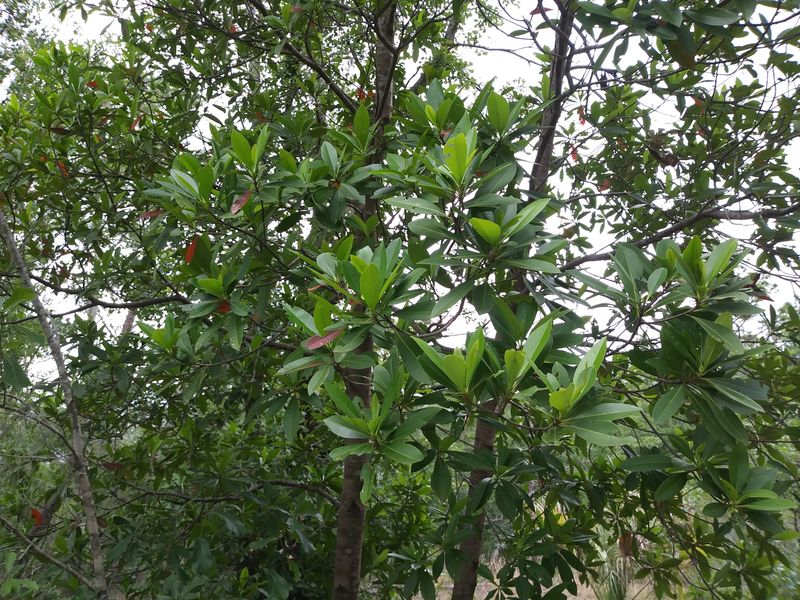
The tree’s glossy, evergreen or broadly evergreen foliage holds through most of the year, giving it a structural role that deciduous trees cannot fill in winter. Its form is generally narrow, running columnar to pyramidal, which means it provides a vertical accent and canopy layer without spreading as wide as many shade trees.
Some leaves turn scarlet in fall before dropping, adding seasonal color to what is otherwise a year-round green presence. NC State’s plant profile confirms the evergreen foliage and fall color as part of the tree’s seasonal interest.
On the wildlife side, North Carolina Sea Grant’s coastal landscaping guide identifies loblolly bay as a wildlife-habitat tree that attracts birds and butterflies. That designation covers more than nectar: evergreen canopy can provide shelter and nesting cover for birds, and the tree’s form gives vertical structure in a planting bed or woodland edge.
The coastal guide also notes that loblolly bay has no salt tolerance, which is an important limit for homeowners on exposed barrier island or high-spray shoreline sites.
None of these benefits include pest reduction, mosquito control, or tick suppression. Loblolly bay is a habitat and nectar plant, not a pest-management tool, and overstating that angle would set up unrealistic expectations.
What it does offer, honestly described, is a year-round structural presence, documented wildlife use, and summer flower interest that most ornamental trees in the same size class cannot match.
Test your site before you choose the tree
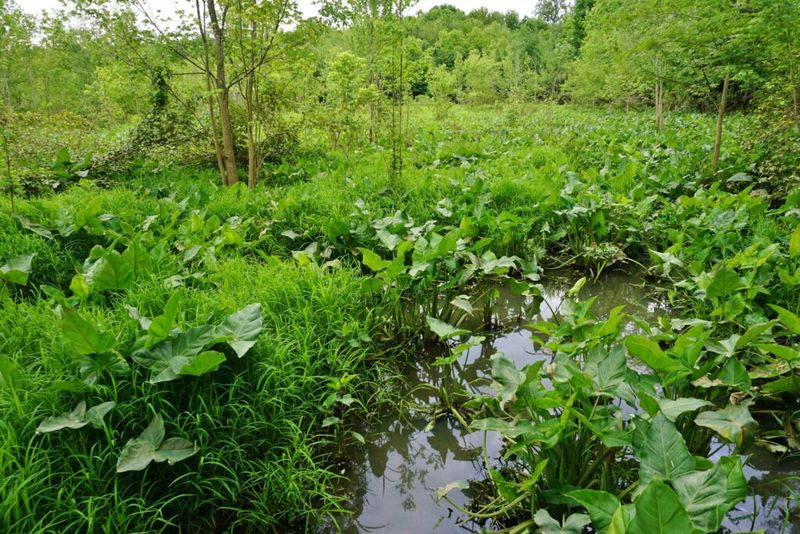
Before ordering a loblolly bay, walk your property and ask four honest questions: Is the soil acidic? Does the ground stay consistently moist without sitting underwater for weeks at a time?
Does the spot get full sun to partial sun? And is there enough vertical clearance for a tree that may reach 30 to 75 feet tall?
Loblolly bay’s natural habitat gives the clearest picture of what it needs. Pocosins, bayheads, and wet pine savannas share a few consistent traits: acidic, organic-rich soils, moisture that rarely disappears but rarely becomes a permanent pond, and open to partly shaded canopies.
NC State’s guidance recommends moist, well-drained conditions with acidic soil and notes that occasional wetness or brief flooding can be tolerated. That is different from a low spot that holds standing water for weeks after heavy rain.
The distinction between “moist” and “chronically saturated” matters practically. The NC Sea Grant coastal landscaping guide specifies that loblolly bay does not tolerate prolonged standing water, even though it naturally grows near wetlands.
A yard with a slow-draining clay pan or a depression that stays flooded after storms is not a suitable match.
Piedmont and mountain homeowners face a different set of obstacles. Dry, alkaline, or compacted soils are common in developed Piedmont neighborhoods, and those conditions work against loblolly bay from the start.
Being native to North Carolina does not mean the tree is adapted to every North Carolina yard. Regional nativity and site suitability are separate questions, and conflating them leads to a poorly placed tree that struggles or fails.
On space: a mature loblolly bay in good conditions can reach considerable height, and its narrow form does not eliminate overhead clearance concerns. Check for power lines, roof overhangs, and neighboring structures before selecting a planting spot.
A tree placed well from the beginning is far easier to care for than one that needs correction later.
Plan for a demanding establishment period
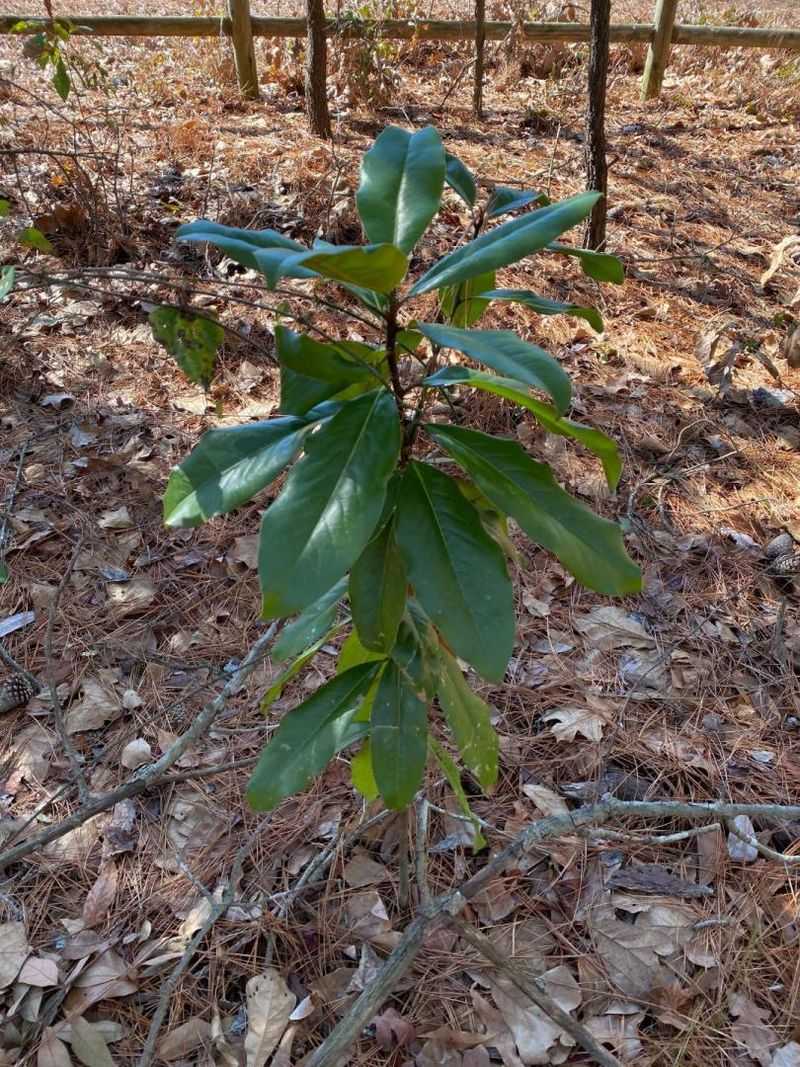
Choosing the right site is step one. Getting the tree through its first few years in the ground is where loblolly bay earns its reputation as a finicky plant.
NC State is direct about the challenges: the tree can be difficult to establish, may be short-lived compared with other native trees, can be hard to find at local nurseries, and is susceptible to root rot when immature. NC State’s plant profile classifies it as medium maintenance, which means it is not a plant-and-forget choice.
Starting with container-grown nursery stock is the most reliable approach. Wild-dug plants rarely survive transplanting because loblolly bay forms specific root associations with its native soil environment, and disturbing those relationships during digging causes high mortality.
Sourcing from a nursery that grows the plant in containers from seed or cuttings sidesteps that problem. Be prepared to search: commercial availability is limited, and not every native plant nursery carries it regularly.
Calling ahead or joining a local native plant society network can help locate stock.
During establishment, the distinction between moist soil and chronic saturation becomes especially important. Young plants are particularly vulnerable to root rot in poorly drained conditions, even though mature trees in natural habitats can handle periodic flooding.
Keeping the root zone consistently moist but not waterlogged through the first one to two growing seasons gives the plant the best chance of developing a stable root system.
Medium maintenance means monitoring matters. Watch for signs of root rot (wilting despite moist soil, yellowing lower leaves, soft bark at the base) and address drainage problems early rather than waiting to see if the tree recovers on its own.
Realistic expectations going in, rather than hope that the tree will simply adapt, make the difference between a successful planting and a frustrating replacement cycle.
Build a pollinator planting around seasonal gaps
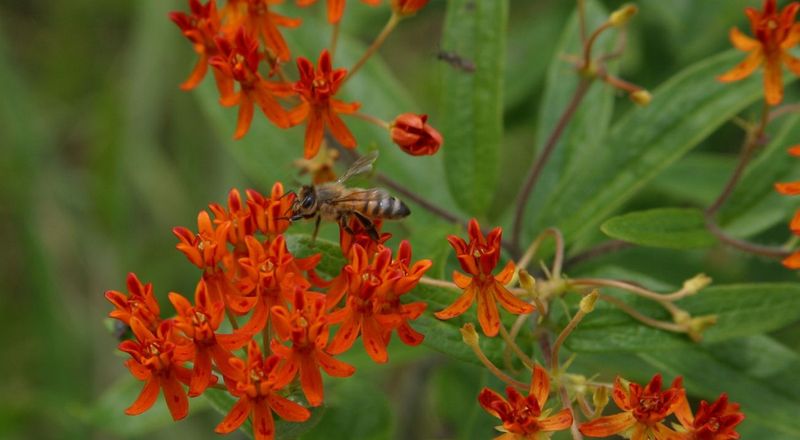
Loblolly bay can anchor the summer portion of a pollinator planting, but summer is only one part of the calendar that matters. Bees, butterflies, and hummingbirds need consistent food sources from early spring through late fall, and a single tree cannot cover that span reliably on its own.
NC State Extension’s pollinator habitat guidance recommends a diverse mix of native plants with varied flower colors, shapes, and bloom periods, with the goal of having several species blooming in each month from March through November when possible. The NC State Extension Gardener Handbook’s native plants chapter reinforces that target, recommending at least three native species blooming in each of spring, summer, and fall.
For a Coastal Plain yard built around loblolly bay, that means adding plants that cover the months before and after the tree’s main summer flowering window. Early spring options include native shrubs like Carolina jessamine or native azaleas that open well before the tree begins flowering.
For late summer into fall, native goldenrods and asters are workhorses: they bloom from late August through October or beyond, attract a wide range of bee species, and are relatively easy to establish in Coastal Plain soils.
Positioning loblolly bay within a layered planting rather than as a standalone specimen makes the most of what it offers. The tree’s height and evergreen structure can anchor the back of a bed or a naturalized edge, while shorter native shrubs, perennials, and groundcovers fill in the spring and fall gaps at lower levels.
That combination creates a planting that supports pollinators across more of the year than any single plant could manage alone, and it makes the garden more resilient if loblolly bay has a shorter flowering window in a given year.
Compare seasonal roles instead of declaring a winner
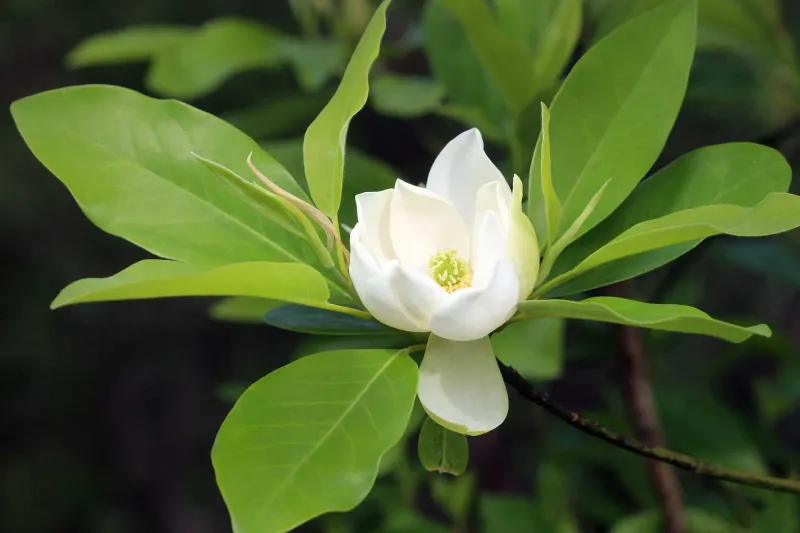
Several native North Carolina trees come up whenever the conversation turns to summer nectar, and each one occupies a different seasonal slot rather than competing directly with loblolly bay for the same role.
Sweetbay magnolia (Magnolia virginiana) is a relevant comparison because it is also a Coastal Plain native that tolerates moist, acidic conditions. North Carolina Parks records sweetbay magnolia flowering from April through July, while a USDA NRCS pollinator trees technical note lists June through September.
That range suggests a late-spring-to-summer window with some overlap with loblolly bay’s main period. Sweetbay magnolia is more broadly represented across North Carolina’s Coastal Plain and into the Piedmont than loblolly bay, but broader distribution is a statement about where the species naturally occurs, not about where it can be successfully planted in any yard or soil type.
Sourwood (Oxydendrum arboreum) is one of the most important honey trees in the eastern United States, with documented bloom generally running June through August. Its nectar is highly regarded, and it serves as a reliable mid-summer resource, but its window does not extend into spring or deep into fall on its own.
Tulip poplar (Liriodendron tulipifera) is a major native nectar source, but its flowers are concentrated in spring and early summer. It is also a very large tree, and its documented vulnerability to wind damage makes it a poor fit for many smaller residential yards or exposed coastal sites.
None of these trees covers spring through fall on its own. The practical takeaway is that each offers a different seasonal contribution, a different size, and a different set of site requirements.
Choosing among them is a matter of matching the tree to the site and the gap in the planting calendar, not ranking one as better overall.
Choose loblolly bay for the site, not the slogan
Coastal Plain and southern Tidewater homeowners with acidic, moist, well-drained ground have a genuine reason to consider loblolly bay. As an underused native tree with documented summer nectar, evergreen structure, and wildlife value, it can fill a real gap that most ornamental or commonly planted trees leave open in July and August.
The honest limits are just as worth stating. Loblolly bay cannot guarantee nectar from spring through fall, it is not a low-effort plant, and it is not suited to every North Carolina yard or region.
NC State’s guidance is clear that establishment is demanding and commercial availability is limited. Pairing it with native plants that bloom earlier and later, following NC State’s recommendation for at least three native species in each season, is what turns a single tree into a planting that actually sustains pollinators across the year.
Start with your site conditions, find nursery-grown stock from a reputable native plant source, and treat loblolly bay as one well-chosen piece of a larger planting rather than a complete solution. A tree planted for the right reasons in the right place tends to outlast the enthusiasm of any single gardening season.