
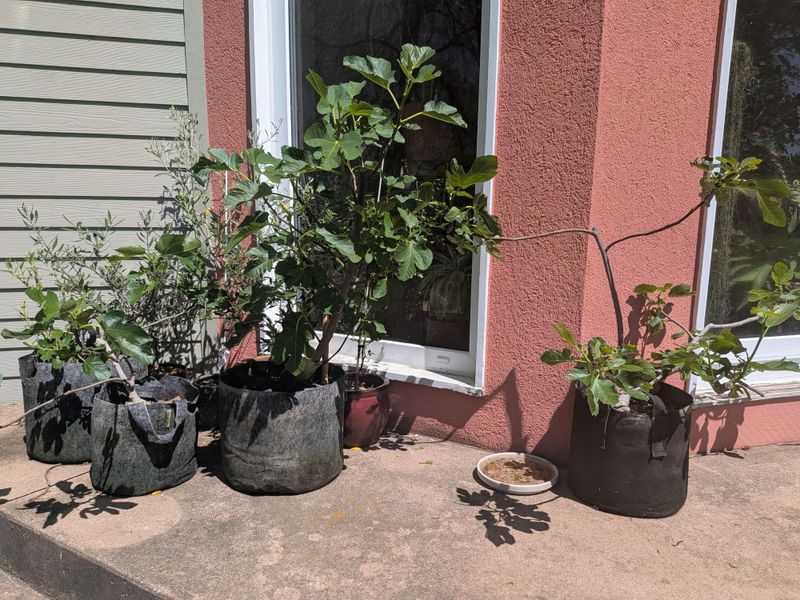
Moving a potted fig into the garage feels like the safe thing to do when winter turns nasty. But some gardeners worry that a garage that gets too warm might nudge the tree awake early and put next year’s figs at risk.
Is that really true, or is it a worry that sounds scarier than it is? Here is what we know, what we don’t, and how to keep your tree on track.
Cold protection depends on where you garden in Texas
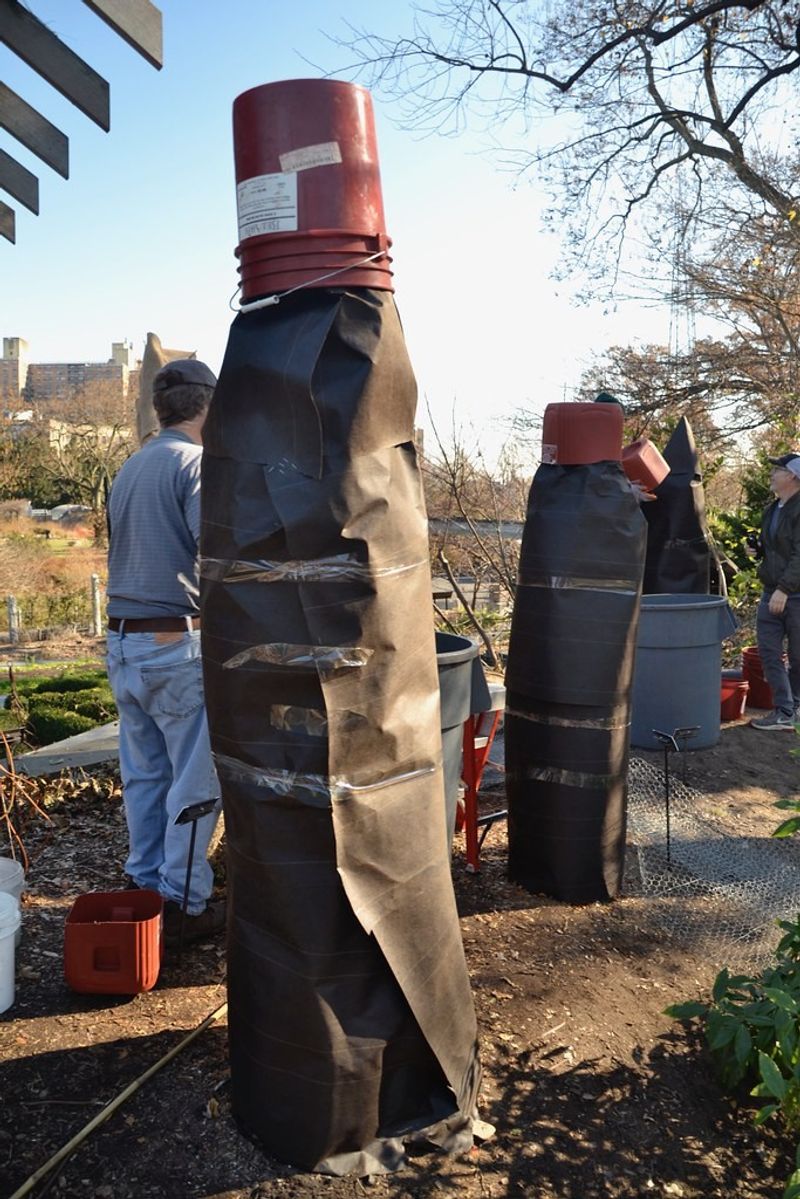
Figs grow across Texas, but not every Texas fig needs the same winter care. Texas A&M AgriLife guidance on growing figs says trees in far northern and western parts of the state are the ones that need cold protection.
If you garden in the Gulf Coast, Central Texas, or the southern part of the state, your potted fig may do fine outside with a little attention.
That regional split matters for containers. The A&M advice about growing in-ground figs in a bush form to help with freezes is meant for trees planted in the soil, so it is not a rule for pots.
A pot is its own situation, because the roots sit above ground and have no soil around them to soften a hard freeze.
So think of the garage as one option for protecting exposed roots, not a requirement. It works well for some gardeners in colder pockets.
For others, it may not be needed at all, or the space may not be suitable. Start with your local winter lows, then decide.
Move the pot after leaf fall and before a hard freeze
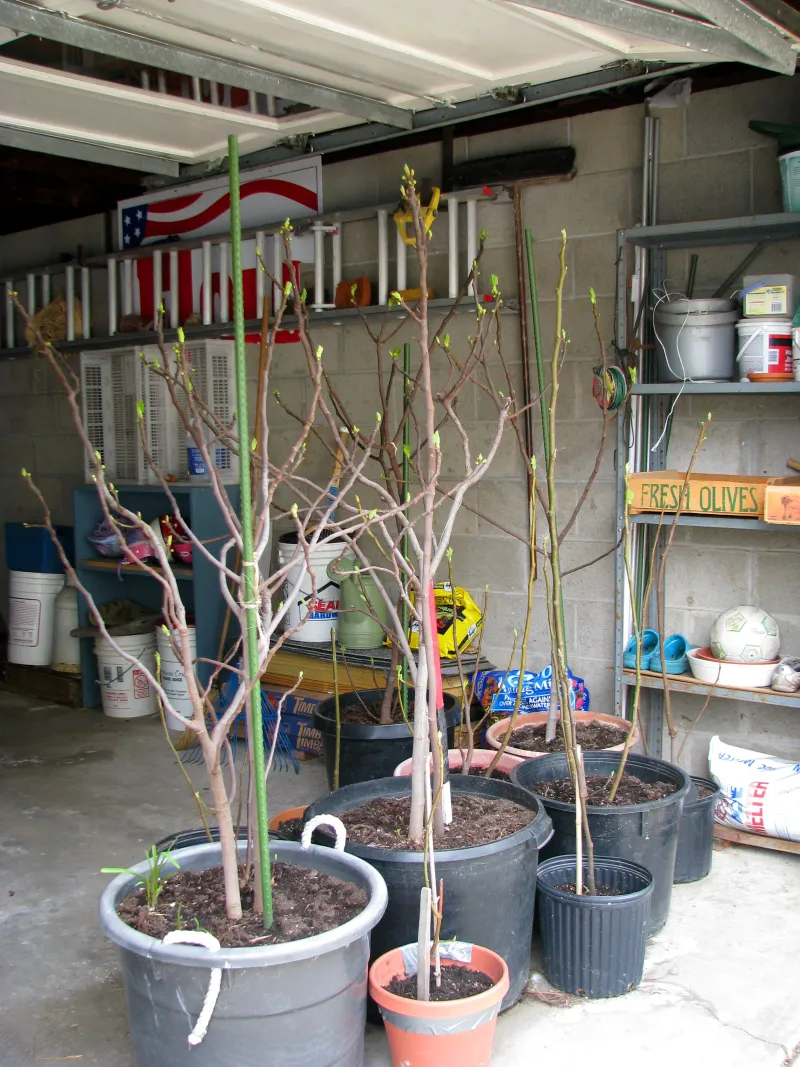
Let the leaves tell you when to move. Once your fig drops its foliage, it has settled into dormancy and is ready for shelter.
An Ask Extension response on winterizing potted figs suggests an unheated garage and checking the soil moisture along the way.
The goal is to get the pot in before a hard freeze arrives. Watch the forecast in November and December, and keep a spot cleared so you can move quickly.
A wheeled plant caddy makes a heavy pot much easier to shift.
Shelter is about the roots, not about keeping the tree cozy. Iowa State Extension explains that roots in above-ground containers can get much colder than roots in the ground.
A protected spot softens the worst cold without trying to keep the tree growing.
Timing will vary by where you live. A freeze may come in early December in the Panhandle and weeks later farther south, so let your local weather guide you rather than a fixed calendar date.
Measure garage temperatures instead of guessing
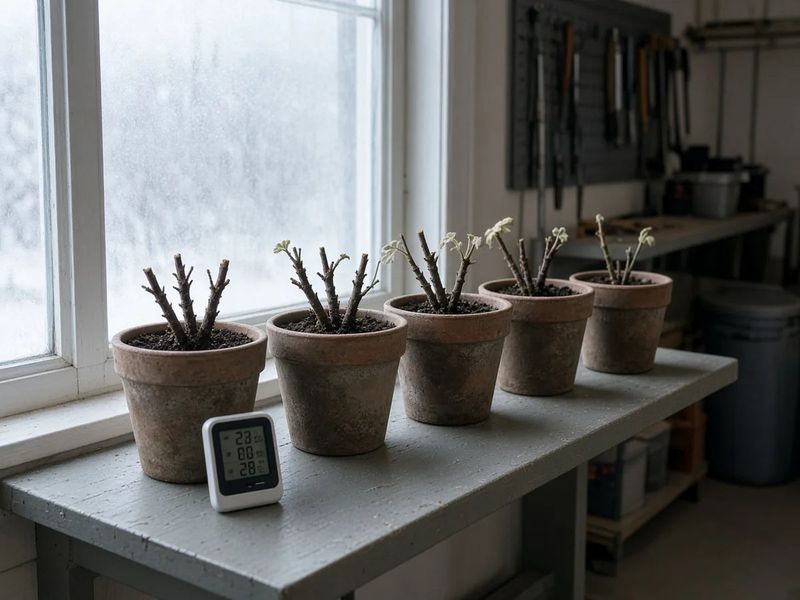
Garages are moody places. Sun on the door can warm the space by afternoon, and a clear night can drop it back down fast.
Guessing leaves you with a false sense of how your tree is really living.
A simple min/max thermometer solves that. It records the warmest and coolest readings since you last reset it, so you can see the swings you would otherwise miss.
Check it every few days and reset it each time.
For a comparison point, Iowa State Extension describes an unheated space of roughly 20 to 45 degrees F as suitable for overwintering container plants. Treat that as general guidance for container plants, not a fig-specific rule.
It also does not prove that a reading of 50 degrees will trigger budbreak or cost you a crop. The number is a handy yardstick.
Your thermometer log, plus a look at the buds, tells you what is actually happening in your garage.
Early budbreak does not automatically erase the next crop
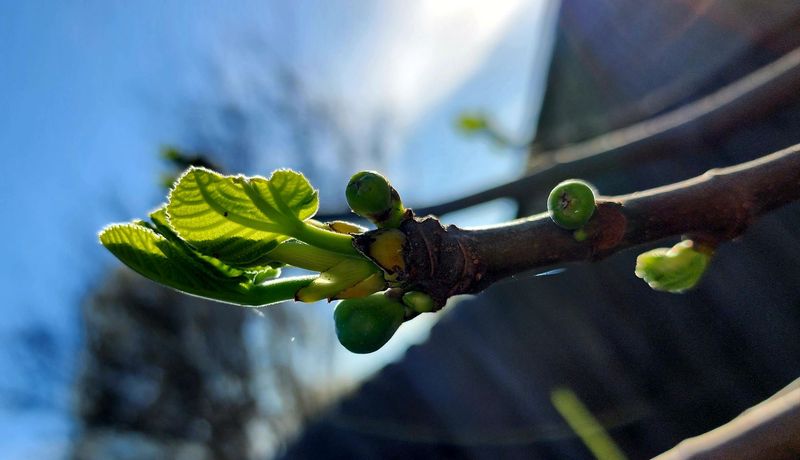
Seeing green tips in February can feel like a disaster, but it does not mean the harvest is gone. According to UC IPM’s fig guide, figs need very little winter chilling to fruit.
They are not like apples or peaches that depend on long cold stretches.
It helps to know there are two possible crops. The breba crop, when a variety makes one, forms on the previous year’s growth.
The main crop forms on the current season’s growth, which has not even grown yet when buds first swell.
Not every tree makes both. LSU AgCenter notes that some varieties produce a small breba crop or none at all.
Rutgers Extension adds that variety and pruning affect whether you get one crop or two, and that two-crop types may not deliver both every year.
So find out which type you own. If yours is a main-crop-only variety, early buds alone say little about the coming figs.
A freeze after growth starts is a separate, conditional risk
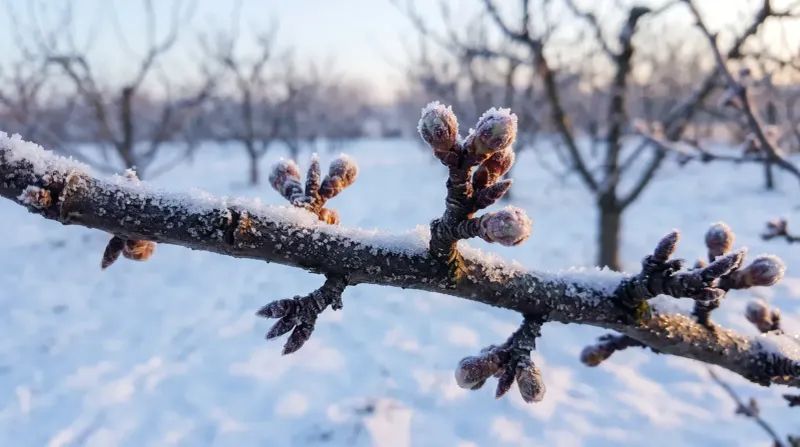
Cold is rarely the problem for a sleeping tree. The trouble comes if the tree has begun to grow and a freeze follows.
LSU AgCenter describes fully dormant trees as more cold-resistant than those that have not gone dormant, and points to untimely freezes as a major cause of winter injury.
The realistic concern is tender new growth. Fresh shoots and leaves have little cold tolerance, and Iowa State guidance on freeze damage says freezing can harm new spring growth and flowers, with crop effects depending on the species and growth stage.
What that means for your harvest is not fixed. It depends on your variety and on what was actually growing when the cold hit.
An injured shoot does not necessarily wipe out the main crop, since new shoots can often grow again.
If a freeze is forecast after buds have opened, you can move the pot back into shelter for the night. Then wait and see what grows.
Check soil moisture without keeping the dormant fig soggy

A sleeping fig drinks very little, but the mix should not turn to dust. Poke a finger a few inches into the pot every couple of weeks.
If the top 2 to 3 inches feel dry, water sparingly.
That approach matches what Ask Extension advice on potted figs describes, with light watering when the upper layer dries and care not to overdo it. The earlier winterizing answer also stresses checking moisture rather than following a calendar.
Skip two extremes. A pot left bone dry for months can stress the roots, and a heavy, regular soaking can leave the mix soggy and invite rot.
Make sure the pot drains freely and never sits in a saucer of water.
Give just enough water to dampen the mix, not drench it. A small amount, checked again in a couple of weeks, is a safer habit than a fixed schedule.
Use the garage as protection, not as a promise of a harvest
Work through it step by step. Look at your local cold exposure, since Texas A&M ties protection needs mainly to far northern and western areas.
Move the pot after leaves drop, and track the garage temperature swings. Check the soil occasionally, and watch for tender growth while freezes are still possible.
A warm garage alone has not been shown to cost you a crop, and breba and main crops form on different-aged wood. A garage guards roots, and your attention guards the rest.