
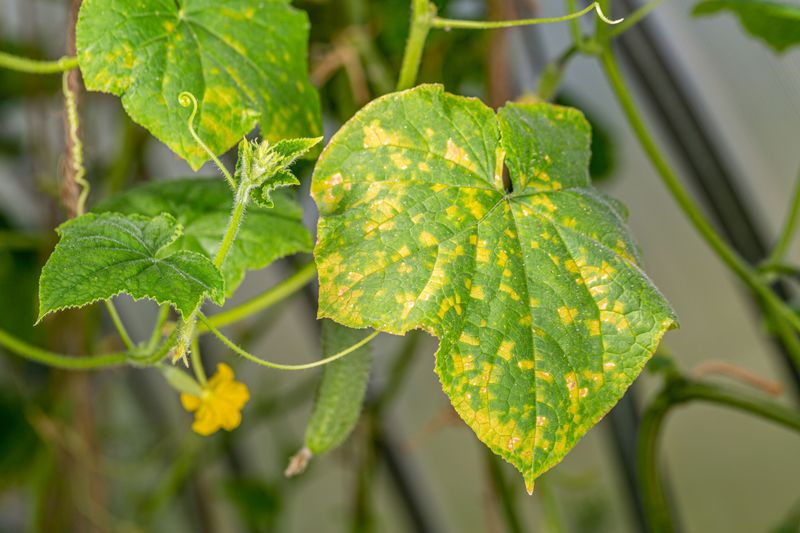
Watching the bottom leaves of your cucumber plant turn yellow while the rest of the vine still looks green can stop you cold in the garden. The good news is that bottom-up yellowing follows a pattern, and that pattern gives you real clues to work with.
Before you reach for fertilizer or start pulling leaves, a few quick checks around the roots and on the undersides of the leaves can tell you far more than the color alone. Getting the diagnosis right first means you spend less time guessing and more time actually helping the plant.
Heat is a clue to investigate, not the diagnosis
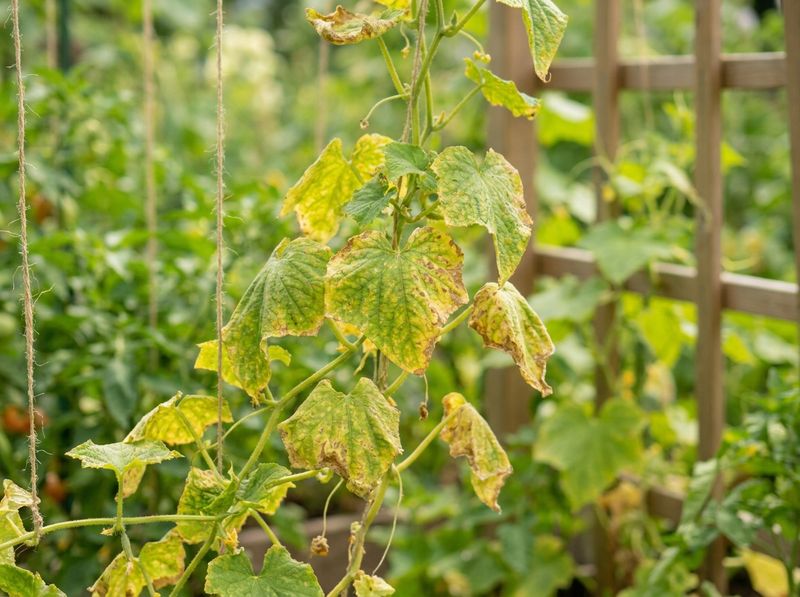
Hot, windy weather puts real stress on cucumber plants, but it does not explain everything you are seeing. High temperatures and dry wind pull moisture out of leaves faster than roots can replace it, which can cause wilting, curling, scorched leaf edges, stalled fruit growth, and even blossom drop.
Those are genuine heat symptoms. Uniform yellowing that starts at the bottom of the vine and moves upward is a different signal, and heat alone is not a reliable explanation for it.
The most informative pattern to look for is broad, even paleness across the oldest, lowest leaves, while newer leaves higher on the vine stay noticeably greener. When that pattern shows up alongside weak stems, small leaves, or slow overall growth, it can point toward limited nitrogen availability.
Nitrogen is a mobile nutrient, meaning the plant can pull it from older tissue and send it toward newer growth when supplies run low, which is why University of Minnesota Extension guidance on fertilizing plants identifies older leaves as the first place to see signs of nitrogen shortage.
Even so, that pattern is a starting clue rather than a confirmed answer. Root-zone moisture problems, spider mites, disease, and other nutrient gaps can produce similar symptoms.
The UMN Extension heat-stress guide notes that hot, dry conditions also favor spider mites, which create their own yellowing. Check the root zone and leaf undersides before drawing any conclusions.
Check the root zone before you feed the plant
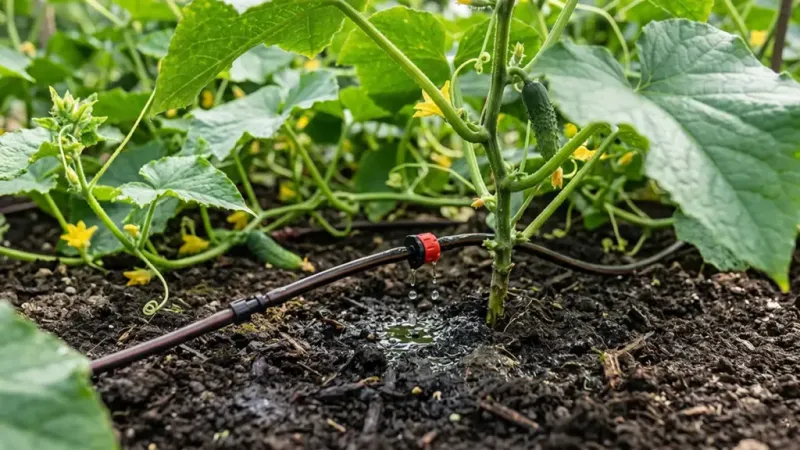
Soil moisture is the first thing to assess, and it requires more than a glance at the surface. Push a finger two to three inches into the soil near the plant’s base.
Dry, crumbly soil at that depth tells you the plant has likely been running short on water, which can slow nutrient uptake and mimic a deficiency even when fertility is fine. Saturated, waterlogged soil is equally damaging, because roots sitting in standing water lose their ability to absorb nutrients, and nitrogen in particular can leach out of the root zone after heavy rain or overirrigation.
According to Utah State University Extension’s cucumber growing guide, cucumbers need consistent, ample moisture, especially during flowering and fruiting, but they are sensitive to flooding and poorly drained soil. The goal is steady moisture without saturation.
Water deeply at the root zone when the soil is dry at finger depth, and allow excess water to drain fully before the next irrigation. Avoid the cycle of letting the soil go bone dry and then flooding it, because that stress pattern can injure roots and disrupt nutrient movement even when fertility is adequate.
Mulching around the base of the plant helps conserve moisture between waterings and keeps soil temperature more stable. Drip or soaker irrigation delivers water directly to the root zone while keeping foliage drier, which also reduces disease pressure.
If drainage is consistently poor, that structural problem needs attention before any fertilizer application will make a meaningful difference. Feeding a plant whose roots are drowning rarely helps and can make things worse.
Inspect the undersides for spider mites
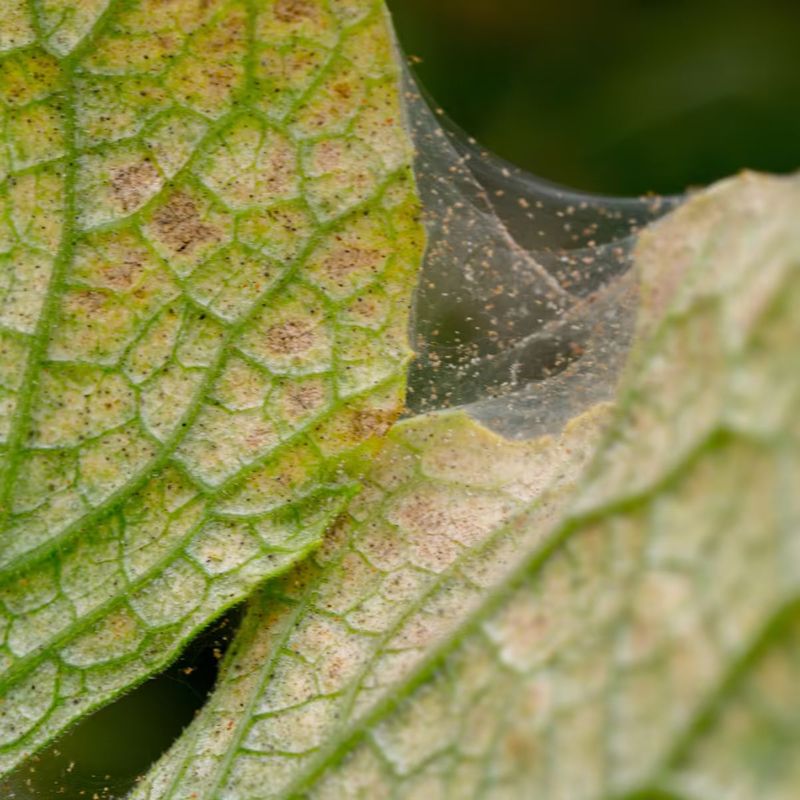
Flip a few of the yellowing lower leaves over and look carefully at the surface underneath. Spider mites are tiny, often barely visible without magnification, but the damage they leave behind is distinctive.
Look for fine pale or yellowish dots scattered across the leaf surface, a dull or washed-out look to the tissue, and in heavier infestations, delicate webbing stretched between the leaf and the stem. A hand lens or even a smartphone camera in macro mode makes the inspection much easier.
The UMN Extension cucumber leaf-discoloration diagnostic guide lists spider mites among the causes of discolored cucumber foliage, and they are especially common during hot, dry stretches in late summer. That timing matters because it overlaps with the same conditions that can trigger nutrient stress, making it easy to confuse the two.
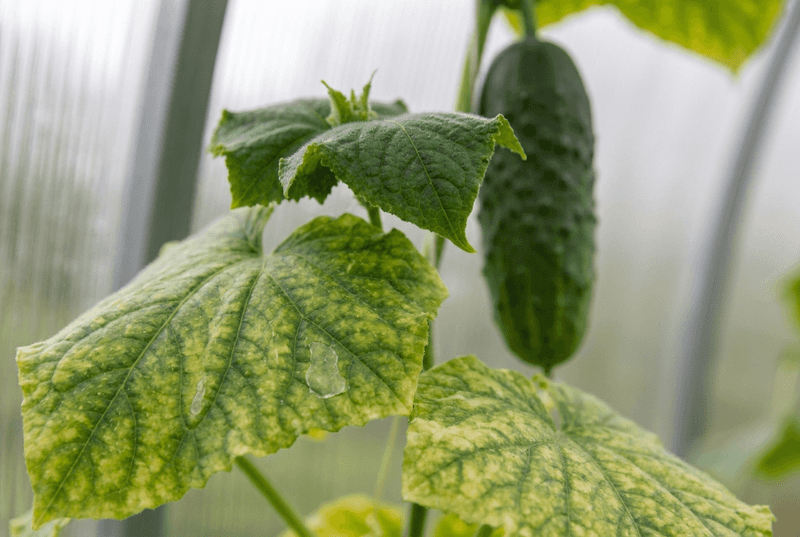
The visual difference is worth memorizing. Stippling from mites appears as a scattering of tiny pale flecks rather than a smooth, even yellowing of the whole leaf.
If you see stippling, webbing, or tiny moving specks when you hold the leaf up to light, the diagnosis shifts away from a nutrient problem entirely. Applying fertilizer will not address mite damage, and the mites will keep feeding and spreading while you wait for a response that will not come.
Identifying them early gives you a much better chance of managing the infestation before it moves to healthy upper leaves.
Use the shape of the yellowing to narrow the cause
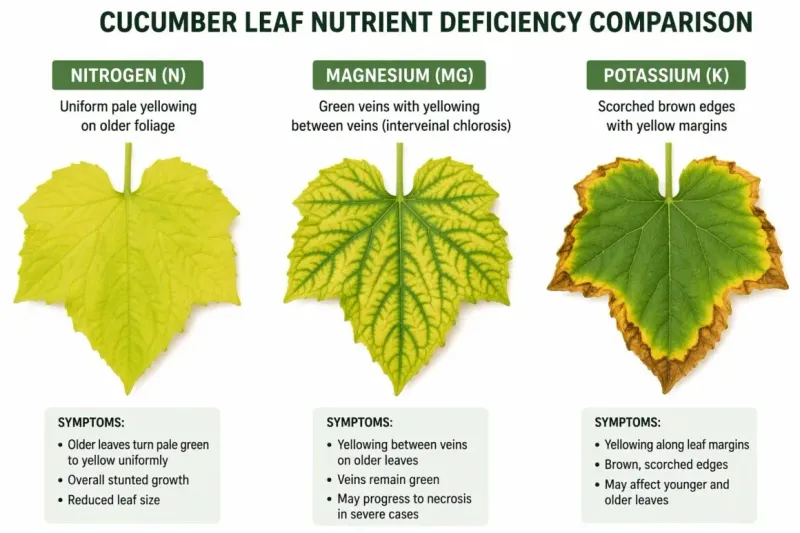
Where the yellow appears on a leaf, and what shape it takes, carries more diagnostic information than the color alone. Uniform, even paleness spread across an entire older leaf, while the veins remain a similar color to the surrounding tissue, is the pattern most consistent with limited nitrogen availability.
The plant looks generally thin or slow, and the yellowing progresses from the oldest leaves upward as the season advances.
Potassium deficiency tends to show up differently, with yellow, tan, or scorched-looking margins along the edges of older leaves rather than a wash of pale color across the whole blade. Magnesium deficiency produces interveinal yellowing on older leaves, meaning the tissue between the veins turns yellow while the veins themselves stay green.
According to the UF/IFAS Vegetable Production Handbook fertilizer management section, these nutrient patterns can overlap, and soil testing is a more reliable way to confirm which element is actually short than visual matching alone.
Disease patterns look different again. UMN Extension’s downy mildew guide for cucurbits describes the symptom as pale yellow to green angular spots that are bounded by leaf veins, often with gray or purplish fuzz on the underside of the leaf under humid conditions.
That angular, vein-limited shape sets it apart from nutrient yellowing immediately. Viral infections may show as irregular yellow-and-green mosaic patterns with distorted or curled leaves and stunted growth.
Bacterial wilt tends to present as daytime wilting that partially recovers overnight, followed by progressive collapse of the vine, sometimes with cucumber beetles present nearby. Comparing symptom geometry with the whole plant, recent weather, and any pest evidence gives a more complete picture than any single clue on its own.
Choose fertilizer only when the evidence supports it
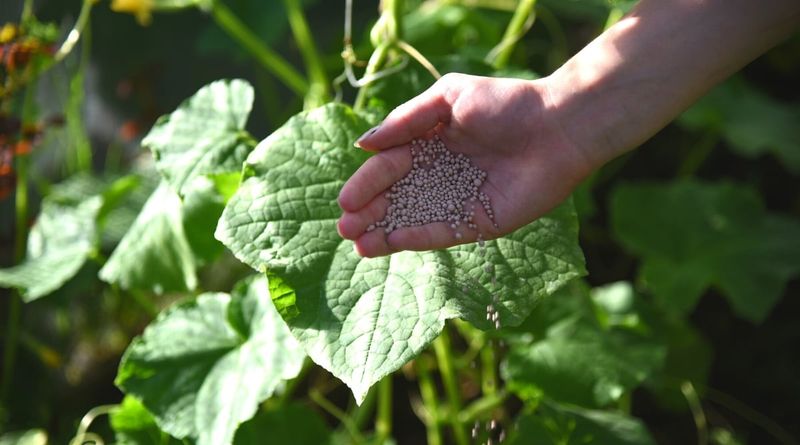
Feeding a cucumber plant makes sense under a specific set of conditions, not as a default response to yellow leaves. The evidence that points toward low fertility looks like this: the oldest leaves are broadly and evenly yellow, newer leaves higher on the vine are noticeably greener, overall growth is weak or stunted, the root zone is receiving consistent and appropriate moisture, and your inspection of the leaf undersides turned up no convincing sign of mites, disease, or other pest activity.
When all of those conditions are true at once, limited nitrogen availability becomes a reasonable working hypothesis.
A soil test is the most reliable next step when low fertility remains plausible. UF/IFAS guidance on soil and fertilizer management for Florida vegetable production identifies nitrogen deficiency as especially likely on sandy soils after heavy rain or overirrigation, and notes that potassium can also leach under similar conditions.
A test tells you which nutrient is actually low and how much to apply, which protects you from correcting one problem while creating another.
If you cannot wait for a test, use a modest, labeled fertilizer product formulated for vegetables and follow the application rate on the package. UF/IFAS Gardening Solutions notes for cucumbers and Oklahoma State University Extension’s cucumber production fact sheet both caution that excess nitrogen can push lush leafy growth at the expense of flowers and fruit.
Overapplication also risks salt injury to roots, nutrient imbalances in the soil, and fertilizer runoff that harms nearby water. More is not better here.
The label rate for a balanced vegetable fertilizer is the ceiling, not the starting point.
Follow a low-risk rescue sequence
Once you have gathered your observations, put them together in a logical order before taking any action. Start with the root zone.
Press your finger into the soil two to three inches deep and assess what you find. Dry soil calls for a deep, thorough watering at the base of the plant.
Saturated or poorly draining soil calls for improved drainage and a pause on irrigation, not fertilizer. If the moisture level looks appropriate and the soil seems to be draining normally, move on.
The second check is the leaf undersides. Look for stippling, webbing, tiny moving insects, powdery growth, or any other sign that a pest or pathogen is already at work.
The UMN Extension cucumber diagnostic guide walks through the range of possible causes, and cross-referencing what you see against that list can help you rule out mites, disease, and viral symptoms before concluding that fertility is the issue. If you find evidence of pests or disease, address those specifically rather than defaulting to a feeding.
After ruling out moisture problems and pest or disease activity, classify the yellowing itself. Uniform paleness on older leaves with greener new growth supports a low-fertility hypothesis.
Marginal scorch, angular spots, interveinal patterns, or mosaic coloring each point in a different direction. If the evidence consistently supports low nitrogen availability, use a soil test or a modest, labeled vegetable fertilizer at the recommended rate.
Then maintain consistent watering and monitor the plant over the following week or two. Remove only foliage that is severely dead or diseased when doing so would clearly improve airflow or reduce the spread of a confirmed pathogen.
The goal is to protect the healthy leaves still on the vine, not to strip it bare chasing every yellow symptom.
Judge the response by new growth and overall vigor
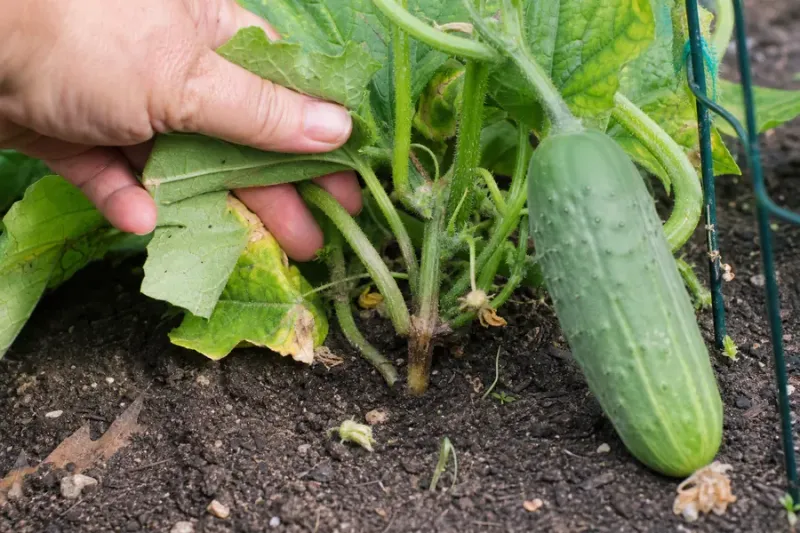
After making a correction, the most useful thing to watch is not the leaves that are already yellow. Tissue that has lost its chlorophyll rarely recovers full color, regardless of the cause.
Whether existing yellow leaves improve depends entirely on what caused the problem and how far it progressed before you intervened. Counting on them to turn green again is not a reliable way to judge whether your response worked.
New growth at the tips of the vine tells a more honest story. If the underlying issue was limited nitrogen availability and your correction addressed it, fresh leaves should emerge with better color and the plant’s overall energy should gradually improve.
Continued spread of yellowing upward, new stippling, or expanding spots would suggest the original problem has not been resolved or that a second issue is also present. The UMN Extension cucumber diagnostic guide reinforces that the whole plant, not a single leaf, is the most reliable unit of assessment.
One older yellow leaf on an otherwise vigorous, productive vine may simply reflect the natural aging of older foliage rather than a systemic problem, though the available evidence does not confirm that explanation for every cucumber situation. Regional timing also matters.
UF/IFAS planting windows for Florida cucumbers vary by location, with North Florida planting in July through August, Central Florida in September, and South Florida from September through February. A plant nearing the end of a spring production cycle should not be interpreted the same way as a newly established late-summer planting.
The vine that keeps pushing healthy new leaves forward is the one worth investing in.