
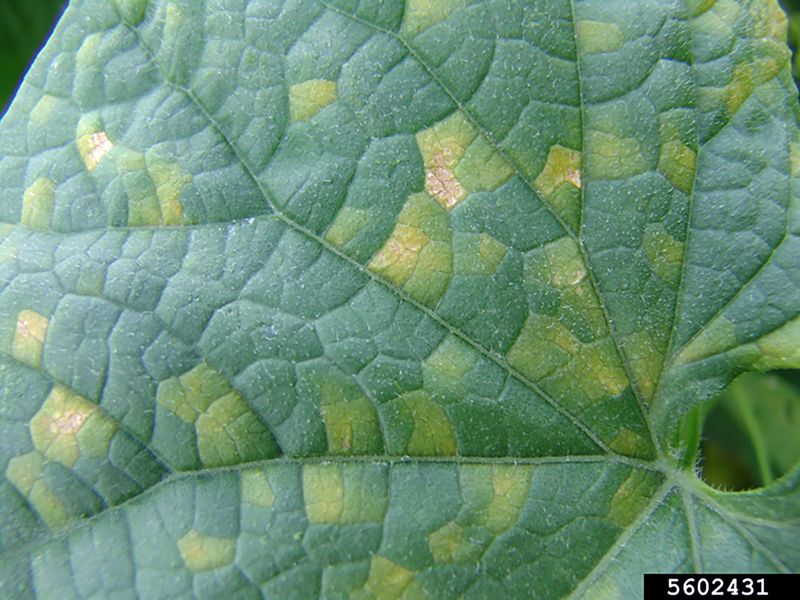
Noticing pale yellow patches spreading across your cucumber leaves can send a gardener into full alarm mode, especially when the vines were producing well just days earlier. Not every yellow leaf points to the same problem, and jumping to the wrong fix can waste time while the real issue keeps spreading. Knowing what to look for, and what questions to ask before reaching for any spray or pruner, can make the difference between a vine that keeps producing and one that collapses by Labor Day.
Yellow patches need a closer look
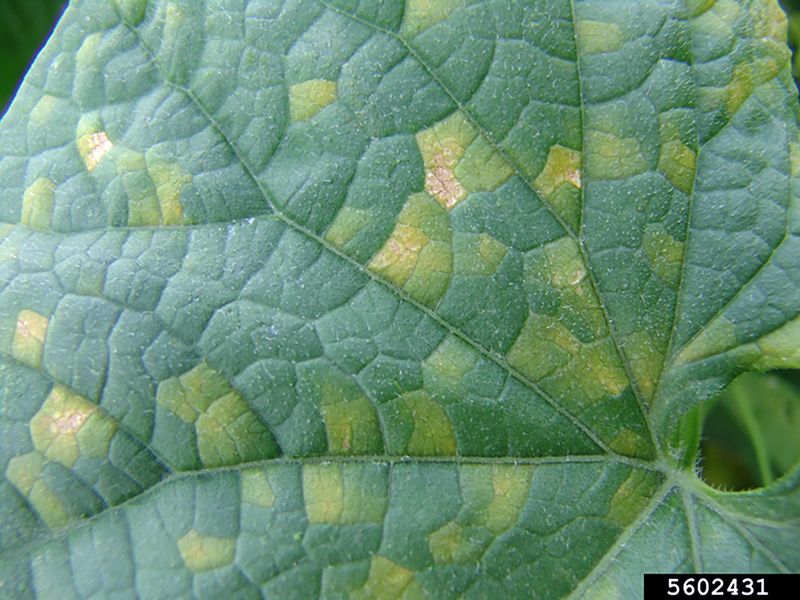
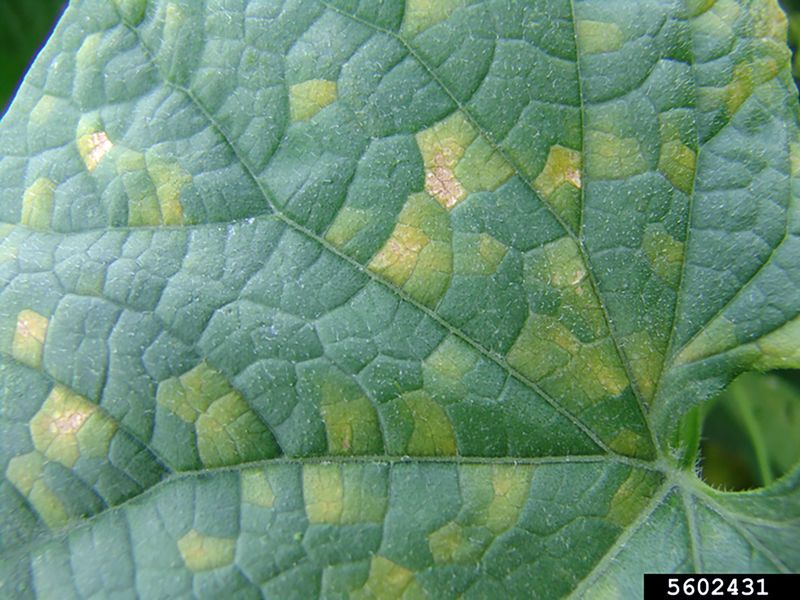
Pale yellow leaves on a cucumber plant can mean a dozen different things, and the color alone does not tell you much. What matters is the shape, size, and location of each spot. If you are looking at small, angular patches that seem to stop right at the leaf veins rather than spreading into rounded blobs, that geometric pattern is the first real clue worth paying attention to.
UC IPM’s cucurbit downy mildew guidance describes the characteristic early symptom as small pale-green to yellow spots that are restricted by veins, with older leaves often showing symptoms before younger ones. As the disease progresses, spots can merge, turn brown, and trigger early leaf drop that strips the vine well before harvest. Seeing that sequence unfold quickly is more telling than the color alone.
General whole-leaf yellowing, where the entire leaf fades without sharp edges, points in a different direction entirely. Nutrient deficiency, overwatering, and root stress can all cause that kind of diffuse fading. The angular, vein-bounded pattern is what separates a disease candidate from an environmental one.
Before you treat anything, flip a leaf over and look at the underside of the most affected areas. The surface pattern gives you a starting hypothesis, but the underside check is what builds or weakens the case. Skip that step and you risk treating the wrong problem entirely.
Check the underside for a confirming clue
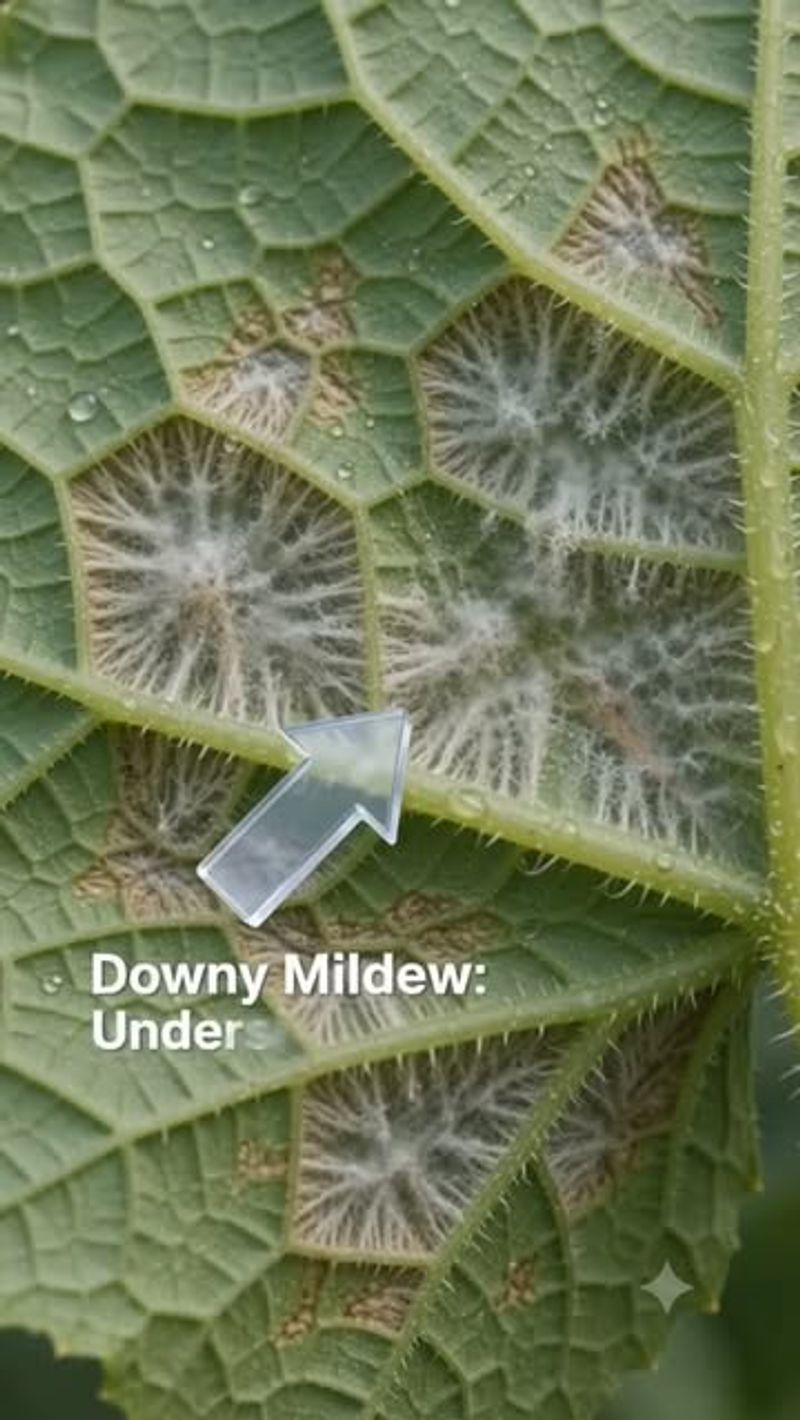
Flip any leaf showing the angular yellow pattern and examine the underside carefully, ideally during a humid morning when conditions favor spore production. What you are looking for is a growth that appears gray, brown, or purplish, sometimes described as velvety or downy. That texture comes from the sporangiophores and spores of the oomycete responsible for the disease, and seeing it alongside the upper-surface lesions strengthens the diagnosis considerably.
University of Minnesota Extension’s downy mildew guide notes that humidity and leaf moisture make this underside sign more likely to appear. On a dry afternoon or during a stretch of low humidity, the fuzz may be absent or faint even when the disease is present. Dry conditions can hide the growth without eliminating the infection.
The absence of visible underside fuzz does not rule downy mildew out. If the upper-surface lesions are angular and vein-bounded, the lesions are spreading quickly, and the weather has been wet or heavily humid, the disease remains a strong possibility even without a clear underside sign. Combine what you see on both surfaces with the rate of spread and the recent weather before drawing a conclusion.
When the pattern is still unclear after a thorough inspection, a local cooperative extension office, university plant clinic, or diagnostic laboratory can examine a sample and give you a confirmed answer. Acting on an uncertain diagnosis can cost you time and money without helping the vine.
August can raise suspicion without proving the cause
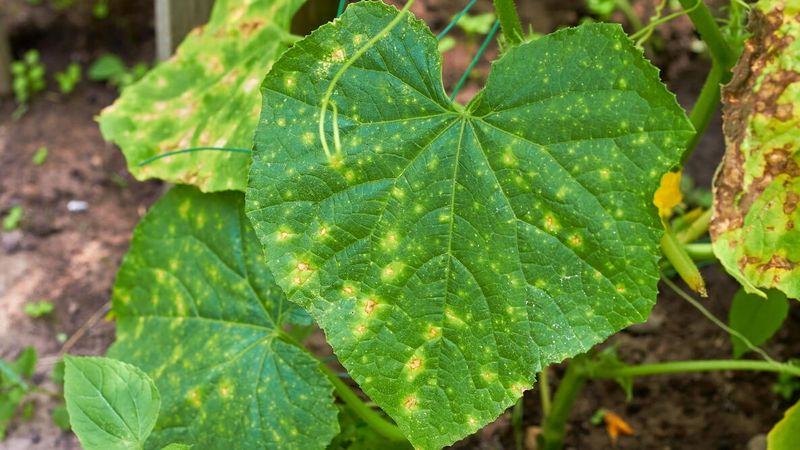
Late summer does bring conditions that favor cucumber downy mildew in many parts of the country, and gardeners in temperate regions have good reason to stay alert once August arrives. Wet nights, morning dew, and stretches of high humidity create the kind of prolonged leaf wetness that helps the disease take hold and spread. The oomycete Pseudoperonospora cubensis, the organism behind downy mildew, moves through airborne spores that travel on wind, and it also spreads through rain splash, irrigation water, and contact with wet foliage.
Timing, though, is regional and weather-dependent, not fixed to a calendar date. UMN Extension reports that the disease often arrives in August in some eastern states, but earlier and later appearances happen depending on the year and the region. The 2026 Penn State cucurbit downy mildew updates documented activity in Georgia and Florida earlier in the season, and a confirmed North Carolina case from a sample collected July 20 and confirmed July 21, 2026, shows how early the disease can move in some areas.
Rather than treating August as a trigger, treat confirmed regional reports as your most useful cue. Scout your plants at least twice a week during any period when disease has been confirmed nearby, concentrating on older leaves, shaded areas, and dense sections of the canopy where airflow is limited.
The IPM PIPE forecasting page notes that formal forecasting has been suspended and recommends relying on confirmed occurrence reports instead. Checking those reports for your region gives you a more reliable picture than the date on the calendar.
Compare the pattern with common look-alikes
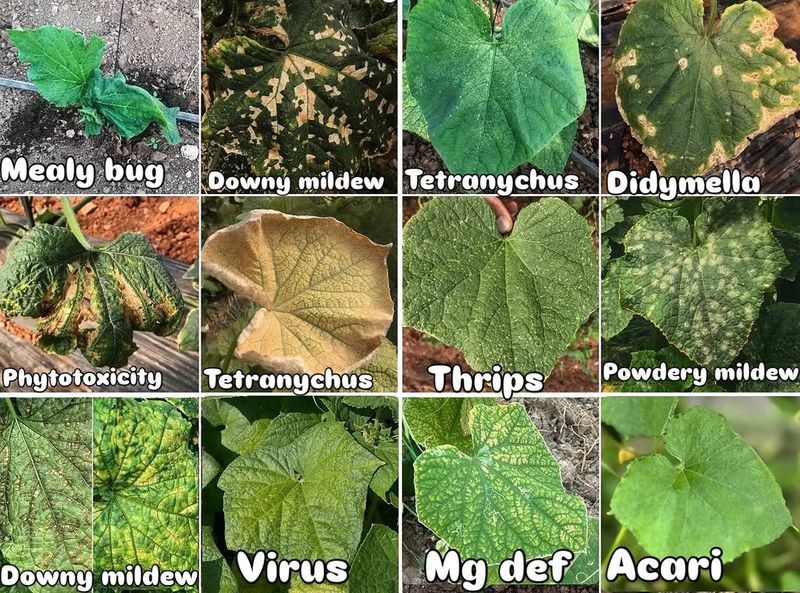
Angular, vein-bounded yellow spots are not unique to downy mildew, and working through the other possibilities protects you from a misdiagnosis that costs you weeks. Colorado State University Extension’s plant disorder diagnostic guidance makes the point clearly: “yellow leaves” is too general a description without details about lesion shape, affected surface, watering history, insect activity, and how symptoms are distributed across the plant.
Powdery mildew is the most commonly confused disease. Rather than angular yellow lesions, powdery mildew produces a diffuse white or grayish powder on the upper leaf surface, sometimes spreading to stems. It tends to look dusty rather than spotted. A product that targets powdery mildew will not necessarily control downy mildew, and the reverse is equally true, so confirming which disease you are facing matters before you choose any product.
Angular leaf spot is the trickiest look-alike because its bacterial lesions can also be angular and vein-limited, just like early downy mildew. The key difference is what appears on the underside: angular leaf spot may show a water-soaked or white crusty residue rather than the gray-purple fuzz of downy mildew. UMN Extension’s comparison notes also flag anthracnose, Alternaria leaf blight, and viral infections as additional causes of yellowing or browning cucumber foliage.
Beyond disease, consider insect feeding damage, nutrient deficiencies, drought stress, overwatering, and herbicide drift or injury. Each leaves a recognizable pattern when you look closely. Penn State Extension’s home-garden mildew guide recommends bringing a sample to an extension office when the clues do not add up, rather than guessing and treating.
Remove affected tissue and dry the canopy
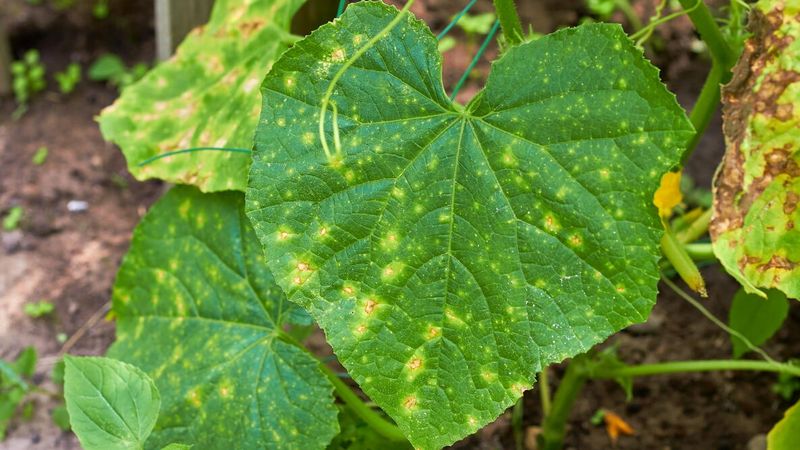
Once you have a convincing pattern, the first non-product response is to remove visibly diseased leaves when only a few are affected. Place them directly into a trash bag rather than dropping them on the soil or adding them to a compost pile, where spores can survive and spread. Removing that material reduces the local concentration of spores available to infect nearby leaves, even if it cannot stop windborne spores from arriving from elsewhere in the neighborhood.
When the infection has already covered most of the canopy, pulling the entire plant may be the more practical choice. UMN Extension notes that removing a heavily affected plant can reduce the local spore source, but it does not protect neighboring vines from reinfection carried on the wind. Keep that limitation in mind before deciding whether removal is worth the effort at that stage.
How you water matters as much as what you remove. Switching to drip or ground-level irrigation keeps foliage dry and removes one of the conditions the pathogen depends on. Overhead watering that leaves leaves wet for extended periods works against you, especially during humid stretches when leaf surfaces are already slow to dry.
UC IPM’s management guidance for cucurbit downy mildew also recommends trellising vines to improve airflow, avoiding overcrowding between plants, and pruning dense foliage to let air move through the canopy. Each of those steps shortens the period that leaves stay wet after rain or irrigation. Together they can reduce how quickly the disease spreads, though none of them can stop spores that arrive by wind from an outside source.
Use products only when the label fits
Products that manage downy mildew in cucumbers do exist for home gardeners, but their availability depends on where you live and what is currently registered in your state. Preventive applications, applied before or very early in an infection, generally perform better than treatments started after symptoms have already spread across the canopy. Waiting until damage is widespread reduces what any product can realistically accomplish, and no product will restore tissue that has already turned yellow or brown.
UMN Extension and UC IPM both note that effective downy-mildew products may not be available to home gardeners in every region, and that guidance for commercial production should not be applied directly to backyard situations. Commercial crop guides recommend products and application schedules designed for professional growers with access to restricted materials, not for a garden with a handful of vines.
University of Wisconsin Extension identifies certain chlorothalonil- and copper-containing products as labeled for some home-garden uses, but availability and registration vary by state. The product label is the legal document that governs how any pesticide may be used. It specifies the target disease, eligible crops, application rate, required protective equipment, re-entry interval, and pre-harvest interval. Following the label is not optional.
Before purchasing anything, check with your local cooperative extension service to confirm what is registered and appropriate for your situation. Do not assume that a product labeled for powdery mildew will work against downy mildew. The two diseases are caused by different organisms and respond to different chemistries. Household remedies such as baking soda, vinegar, or hydrogen peroxide lack reliable authoritative support as general cures for cucumber downy mildew and should not replace a legally labeled, crop-specific product.
The EPA Pesticide Product Label System lets you look up registered labels before you buy.
Decide whether the vine can still produce
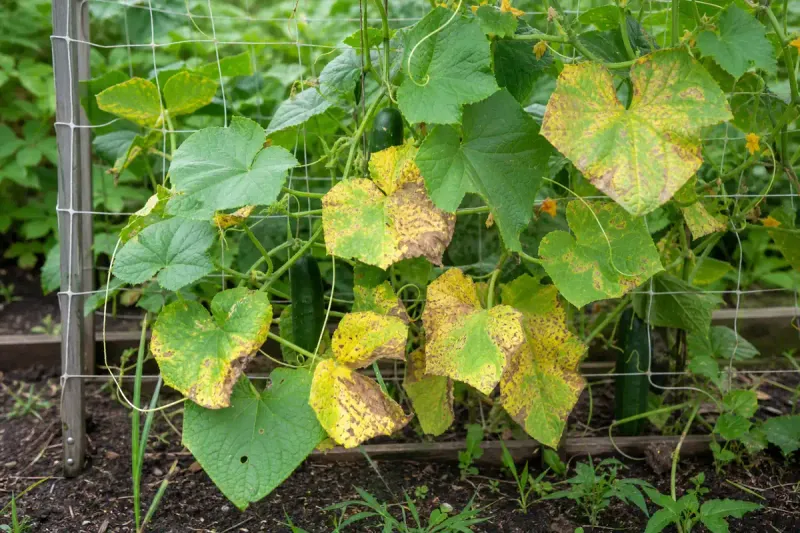
Removing diseased leaves can make a plant look healthier and may slow local spread, but it cannot bring dead tissue back. The question worth asking honestly is how much canopy remains after the damage is accounted for. A vine that has lost a few older leaves but still carries healthy mid-canopy foliage and developing fruit has a reasonable chance of finishing the season with a useful harvest if you act quickly and consistently.
A plant that has already lost most of its leaf area is in a harder position. UMN Extension cautions that extensive defoliation may be irreversible, and that heavily damaged vines may keep declining even with intervention. Continuing to invest water, nutrients, and product on a vine that has passed that threshold may not be the best use of your time or resources.
Scout twice weekly during any period of regional disease activity, checking both leaf surfaces and noting how quickly new lesions are appearing. Prompt action on a credible diagnosis, before the damage becomes extensive, consistently produces better outcomes than waiting. Penn State’s 2026 regional reports reinforce that the disease can move faster than a once-a-week check will catch.
For next season, look into cucumber varieties described as resistant or tolerant to downy mildew. CSU Extension’s plant disorder guidance reminds gardeners that variety resistance is not immunity, and performance can vary with the local pathogen population. Still, starting with a less susceptible variety gives the vine a meaningful head start before conditions turn favorable for disease. A cucumber that reaches harvest before heavy disease pressure arrives is the best outcome any of these strategies can aim for.