
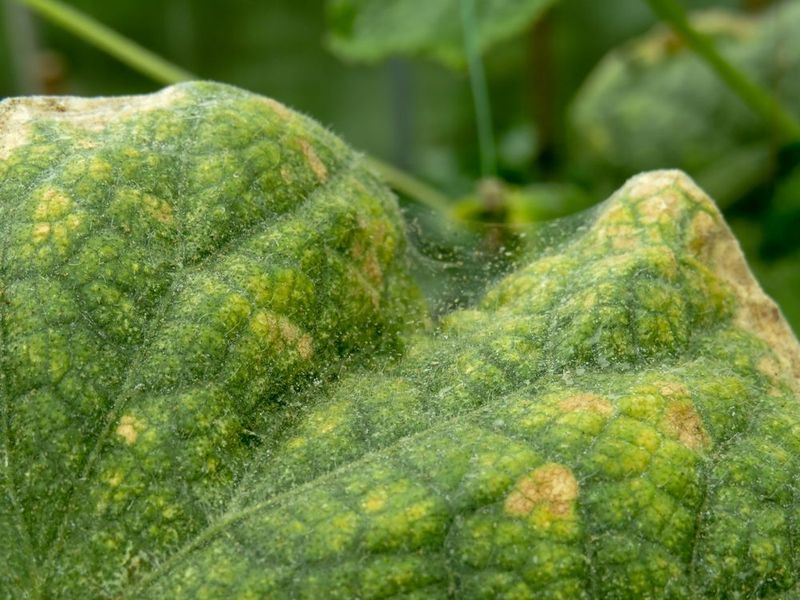
Pale, dusty-looking cucumber leaves in the middle of summer can catch a gardener off guard, especially when the vine looked fine just a week before. Fine stippling or mottling on the foliage often points toward spider mites, tiny pests that feed on leaf undersides and can multiply quickly in hot, dry conditions. But silver or whitish leaves are not a guaranteed diagnosis on their own, and treating the wrong problem can make things worse. A close inspection comes first, and this guide walks through exactly how to do that and what to do next.
Fine stippling is a warning sign, not a diagnosis
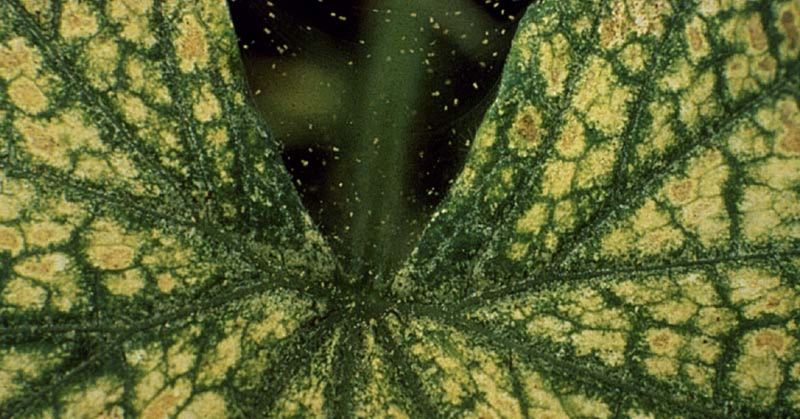
Pale dots scattered across a cucumber leaf like fine pinpricks are one of the more telling early signs that something is feeding on the plant. Spider mites pierce individual leaf cells to extract their contents, destroying chlorophyll in the process, and each feeding site shows up as a tiny pale or whitish speck. Multiply that across dozens of mites feeding simultaneously and the leaf can take on a dusty, mottled, or speckled look that gardeners sometimes describe as silver.
That word “silver” is worth pausing on. UC IPM’s spider mite guidance describes early damage as tiny white or yellow dots, not a uniform metallic sheen, and a more solid whitening or bleaching of the leaf surface can point to other causes entirely. The month of August and the presence of pale foliage together are a reason to look more carefully, not a reason to conclude spider mites are responsible.
As feeding continues and mite numbers climb, leaves can shift from stippled to broadly pale, then yellow, then bronze or dry, and eventually drop early. UC IPM’s cucurbit spider mite page notes that heavy infestations can reduce both yield and fruit quality. The practical takeaway is this: fine stippling during hot, dry weather should prompt an immediate underside inspection, but color alone cannot identify the pest or the disease.
Why hot, dry weather can accelerate damage
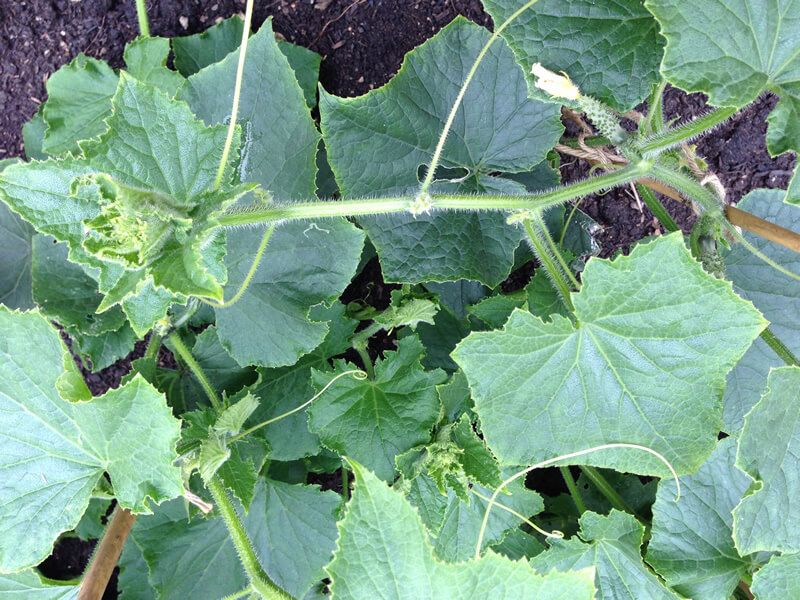
Spider mites thrive when conditions push toward the uncomfortable end of the summer thermometer. University of Minnesota Extension reports that mite colonies can reach very high numbers in fewer than two weeks when temperatures climb above 90 degrees Fahrenheit. That speed is part of what makes a light infestation in early August feel like a serious problem by mid-month.
Dry conditions compound the risk in two ways. First, water-stressed plants are generally less able to tolerate pest feeding, so a cucumber that is already struggling in drought is more vulnerable to the same level of mite activity than a well-irrigated vine. Second, Colorado State University Extension notes that dusty, dry environments favor mite populations and can reduce natural controls. Mites feed primarily on leaf undersides, where they are sheltered from wind and direct sun, and damage tends to spread outward from the initial feeding sites as the population expands.
None of this makes August a universal trigger. Summer temperatures and humidity vary considerably across the continental United States, and conditions that produce a mite explosion in a dry inland valley may not replicate in a humid coastal garden. What the heat-and-drought pattern does justify is more frequent scouting during any extended hot spell, not a standing assumption that mites are already present. Catching a developing infestation early gives far more options than waiting until the foliage has already declined.
Use an underside check to investigate the cause
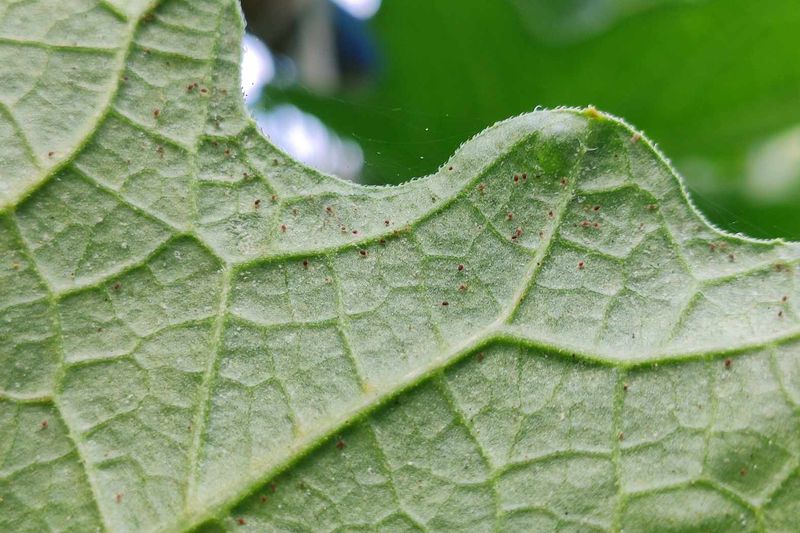
Flipping a leaf over is the single most useful step a gardener can take when cucumber foliage looks off. Spider mites are tiny, hard-to-see pests that spend most of their time on leaf undersides, and the top surface of the leaf rarely reveals much beyond the damage they leave behind. UC IPM recommends using a hand lens to look for moving mites, eggs, translucent cast skins, and fine webbing, all of which can help confirm an infestation that stippling alone cannot prove.
A second technique takes almost no equipment. Hold a piece of white paper under a suspect leaf and tap or shake the leaf sharply. Any mites dislodged will land on the paper as tiny moving specks, often smaller than the period at the end of this sentence. Minnesota Extension describes this paper test as a practical way to make otherwise hard-to-spot mites visible to the naked eye.
If the specks move, mites are present.
One important caution: UC IPM’s cucurbit guide notes that early infestations can produce stippling before webbing becomes obvious, so the absence of webbing does not rule out mites. Check several leaves in different parts of the vine, note what you find on the underside, and treat the inspection as one piece of evidence rather than a definitive verdict. Other causes can produce similar-looking leaf symptoms, and the next step is comparing what you see against the most common alternatives.
When silvering points somewhere else
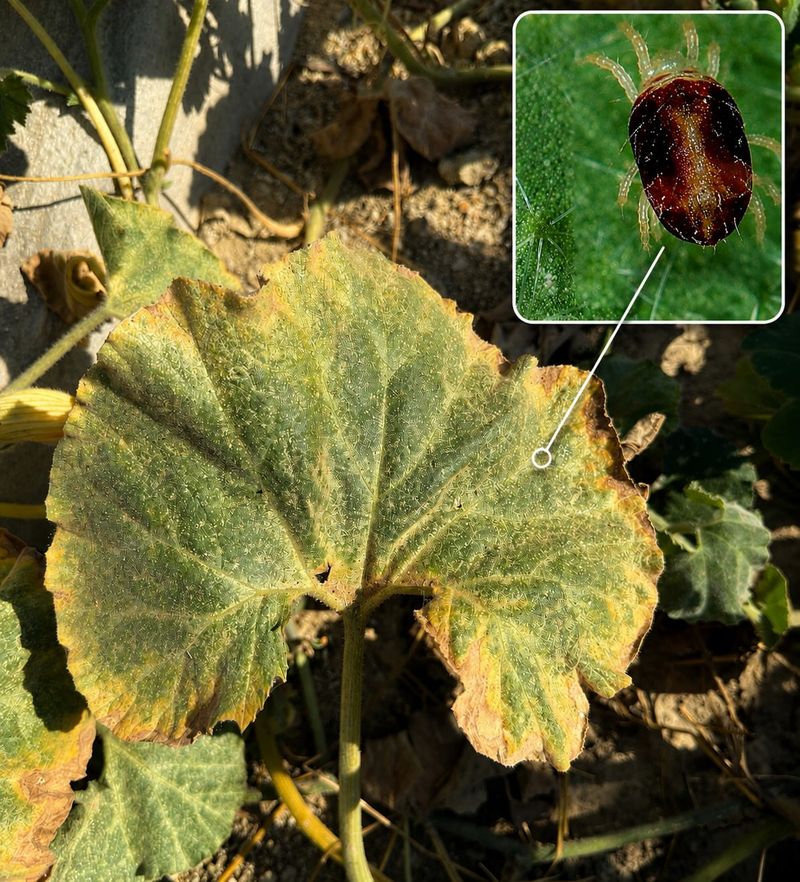
A cucumber leaf that looks pale, washed-out, or silvery does not automatically have mites. UC IPM’s cucurbit pest damage comparison points out that silverleaf whiteflies can cause cucurbit foliage to turn whitish or silvery, and the symptom can look convincingly similar at a glance. The key distinction is what else you find: whitefly adults are visible to the naked eye as small white-winged insects that flutter up when the plant is disturbed, and their feeding often leaves sticky honeydew on leaf surfaces.
UC IPM’s cucurbit whitefly page describes the silverleaf symptom as a more diffuse discoloration rather than the concentrated fine stippling that mite feeding produces. If you do not find mites or their webbing on the undersides but do notice small white insects or a sticky residue, whiteflies deserve serious consideration before any treatment decision is made.
Fungal diseases add two more possibilities. Powdery mildew begins as pale yellow patches but progresses to a distinctive white, powdery or fluffy coating on leaf surfaces, a texture that mite damage never produces. UC IPM’s cucurbit powdery mildew guide describes how that fungal growth spreads across the leaf face as the disease advances. Downy mildew follows a different pattern, producing pale yellow angular lesions that are bounded by leaf veins and often show a grayish-purple fuzz on the underside in humid conditions.
Matching what you observe against these specific patterns, rather than relying on leaf color alone, is what leads to the right response.
Start with water and lower plant stress

Once spider mites are confirmed or strongly suspected, the first practical responses focus on the plant’s environment and physical removal rather than reaching for a spray bottle. Consistent, adequate irrigation is the foundation. UC IPM’s cucurbit mite guidance identifies drought stress as a factor that makes plants more susceptible to mite damage, and keeping cucumbers well-watered helps the vine tolerate some level of feeding. That said, watering alone does not reliably eliminate mites that are already established on the plant.
Think of irrigation as support for the vine, not a treatment for the infestation.
A forceful stream of water directed at leaf undersides can physically knock mites off the plant and reduce their numbers. Utah State University Extension recommends this approach as part of an integrated management plan for cucurbit mites. Apply the spray early in the day so foliage has time to dry completely before evening, since wet leaves overnight can invite fungal problems.
Oklahoma State University Extension echoes the same early-application timing and emphasizes repeating the process while continuing to monitor. Mites that survive or re-infest from nearby plants can reestablish quickly, so a single water treatment is rarely the end of the story. Check the undersides again a few days later and assess whether numbers are dropping, holding steady, or climbing before deciding on next steps.
Protect predators before choosing a spray
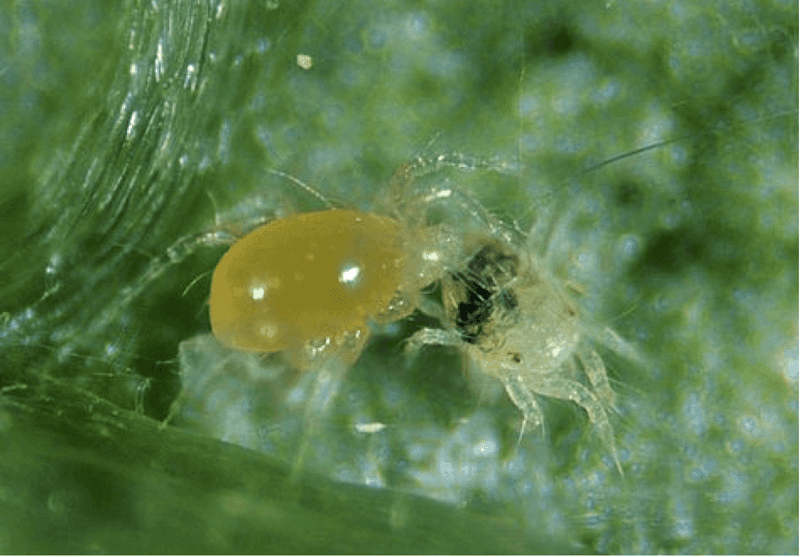
Before selecting any spray product, look carefully at what is already living on the plant. Predatory mites, sixspotted thrips, lacewings, lady beetles, and other beneficial insects can suppress spider mite populations without any intervention from the gardener. UC IPM’s spider mite overview explains that preserving these natural enemies is one of the most effective long-term strategies available, and that disrupting them can allow mite populations to rebound faster than the original infestation.
Broad-spectrum insecticides are the main threat to those allies. Utah State University Extension and Penn State Extension both warn that broad-spectrum treatments applied for any pest, including mites, can eliminate predatory insects and actually worsen the mite problem over time. Avoiding unnecessary applications protects the garden’s existing biological balance.
When physical controls are not enough and mites are still increasing, insecticidal soaps and horticultural oils are among the conditional options. They work by direct contact, so thorough coverage of leaf undersides is essential. Both may require repeat applications, and neither offers lasting residual protection. Oklahoma State’s pest control fact sheet cautions against substituting household dish detergent for commercial insecticidal soap, as improvised mixtures can scorch cucumber foliage.
Even commercial soaps can cause phytotoxicity on stressed or heat-exposed plants, so test a small area of the vine first and allow a day or two to check for leaf injury before treating the whole plant.
Every product used on an edible crop must carry a label that specifically permits use on cucumbers. EPA guidance on pesticide labels makes clear that the label is a legally enforceable document, and EPA’s read-the-label resource outlines why following it matters for both safety and effectiveness. Pay attention to temperature restrictions as well: oils and soaps applied during peak afternoon heat or to water-stressed vines carry a higher risk of leaf injury, and some sulfur-based products carry explicit high-temperature warnings that apply to cucurbit crops.
Let monitoring determine whether more action is needed
Returning to the plant every few days after initial treatment is how a gardener stays in control of the situation rather than reacting to it. Recheck the leaf undersides, paying attention to both older leaves where mites were previously found and newer growth toward the tips of the vine. UC IPM’s cucurbit mite page frames the decision to intervene around whether mite numbers are increasing, whether webbing is spreading, and how much of the plant is affected, rather than around a fixed date or a single sighting.
UC IPM’s general spider mite guidance also points to predator presence as a meaningful factor. If you spot small, fast-moving predatory mites alongside the pest mites, or see lacewing eggs or lady beetle adults nearby, those populations may be doing useful work. Treating at that moment could eliminate the very insects keeping the infestation from escalating. Utah State University’s IPM threshold guidance reinforces the principle that crop stage, plant vigor, and the presence of natural enemies all belong in the treatment calculation.
Cucumbers can tolerate some light mite feeding without significant yield loss, and no universal treatment threshold applies to every backyard garden. A vine in full production with a modest, stable mite population and visible predators is a different situation from a vine with expanding webbing, heavy stippling on multiple leaves, and no beneficial insects in sight. Severe, advancing infestations can cause defoliation and yield loss, but the outcome depends on how quickly the situation is caught, the plant’s overall health, and what controls are already in place.
A quick inspection can prevent a bigger problem

Fine stippling on cucumber leaves during hot, dry weather is a reasonable prompt for an underside inspection, but silvery or pale foliage by itself does not establish that spider mites are responsible. UC IPM’s cucurbit mite guide and UC IPM’s cucurbit pest damage comparison both point toward using multiple signs, including actual mites, eggs, or webbing found on the leaf underside, before committing to a treatment path. Check for whiteflies and honeydew, look for fungal growth, and match the symptom pattern against the alternatives before acting.
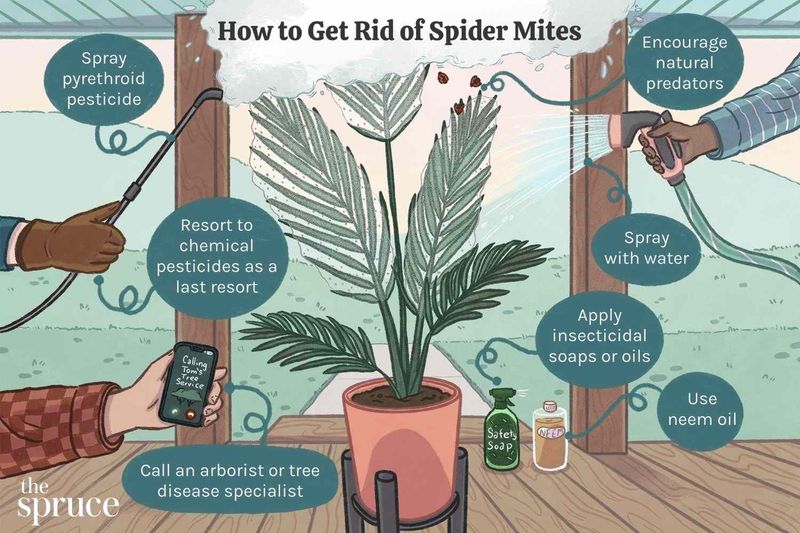
When mites are confirmed, reduce drought stress through consistent irrigation, dislodge mites with targeted water sprays early in the day, protect any predators you find, and reach for a labeled product only when monitoring shows numbers are climbing and the vine cannot recover on its own. Early observation paired with measured steps gives the plant its best chance without causing additional harm. A gardener who looks closely before spraying is the one most likely to still have cucumbers worth harvesting by the end of the season.