
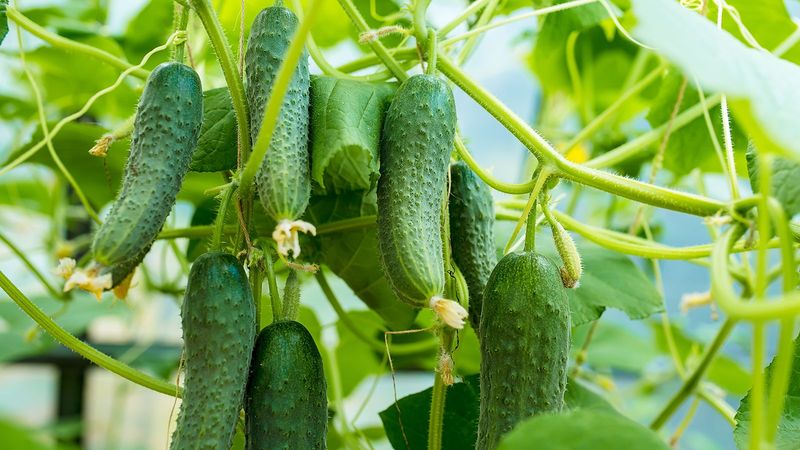
Walking out to a garden full of sprawling, dark-green cucumber vines and finding almost no new cucumbers can feel like a mystery. The plants look healthy, flowers keep opening, and yet the harvest has stalled.
Late summer in the South brings a tangle of possible causes, from scorching heat to fertilizer habits to flower type, and blaming the wrong one can waste time and make things worse. Working through a short checklist is the fastest way to figure out what your vines actually need right now.
A flower is not proof that a cucumber is ready to set fruit
Plenty of open flowers on a cucumber vine can look like progress, but flowers alone do not mean cucumbers are on the way. Before reaching for fertilizer or a watering can, spend two minutes looking closely at what those flowers actually are.
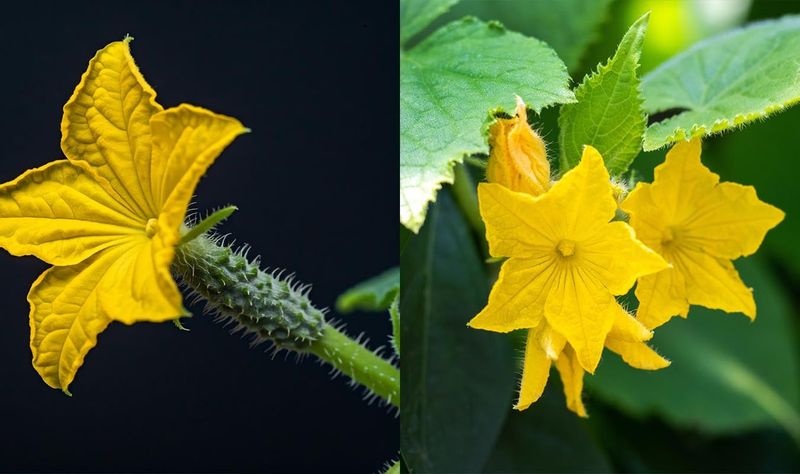
Male and female flowers grow on the same vine, and they look noticeably different once you know what to check.
A female flower has a small, cucumber-shaped swelling right at its base, just behind the petals. That swelling is the tiny future cucumber, and it only develops into a harvestable fruit after a bee carries pollen from a male flower to it.
A male flower has a slender, plain stem with no swelling, and it exists only to produce pollen. Iowa State University Extension notes that early-season flowers are often almost entirely male, so a vine can bloom heavily for a week or two before female flowers appear in meaningful numbers.
If most of the flowers you find are male, the vine is not yet in a position to set many cucumbers regardless of fertilizer or moisture. Check several flowers along different parts of the vine before drawing any conclusions.
Cultivar type can also shift this pattern significantly. Gynoecious varieties produce mostly female flowers and may need a monoecious pollinator plant nearby, while parthenocarpic types can set seedless fruit without any pollination at all.
Knowing your cultivar saves you from diagnosing a problem that does not exist.
When foliage outruns fruit, excess nitrogen becomes one suspect
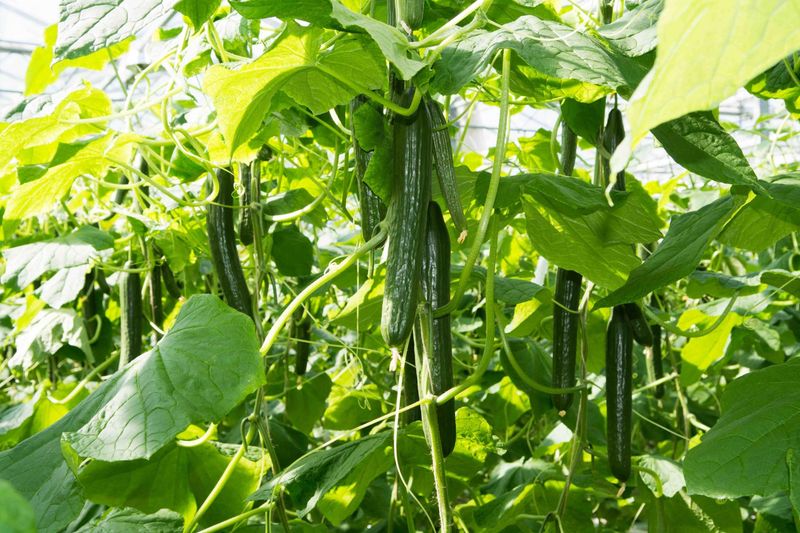
A vine that is unusually leafy, very dark green, and still growing aggressively after repeated high-nitrogen fertilizer applications fits the profile for nitrogen overload. Nitrogen drives vegetative growth, and when there is too much of it available, a cucumber plant can prioritize producing leaves and stems over setting and maturing fruit.
Oklahoma State University Extension and several other land-grant programs caution that excessive nitrogen can delay flowering or reduce fruit production in cucumbers.
The key word here is “can.” Excess nitrogen is one plausible cause when the vine’s appearance and feeding history both point toward it, not a guaranteed explanation for every stalled crop. Pull out your fertilizer bag or jug and look at the first number in the N-P-K ratio.
If you have been applying a product with a high first number every week or two, that pattern is worth pausing. Dense foliage can also create a secondary problem by making flowers harder for bees to find and reach, so nitrogen stress and pollination trouble can layer on top of each other.
UF/IFAS and Oregon State University Extension both recommend fertilizing cucumbers based on actual plant needs rather than a fixed schedule. Diagnosing from the vine’s appearance and your application history together gives you a much more reliable read than looking at flowers alone.
The safe correction is to pause high-nitrogen feeding
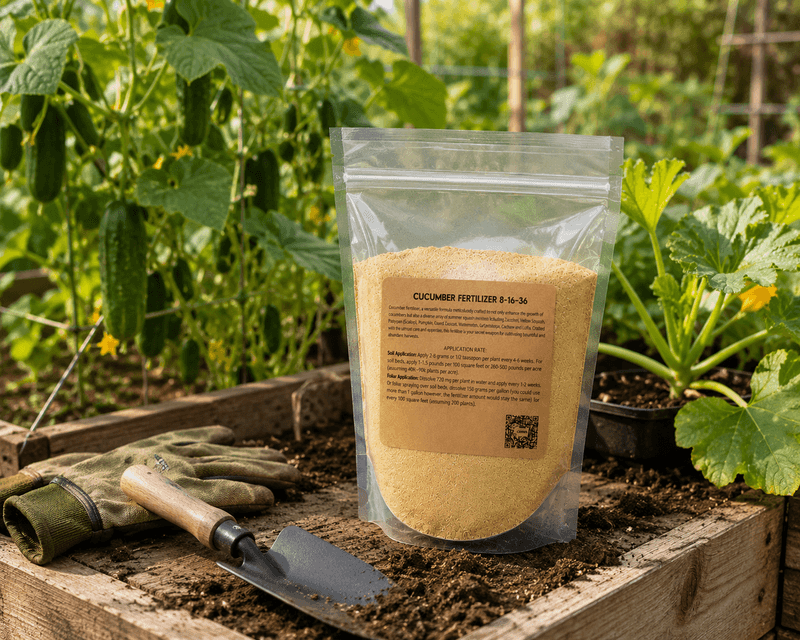
When the vine’s growth pattern and fertilizer history both suggest excess nitrogen, the right immediate move is simple: stop applying high-nitrogen fertilizer. Do not add more of the same product hoping the vine will balance itself out, and do not switch to a “bloom booster” or a phosphorus- and potassium-heavy fertilizer without a soil test or a clearly diagnosed deficiency to back that up.
Adding nutrients the soil does not need is neither free nor harmless, and it will not override a heat or pollination problem.
Pausing nitrogen is not the same as cutting off all feeding for the rest of the season. Cucumbers do need nutrients to grow and produce, and UF/IFAS recommends a balanced, slow-release fertilizer applied as needed rather than heavy, repeated high-nitrogen doses.
If conditions improve and the vine shows signs of deficiency, a soil test or careful label guidance can tell you when and how much to resume. Iowa State Extension’s fertilizer guidance consistently points to soil testing as the most reliable way to know what your garden actually needs before adding anything.
When fertilizer does go back on, apply it to the soil according to the product label, keep granules or concentrate away from the base of the stem, and water it in well. Avoid spraying liquid fertilizer directly on the leaves as an emergency fix.
Kentucky Extension warns that cucurbit leaves are vulnerable to fertilizer burn, and the risk rises sharply under hot, drying conditions common in Southern summers. UC IPM describes sidedressing or drip application as the appropriate delivery method when soil feeding is warranted.
Heat and pollination can stop fruit set on a vigorous vine
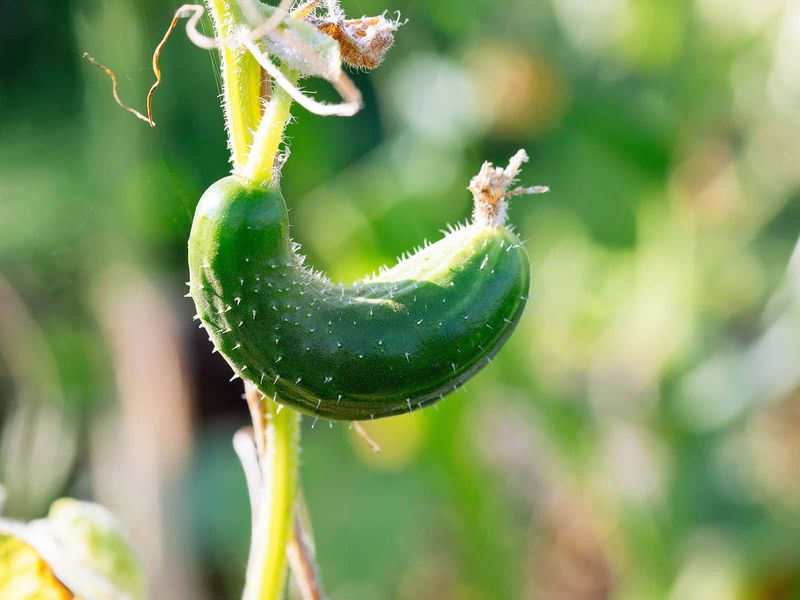
A vine can look perfectly healthy and still fail to produce cucumbers when late-summer heat and poor pollination are working against it. Penn State Extension identifies temperatures above about 90 degrees Fahrenheit as capable of causing reproductive failure in cucumbers, with fruit set sometimes resuming once conditions cool.
That temperature is a practical warning point, not a hard cutoff, because duration of heat, nighttime temperatures, humidity, water availability, and cultivar all affect how a specific plant responds.
Cornell Cooperative Extension reports that heat can push plants toward producing more male flowers, reduce bee activity during the hottest parts of the day, and cause young fruit or flowers to abort before they develop. A cucumber that starts to form and then shrivels, or a flower that drops without setting, often points to a combination of heat and inadequate pollination rather than a fertilizer problem.
Standard outdoor cucumbers generally depend on bees and other insects to move pollen from male flowers to female flowers. UC IPM notes that poor pollination can cause flower drop, shriveled young fruit, or small, flattened, crooked, or misshapen cucumbers.
Check your female flowers for bee visits during the morning hours when bees are most active, and avoid applying insecticides while flowers are open. Gently tapping flowers near midday can help move pollen when bee activity is low, but treat that as optional assistance rather than a reliable fix, especially during severe heat or with cultivars that have specific pollination requirements.
Even moisture supports the fruit that conditions allow to form
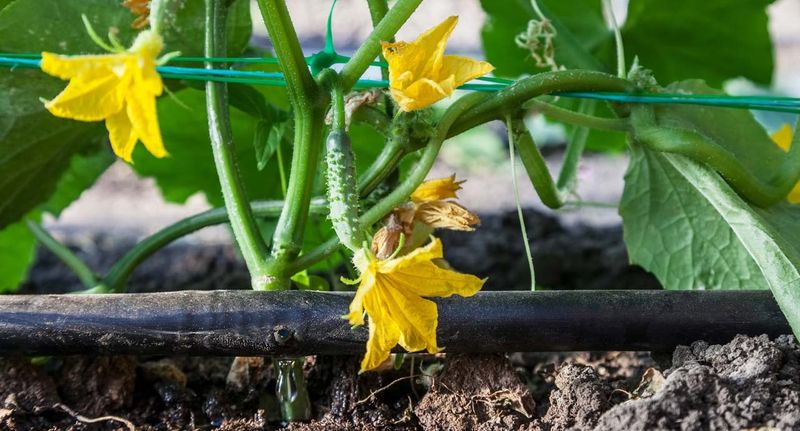
Root-zone moisture management is one of the most controllable factors in cucumber fruit development, even when heat or pollination issues are limiting overall production. Uneven watering, where the soil swings between dry and saturated, stresses the plant at exactly the moment when fruit needs steady resources to size up properly.
UC IPM recommends consistent soil moisture, soil-level irrigation, and mulch to reduce rapid drying, while also emphasizing that cucumbers require well-drained soil to avoid root problems.
Water stress during fruit set tends to produce small or misshapen cucumbers. Too much water, especially when drainage is poor, can contribute to fruit splitting and encourage fungal disease at the roots and crown.
A two- to three-inch layer of straw or shredded mulch over the root zone slows evaporation and helps keep soil temperature more stable during peak afternoon heat.
Spraying foliage with water to cool the plant is not a recommended fix. Wet leaves in warm, humid conditions can encourage powdery mildew and other foliar diseases that will add another problem to your list.
Keeping water at the soil level, directed at the root zone rather than over the canopy, addresses moisture stress without creating a disease opening. Moisture management alone will not overcome extreme heat or a pollination gap, but it removes one additional stress that might otherwise tip a borderline plant toward poor fruit set.
A quick plant-health check can prevent a fertilizer detour
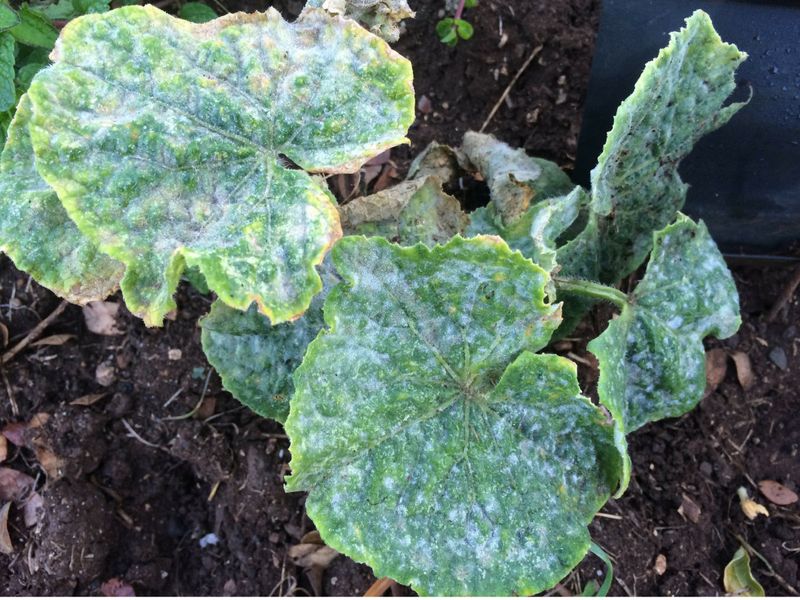
Before settling on nitrogen as the culprit, spend a few minutes doing a quick triage of the whole plant. A vine that has stopped producing may be dealing with something that a fertilizer change will not touch.
Iowa State University Extension and other extension programs point to cucumber beetles, viral disease, mildew, root problems, and vine age as common reasons production drops off in late summer.
Look at the leaves first. Yellowing between the veins, white powdery patches, brown edges, or mosaic-patterned discoloration all suggest a problem that needs a different response than adjusting fertilizer.
Check the undersides of leaves for aphids, spider mites, or beetle damage. Cucumber beetles, which are yellow with black spots or stripes, feed on both foliage and flowers and can spread bacterial wilt, which cuts off water movement through the vine quickly.
Texas A&M AgriLife Extension identifies high temperature, low moisture, low soil fertility, and foliage disease as separate stresses that can all reduce cucumber yield.
Also consider vine age. A plant that went in the ground in May may simply be winding down its productive life by August, which is normal.
Wilting that does not recover after watering, or roots that look brown and soft at the crown, points to a root disease or soil drainage problem. Any of these findings changes the diagnosis and the next step.
Extension offices in your state can help identify disease or pest samples if you are not sure what you are seeing.
Your climate and cucumber type change the next move
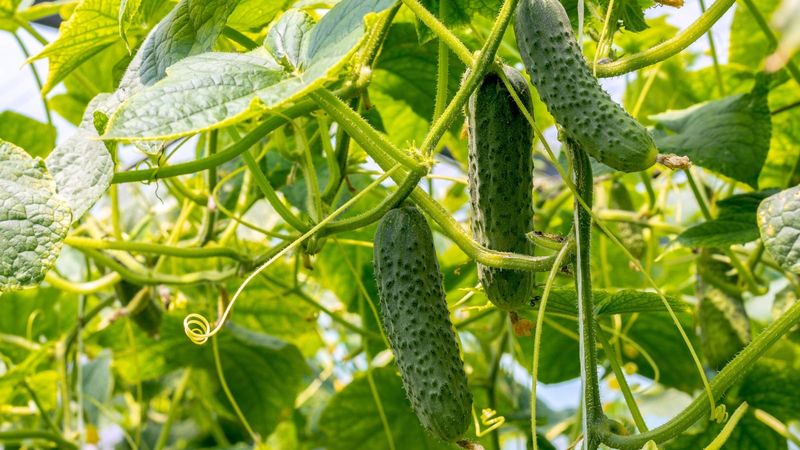
Where you garden and what variety you planted matter as much as anything else when deciding whether to wait out a heat stall or make a bigger change. UF/IFAS specifically identifies September through February as the preferred cucumber planting window for South Florida, which means a South Florida gardener trying to push production through July and August is working against the most favorable conditions.
Replanting for the cooler season is often a more practical choice than fighting heat, pests, and disease through peak summer.
Gardeners in North Florida, Texas, and other hot Southern locations may have more flexibility, but heat, inconsistent moisture, pests, and disease can still interrupt production at any point in a long warm season. Waiting for temperatures to moderate may allow fruit set to resume on a still-healthy vine, but that is not a guarantee, and a plant that has been under sustained heat stress for weeks may not recover fully even when conditions improve.
Cultivar type also changes the playbook. Standard monoecious cucumbers produce both male and female flowers and rely on insect pollination.
Oklahoma State University Extension notes that gynoecious varieties produce mostly female flowers and may need a monoecious pollinator plant in the same garden unless they are also parthenocarpic. Oregon State Extension and Penn State Extension both describe parthenocarpic greenhouse types as capable of setting seedless fruit without pollination, making pollinator advice irrelevant for those varieties.
Check your seed packet or plant tag before assuming any single fix applies to your crop.
Pause the nitrogen, then let evidence guide future feeding
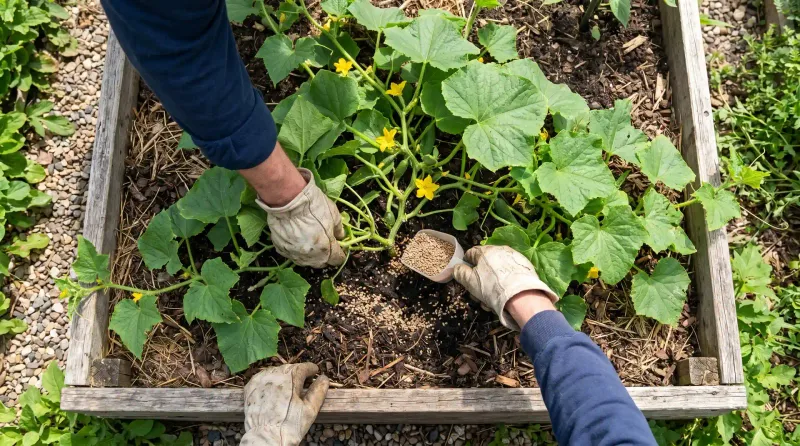
Pulling together the steps from this guide gives you a clear sequence rather than a single fix. If the vine is unusually lush and dark green after a history of heavy nitrogen applications, stop adding high-nitrogen fertilizer now and do not add anything else until a soil test or a visible deficiency gives you a specific reason to.
At the same time, check female flowers, watch for bee activity in the morning, maintain even soil moisture at the root zone, and keep an eye on plant health for disease, pests, or signs of decline.
Iowa State Extension recommends soil testing as the foundation for any nutrient decision, and that guidance applies here. Future feeding should be based on what the soil and plant actually need, not on a schedule or a hope that adding something will restart production.
UC IPM advises applying fertilizer to the soil according to label directions, away from stems, and watering it in well when an application is warranted.
Once cucumbers do begin forming again, harvest them frequently. Oklahoma State University Extension notes that repeated harvesting is needed to keep slicing cucumbers setting additional fruit.
Pausing excess nitrogen is the right immediate response when overfeeding is the likely culprit, but it is a starting point for diagnosis, not a cure that works for every vine in every Southern summer.