
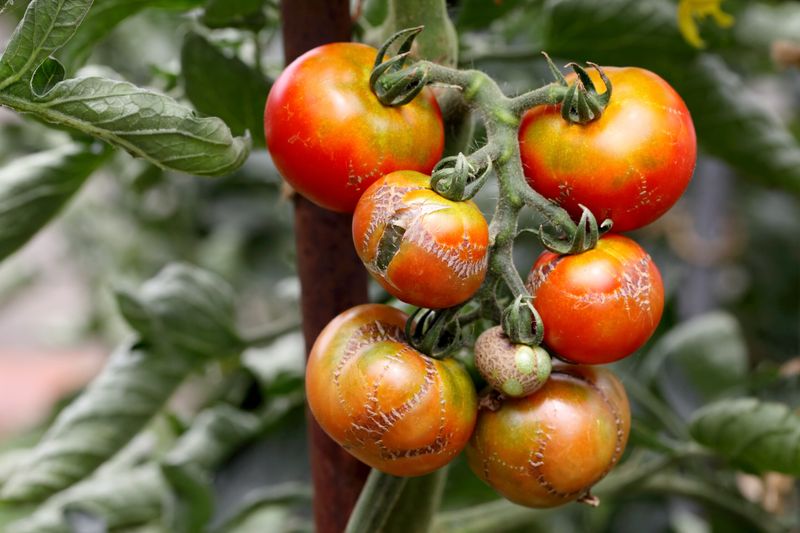
Finding a nearly ripe tomato split open in circular rings near the stem is one of late summer’s most frustrating garden moments. Those rings have a name and a common cause, and understanding both puts you back in control. A dry-to-wet moisture swing is a frequent trigger, but the full picture involves your cultivar, the fruit’s maturity, the August heat, and a few other conditions working together. Once you know what you’re dealing with, there are real steps you can take right now.
Those rings usually signal tomato growth cracking
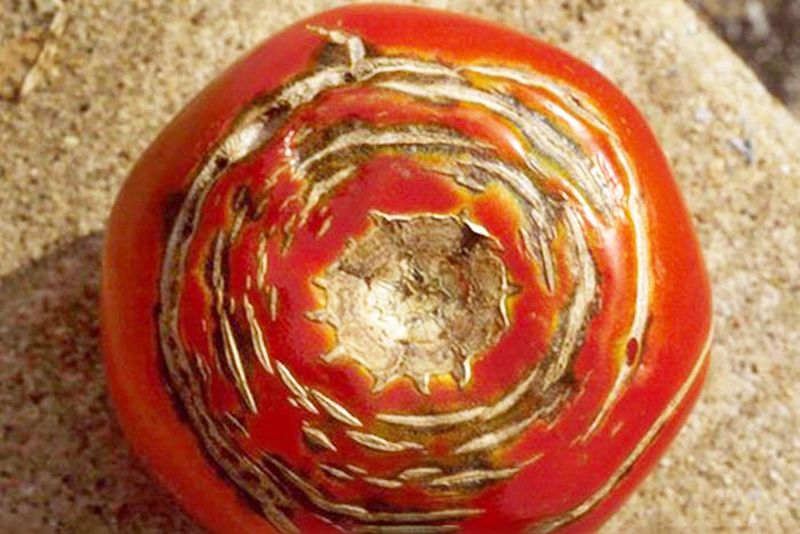
Circular splits that form in rings around the top of a tomato, near the stem scar, are the signature of concentric growth cracking. University of Minnesota Extension’s tomato fruit crack diagnosis tool identifies this pattern as a physiological disorder, meaning it comes from internal stress rather than from a bacterium, virus, or fungus. That distinction matters, because it changes how you respond.
Concentric cracks circle the fruit near the top. Radial cracks, by contrast, extend outward from the stem scar like spokes on a wheel. Both are growth-cracking disorders, and both stem from the same general problem of skin failing to keep pace with the fruit inside. Seeing one type versus the other can help you describe the problem accurately, but the practical response is similar for both.
Two other tomato problems are sometimes confused with growth cracking and are worth ruling out. Blossom-end rot appears as a sunken, brown or black leathery patch at the bottom of the fruit, the end opposite the stem, not the top. Penn State Extension’s guide to tomato diseases and disorders notes that ringed or circular patterns on tomato leaves are a separate symptom that may point to a disease requiring its own diagnosis and management plan. Leaf spots and fruit cracks are different problems, so check both the fruit and the foliage carefully before deciding what you’re dealing with.
A dry-to-wet swing often starts the split
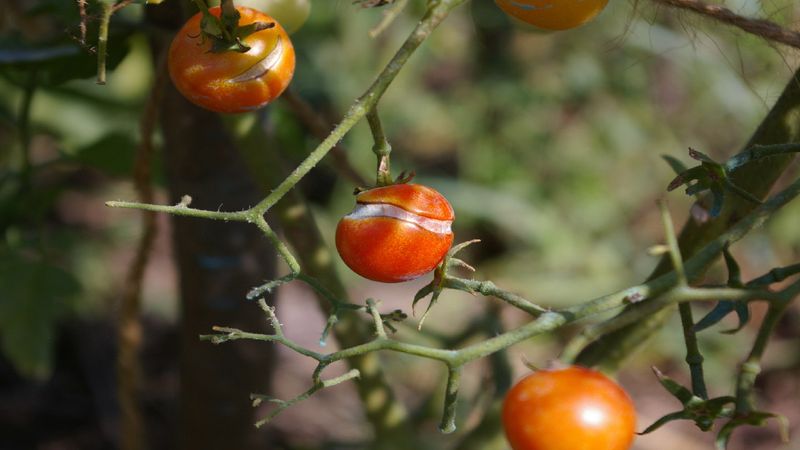
The sequence that most often leads to concentric cracking goes like this: the soil dries out over several hot August days, then a soaking rain or a heavy irrigation session arrives. The roots pull water in rapidly, the fruit swells from the inside, and the skin cannot stretch fast enough to accommodate the sudden growth. The result is a split, usually appearing within a day or two of the moisture event.
Penn State Extension’s cracking explainer adds an important detail: rain and overhead irrigation can also wet the fruit surface directly, and water may enter through small openings or the corky tissue around the stem scar. So the trigger is not only what happens underground at the roots. Both pathways, root-zone uptake and direct surface wetting, can contribute to the same outcome.
The biology behind cracking involves more than a simple pressure burst. Peer-reviewed research on tomato fruit water relations describes an interaction among fruit water uptake, cell expansion rates, skin strength, skin elasticity, the ripening process itself, and cultivar-specific traits. A dry-to-wet moisture swing is a common and practical trigger, but calling it the sole cause of every concentric crack overstates the case. Genetics, maturity stage, heat, sun exposure, and other conditions all play a role, sometimes a large one.
Use the root zone to decide when and how to water
Rather than watering on a fixed calendar, check what the soil is actually doing. Push a finger or a trowel blade into the ground near your tomato plants and feel the soil about two inches down. UMN Extension’s tomato growing guide advises watering when the soil at that depth feels dry, and recommends watering thoroughly into the root zone rather than applying light, frequent sprinkles that barely penetrate the surface.
About one inch of rainfall or irrigation per week is a reasonable starting point for established garden tomatoes, but treat that number as a flexible benchmark rather than a firm rule. UMN Extension’s vegetable garden watering guidance is clear that sandy soils drain faster and may need more frequent attention, while clay-heavy soils hold moisture longer. Containers dry out faster than in-ground beds, especially during a heat wave. Wind, plant size, mulch coverage, and recent rainfall all shift the equation.
The goal is to keep the root zone moist and reasonably consistent, not to follow a precise schedule. Letting the soil dry severely and then flooding it is exactly the pattern that raises cracking risk. Restoring moisture thoroughly but steadily after a dry period is far better than either extreme: withholding water entirely or soaking the bed so heavily that the roots are suddenly overwhelmed with supply after days of scarcity.
Buffer moisture with mulch and uniform irrigation
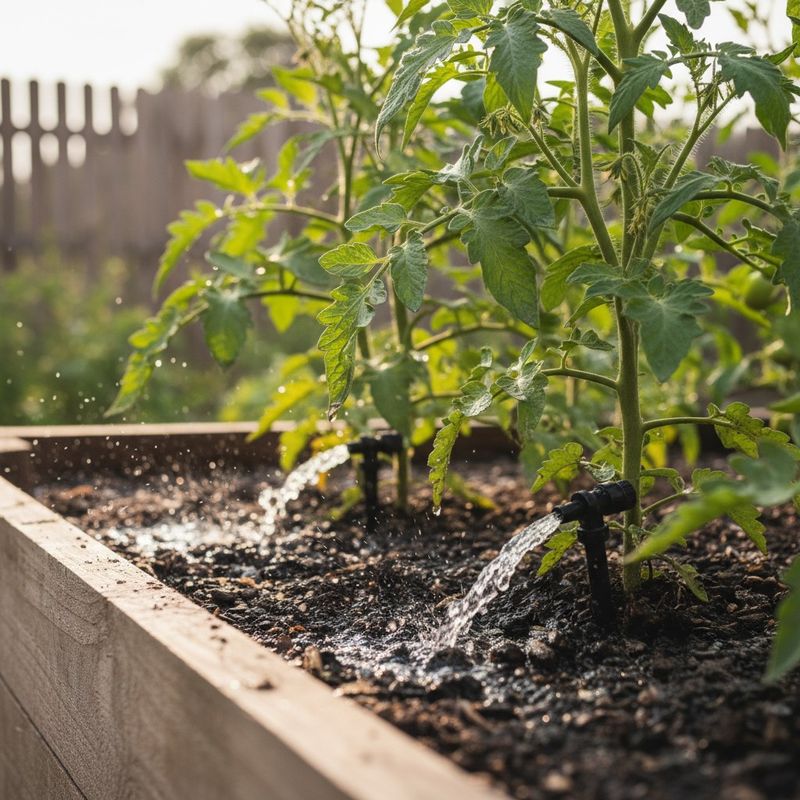
Mulch is one of the simplest tools for keeping root-zone moisture from swinging wildly between waterings. University of New Hampshire Extension’s tomato fact sheet recommends applying organic mulch such as straw, shredded leaves, or compost after the soil has warmed in spring. A layer two to four inches deep reduces evaporation from the soil surface, keeps the root zone cooler on hot August afternoons, and helps slow the transition from dry to wet when rain or irrigation arrives.
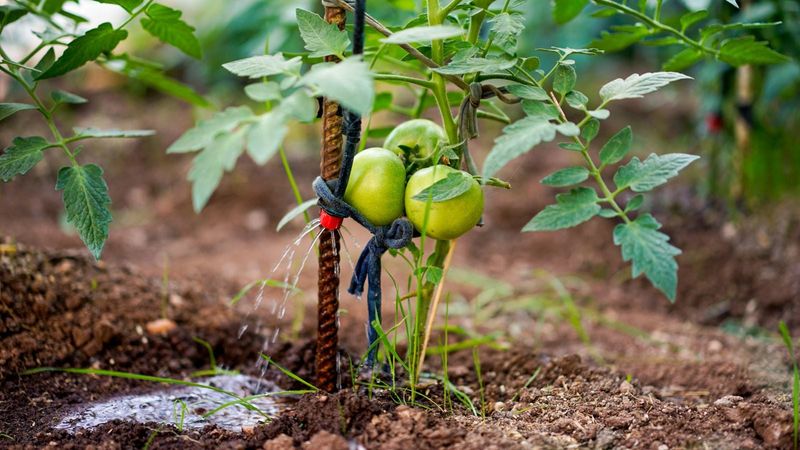
How water is delivered matters almost as much as how much is applied. Oregon State University Extension’s tomato guide recommends drip irrigation or soaker hoses because they deliver water directly to the root zone at a steady rate, without wetting leaves or fruit. Overhead watering, by contrast, splashes soil onto foliage, keeps surfaces wet longer, and can encourage the fungal and bacterial diseases that further weaken plants already stressed by cracking.
Healthy leaf cover is worth protecting too. Penn State Extension notes that stripping away foliage or pruning aggressively around the fruit exposes tomatoes to stronger sun and wider temperature swings, both of which can raise cracking susceptibility. Leave healthy leaves in place; they buffer the fruit from the direct August sun and help moderate the microclimate around developing tomatoes.
Protect nearly ripe fruit before heavy rain
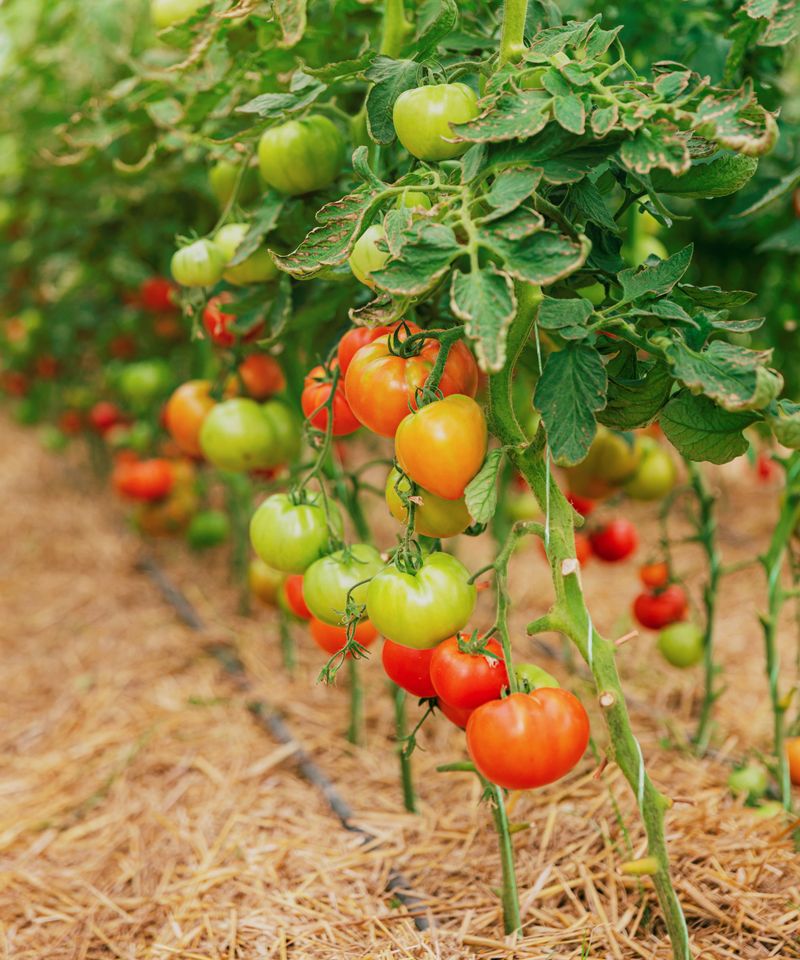
August in most US temperate zones brings the combination that growers dread most: a stretch of hot, dry days followed by a heavy thunderstorm. When nearly ripe tomatoes have been sitting in dry conditions and a significant rain is in the forecast, you have a decision to make before the storm arrives.
Penn State Extension and University of Missouri Extension’s cracking news article both suggest harvesting tomatoes at the breaker-to-pink stage before an expected heavy rain as a practical way to reduce late-season cracking losses. At that point, the fruit has enough starch and color development to finish ripening on its own indoors. Set harvested tomatoes on a countertop or tray at room temperature, out of direct sunlight, and they will continue to ripen over the next several days.
The tradeoff is real and worth acknowledging honestly. Tomatoes picked at the breaker stage will ripen indoors, but many gardeners find that fully vine-ripened fruit has a flavor depth that early-picked tomatoes may not quite match. Harvesting early is a damage-reduction strategy, not a perfect substitute. For fruit that is still small, green, or weeks away from ripening, early harvest offers little benefit and is not worth the disruption.
Reserve the practice for tomatoes that are already showing color and are close to ready.
Maturity, heat, and variety change the risk
Two tomatoes growing on the same plant, exposed to the same rain, can respond very differently. Ripening stage is a major reason why. As a tomato matures, its skin gradually loses elasticity and tensile strength, so a moisture event that would barely affect a green fruit can split a nearly ripe one. Penn State Extension’s tomato disorders page confirms that cracking is especially likely when ripening fruit experiences the dry-then-wet sequence.
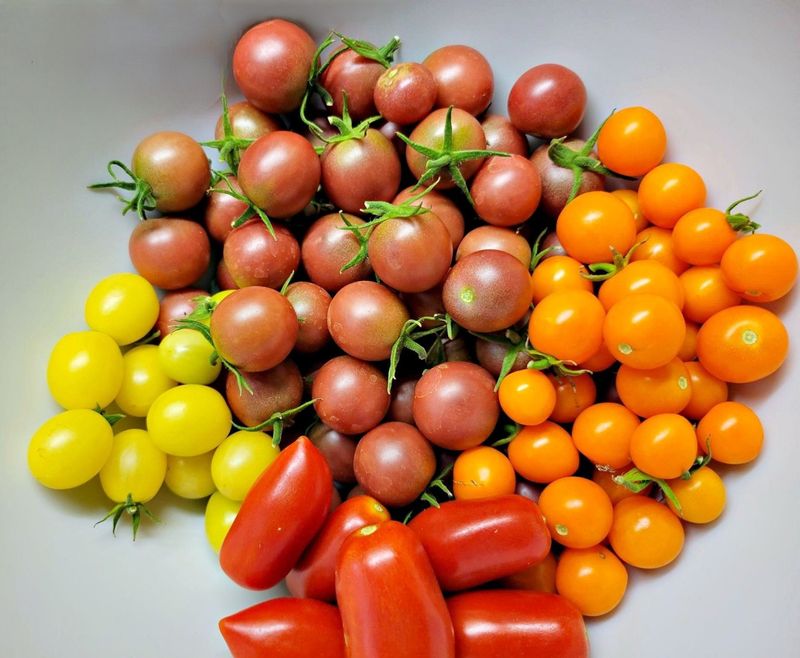
Variety plays a substantial role. University of Minnesota Extension notes that large-fruited and many heirloom types are frequently more prone to cracking, while smaller-fruited cultivars tend to be less susceptible overall. That said, small tomatoes are not immune. University of Missouri Extension points out that cherry and grape tomatoes can also crack after an abrupt swing from dry to wet conditions, particularly when they are fully ripe and hanging on the vine.
High heat and direct sun are contributing factors rather than root causes on their own. Fruit left exposed after leaf removal or aggressive pruning heats up faster, and hotter skin is less pliable when water pressure rises suddenly. Penn State Extension advises against automatically adding calcium or other amendments to address cracking without a soil test. Stable moisture is the better-supported first response; fertilizer changes should be guided by confirmed soil deficiencies, not guesswork.
Use cracked tomatoes quickly and never can damaged fruit
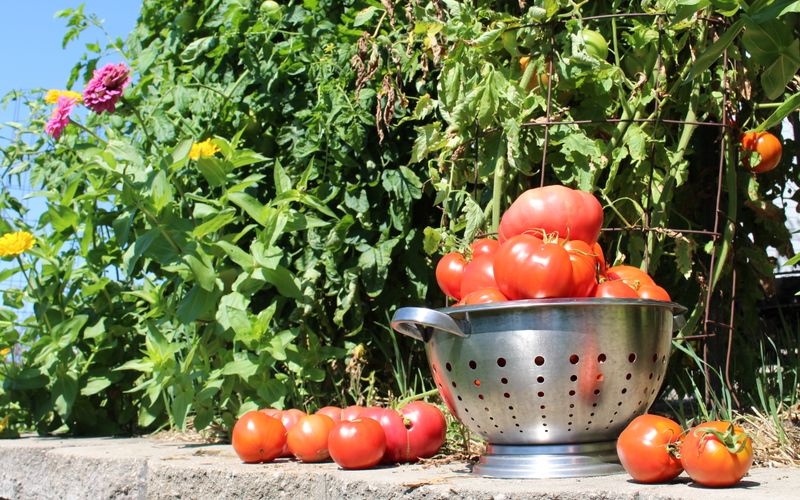
When a tomato splits on the vine, the clock starts immediately. Cracks open a path for soil bacteria, fungi, insects, and decay organisms to reach the interior of the fruit. University of Missouri Extension recommends picking cracked tomatoes as soon as you spot them, inspecting each one carefully, and planning to use them within a day or two rather than leaving them in a bowl on the counter for a week.
Before using a cracked tomato, wash it thoroughly under cool running water. UMN Extension’s fresh produce washing guidance notes that washing helps remove surface contaminants, though it cannot reverse deterioration that has already begun inside the fruit. Inspect the flesh around and beneath the crack. Discard any tomato that shows rot, mold, a sour or fermented smell, slimy texture, or extensive browning below the surface.
A fresh surface crack on an otherwise firm, good-smelling tomato is generally fine for immediate cooking, sauces, or fresh eating.
Home canning is a different matter entirely. UMN Extension’s home canning guidance for tomatoes is explicit: only high-quality, disease-free, undamaged tomatoes belong in a canning batch, processed using research-tested, properly acidified recipes. Cracked, overripe, damaged, or diseased fruit should not be canned, and cutting away the cracked section does not make the remainder safe for canning. The risk is not just spoilage but potentially serious food safety failure.
Use cracked tomatoes fresh or cooked and skip the canning jar entirely.
Keep conditions steadier for the next harvest
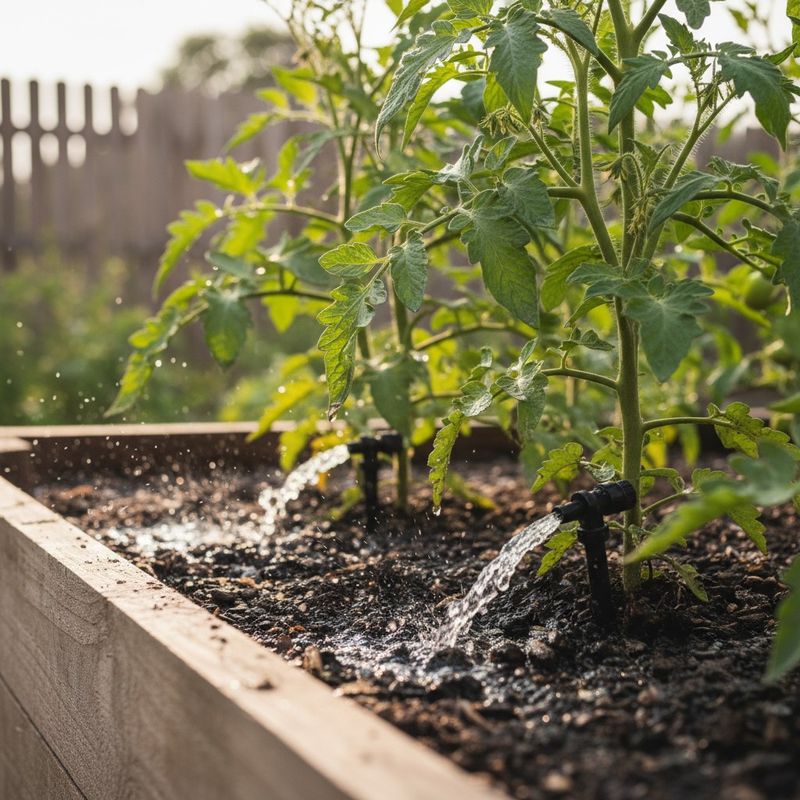
Preventing concentric cracking comes down to reducing the extremes your plants experience from week to week. Check root-zone moisture every few days during August rather than waiting for the soil to go bone dry. UMN Extension recommends watering thoroughly when the soil two inches down feels dry, delivering water into the root zone rather than wetting the canopy. Mulch the bed consistently so evaporation between waterings stays manageable.
Drip lines or soaker hoses give you more control over timing and volume than overhead sprinklers, which also wet foliage and fruit. Keep healthy leaves on the plant; they shade the fruit and moderate temperature swings that make ripening skin more vulnerable. Watch nearly ripe tomatoes closely in the days before a forecast heavy rain, and harvest any that are already showing good color if you want to avoid a post-storm cracking loss.
A dry-to-wet moisture swing is a common trigger for concentric cracking, but it does not explain every case. If the problem keeps returning despite steady watering and mulch, look at the full picture: which cultivars are cracking most, how ripe the fruit is when it splits, how much direct sun the fruit receives, and whether irrigation timing could be more even. Penn State Extension and University of Minnesota Extension both list crack-tolerant cultivars as a longer-term option worth exploring, with the honest caveat that no variety is fully immune when moisture conditions swing hard enough. Steadier conditions are the goal; perfection is not on the table, but meaningful improvement almost always is.