
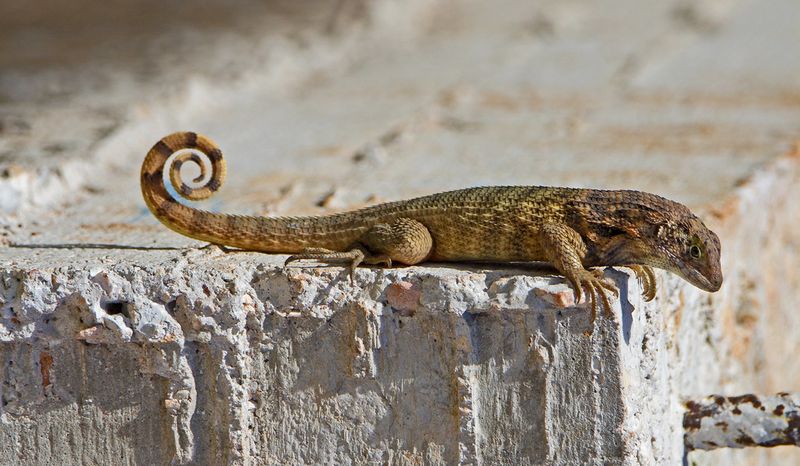
You spot a lizard on the patio with its tail curled up like a question mark. Is it a northern curly-tailed lizard, a nonnative species that now lives in Florida?
Some people say it is chasing off the little anoles in your garden, but the real story is more tangled. Here is how to identify it, what scientists have found, and what to do next.
A curled tail is a clue, not an identification

Picture a stocky, gray-to-tan lizard on the warm concrete, tail looping up over its back. That is the classic look of the northern curly-tailed lizard, which grows to roughly 7 to 10.5 inches long, according to the UF/IFAS identification guide for nonnative South Florida reptiles.
Size and color give you a first set of clues to check.
A curled tail alone, though, does not settle the question. Lizards hold their tails in different positions for many reasons, and a single glimpse of a curl can mislead you.
Body shape, overall size, and coloring all need to fit before you can feel confident.
Mix-ups are common. The same UF/IFAS guide warns that nonnative lizards can be confused with Florida natives, so a quick guess from the kitchen window can easily be wrong.
Some native species look similar at a glance, and young lizards of different kinds can resemble each other even more.
Keep your approach simple and observational. Note where the lizard is, how big it looks compared with a familiar object like a flip-flop or a flowerpot, and what color it is in full sun.
A few clear phone photos taken from a distance will help far more than any close encounter.
Before anyone talks about removal, the identification has to be confirmed. Guessing wrong could mean treating a harmless native neighbor as a problem.
Watching quietly costs nothing and keeps both you and the lizard out of trouble.
Why this ground-dweller shows up around patios

Unlike the anoles that climb walls and shrubs, curly-tails live mostly on the ground. A Florida reptile and amphibian monograph from 2011 notes that hard, open urban surfaces such as sidewalks and parking areas can provide suitable habitat.
That helps explain why one might turn up near pavement and sunny slabs.
Not every patio fits that description, though. A shady, heavily planted yard with no open hard surfaces may never see one.
Habitat is a matter of the specific spot, not a rule for all Florida homes.
The species itself is nonnative, meaning it came from outside Florida, and it is established here. A 2003 Florida-focused review documented its range expansion in the state.
That is a record of spread over time, and it tells us the lizard has been around for a while.
So what does one sighting mean? Not much about timing.
Seeing a curly-tail today does not prove it just arrived, and it does not show the species is spreading fast in your neighborhood. It may simply be part of a population that has lived nearby for years.
A useful habit is to notice the setting. Is the lizard on open pavement, along a sunny wall base, or near a rock edge?
Jotting down where and when you see it can help if you later share photos with an expert for identification.
Eating insects does not prove garden pest control
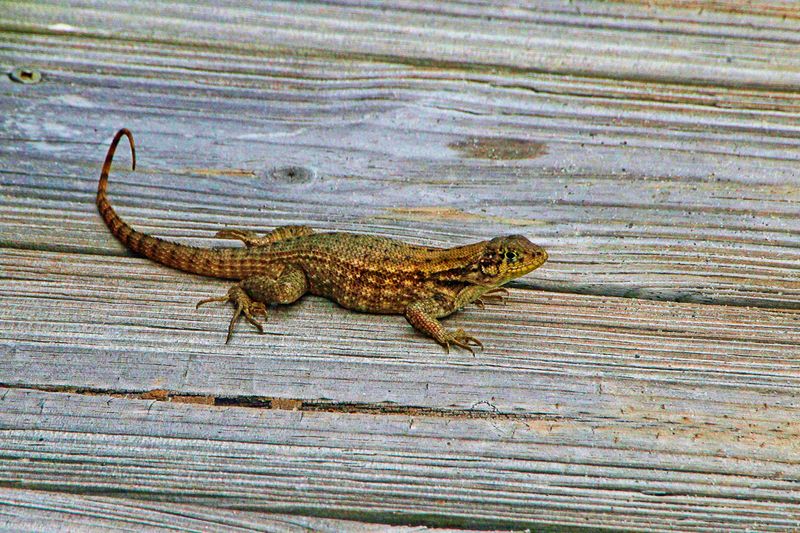
Curly-tails are not picky about a meal. Florida observations summarized in the 2011 monograph include lizards eating invertebrates such as roaches and ants.
That sounds like good news for a bug-weary gardener.
A 2019 experimental study in the Bahamas reported cockroaches as prominent prey in its study system. The same work found anole consumption was relatively infrequent in its larger-island experiment.
So anoles are a possible meal, but not shown to be the main one.
Here is where caution matters. Those diet findings come from specific places and conditions.
They do not tell us what a curly-tail will eat in your yard, or how many pests it will leave behind.
Pest control means a steady, dependable drop in the bugs that bother your plants or home. A lizard snapping up an ant now and then does not show that.
Nothing in the sources reviewed here promises a net benefit to a Florida garden.
If you want fewer pests, treat the lizard as a curiosity rather than a plan. Watch what it actually does around your beds, and keep using the pest management approaches UF/IFAS recommends for your yard.
What the Bahamian anole experiment found
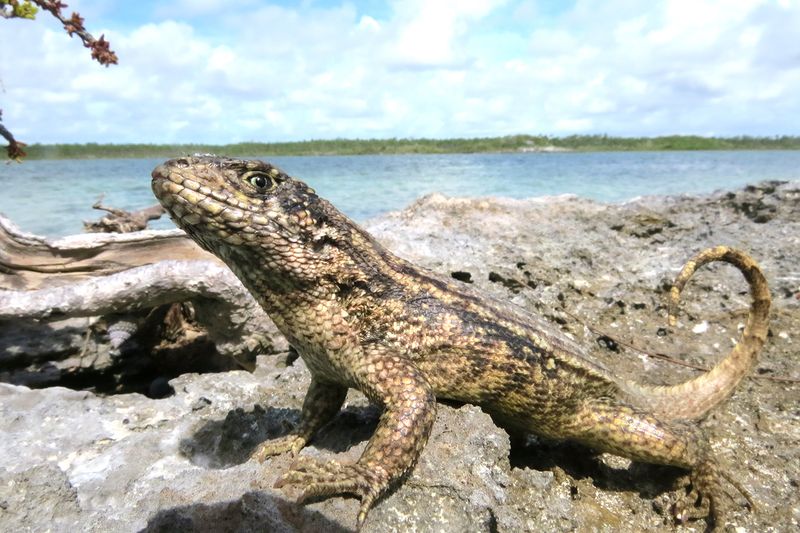
The strongest evidence about curly-tails and anoles comes from a 2019 experiment on small Bahamian islands. Researchers found that curly-tails affected brown-anole populations and how the anoles used their habitat.
Outcomes also depended on conditions such as available vegetation and refuge habitat.
That detail matters. Where anoles had places to hide, the story played out differently than where cover was scarce.
In the larger-island experiment, anole consumption was relatively infrequent.
What does this show? It shows predator effects are possible and depend on the setting.
It does not measure what is happening to anoles on a Florida patio, since the study was not run in Florida yards.
It also helps to know which anole is which. The brown anole is nonnative in Florida, as described in UF/IFAS’s brown anole profile.
The green anole, by contrast, is native, and the Florida Museum’s lizard pages help you tell Florida’s lizards apart.
Because the experiment focused on brown anoles, its results should not be stretched to every Florida anole. Green anoles and browns have different histories here, so any effect on one tells us little about the other.
Florida evidence does not establish an anole takeover
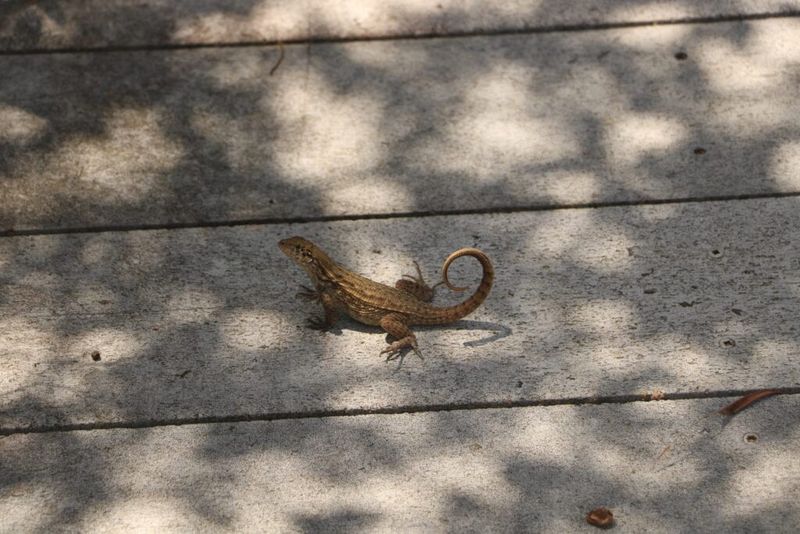
Back in Florida, the picture is less settled. The 2003 review reported that the lizard’s range had grown, but said its ecological effects on native lizards and other animals had not been quantified and needed further study.
It was a snapshot of what was known then, not a current impact assessment.
More recent work adds a local data point. A study of South Florida herpetofauna found that curly-tails increased in abundance across the parks it surveyed between 2017 and 2022.
Read that carefully. It describes change at those surveyed parks only.
It is not a statewide census, and it does not show that curly-tails caused any anole decline.
Could curly-tails affect native lizards? That is a reasonable question, given that they can prey on anoles.
But a possible effect is not the same as a documented one, and Florida displacement has not been established.
For a gardener, the practical meaning is simple. If you see more anoles or fewer anoles this season, many things could be behind it, from weather to habitat changes.
One lizard on your patio is not a verdict on the local anole population.
Confirm the lizard’s identity before you act

Start with the easy part: watch, and keep your hands to yourself. Snap photos from a distance, note the size and color, and see whether the lizard sticks around.
UF/IFAS cautions in its nonnative reptile guide that most reptiles may bite or scratch if provoked, so grabbing one is a poor idea.
Next, confirm what you are looking at before considering any removal. Nonnative lizards can be mistaken for natives, and a curled tail alone will not tell you.
Compare your photos with the guide or ask a local extension office to help.
The sources reviewed here do not lay out a recommended homeowner control method, so this article does not suggest one. That means no trapping, relocating, or other hands-on fixes based on a hunch.
Finally, keep the sighting in proportion. One lizard is not proof that anoles are vanishing, and it is not a promise of fewer garden pests.
Sometimes the best patio science is a chair, a phone, and a little patience.