
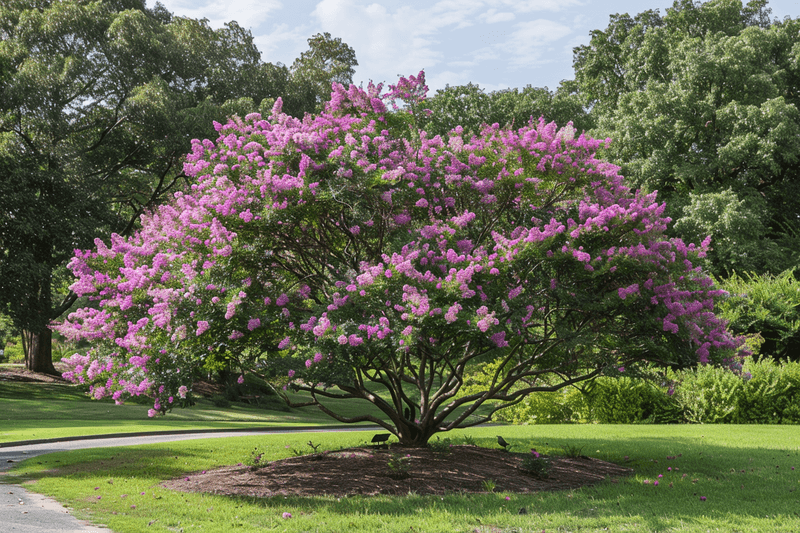
Chopping a crepe myrtle down to bare stubs this winter can leave knobby knuckles on the tree that stick around as lasting features. The cut also changes the plant’s natural shape and can leave you with crowded clusters of skinny shoots.
The good news is that a lighter, smarter approach keeps your tree graceful and lets it bloom each summer. Here is how to tell the difference and what to do instead.
The problem is topping, not winter pruning
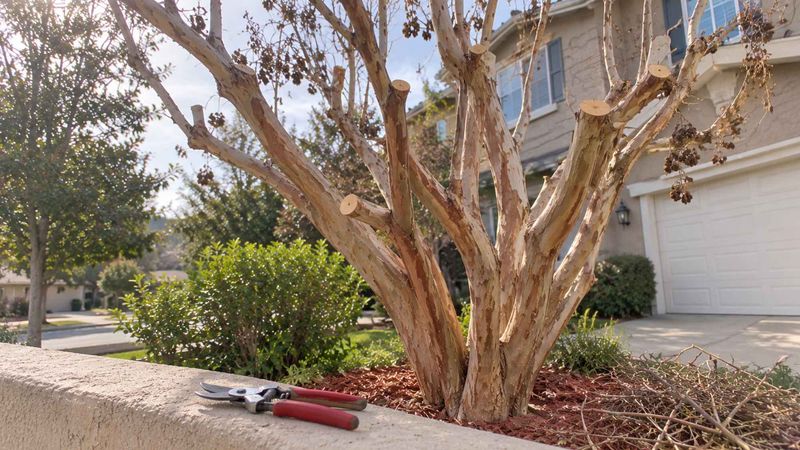
Winter itself is not the villain here. North Carolina guidance supports pruning crape myrtles while they are dormant, usually in late winter before spring growth starts, as NC State Extension in Wayne County explains.
The trouble comes from what gets cut, not when.
Topping means chopping the main branches of a tree-form crape myrtle back to arbitrary stubs, often at about the same height across the whole plant. It is the habit many people call crepe murder, and it is common because it looks tidy for a few weeks.
The results tend to show up as the seasons roll on. According to Brunswick County Extension, cutting main branches to stubs can spoil the tree’s natural form, create conspicuous knuckles and clusters of shoots, delay flowering, and shorten the bloom period.
New growth from those cut points can also be weakly attached.
None of this means every winter cut does harm. A dead branch removed in February is a different job from lopping a whole canopy to the same height.
Think of it as the difference between a careful trim and a flat-top haircut.
Once you can spot that difference, you can decide calmly whether your tree needs anything at all. The next sections walk through how to do that, one step at a time.
How repeated stub cuts affect the tree
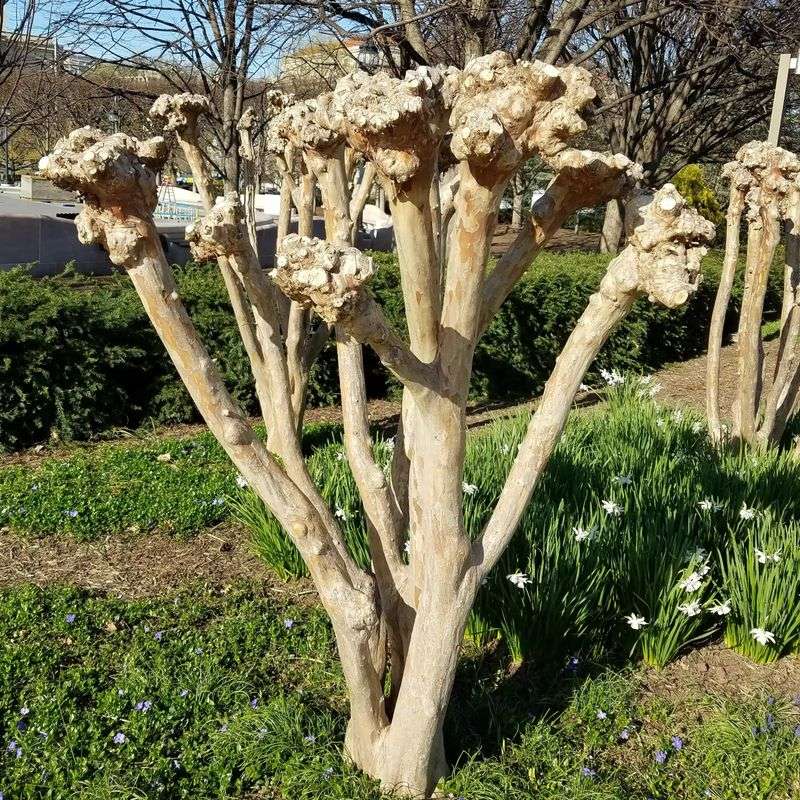
Cut the same branch tips back to stubs year after year, and the tree responds in a predictable way. Each cut site sprouts a cluster of shoots, and the wood around the wound swells into a knob.
Over time those knobs can become lasting features of the tree, and the new shoots can be weakly attached to the stub beneath them.
Research gives a closer look at what happens inside. In a Journal of Arboriculture study, researchers compared topped crape myrtles with pollarded ones.
Five years after pruning, the topped trees had longer decay behind the cuts and six times the volume of dead-stub wood in the canopy.
Be careful about how far to stretch that finding. The study compared topping with pollarding, a method that cuts back to the same knuckle each time.
It did not compare topped trees with unpruned trees or with trees that were selectively pruned.
So the fair takeaway is practical rather than dramatic. Topping carries real risks to form, shoot attachment, and decay, but it does not automatically kill a crape myrtle.
As a quick diagnostic, look at the ends of your branches. Fat knobs with a thicket of thin shoots mean the tree has been cut back to stubs before, and a gentler plan will serve it better from here on.
When a crape myrtle needs pruning

Late winter is a comfortable time to work, if work is needed. Crape myrtles are best pruned while dormant, before growth resumes in spring.
Extension in Wayne County describes late February into early March as a common window there.
That is a local pattern, not a fixed statewide date. A mountain yard and a coastal yard warm up on different schedules, so follow what your plants and weather are doing.
The simple rule is to finish before buds swell and new leaves appear.
Here is the part that surprises many people: pruning is not what makes a crape myrtle bloom. These plants flower on new growth, and Clemson Extension notes they can bloom without being pruned.
Light pruning may change the size of flower clusters or the look of the display, but it is not a requirement.
That frees you from an annual chore. Some years the right answer is a walk around the tree, a look for problems, and a decision to leave it alone.
If the tree looks healthy and fits its space, you can skip the pruners this winter and still expect flowers when summer heat arrives.
Start with a reason, not a haircut
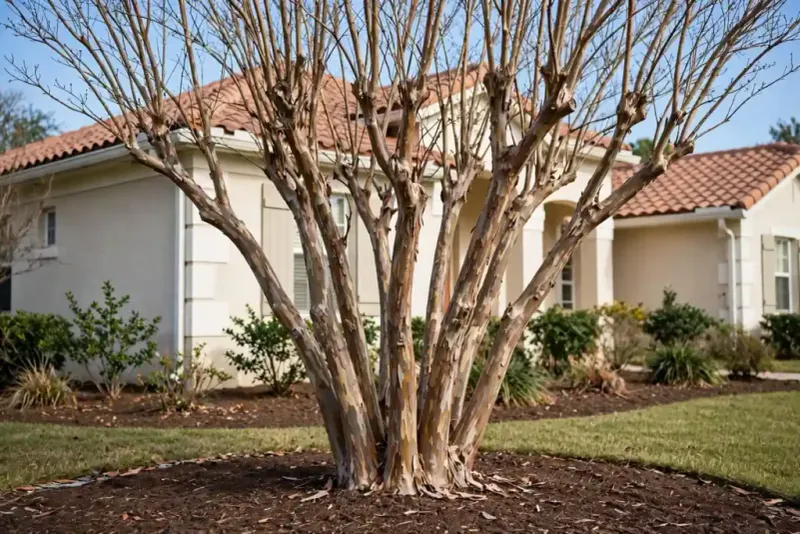
Before any tool comes out, give yourself a reason for each cut. Good reasons are simple: a branch is dead, diseased, or damaged, or two branches cross and rub against each other.
Suckers growing from the base can go if you are keeping a tree form, and crowded growth in the interior can be thinned as needed.
That short list comes from Wayne County Extension, which also points out that established plants may need little or no pruning. If you cannot name the reason for a cut, that is a good sign to skip it.
Walk around the tree first. Look for dark, dry-looking wood, split limbs, and spots where bark is scraped from rubbing.
Mark them with a bit of ribbon so you can find them again.
Selective maintenance like this is different from severe annual pruning. Clemson notes that a healthy plant can survive being cut back to about six inches each year when someone wants a deliberately low, compact form.
That is a management choice for a particular kind of plant. It is not advice for a mature tree-form specimen, and it is not a shortcut for shrinking a tall tree.
Every hard cut is not automatically harmful, but cutting a tree-form crape myrtle’s main branches to stubs is the practice to avoid.
Cut at a branch junction, not midway down a limb
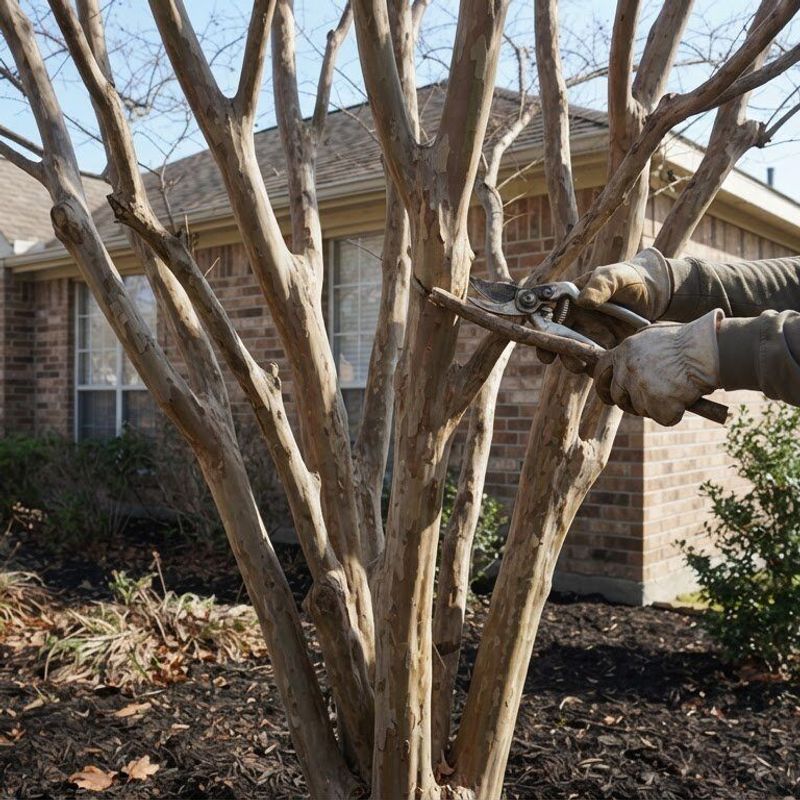
Where the blade lands matters more than how much you remove. If a branch is too tall or wide, trace it back to a smaller side branch and cut there.
According to Brunswick County Extension, reducing height or spread works best when you cut back to a suitable lateral branch instead of snipping midway and leaving a stub.
The side branch then takes over as the new leader, so the limb keeps a natural line. A stub has no such partner, which is why it sprouts a cluster of shoots and swells into a knuckle.
To remove a branch entirely, find the branch collar, the slightly raised ring where the limb meets the trunk or a larger limb. Cut just outside that collar.
Avoid cutting flush to the trunk, and avoid leaving a stub behind.
These cuts also look different from topping. Topping chops many branches at once to roughly one height, while junction cuts are scattered, small, and chosen one at a time.
Keep the work within what you can safely reach from the ground using hand pruners or a small pruning saw. Thin, low branches suit a homeowner well.
Anything that needs a ladder or a heavy saw belongs in a different category, which the final section covers.
Choose a form and size that fit the space
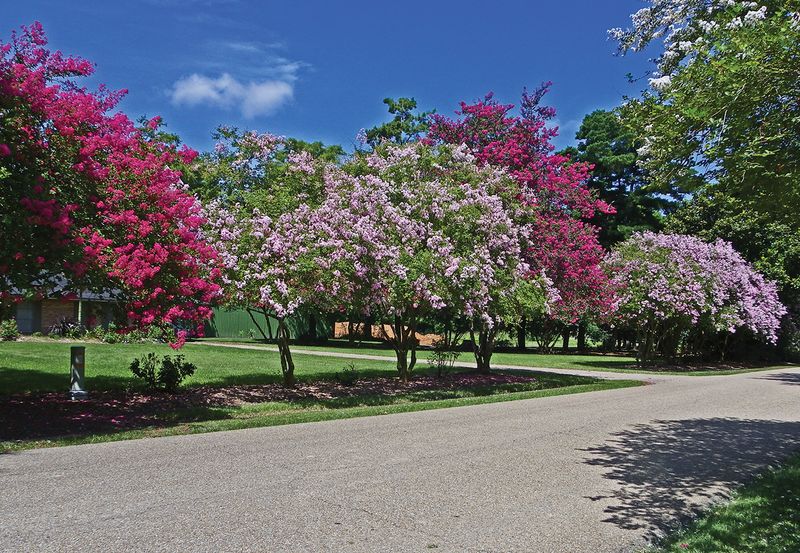
Shape is a choice you make early, and it need not be the same for every plant. If you like a classic tree form, NC Extension suggests selecting three to five strong trunks and removing competing trunks at ground level.
That is a training option, not a rule every crape myrtle must follow.
Size matters just as much. Extension in Brunswick County says cultivars range from about 3 feet to over 30 feet.
A variety that grows 25 feet tall will keep pushing upward no matter how often it gets cut.
If you find yourself hacking back the same oversized plant every winter just to keep it off the roof or the driveway, the plant may be in the wrong spot. A cultivar suited to the space may be a better long-term answer than yearly battles.
Compact plants are a separate story. A dwarf or low-growing crape myrtle that you want to keep small can be managed differently, and Clemson notes that a healthy plant can be cut back to about six inches each year for a deliberately low form.
That approach does not carry over to a mature, tree-form specimen. Match the method to the plant you actually have, and check the tag or nursery listing for mature height before you buy.
Know when to stop and call an arborist
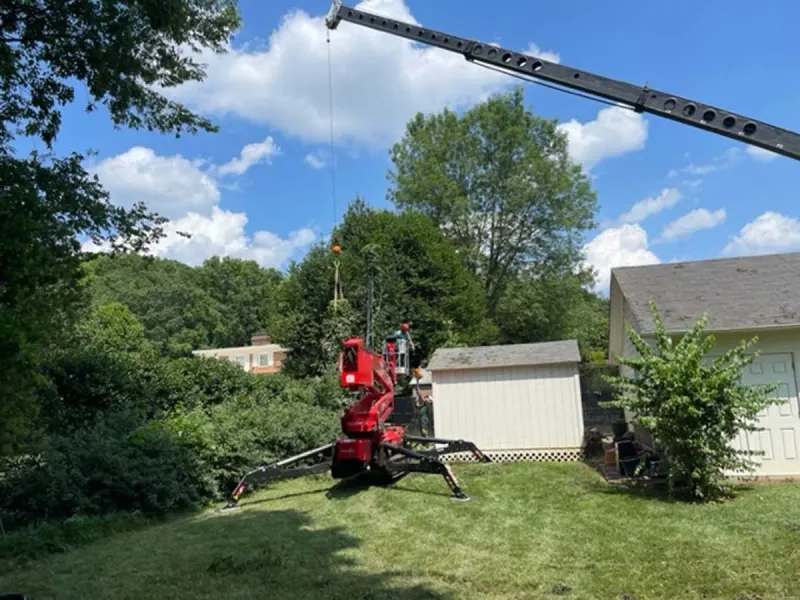
Some jobs are worth handing off. If a limb is large, high overhead, or tangled near power lines, or if the work calls for tools you do not own, consider a certified arborist.
NC State Extension recommends that route for work beyond your skill or equipment, and a wobbly ladder is not worth the risk.
One more tip from the same source: skip the wound paint or tar. NC State says these coatings can increase the risk of infection, so a clean cut is all the tree needs.
The overall plan is short. Prune for a clear purpose, make cuts at appropriate branch points, and let go of the idea that selective pruning guarantees any particular bloom display.
Bloom performance also depends on the cultivar and the growing conditions.
A crape myrtle left to grow into its own shape tends to reward patience more than a flat-topped one ever will.