
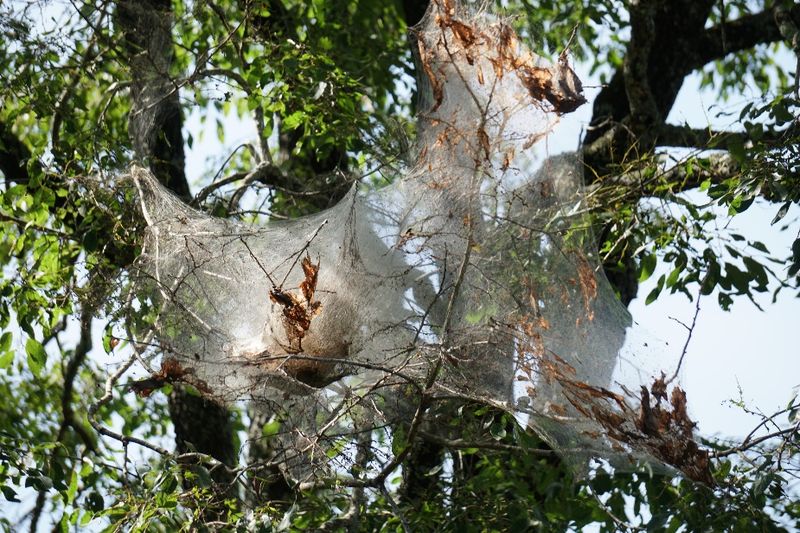
Late summer in North Carolina often brings a surprise in the backyard: silky white webs draped over the tips of tree branches, sometimes several at once. These are fall webworm nests, and they tend to alarm homeowners who worry the tree is in trouble or that ignoring the problem will make next year far worse. The good news is that most established trees handle a moderate infestation without lasting harm, and the decision to act or leave it alone is simpler than it looks. Understanding what you are actually seeing, and what those webs do and do not mean, is the first step toward a calm, practical response.
Identify the branch-tip web before you act
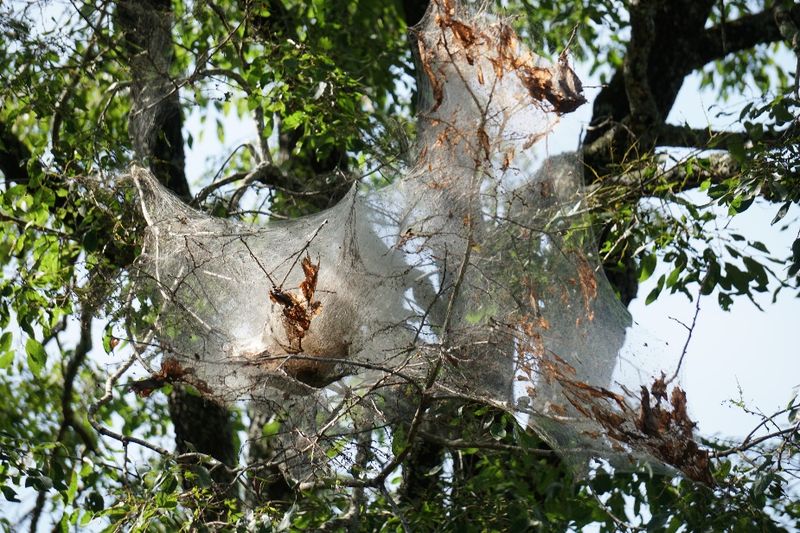
Loose, milky-white silk tents draped over the very ends of branches are the calling card of fall webworm (Hyphantria cunea). The webs appear during late summer and continue into fall, and they tend to expand as the colony grows and the caterpillars consume the leaves enclosed inside. According to NC Cooperative Extension’s guidance on webworms and bagworms, fall webworms can feed on more than 600 species of trees and shrubs, and in North Carolina they commonly show up on pecan, sourwood, persimmon, black walnut, and many other deciduous hosts.
Location on the tree is your fastest identification clue. Fall webworm webs form at branch tips or the outer ends of branches, while eastern tent caterpillar tents form in the forked crotches of branches earlier in the spring, usually in cherry or apple trees. Bagworms build individual, spindle-shaped cases that hang from branches like small ornaments and are made partly from bits of the host plant’s foliage rather than broad sheets of silk.
Getting the identification right matters before you reach for any tool or product. Advice meant for eastern tent caterpillars, such as scraping off overwintering egg masses in winter, does not translate to fall webworm control. Fall webworm primarily overwinters as a pupa in soil, leaf litter, bark crevices, or other sheltered spots, so egg-mass removal is not a reliable strategy for this particular pest. Confirm what you have, then decide what, if anything, to do about it.
A fall webworm nest is not a tree-health diagnosis
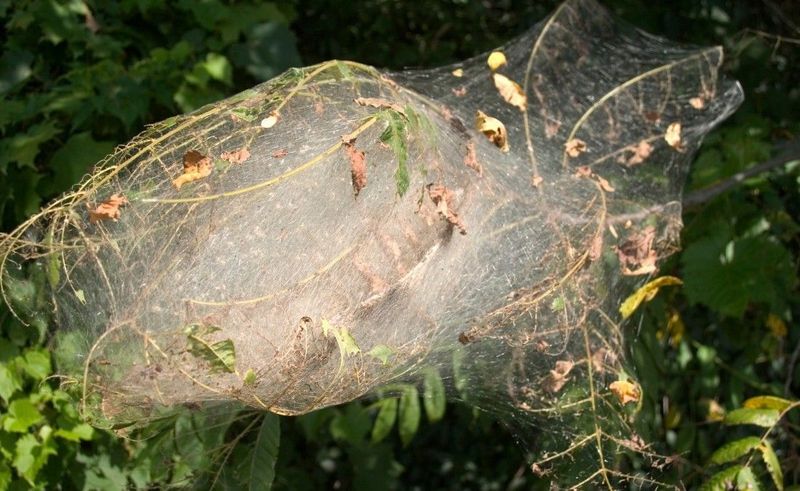
Seeing a webworm nest does not mean the tree is sick. Fall webworm is a native insect and a late-season defoliator, and on a mature, otherwise healthy deciduous tree, the feeding it causes is usually cosmetic. Because the damage occurs close to the time leaves would naturally drop anyway, established trees generally tolerate an ordinary infestation without lasting setback. As UMass Amherst Extension notes in its fall webworm fact sheet, aesthetic damage is the primary concern for most homeowners with healthy trees.
A nest tells you caterpillars are present and actively feeding. What it cannot tell you is whether the tree has underlying problems. For a more useful health picture, look at the whole tree: check for drought symptoms such as wilting, scorched leaf edges, or premature leaf drop; scan the canopy for sparse or thinning areas; look for dead branches, trunk wounds, cracks, or signs of disease or fungal growth at the base. Those are the signals that point to a tree under real stress.
Certain trees do deserve a closer look when webworms arrive. Young or recently transplanted trees, trees already dealing with drought or disease, fruit and nut trees where extensive defoliation can reduce yield, and trees that have been severely defoliated repeatedly over several seasons are all more vulnerable than a large, well-established shade tree. As the USDA Forest Service’s fall webworm fact sheet explains, repeated or severe defoliation can compound stress on a tree that is already struggling, even though a single late-season infestation rarely kills a mature specimen.
The practical takeaway is straightforward: use the nest as a prompt to assess the whole tree, not as proof that something is wrong with it.
Remove or disrupt an accessible nest when control is warranted
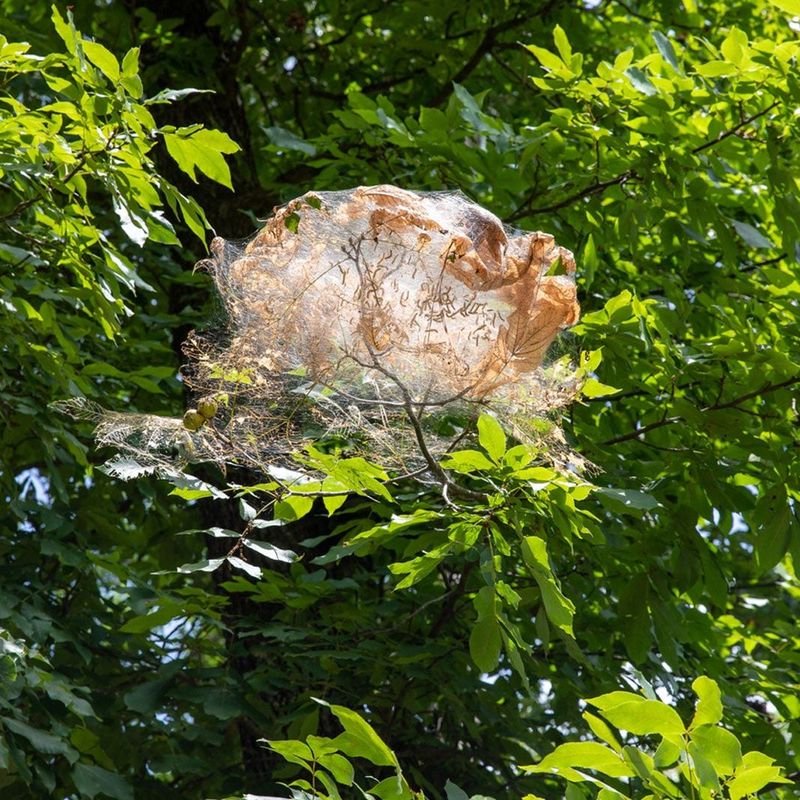
When a tree is young, stressed, or carrying an unusually heavy infestation, removing an accessible nest is a reasonable, low-effort response. The key word is accessible. UGA Extension’s fall webworm management guide recommends pruning out webbed branch terminals with hand pruners or a pole pruner when the nest can be reached safely, then sealing the clippings in a bag or disposing of them away from the tree so the larvae cannot simply crawl back.
Disruption is a second option for webs you can reach but do not want to prune. Pulling the web apart with a long stick or pole exposes the caterpillars to birds and other predators that might not be able to reach them through the intact silk. Either approach works best when the caterpillars are still small and the web is still compact, because young larvae and small webs are easier to manage and more susceptible to any follow-up treatment if one becomes necessary.
A few limits apply. Avoid heavy or unnecessary pruning, particularly on fruit trees, where removing too much wood can reduce productivity or alter the tree’s shape in ways that take seasons to correct. Penn State Extension’s fall webworm resource similarly emphasizes acting while larvae are small and webs are limited rather than waiting until the colony has expanded and spread to multiple branch tips. Keep the job proportional: remove what you can reach comfortably and safely, dispose of it, and leave the rest to natural enemies or a professional if the infestation is high in the canopy.
Mechanical removal reduces the larvae still inside the web at the time of removal. It is a practical, targeted response, not a guarantee that webworms will not appear again later in the season or in future years.
Nest removal cannot predict next summer’s population
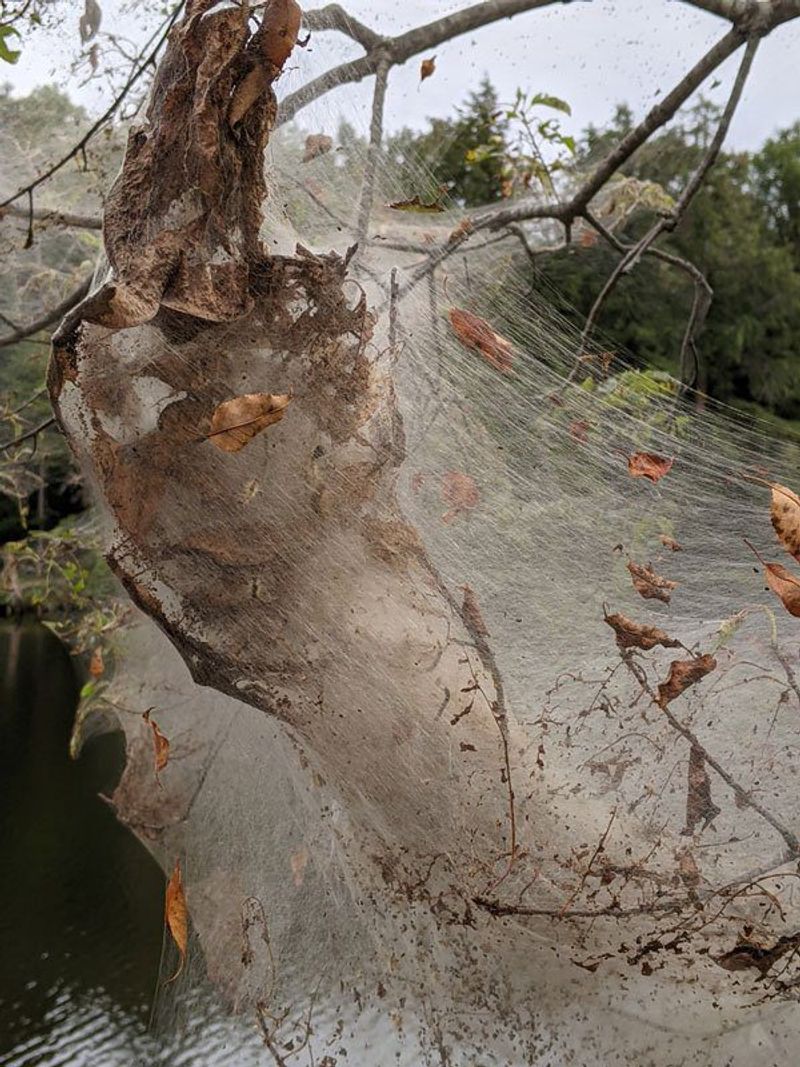
Removing a visible nest can reduce the caterpillars still inside it at that moment, but the life cycle of fall webworm puts a firm ceiling on what mechanical control can accomplish. UGA Extension explains that mature larvae leave the web before pupating, dispersing into soil, leaf litter, bark crevices, and other sheltered locations. By the time a nest becomes large and obvious, some of the older caterpillars in that colony may already have left to pupate elsewhere.
From those pupation sites, adult moths eventually emerge, mate, and lay eggs for the next generation. The cycle means that removing one visible nest, or even several, cannot eliminate pupae already distributed across the yard and surrounding landscape. Populations fluctuate from year to year based on weather, the availability of natural enemies, and other factors that a single fall cleanup cannot control.
The claim in many online sources, that leaving a nest untreated guarantees a worse outbreak the following summer, is not supported by extension entomology guidance. As the USDA Forest Service fall webworm fact sheet notes, local populations can build and decline in ways that are not directly tied to whether individual nests were removed the previous fall. Some years bring heavier pressure; others are light, regardless of what homeowners did the season before.
Frame mechanical removal accurately: it is a way to reduce current larval activity on a specific branch, particularly useful when the tree is vulnerable or the homeowner prefers not to watch the nest expand. It is not a reset button for next year’s population, and the absence of removal is not a reliable predictor of next summer’s severity.
Let the tree’s condition set the urgency
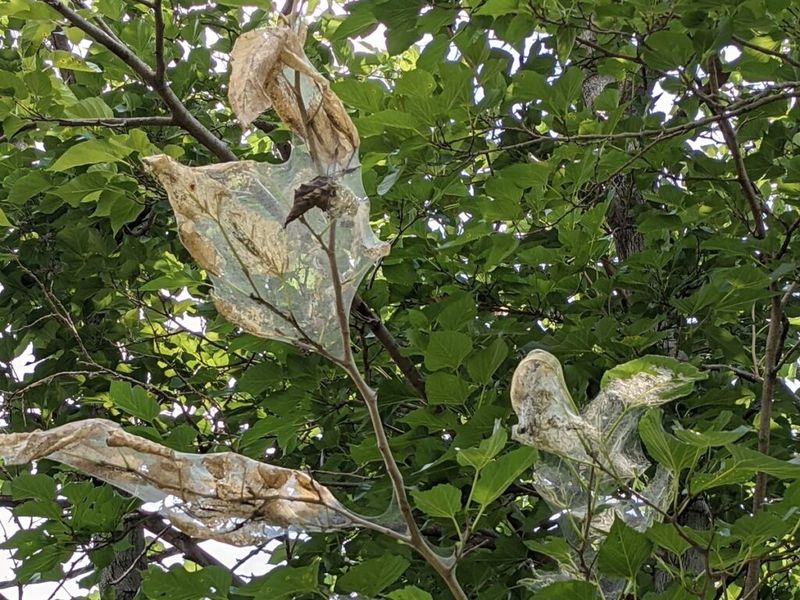
Not every webworm nest calls for the same response. On a large, well-established shade tree with only a few small webs and no signs of stress, leaving the colony alone is a perfectly reasonable choice. Natural enemies are already at work in most yards. Penn State Extension’s fall webworm page notes that birds, spiders, predatory insects, and parasitoids all contribute to suppressing fall webworm populations, and those allies do their best work when broad-spectrum insecticides are not disrupting the local insect community.
The calculus shifts for certain trees. Young or recently planted trees have smaller energy reserves and can be set back more noticeably by significant defoliation. Trees already under drought or disease stress are less equipped to compensate for lost leaf area. Fruit and nut trees, such as pecan, are worth monitoring more closely because heavy feeding during the growing season can affect yield.
UGA Extension’s management guidance points to repeated or extensive defoliation as the condition most likely to cause compounding harm, even when a single late-season infestation on a healthy tree would not.
Use the tree’s actual condition, not the presence of a nest, to set your level of urgency. A mature pecan with one small nest near normal leaf-drop time warrants a different response than a two-year-old transplant carrying several expanding webs during a dry August. Avoiding unnecessary broad-spectrum insecticide applications is worth doing regardless of the situation, because those products can reduce the populations of natural enemies that help keep webworm numbers in check over time.
Think of the decision as a proportional one: match your response to the real risk the infestation poses to that particular tree, at that particular time of year, in its current state of health.
Stop when the job becomes unsafe or overly disruptive
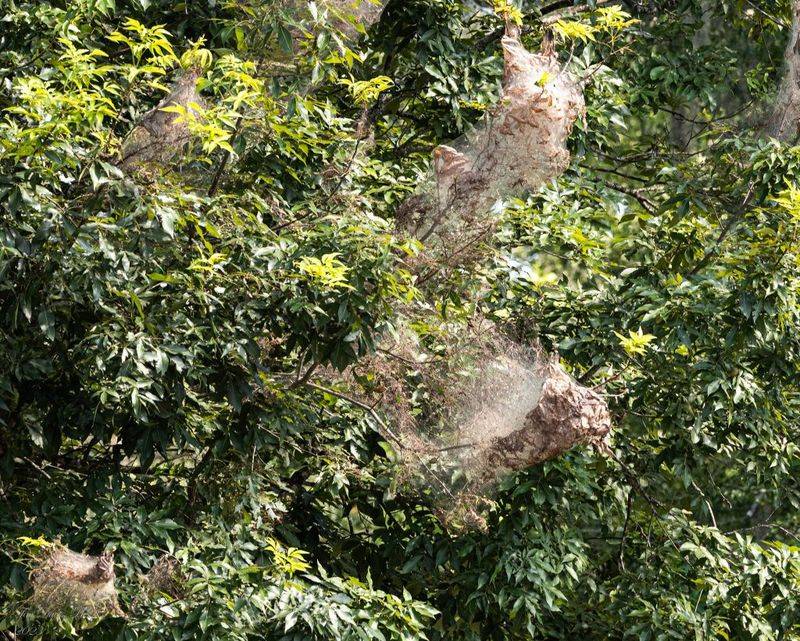
Mechanical removal has a clear stopping point: when the nest is out of safe reach, the job is done for the day. NC Cooperative Extension specifically warns against burning nests in trees, a practice that can spread fire, damage bark and cambium, endanger the homeowner, and threaten nearby structures. No nest is worth a house fire or a trip to the emergency room.
Do not climb an unstable ladder to reach a high branch, and do not attempt to spray the top of a large tree from the ground with a hose-end sprayer. UGA Extension notes that treating trees of substantial size is problematic and may be best handled by trained professionals with the right equipment. If a nest is high in the canopy of a large tree, a certified arborist can assess whether the infestation warrants professional treatment and can do the work without putting the tree or anyone else at risk.
If a pesticide seems necessary for a reachable nest with small, young larvae, the product must be registered and labeled for the intended site and pest. The EPA is clear that pesticide labels carry the force of law, meaning users must follow all stated directions, application rates, protective-equipment requirements, and restrictions on drift, contact with people, pets, water, and wildlife. Read the current label before every use, because labels can change between product batches.
Timing also matters and varies across North Carolina. Penn State Extension recommends applying any registered treatment when webs and larvae are still small, since young caterpillars are more susceptible. The exact window shifts depending on your part of the state, the season’s weather, and when the local population hatched, so monitor conditions rather than following a fixed statewide calendar date.
Support tree resilience without trying to fertilize webworms away
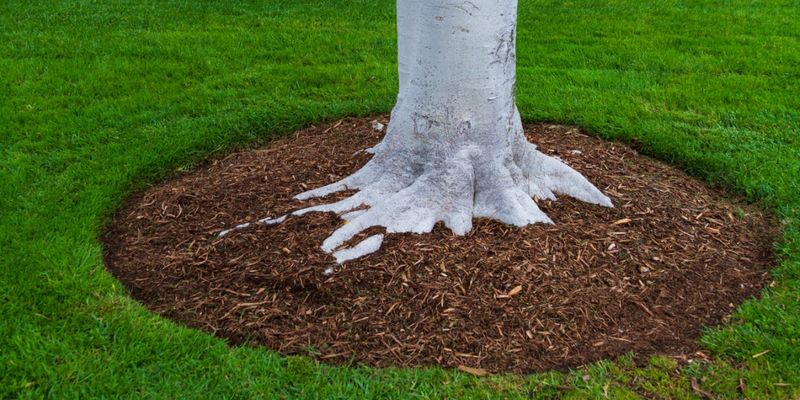
General tree care is worth doing on its own terms, separate from any pest response. NC State Extension’s woody ornamentals guidance recommends watering established trees slowly and deeply during prolonged dry spells, applying water at a rate the soil can absorb rather than letting it run off, and avoiding conditions of either prolonged drought or standing water around the root zone. A well-watered tree enters any stressful period, pest pressure included, in better shape to recover.
What watering cannot do is prevent fall webworms. The moths that lay webworm eggs choose host trees based on factors a homeowner cannot easily control. Good soil moisture supports a tree’s ability to push out new growth and bounce back from defoliation, but it does not make the tree invisible to egg-laying adults. Similarly, UGA Extension’s fall webworm resources do not list fertilization as a preventive treatment.
Applying fertilizer in response to a webworm nest is not an established control method and can create its own complications, including pushing tender new growth at the wrong time of year.
The practical framework for the whole season comes down to a few consistent steps: identify what you are actually seeing before you act, assess the tree’s real condition rather than reacting to the nest alone, remove or disrupt an accessible small web when the tree is vulnerable or the infestation is expanding, and leave limited webbing alone on healthy established trees when treatment would offer little benefit or create unnecessary risk. Webworms are a recurring part of the North Carolina landscape, and working with that reality, rather than against it, is the approach most likely to keep both your trees and your yard’s beneficial insects in good shape year after year.