
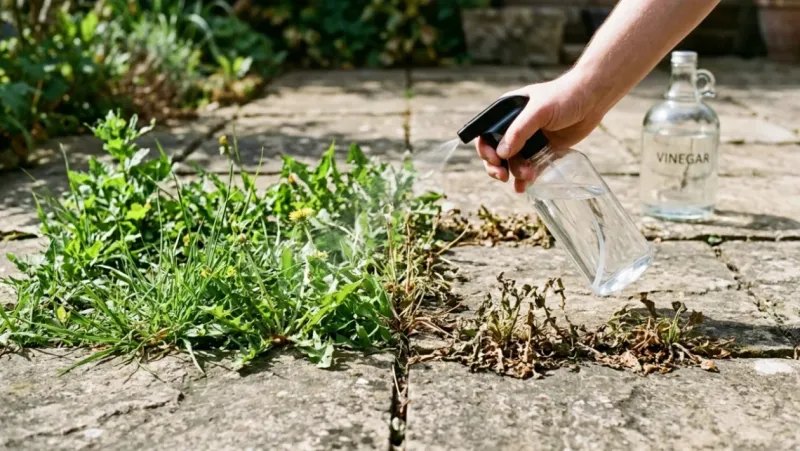
Picture a weed poking up from a crack in a driveway, and a bottle of vinegar sitting in the pantry. It is easy to see why someone might connect the two.
Vinegar can scorch leaves, but it does not work the same way on every weed or every yard. Here is what it can and cannot do along North Carolina driveways and walkways.
Vinegar burns the foliage it touches
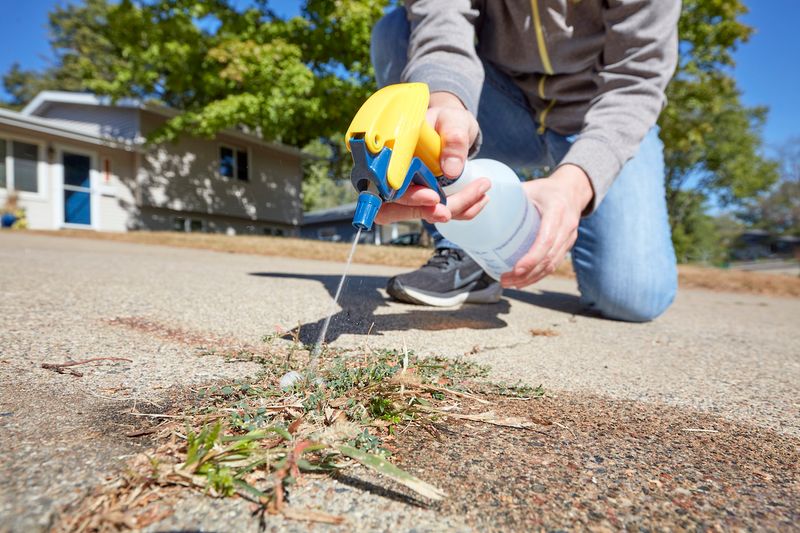
Weeds in driveway cracks are stubborn, and they show up fast after a warm, wet spell in the Piedmont or coastal plain. A homeowner staring at a green strip along the edge of a walkway might reach for vinegar because it is cheap, familiar, and already in the kitchen.
There is a real reason behind the idea. Acetic acid, the active ingredient in vinegar, can damage the leaves and stems it lands on.
That damage is the key to understanding the whole practice. Vinegar works as a non-selective contact treatment, which means it harms plant tissue it touches and does not pick favorites.
A weed leaf, a bit of lawn grass, and a petunia petal can all be burned if the spray reaches them. Within hours on a sunny day, sprayed foliage may look wilted, spotted, or brown.
The burn stays mostly on the surface, though. Vinegar does not travel down through the plant to reliably kill established roots.
NC State Extension notes that acetic-acid products can work on small annual broadleaf weeds, but generally only burn the tops of perennial weeds and grasses.
It is also fair to say that nobody can point to a documented North Carolina trend here. This is simply a scenario that makes sense: a quick way to knock back green growth in a spot where digging is awkward.
Whether it earns a place in your routine depends on the weeds you have and the results you expect.
Kitchen vinegar is not the same as a herbicidal product
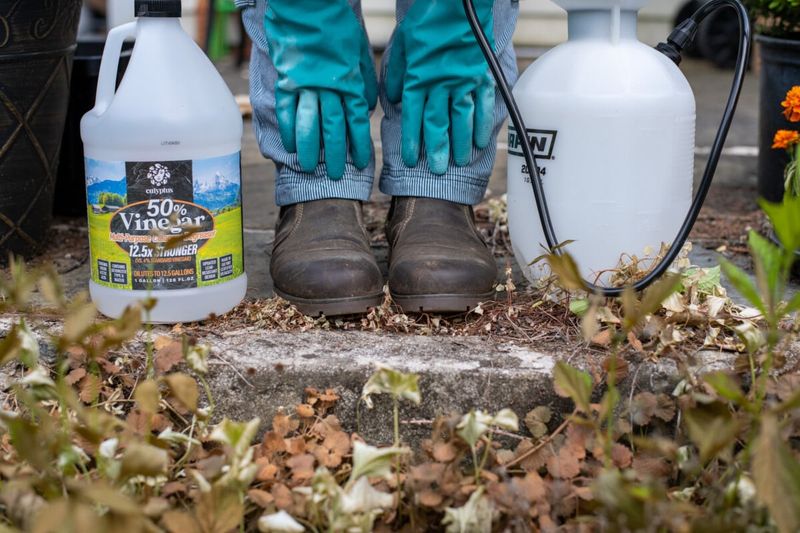
The jug in your pantry and the bottle in the garden aisle may both say vinegar, but they are not twins. Household white vinegar usually contains about 4 to 6 percent acetic acid.
Products sold for weed control can be much stronger, and horticultural vinegar commonly refers to formulas around 20 percent or higher, according to the National Pesticide Information Center.
Strength changes two things at once. A higher concentration gives the spray more power to burn foliage, so it may do more to a weed than kitchen vinegar will.
But it also raises the handling risk, because concentrated acetic acid can irritate or injure skin and eyes.
Ordinary kitchen vinegar may scorch tiny seedlings. It is a weak bet for larger weeds, and it should not be counted on to clear most established driveway growth.
Stronger products can perform better on the right targets, yet a higher percentage does not turn a contact burn into a root killer.
Another thing to keep in mind is that products differ from one another. One label may name specific sites, spray methods, or protective gear, while another says something different.
Reading the label on the exact bottle you buy is the only way to know what applies, so avoid assuming that the directions for one product carry over to the next.
Which driveway weeds are most likely to return?
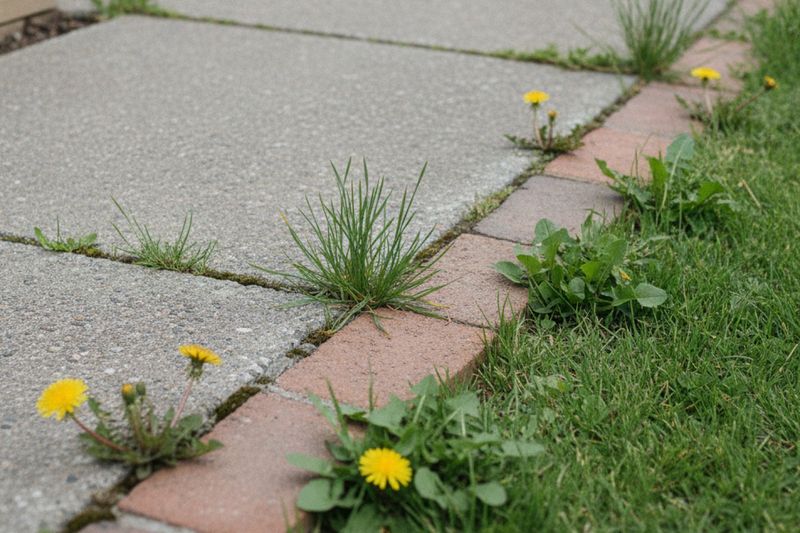
Size and type of weed matter more than almost anything else. Small, young annual weeds, the ones that sprouted a couple of weeks ago in a crack or paver joint, are the best fit for a contact burn.
Their leaves are tender and their root systems are shallow, so losing the foliage can set them back for good.
Older plants tell a different story. Larger weeds, grasses, and established perennials often bounce back, because the roots stay alive and send up fresh growth.
NC State Extension says acetic-acid products generally burn only the tops of perennial weeds and grasses. Think of Bermudagrass creeping from the lawn into a walkway joint, or a dandelion with a long taproot.
Both can look scorched for a week and then green up again.
A good diagnostic clue is what you see two or three weeks after spraying. If new shoots appear from the same spot, the roots survived.
University of Maryland Extension also points out that results vary with the weed, the concentration, and how thoroughly the leaves are covered, and that repeat treatments may be needed within what the label allows.
Vinegar also leaves nothing behind to stop later weeds. New seeds blowing into a crack can sprout the following week, so a clean-looking edge may not stay that way through a long Carolina growing season.
Where can spraying along an edge backfire?
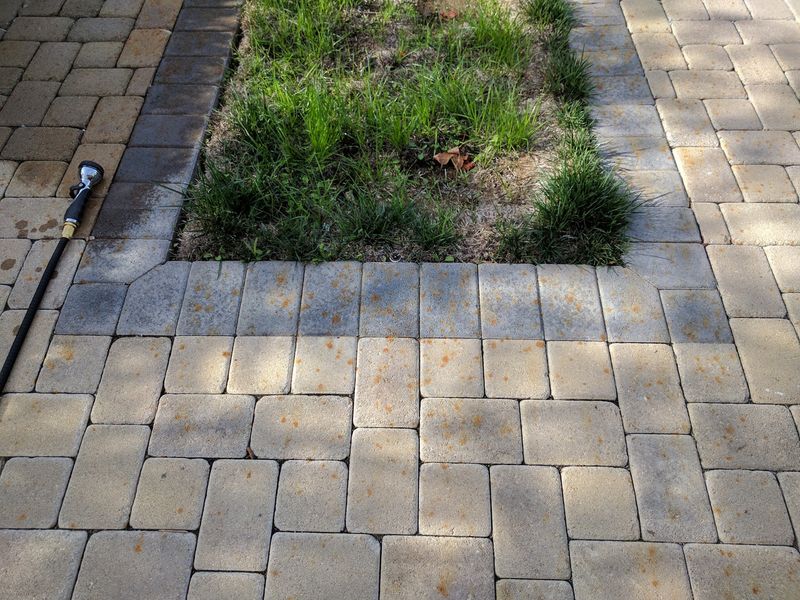
Edges are tricky because the weeds you want gone often grow inches from plants you want to keep. A contact spray does not know the difference.
Mist drifting from a bottle on a breezy afternoon can land on lawn edges, hostas, liriope, or a row of native perennials, leaving brown spots or scorched leaf tips.
Because vinegar is non-selective, any green tissue it reaches is fair game, as NC State Extension describes for acetic-acid products. Spraying close to the ground on a calm day, and shielding nearby plants with a piece of cardboard, can cut the risk.
It will not remove it entirely.
Surfaces deserve a second look too. University of Maryland Extension warns that some acetic-acid products can stain, mottle, or etch masonry.
That does not mean vinegar always harms concrete or pavers, and it does not mean it is always safe. Results can depend on the product, the surface, and how long it sits.
The practical step is to read the label for the exact product and see whether it restricts use on masonry. If you are unsure, test a small, hidden spot first, or skip spraying near decorative pavers and stained concrete and pull the weeds by hand instead.
Pull first, and follow the product label if you spray
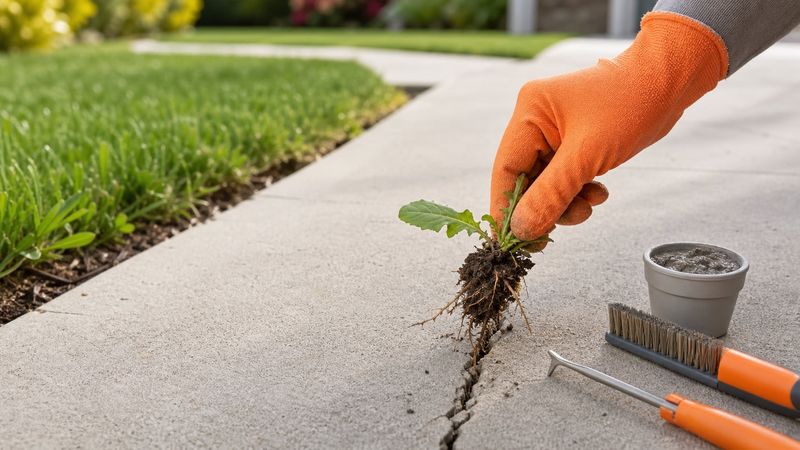
For most cracks and edges, the simplest tool is still the best. Pull or scrape weeds where practical, ideally after a rain when the soil is soft and roots slide out more easily.
A hand weeder, an old kitchen knife, or a crack-weeding tool reaches deep into narrow gaps, and removing the whole plant means nothing is left to regrow.
If pulling will not work and you decide to spray, choose a product labeled for the site you are treating. The EPA explains that pesticide labels spell out approved uses and precautions, and following them is required by law.
Keep overspray off lawn, ornamentals, and other wanted plants.
Protective gear is part of that label reading. NPIC guidance cautions that concentrated acetic acid can injure skin and eyes, and some labels call for goggles or a face shield, gloves, and long sleeves.
One example is a vinegar weed killer label with its own protective equipment list. Another product may say something different, so check yours rather than borrowing instructions.
Skip homemade blends of vinegar, salt, and dish soap. Oklahoma State Extension warns that such mixes lack verified label directions and that salt can build up in soil.
Keep children and pets away from treated areas as the label directs.
Expect a burn-down, not a weed-free edge
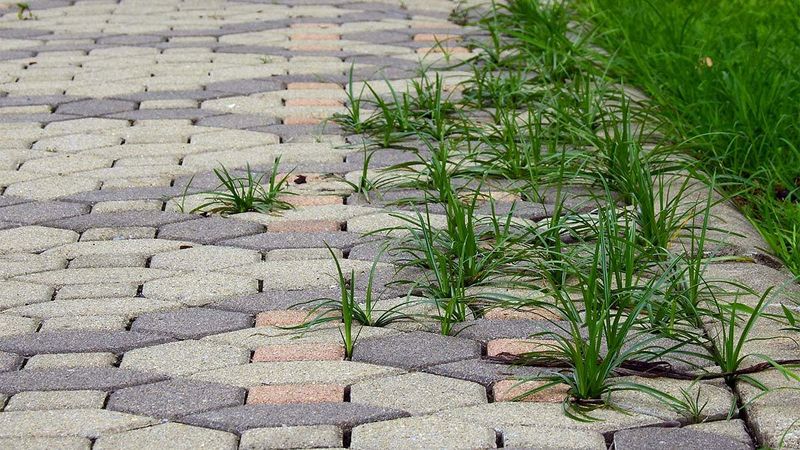
Vinegar can scorch the leaves of small, tender weeds in a crack, and that may be all you need for a quick tidy-up before guests arrive. It is not a lasting fix for established growth, and it will not stop the next round of seedlings.
NC State Extension offers more detail on options. For stubborn spots, pull them; for a labeled product, follow its directions.
A neat edge comes from steady, small touch-ups, not a single spray.