
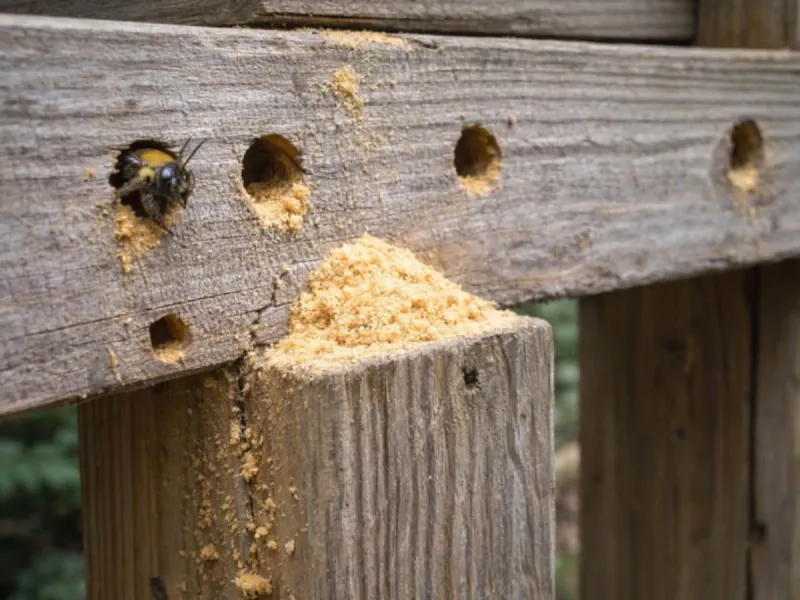
Spotting a big, buzzing bee hovering around your porch railing can send most homeowners straight for the nearest can of spray. Before you reach for it, those bees are actually giving you useful information about your wood that is worth a quick look. Understanding what carpenter bees are really after can save your porch, protect your wallet, and keep a native pollinator from being killed for no good reason.
Carpenter bees point to an attractive wood surface—not automatically to rot
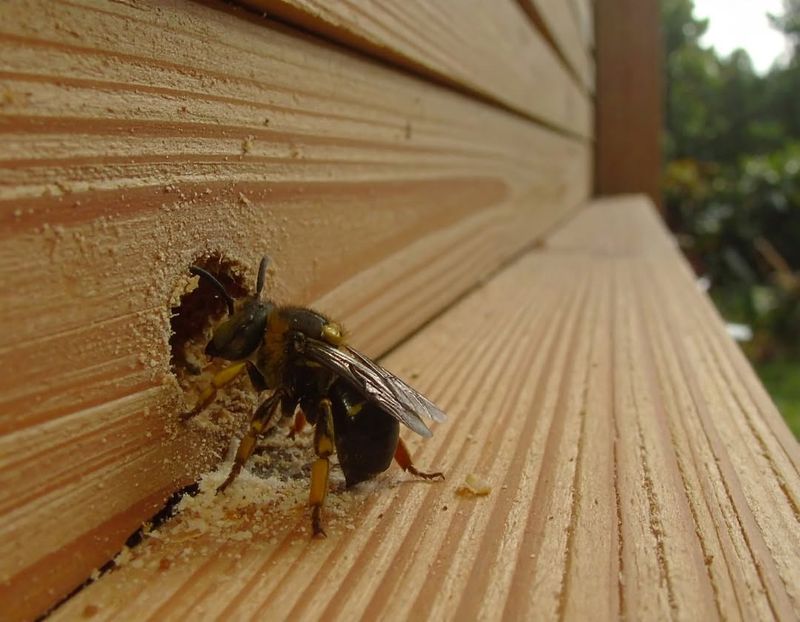
Seeing a large bee hovering around your porch does not mean the wood underneath is crumbling. NC State Extension guidance on non-honeybee stinging insects identifies large carpenter bees as wood-excavating bees that commonly target porch rails, decks, eaves, and other exposed wood, with a clear preference for untreated or lightly finished surfaces. Their presence is a clue about your wood’s surface condition, not a verdict on its structural health.
The distinction matters. Rot is caused by fungal decay driven by sustained moisture, while carpenter bees are drawn in by exposed grain, weathered finishes, and easy-to-excavate softwood. A bee can choose a perfectly sound board simply because the paint has worn thin or a crack has opened up near a nail hole.
University of Maryland Extension’s carpenter bee resource reinforces this point: a few holes from a single bee season generally do not create an immediate structural emergency, though repeated nesting and reuse of tunnels over multiple years can weaken wood, allow moisture entry, and attract woodpeckers. The risk increases when tunnels appear in thin, cracked, softened, or load-bearing members.
The practical rule for working through the rest of this article is simple. Identify the insect first so you know what you are dealing with. Then inspect the wood and the tunnel location. Finally, assess the extent of activity before deciding whether any treatment is actually justified.
That sequence keeps you from spraying at the wrong problem or sealing a hole at the wrong time.
Identify the bee and the nesting signs before you act
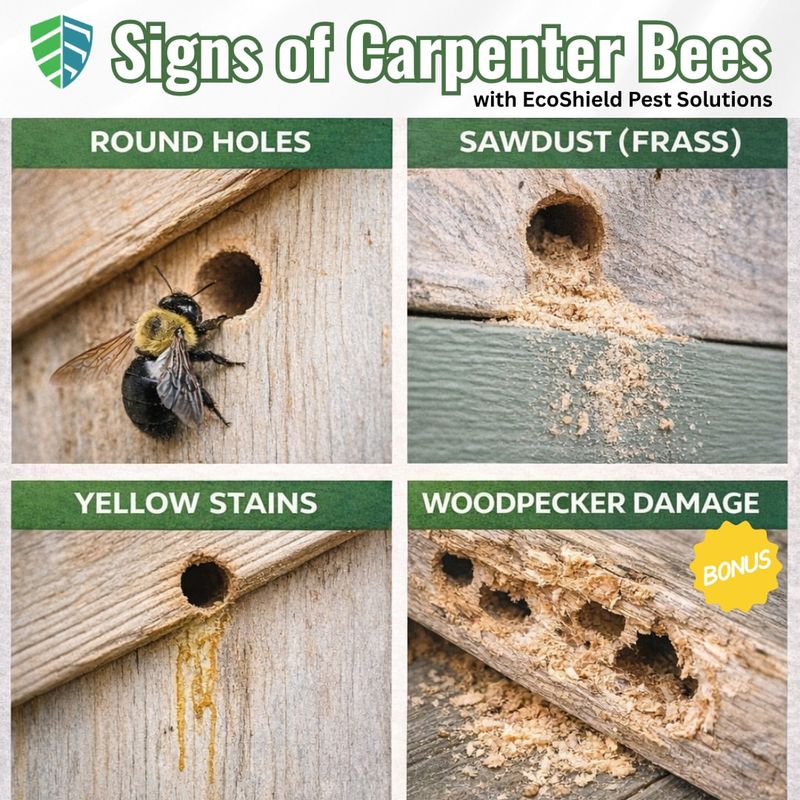
Not every bee buzzing around a porch is a carpenter bee, and acting on a misidentification wastes time and money. The key physical feature to look for is a relatively hairless, shiny black abdomen. The Bees of North Carolina identification guide lists two Xylocopa species in the state, both noticeably larger than honeybees and distinct from bumblebees, which carry a dense coat of yellow and black fuzz across their abdomen.
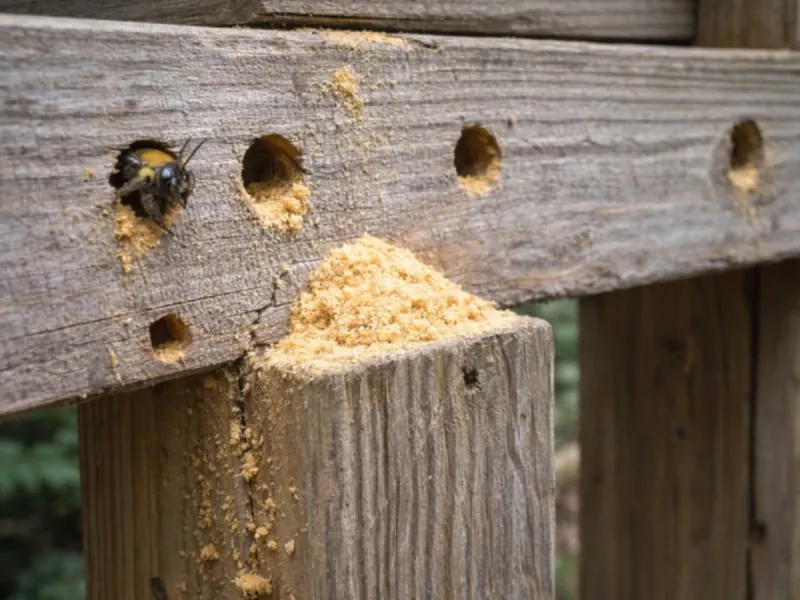
Beyond the bee itself, the nesting signs are just as telling. A carpenter bee entrance is a nearly perfect circular hole, roughly half an inch across, bored cleanly into the wood surface. Below the opening you will often find coarse, pale sawdust, and the wood around or beneath the hole may show a yellowish stain from bee waste. Bees hovering persistently near one spot on a railing or beam are another reliable indicator.
Seasonal timing adds context. NC State’s stinging insect guide describes April and May as typical emergence months in North Carolina, though actual activity varies with weather, location, sun exposure, and the life stage of individual bees. A warm February can push activity earlier; a cool spring can delay it. Treat those months as a general window rather than a firm calendar deadline.
Knowing which sex you are watching also helps. Penn State Extension’s carpenter bee guide explains that males are the ones most often seen hovering aggressively near people or darting at passersby, and males cannot sting. Females can sting but are generally docile and are unlikely to do so unless they are handled directly or genuinely provoked. That hovering bee making you nervous is almost certainly a male putting on a show with no stinger to back it up.
The hole shows what the bee needs from the wood
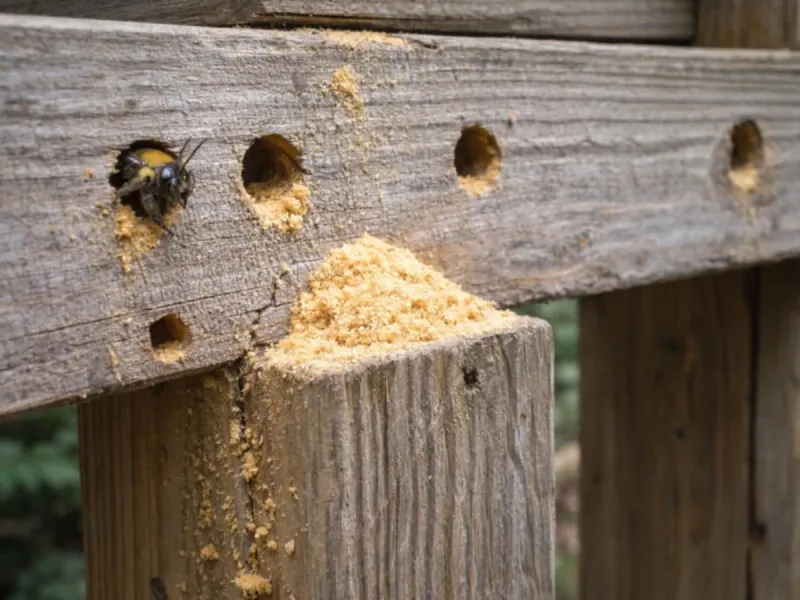
A carpenter bee hole is not the result of feeding. Females excavate galleries in wood to create shelter and brood chambers where they lay eggs and provision larvae with pollen and nectar. NC State’s stinging insect resource and Penn State Extension both confirm that the adult bees themselves feed on nectar and pollen, not on the wood they excavate. The porch is a nesting site, not a food source.
What makes a board attractive is its surface condition and species. University of Maryland Extension and University of Georgia Extension’s neighborhood pest guide both note that carpenter bees prefer raw, unfinished, weathered, or cracked softwood. Pine, cedar, cypress, and redwood are common targets because they are widely used in porch construction and tend to weather quickly when left unprotected.
A protective finish can discourage new excavation by making the surface less inviting, but it cannot reach bees already living inside established galleries. Penn State’s guide on the eastern carpenter bee as a pollinator and houseguest is clear on this point: surface treatments prevent or deter new nesting activity but do not eliminate an existing colony. If bees are already inside a gallery, the finish question and the active-nest question need to be handled separately.
Inspect the tunnel location and the wood condition
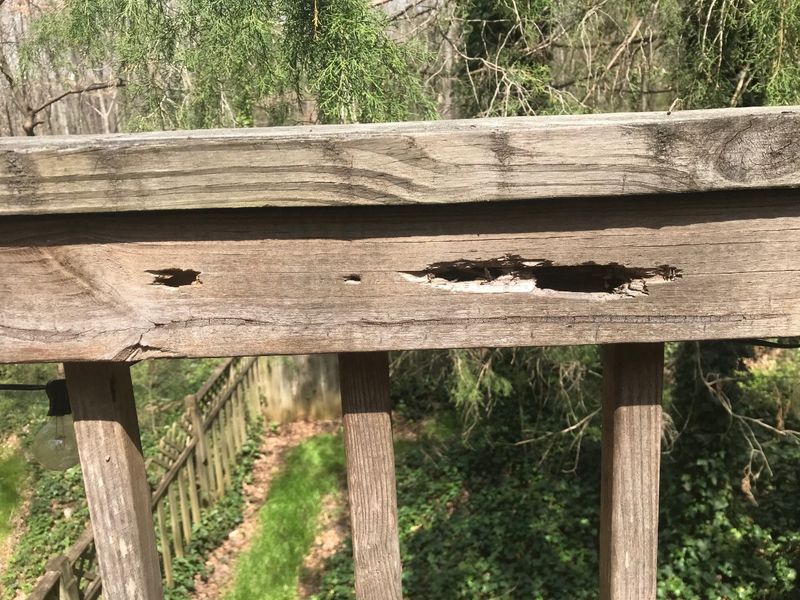
Once you have confirmed the bee and spotted the entrance hole, the next step is figuring out exactly where that hole sits and what the surrounding wood feels like. Run a screwdriver or a firm finger along the board near the entrance. Sound wood resists pressure; soft, spongy, or crumbling material suggests moisture damage or decay that exists independently of the bees.
University of Maryland Extension advises homeowners to check whether each entrance sits in a decorative board, railing, porch ceiling, fascia, post, beam, or another load-bearing component. A hole in a porch railing spindle is a different situation from a hole in a structural post or a main support beam. Location matters as much as the number of holes.
Warning signs that raise the level of concern include visibly softened or decayed wood, open cracks running along the grain, evidence of moisture damage such as staining or peeling finish, multiple entrance holes in the same area, and woodpecker excavation near the bee holes. USDA Forest Service research on wood biodeterioration confirms that carpenter-bee holes can serve as entry points for moisture and deteriorating organisms, though the presence of holes alone does not prove that decay has already occurred.
Penn State Extension notes that a single nest usually causes little structural damage, while repeated nesting and gallery reuse over several years can meaningfully weaken wood. If your inspection turns up soft wood, extensive tunneling, or holes in a load-bearing member, that is the moment to call a contractor or a pest management professional for a closer look rather than attempting a DIY fix on a component the porch depends on. Oregon State Extension’s wood and moisture guide offers useful background on how sustained moisture exposure accelerates deterioration in exactly the kinds of softwoods commonly found on porches.
Repair and protect inactive or exposed wood first
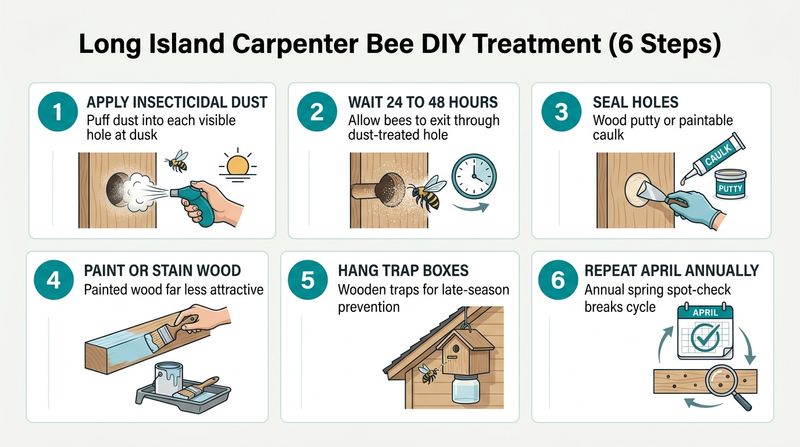
When an inspection turns up weathered boards, open cracks, exposed nail holes, or old bee entrances that show no current activity, repair and protective finishing are the most sensible place to start. University of Maryland Extension and University of Georgia Extension both recommend filling exposed cracks and nail holes with a suitable wood filler, applying a substantial protective finish, and replacing any boards that are too far gone to hold a finish reliably.
The timing of that sealing work matters. Fill or caulk old entrances and surface cracks only after confirming they are inactive, meaning no bees are entering or exiting. Sealing an occupied gallery traps bees inside, which can result in them chewing an exit through a different part of the board or dying inside the wood. Penn State’s eastern carpenter bee guide is explicit that surface treatments do not affect established nests, so inactive holes and active ones require different handling.
A substantial exterior paint or finish can discourage new excavation by covering the raw grain that bees find attractive. USDA Forest Service biological properties research supports using protective finishes to reduce wood vulnerability, though no finish is guaranteed to stop every determined bee. Treat finishing as a meaningful deterrent, not an impenetrable barrier.
A few bees nesting in a low-conflict spot away from structural members and foot traffic may not need any response at all. Carpenter bees are native pollinators that visit garden flowers and contribute to local ecosystems. If the nest is in a fence board at the back of the property and no one is regularly disturbing it, leaving it alone is a reasonable choice that avoids unnecessary pesticide use and preserves a beneficial insect.
Treat an active nest narrowly, legally, and with pollinators in mind
Targeted treatment is appropriate in specific circumstances: an active nest in structural wood that has already suffered damage, a high-conflict location where people regularly disturb the bees, or a recurring nesting problem that repair and finishing alone have not resolved. Those situations justify a carefully chosen product applied precisely to the entrance or gallery, not a broad spray across the entire porch surface.
Product selection must follow the label. North Carolina’s 2026 Agricultural Chemicals Manual, Chapter V lists labeled options for carpenter bee management and directs applicators to treat the entrance or gallery directly. Using a product labeled only for ants, wasps, or general outdoor insects is not a legal substitute. Under federal law, applying a pesticide inconsistently with its label is a violation, and EPA guidance on pesticide do’s and don’ts makes that requirement clear.
Do not plug an active entrance immediately after applying a treatment. Several extension recommendations, including Penn State’s, advise leaving the entrance open temporarily so bees inside can contact the product. Sealing comes after activity has stopped, typically within a few days to a week depending on the product and label directions. Plugging too soon can prevent the treatment from working and may force bees to chew a new exit.
EPA pollinator protection guidance recommends applying pesticides when pollinators are not actively foraging, typically in the early morning or evening, and using targeted applications rather than broad coverage. Spraying the whole porch, the surrounding garden, or nearby flowering plants risks harming honeybees, native bees, and other beneficial insects that have nothing to do with your nesting problem. When structural damage is extensive or you are uncertain about product selection and application, a licensed pest management professional is the right call.
Use the wood and the risk—not the mere sight of a bee—to choose the fix
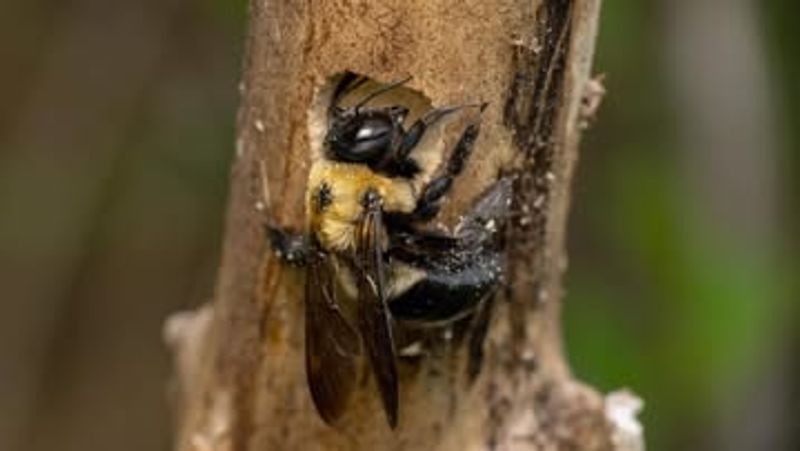
A carpenter bee near your porch is a prompt to look more closely, not a signal to spray. Confirm the insect matches the physical description: shiny abdomen, roughly half-inch circular hole, sawdust below. Then check the wood for its finish condition, any softness, and the structural role of the affected board.
Sound, non-structural wood with a single entrance and no signs of decay calls for filling the hole once it is inactive, repairing surface cracks, and applying a protective finish. Repeated nesting, soft or deteriorating wood, or holes in load-bearing members raises the concern level and may call for professional evaluation or board replacement before any treatment decision. University of Maryland Extension and Penn State’s eastern carpenter bee guide both frame management as a judgment call that depends on damage, location, and recurrence rather than the simple presence of a bee.
Reserve targeted, label-compliant treatment for active nests that create a genuine property or safety problem. NC State’s stinging insect resource acknowledges that carpenter bees fill a dual role as native pollinators and potential wood pests. A response calibrated to actual damage and real conflict protects both your porch and the broader yard ecosystem. The bee pointing at a worn board is doing you a favor; the board is the problem worth fixing.