
Crape myrtle roots can lift a nearby driveway as they grow, and near a Texas foundation they can matter in a quieter way by pulling water out of the soil. They are shallow and fibrous, which sounds harmless, but that does not mean they stay out of the way.
The real risk depends on the tree, the soil, the pavement, and the house. Here is what these roots actually do over the years, and what to do about it.
Crape myrtle roots are shallow, but not confined
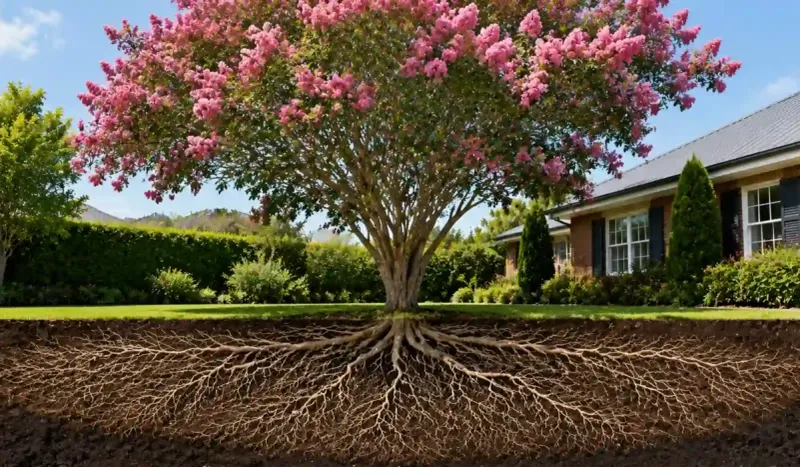
Ask a horticulturist how a crape myrtle is rooted, and the answer is short. Mississippi State University Extension describes the root system as shallow and fibrous.
That means many thin roots spread out near the surface instead of one deep taproot plunging down.
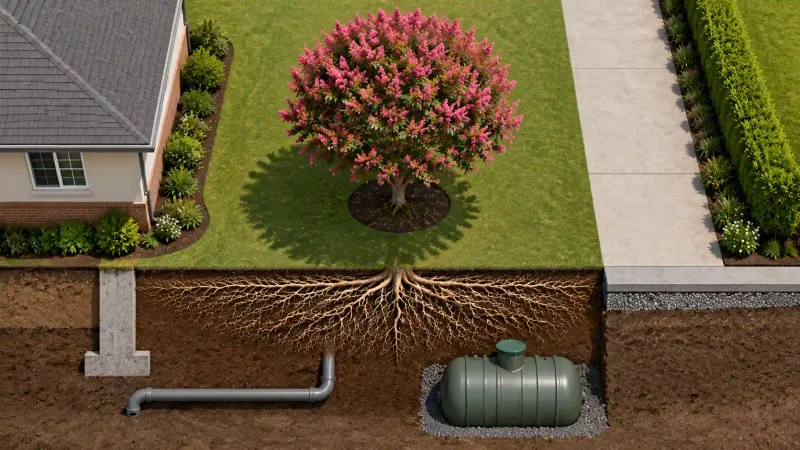
It is easy to read too much into the word shallow. A shallow root system does not mean the roots stop at the edge of the leaves.
It also does not mean they cannot grow beneath a nearby driveway, patio, or walkway. Roots go where they find air, water, and loose soil, and that can be well past the canopy.
Fibrous roots also behave differently from the chunky roots people imagine when they picture a cracked sidewalk. Still, roots do enlarge over time, and a tree that has lived beside a slab for years has had many seasons to spread underneath it.
Roots generally grow around solid surfaces rather than through them. As Purdue Extension explains for trees in general, roots tend to follow the path of least resistance, though they can exploit a nearby crack or breach.
That is general tree guidance, not proof about crape myrtles in particular.
So the fair picture is this: a crape myrtle root system is shallow and fibrous, it is not limited to the area under the tree, and it is not a concrete-drilling machine.
Growing roots can lift a driveway
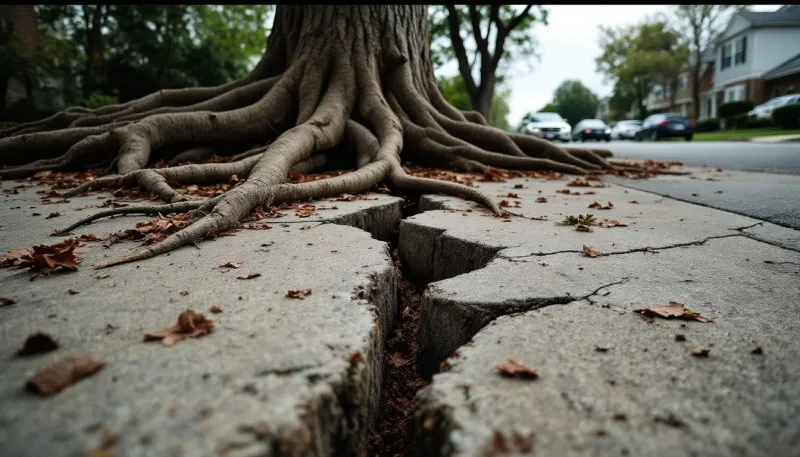
Picture a root the width of a pencil under a driveway. Years later, that same root may be as thick as a wrist.
Roots that grow beneath pavement can lift or displace it as they increase in diameter, and that is the most direct way a tree affects a driveway.
Iowa State Extension documents this kind of pavement lifting for trees near sidewalks. It is general tree guidance, but it applies sensibly to a crape myrtle planted close to a driveway edge.
That does not mean damage is certain. Whether a root ever pushes up a slab depends on several things.
Roots tend to settle in the soil right under pavement because it holds moisture, so a narrow planting strip with little open ground gives them fewer places to go.
Pavement construction matters too. A thin or older slab, a weak base, or an existing crack changes how easily it moves.
A thick, well-built driveway with a wide planting bed between it and the tree is a very different case from a small tree squeezed against an edge.
A practical clue is a slight ridge or raised seam that runs toward the tree. Watching for that kind of change over several seasons tells you far more than the tree’s age alone.
Foundation movement involves soil moisture
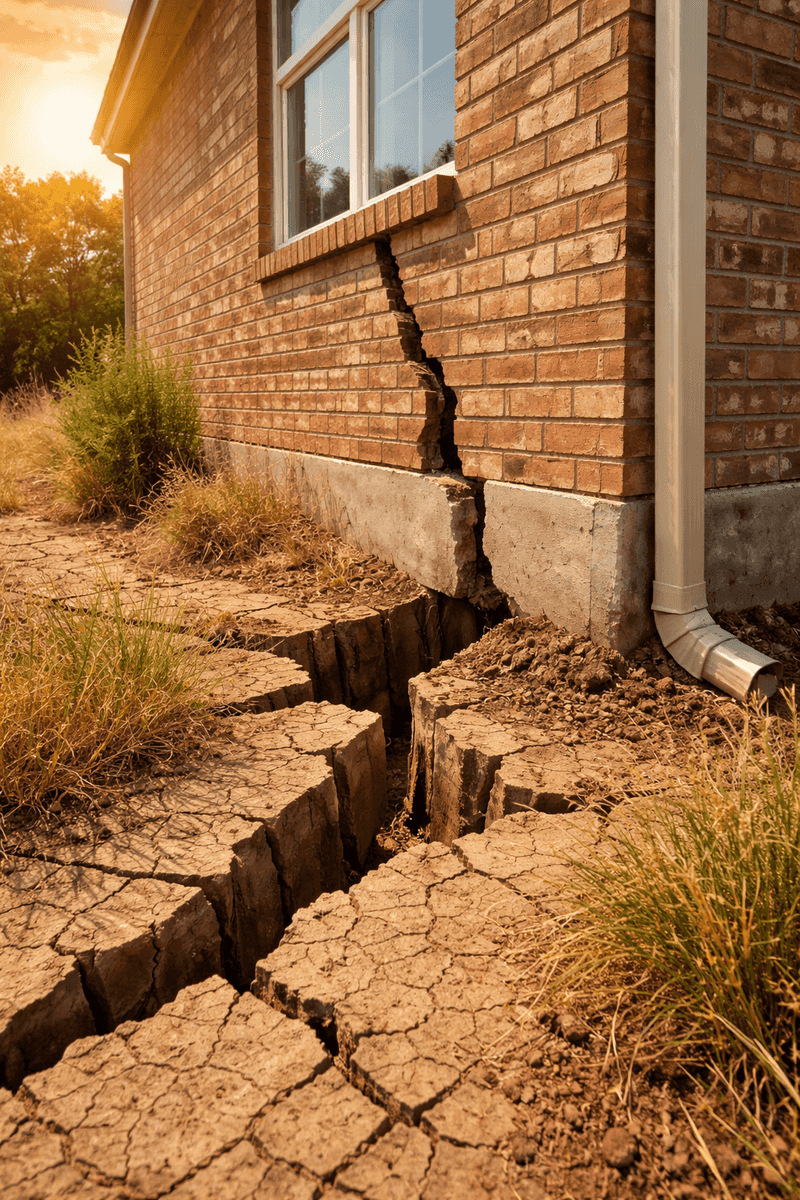
Foundations tend to be affected in a different way than driveways. Instead of roots pushing on concrete, the concern is water.
A Texas Section of the American Society of Civil Engineers document, its recommended practice for residential foundations, says nearby tree roots seasonally remove moisture from the soil and that growing trees can contribute to downward foundation movement.
That matters because of the ground itself. The Texas Department of Licensing and Regulation describes expansive soil as soil that shrinks when dry and swells when wet.
Put those together. A tree drinking from clay soil during a hot, dry stretch can help dry the ground out.
Dry clay shrinks, and the soil under part of a slab may settle, while the soil under another part stays wetter and holds its height. That uneven change is what can contribute to movement.
Notice what this does not say. It does not say crape myrtle roots physically break a sound slab.
It also does not say a crape myrtle caused movement at any particular home. The guidance covers trees and large vegetation in general, and it offers no crape-myrtle-specific damage rate.
Foundation movement also has other causes, including plumbing leaks, poor drainage, and heavy rain after drought. The tree is one possible factor among several, and only a look at the actual site can sort them out.
The site matters as much as the tree
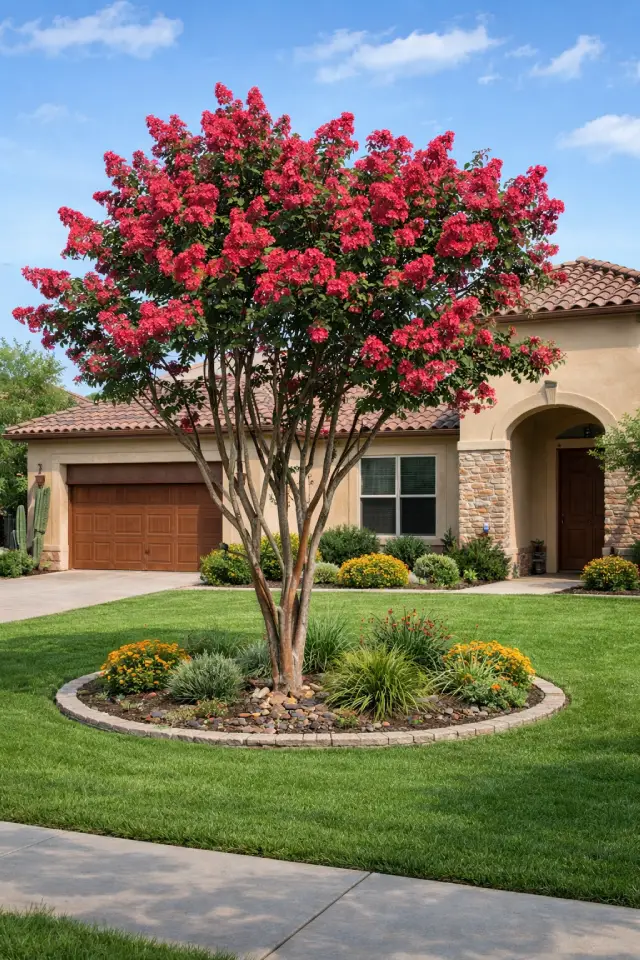
Two Texas yards can have the same tree and very different outcomes. Terms like Texas clay and crape myrtle sound specific, but each hides a lot of variation.
Start with the soil. The Texas Department of Licensing and Regulation notes that how much soil expands depends on its clay content and type, along with moisture changes.
A lot of Texas yards have clay, but not all clay swells the same amount, and some lots have much less than others.
Then look at the tree. University of Maryland Extension lists tree-like crape myrtles at roughly 10 to 30 feet tall and 15 to 25 feet wide, with smaller shrub and dwarf forms also available.
A compact variety and a tall one do not ask the same things of the soil.
Next comes root space. As Iowa State Extension notes in its sidewalk guidance, tree size and the room around the planting affect how roots meet pavement.
A tree with open soil on several sides has more options than one boxed in by a driveway and a wall.
Finally, the structure matters. A slab’s design, its drainage, and how even the soil moisture stays around it all change the picture.
None of these factors turns into a neat formula, so the honest answer is that risk depends on how they combine at your address.
Sewer roots often enter through existing defects
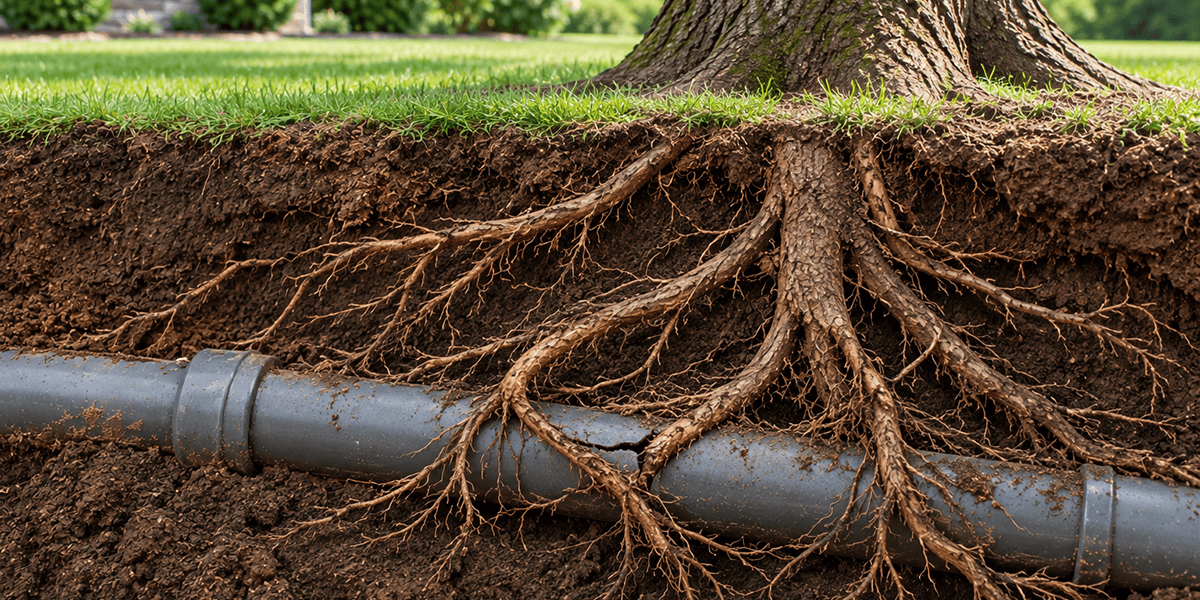
Sewer lines are a separate story from driveways and foundations. Roots are drawn to the moisture and nutrients in a sewer line, but they usually need a way in.
Traverse City Sewer and Water explains that roots commonly enter through existing cracks, leaks, or faulty joints.
Once inside, the roots can keep growing. They can catch debris, narrow the pipe, and worsen blockage or damage that was already starting.
So the pipe defect often comes first, and the roots make it bigger.
That is quite different from the idea that roots usually break sound pipes. An intact pipe with tight joints gives roots much less to work with.
Older lines with loose joints are a more likely target.
Slow drains, gurgling fixtures, or repeated backups can all point toward a line problem. They do not point toward a particular tree.
Distance alone is a poor guide, because roots of many plants can reach a pipe, and a defect can come from age, shifting soil, or installation.
If you suspect trouble, have the line inspected, often with a small camera, before deciding anything about the crape myrtle. The camera can show whether roots are present and where the opening is.
Choose a planting plan, not a magic distance
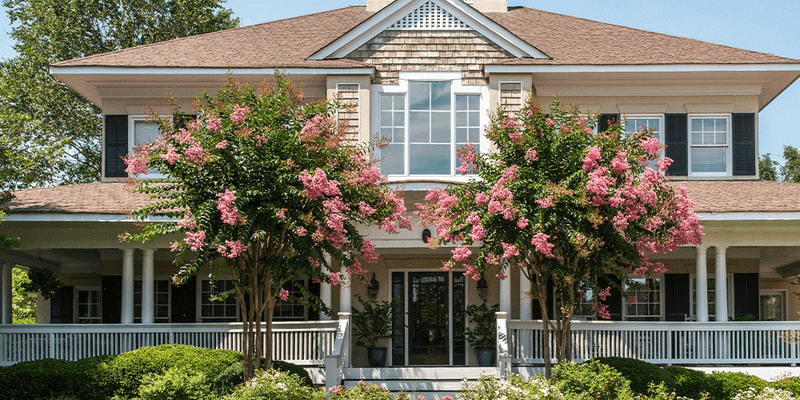
Many homeowners want a single number of feet to plant from the house. No source gives a safe distance that works for every crape myrtle, soil, and foundation, so a plan works better than a number.
First, pick a cultivar that fits the space. Because University of Maryland Extension shows such a wide range of mature sizes, a dwarf or smaller form suits a tight spot far better than a large tree-type.
Second, protect drainage and moisture balance. For expansive soils, the Texas engineering practice document stresses draining water away from the foundation and avoiding nearby trees and large vegetation, with their water demands in mind.
That is general foundation advice, not a crape myrtle rule. Try to avoid sharp swings, such as soaking one side of the house while the other stays bone dry.
Third, give roots room. Iowa State Extension suggests about 4 to 6 feet from sidewalks for smaller trees and 10 feet or more for larger ones.
Treat that as general sidewalk guidance. It is not a Texas foundation standard or a crape myrtle threshold.
If roots are already close to pavement, resist grabbing a saw. Cutting major roots is not a simple do-it-yourself fix, because it can harm or destabilize the tree.
Ask a certified arborist to weigh tree health and safety first.
A crack is a reason to investigate, not assume
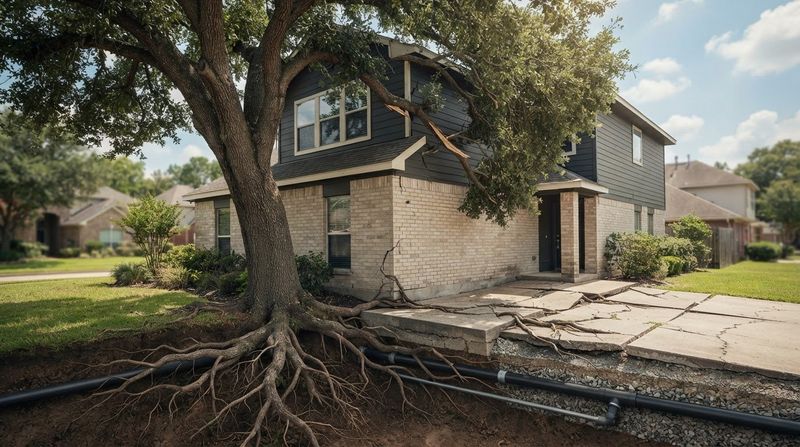
Finding a crack can make the tree outside look guilty. A nearby crape myrtle is not a diagnosis by itself.
Foundation movement can have several causes, and the Texas engineering practice document treats it as a site-specific question.
If a slab is moving or cracking, get it assessed on site by a qualified professional. If a drain keeps backing up, have the line inspected, as Traverse City Sewer and Water suggests, rather than blaming the tree by distance.
Roots can lift pavement, pull moisture from clay, and use openings in pipes, and each works differently. Your site decides which of them, if any, is at play.