
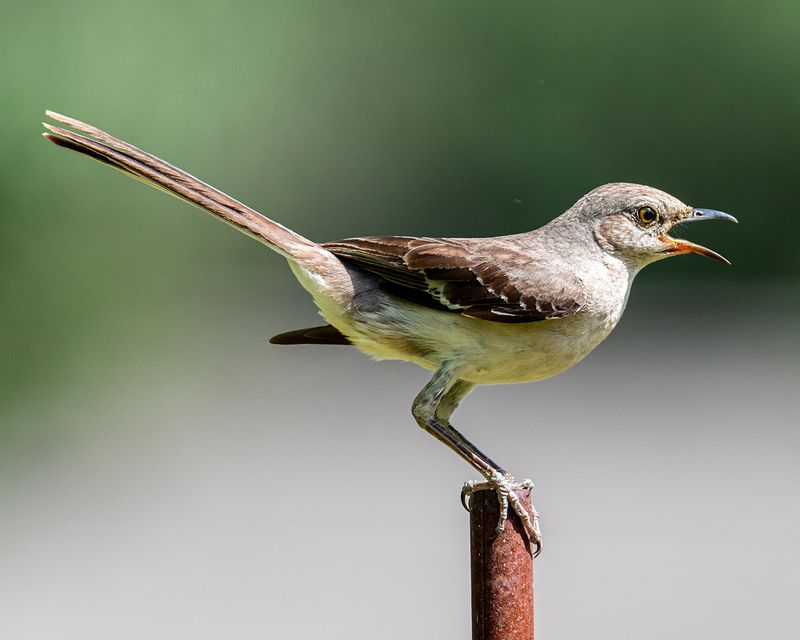
Most Florida mornings, before the neighborhood fully wakes up, a gray bird climbs to a high perch and fills the air with a stream of borrowed calls and original notes. If you have noticed the same bird returning to the same roofline, wire, or shrub top day after day, you are probably watching a Northern Mockingbird work through its morning routine. That repeated performance is worth paying attention to, because it can tell you something real about your yard, though not everything you might assume.
A repeated perch gives you a clue, not a complete explanation
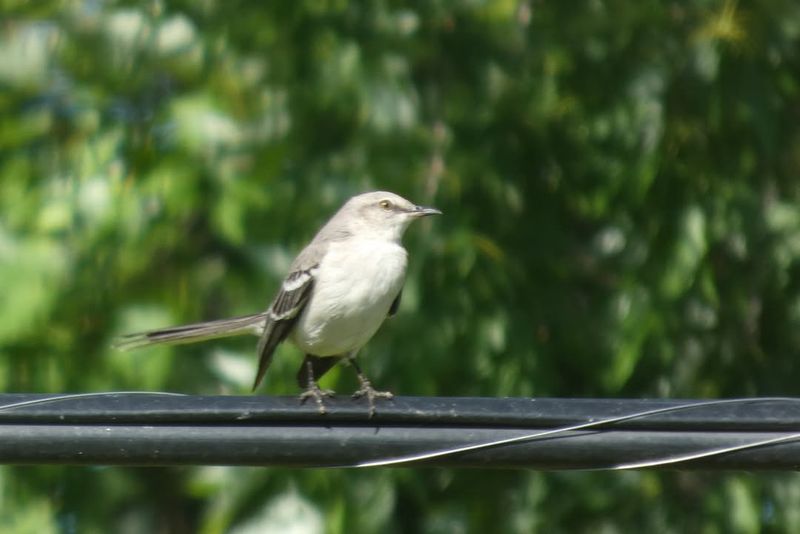
Watching a bird return to the exact same corner of your yard morning after morning feels like a message. The honest answer is that it is a clue, and a useful one, but the observation alone cannot tell you why the bird chose that spot or prove what the performance means.
Northern Mockingbirds are well-documented singers that frequently use high, exposed locations. Cornell Lab of Ornithology’s species account describes them as birds that often perch conspicuously on top of shrubs, utility poles, and wires while singing. The National Park Service’s mockingbird profile similarly notes that males sing to defend territory and attract mates, placing song at the center of the bird’s social life.
What those documented facts do not settle is the motive behind any single bird’s morning routine. Mockingbird song has more than one function. Research published in Animal Behaviour links mockingbird vocalizations to both territorial signaling and male-female interactions, particularly early in the breeding season. A repeated perch is best described as a favored or regularly used singing location, not as proof that the bird is defending a territory, advertising for a mate, or expressing any preference for the people who own the yard.
The perch may be useful for reasons that have nothing to do with what the yard offers as habitat. Height, open sightlines, and proximity to areas the bird uses regularly could all contribute to why a spot gets revisited. Treating the repeated perch as a starting point for observation rather than a finished explanation keeps you closer to what is actually known.
The perch’s height and exposure may make it useful
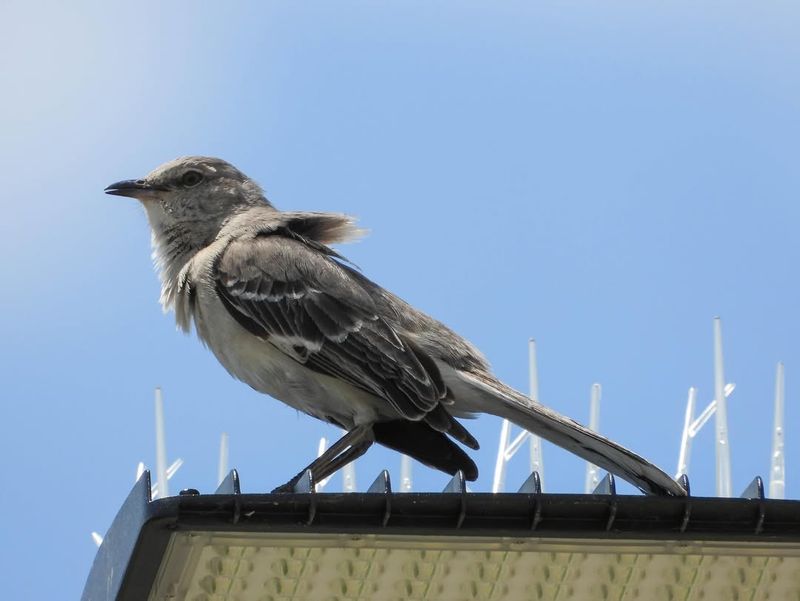
Look carefully at where the bird actually lands each morning. Rooflines, utility wires, fence posts, the bare upper branch of a dead tree, or the tip of a tall shrub are all common choices, and what those spots share is height and openness rather than any one specific feature of a single yard.
Cornell’s species account notes that mockingbirds are habitual high-perch singers, regularly choosing poles, wires, and exposed shrub tops. The National Park Service similarly describes them as birds that use open, elevated locations when singing. Both sources point to a consistent pattern: the bird gravitates toward spots with a clear view outward and upward, not toward hidden or sheltered positions.
Why height and exposure might matter is reasonable to consider. A bird singing from an elevated position can potentially be heard over a wider area and may have a clearer view of its surroundings. Whether better sound travel, broader visibility, or some other physical advantage actually drives this individual bird’s choice is harder to say with certainty. Those are plausible explanations, not verified reasons.
Practically speaking, “same spot” does not always mean the same branch or the same square foot of surface. The bird may shift between a roofline one morning and a nearby wire the next, staying within a small zone that offers similar height and exposure. Watching where it lands across several mornings gives you a better picture of which physical features the bird actually gravitates toward, which is more informative than trying to assign meaning to one repeated location.
Noting the type of perch, its height off the ground, and whether it sits at the edge of open space or near dense vegetation can help you observe the bird’s habits more accurately without jumping ahead to conclusions about its motives.
Morning song can defend space or support social behavior
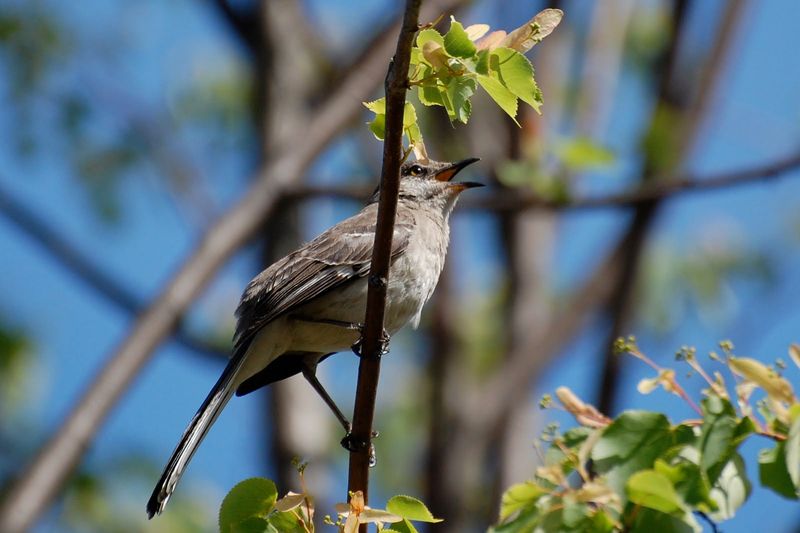
Hearing a mockingbird run through dozens of songs before breakfast raises an obvious question: what is all that sound for? The answer depends on the bird’s situation, and timing alone cannot narrow it down to one cause.
The song itself is remarkably varied. Cornell’s sound guide for the species describes it as a long sequence of imitated calls borrowed from other birds, insects, and even mechanical sounds, with each phrase typically repeated several times before the bird shifts to a new one. Both males and females sing, though males are generally more persistent and vocal, especially during the breeding season.
Song functions are not singular. The Animal Behaviour research on mockingbird vocalizations documents song as a tool for territorial signaling and for interactions between males and females. A study in the journal of the American Ornithological Society adds further context by examining how song rate and complexity relate to breeding season dynamics, reinforcing that song behavior shifts with social context rather than serving a single fixed purpose.
Unmated males are often especially persistent singers. A bird that fills every morning with long, energetic bouts of song may be advertising its presence to potential mates, signaling its claim on a patch of territory to rival males, or doing both at once depending on the season and who is nearby. Early spring and early summer mornings in Florida tend to bring the most intense performances.
The takeaway for a homeowner is that a dedicated morning singer is not simply making noise. The performance likely carries social meaning, but the specific message, whether territorial defense, mate attraction, or something else, cannot be read from the timing and location alone. Watching whether other mockingbirds appear and how this one responds to them can add useful context over time.
Your yard may provide habitat without explaining the whole behavior
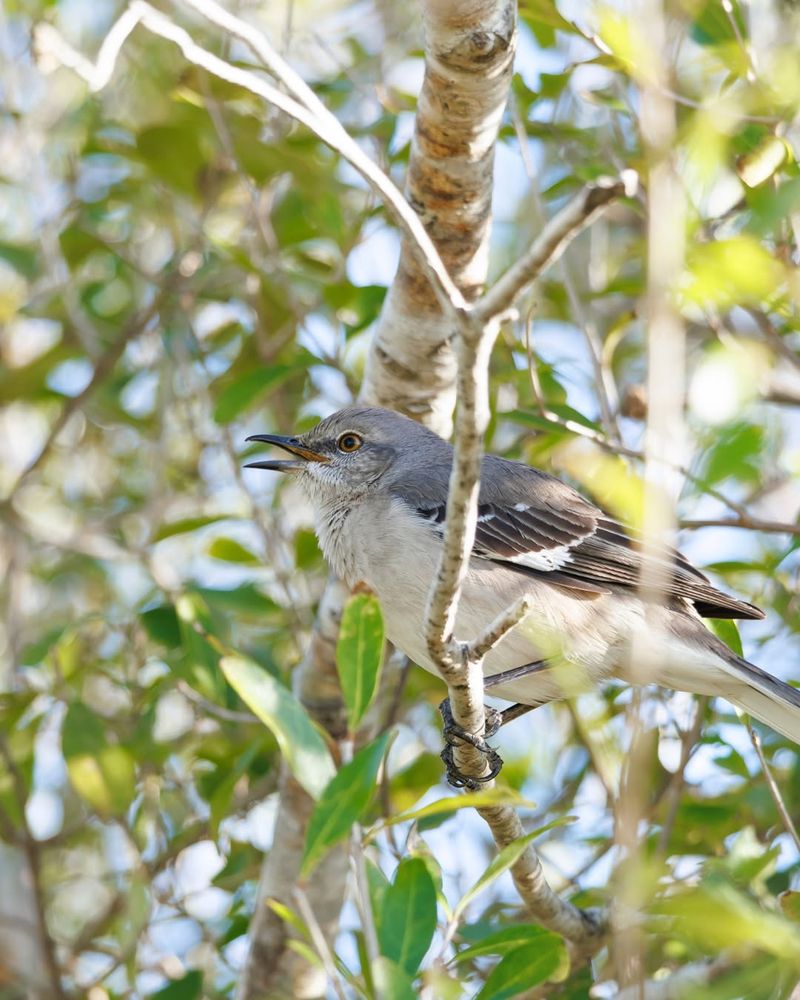
A mockingbird that returns to your yard regularly is probably finding something useful in the area, though the bird’s repeated song perch alone cannot identify which resource matters most or whether the yard is the primary reason the bird is there at all.
Mockingbirds eat a wide range of foods. The National Park Service notes that their diet includes insects and other invertebrates, fruit, and berries, and that they will occasionally take small vertebrates. A yard that supports insects through native plantings and limited pesticide use, and that also offers fruiting plants, can contribute to that food supply, though it is not the only possible draw.
The UF/IFAS bird identification and habitat resource lists sabal palm fruit among the foods mockingbirds use, alongside other native fruiting plants. That same resource frames habitat in terms of multiple elements working together: food, cover, water, and open space all play a role.
UF/IFAS guidance on bird-friendly plants reinforces that point, describing how native plants support both direct food sources like berries and indirect ones like the insects that live on native vegetation. The Florida-Friendly Landscaping nine principles frame habitat support as a combination of food, water, cover, and usable space rather than any single feature.
One important limit on interpretation: a mockingbird’s activity is rarely confined to one yard. The bird may forage, roost, or sing across several neighboring properties, and the singing perch you observe may sit at one edge of a much larger area the bird uses regularly. Treating your yard as a contributor to the bird’s habitat, rather than the whole of it, keeps the picture accurate.
Confirm the singer before interpreting the behavior
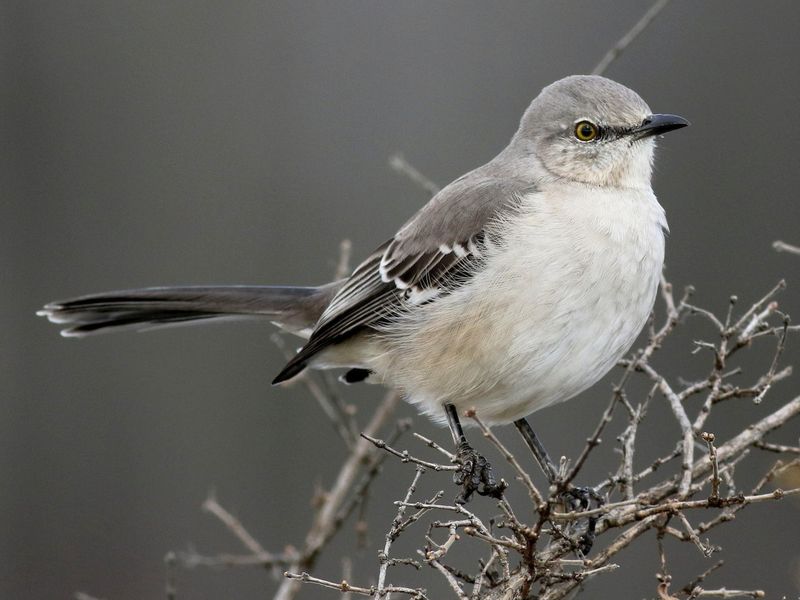
Before spending much time interpreting what a morning singer means for your yard, it is worth making sure you are actually watching a Northern Mockingbird. Other birds sing at dawn, and a reliable identification changes what the behavior can reasonably tell you.
The Northern Mockingbird has a fairly distinctive appearance. Cornell’s species guide describes a medium-sized bird with a gray body, white patches on the wings that flash clearly in flight, white outer tail feathers visible when the tail is spread or pumped, and a noticeably long tail relative to its body. It is not a colorful bird, but the white markings are a reliable field mark even at a distance.
The song is equally distinctive once you know what to listen for. Cornell’s sound guide describes a long, varied sequence of phrases borrowed from other birds, frogs, insects, and mechanical sounds, with each phrase usually repeated several times before the bird switches to something new. That pattern of repetition within variety is a strong audio clue.
The UF/IFAS bird identification card for the Northern Mockingbird also notes its common presence in Florida yards, gardens, and open suburban areas, which matches the typical singing-perch habitat described above.
Dawn singing by itself is not a species identifier. Northern Cardinals, Carolina Wrens, Blue Jays, and several other Florida species can be active and vocal early in the morning. Combining the visual check, gray body with white wing and tail patches and a long tail, with the audio pattern of varied repeated imitations gives you a much firmer identification than timing alone.
Use Florida-friendly planting to support a workable habitat
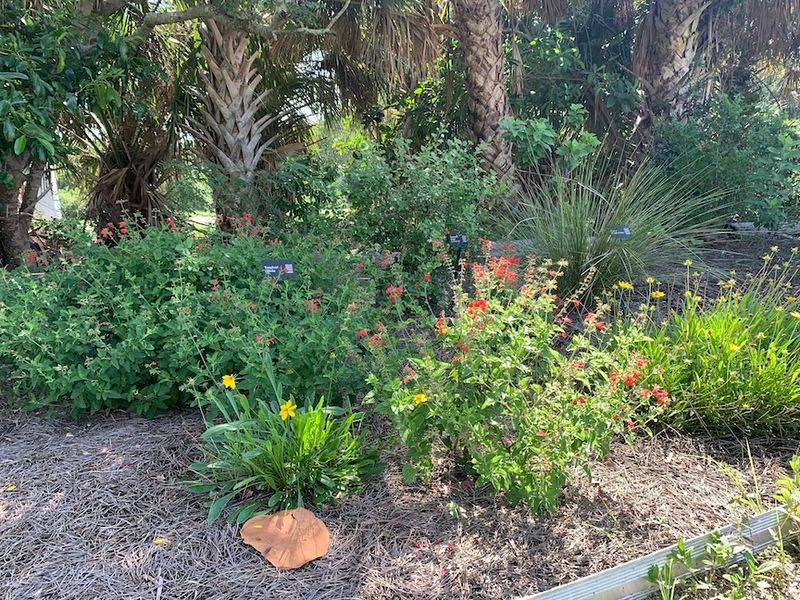
Once you have a good sense of what your yard currently offers, adding or adjusting a few elements can make it more genuinely useful to birds, including mockingbirds, without requiring a full landscape overhaul.
UF/IFAS guidance on bird-friendly plants emphasizes native species as the most reliable foundation because they support the insects that insect-eating birds depend on, in addition to providing direct food through fruit and seeds. Native plants like beautyberry, firebush, wax myrtle, and sabal palm appear in Florida bird habitat recommendations, though the right choice for your yard depends on your specific conditions.
That last point matters more in Florida than in many other states. The Florida-Friendly Landscaping nine principles include right-plant, right-place as a core guideline, recognizing that Florida’s soils, flooding patterns, and climate zones vary considerably from the Panhandle to South Florida. A plant that thrives in well-drained Central Florida sand may struggle in a yard that floods seasonally or in a coastal yard with salt exposure.
The UF/IFAS bird habitat card frames useful landscapes as combinations of food, water, cover, and space rather than any single element. Practically, that means thinking about more than just which plants produce berries. Dense shrubs provide nesting cover and protection from predators. Open lawn or bare ground gives mockingbirds room to forage for insects.
Tall perches, whether a dead snag, a fence, or a utility line, give singers a place to perform.
Retaining some structural variety in the yard, low ground cover, mid-height shrubs, taller trees or perch points, and open areas, tends to support more of those needs at once. No single plant or berry guarantees that a mockingbird will stay, but a yard with layered structure and some native vegetation is more likely to be part of a bird’s regular area than a lawn with ornamental plants alone.
Support the bird without creating new hazards
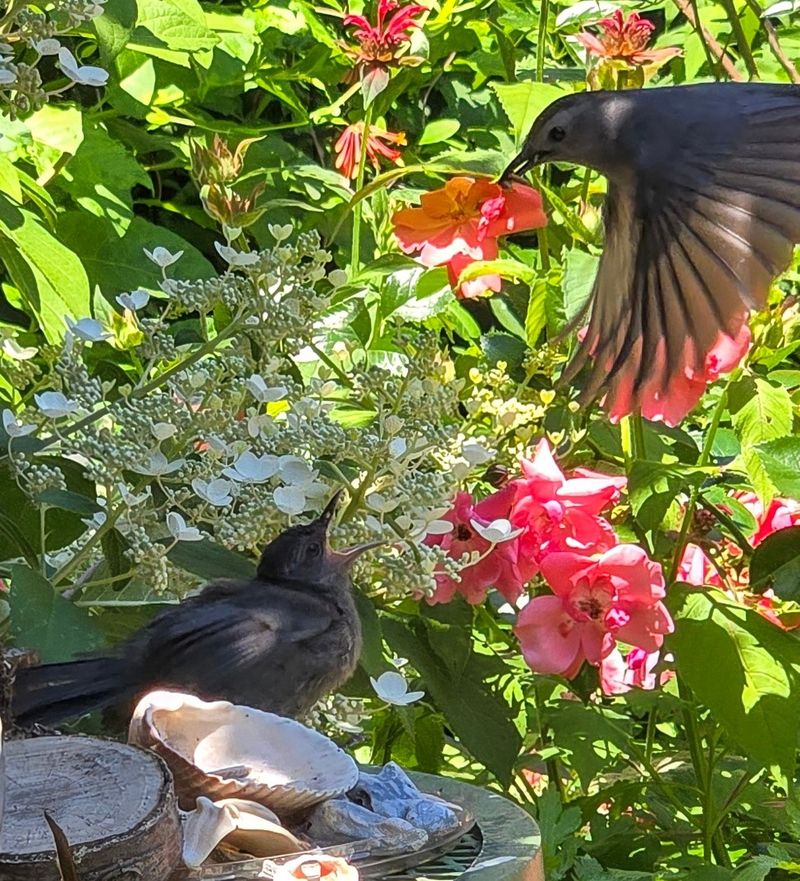
Good intentions can create problems if they are not paired with a little attention to how features are set up and maintained. Water, feeders, and pesticide choices all carry risks worth thinking through before you add anything to the yard.
A birdbath can be genuinely useful, especially during Florida’s hot months when standing water may be scarce. UF/IFAS guidance on providing water to wildlife recommends shallow water, roughly two to three inches at the deepest point, with a firm, textured surface that birds can grip. Nearby cover helps birds feel safe, but low, dense shrubbery right at the base of the bath can conceal cats, so placement matters. In warm Florida weather, water should be changed frequently, ideally every day or two, both to keep it clean and to prevent mosquito larvae from developing.
On the mosquito topic, UF/IFAS mosquito management guidance identifies standing water as the primary breeding site and recommends eliminating or regularly refreshing any container that holds water, including birdbaths. Stagnant water in a birdbath does not attract mockingbirds; it breeds pests and can transmit disease between birds.
Pesticide use deserves equal attention. UF/IFAS integrated pest management principles recommend identifying the specific pest before treating, using the least harmful effective method, and spot-treating rather than applying broad-spectrum products across the whole yard. Related UF/IFAS publications on pesticide selection and minimizing pesticide impacts on beneficial insects both reinforce that routine blanket spraying removes the insect prey that birds like mockingbirds depend on.
Before trimming or removing any shrub or vine, check it carefully for an active nest. The Migratory Bird Treaty Act protects most wild bird nests, eggs, and birds from disturbance, and U.S. Fish and Wildlife Service guidance on bird nests makes clear that inconvenience does not create an exception. If a mockingbird has nested in a shrub you planned to prune, pause the work until the nest is no longer active.
Finally, if a birdbath, feeder, or other bird feature sits near a window, add collision-prevention measures. Cornell’s window-strike prevention guidance recommends placing feeders either very close to glass, within two to three feet, or far enough away, more than thirty feet, that birds cannot build up dangerous speed. Tape, decals, or exterior screens applied to the glass itself are also effective options.
Let the repeated song invite observation, not certainty
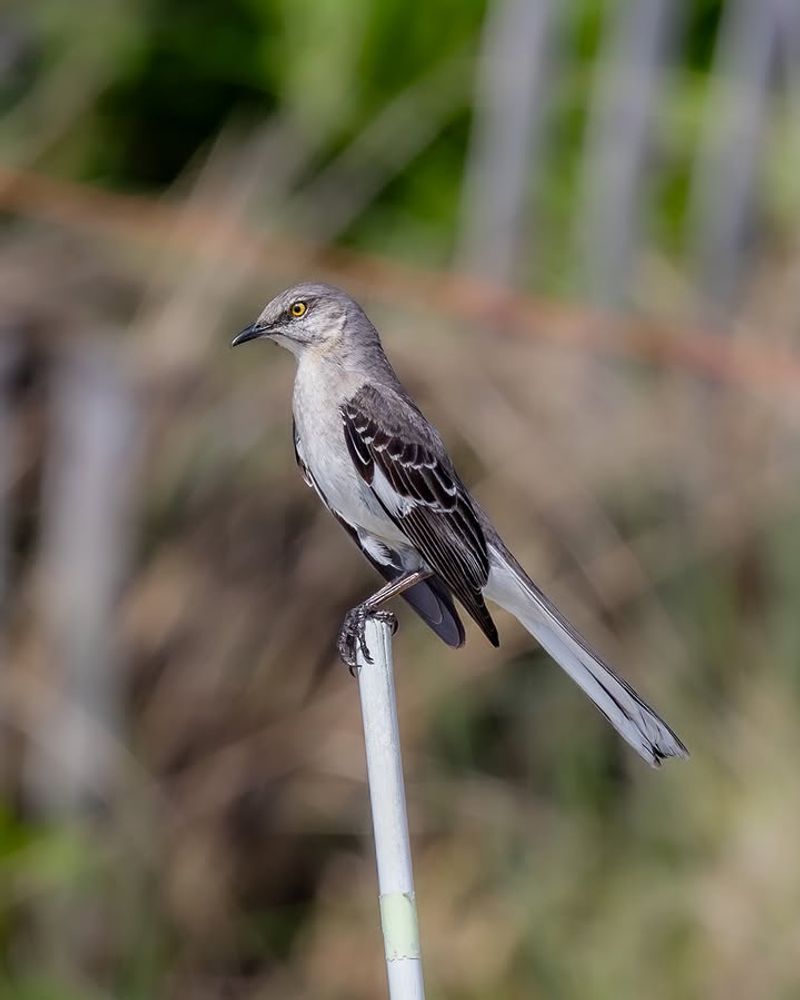
A Northern Mockingbird that returns to the same singing perch morning after morning is doing something real and worth paying attention to. The behavior reflects documented patterns of how this species uses elevated, exposed locations to sing, and the song itself likely carries social meaning related to territory, mate attraction, or other interactions.
What the observation cannot do on its own is identify a single cause. The perch may be useful because of its height and openness. The song may serve territorial purposes, courtship purposes, or both depending on the season. The yard may supply food, cover, or water that matters to this bird, or the perch may simply sit within a larger area the bird moves through regularly.
Cornell’s species overview and UF/IFAS Florida-Friendly Landscaping principles together support a practical approach: observe carefully, protect what is already working in the yard, and make low-risk improvements where they fit your site.
Adding native plants suited to your specific Florida conditions, keeping any water source clean and shallow, and avoiding broad pesticide applications are all reasonable steps that benefit the broader yard ecology without requiring certainty about this one bird’s motives. None of those actions depend on knowing exactly why the mockingbird keeps showing up.
The bird will keep singing whether or not you understand every note. Letting that morning performance prompt a closer look at what your yard offers, rather than a confident conclusion about what the bird is thinking, tends to produce both better observations and a more genuinely useful landscape.