
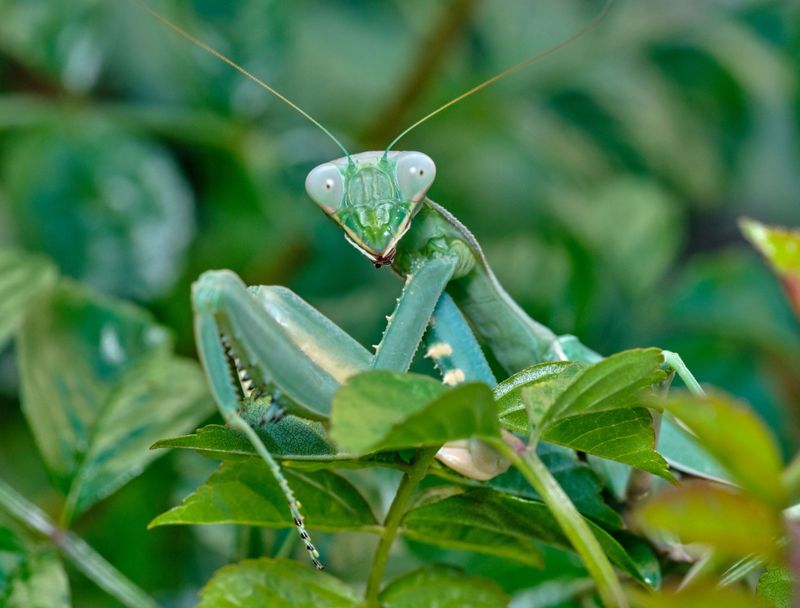
Stepping outside to find praying mantises perched on every shrub and fence post can feel like your yard is trying to tell you something. For North Carolina homeowners, a sudden spike in mantis sightings during summer is genuinely interesting, but the message it carries is more nuanced than most people expect. Understanding what that increase can and cannot tell you helps you make smarter decisions about your yard, your plants, and your family’s safety.
A mantis wave is a clue, not a pest report
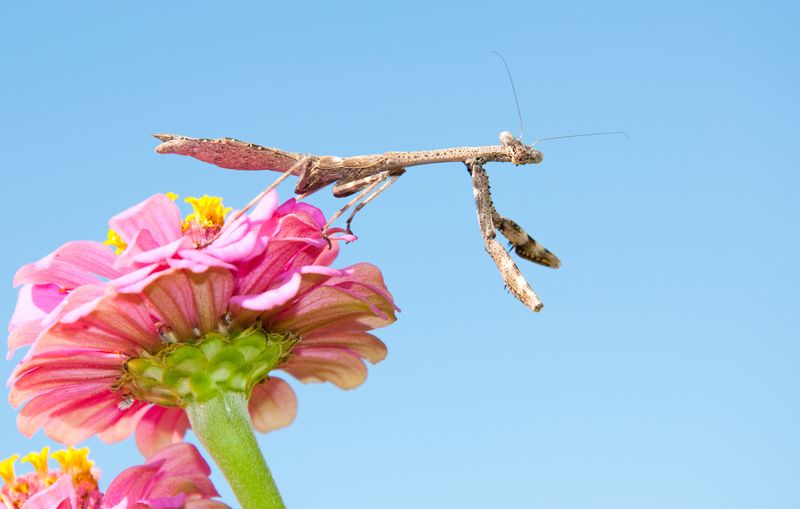
Spotting several praying mantises scattered across your yard on the same afternoon is the kind of thing that grabs your attention. Your first instinct might be to assume that something has gone wrong with your garden’s insect balance, that pests have multiplied and predators have rushed in to compensate. That instinct is understandable, but the evidence behind it is thinner than you might think.
Mantises are ambush predators. Rather than patrolling a garden in search of specific pests, they hold a position and wait for live prey to wander close enough to strike. NC State Extension’s profile of the Carolina mantid notes that these insects have no demonstrated value as targeted pest-management tools, precisely because they do not actively seek out common garden pests like aphids or caterpillars. A mantis sitting on your tomato plant is hunting whatever passes by, not guarding your crop.
NC State’s integrated pest management guidance does note that predators can concentrate where prey populations are dense, which makes a prey-rich or suitable-habitat yard a reasonable ecological inference when mantises are plentiful. But “reasonable inference” is not the same as “confirmed diagnosis.” A few visible mantises cannot measure total insect abundance across your yard, and their presence alone does not tell you whether pest numbers have risen, stayed flat, or dropped.
University of Maryland Extension’s mantid resource reinforces this framing, describing mantises as broadly opportunistic rather than responsive to any single prey type. The sighting is a clue worth noticing. What it cannot do is file a pest report on your behalf, confirm that your garden is in trouble, or prove that biological control is already underway.
A nearby egg case may explain the summer increase
Before assuming that your yard has suddenly become a hotspot for insect prey, consider the simpler explanation sitting right in the biology of the mantis itself. The seasonal life cycle of North Carolina mantises lines up almost perfectly with a summer sighting surge, and it does not require a pest outbreak to explain it.
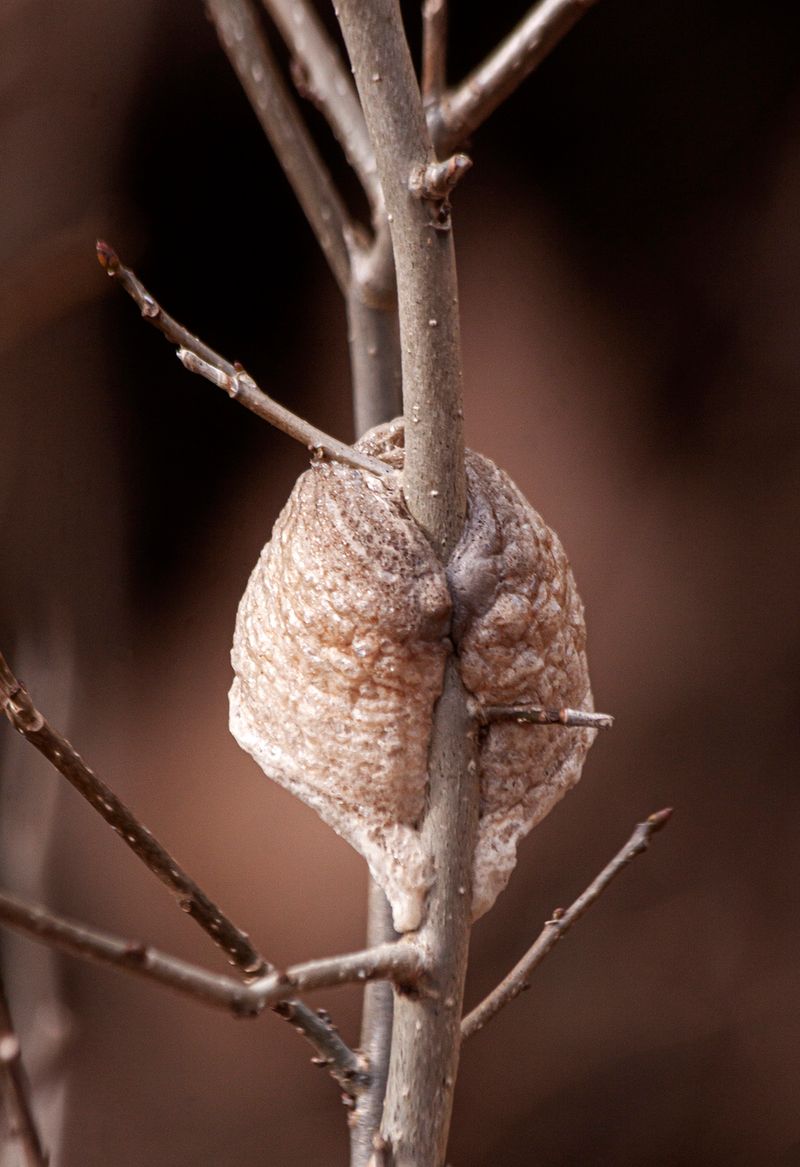
NC State Extension’s small farms resource on praying mantids describes the pattern clearly: female mantises lay their eggs in late summer or fall inside a foam-like egg case called an ootheca, nymphs hatch in late spring, and the young insects grow steadily through the summer months. By midsummer, those nymphs have grown large enough to be obvious. A single ootheca can hold dozens to over a hundred eggs, so one egg case hatching on a nearby shrub, fence post, or garden stake can account for a wave of sightings all on its own.
This means the most straightforward explanation for suddenly noticing mantises everywhere is not that your yard developed a new pest problem in June. More likely, an egg case laid last fall hatched a few weeks ago, and the nymphs have now grown large enough to catch your eye. They were always there, working through their early instars at a size too small to register from a distance.
Keeping this seasonal timeline in mind reframes the whole sighting. A summer increase is, above all else, a sign that mantises successfully overwintered nearby and completed their early development. That is genuinely good news for a wildlife-friendly yard, but it is a different kind of good news than “your pest problem is being handled.”
North Carolina has native and introduced mantises
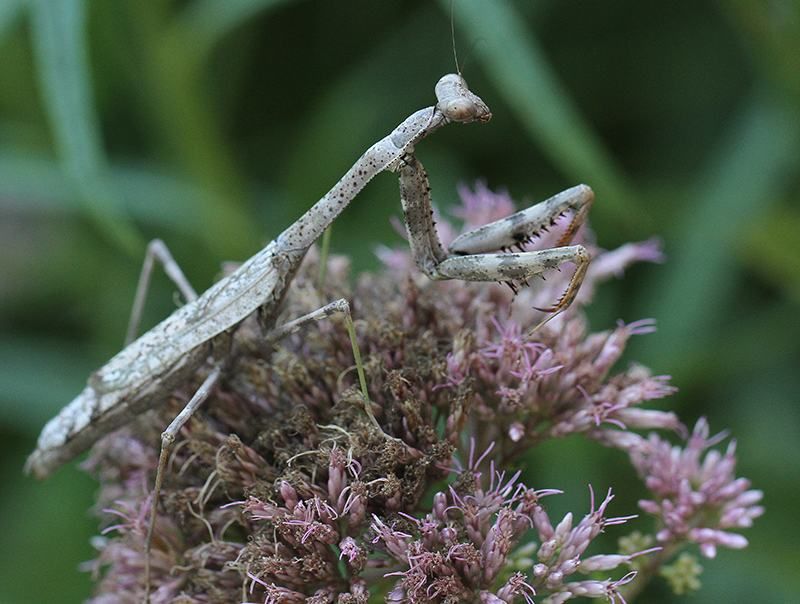
Not every mantis you find in a North Carolina yard belongs to the same species, and the difference matters if you care about supporting native wildlife. Three types show up most commonly for homeowners here, and they are not ecological equals from a stewardship perspective.
The Carolina mantid (Stagmomantis carolina) is the only one native to North Carolina. NC State Extension’s Carolina mantid page describes it as generally smaller, reaching about two inches in length, with shorter wings and a more rectangular face plate compared to the introduced species. Its compact build makes it easier to overlook, especially against bark or dry summer foliage where it blends in well.
The Chinese mantid (Tenodera sinensis) and the European mantid (Mantis religiosa) are both introduced. NC State Extension’s Lee County piece on mantis garden hunters notes that the Chinese mantid is notably larger, sometimes reaching four inches or more, which makes it the species most likely to draw a double-take when spotted on a fence rail. The European mantid falls between the two in size and tends toward a uniform green coloration.
Species status matters for a homeowner who wants to support native wildlife, but the picture is not as simple as “native good, introduced bad.” NC State’s small farms mantid resource cautions against overstating the harm from introduced mantises in every yard context. The practical takeaway is that homeowners should avoid purchasing or releasing non-native egg cases without expert identification, and should recognize that a Carolina mantid sighting in a North Carolina yard is a native species going about its natural business.
Mantises hunt broadly, not selectively
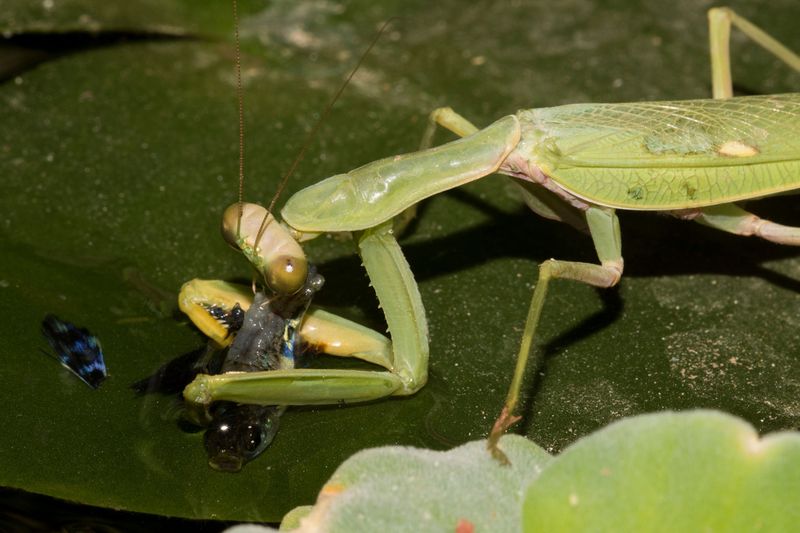
Watching a mantis snatch a moth out of the air is genuinely impressive, and it is easy to jump from that observation to the idea that mantises are quietly clearing your garden of harmful insects. The reality of how they hunt makes that conclusion hard to support.
Mantises are sit-and-wait predators. They choose a perch, hold still, and strike at whatever live prey moves within range of their forelegs. Iowa State University Extension’s mantis encyclopedia entry lists their prey as flies, grasshoppers, moths, beetles and crickets, a range that reflects opportunism rather than specialization. The mantis does not evaluate whether the insect approaching it is a pest or a pollinator before striking.
That generalist behavior has a real downside for anyone hoping mantises will police their garden pests. UC ANR’s natural enemies guide on mantids notes that mantises readily consume bees, butterflies, syrphid flies and other beneficial insects, including the very natural enemies that do provide more targeted pest suppression in a functioning garden ecosystem. A mantis positioned near a blooming plant is as likely to take a native bee as a cucumber beetle.
Mantises will also eat other mantises, particularly when prey is scarce, which limits how densely a population can establish in any one area. University of Maryland Extension describes them as broadly opportunistic, reinforcing the point that their hunting is driven by proximity and movement, not by what a gardener needs controlled.
NC State Extension is direct on this point: the Carolina mantid profile states that Carolina mantises have no demonstrated value in pest management for common garden pests. Impressive predation and targeted pest control are two different things, and mantises reliably deliver only the first.
Mantises do not establish backyard tick or mosquito control
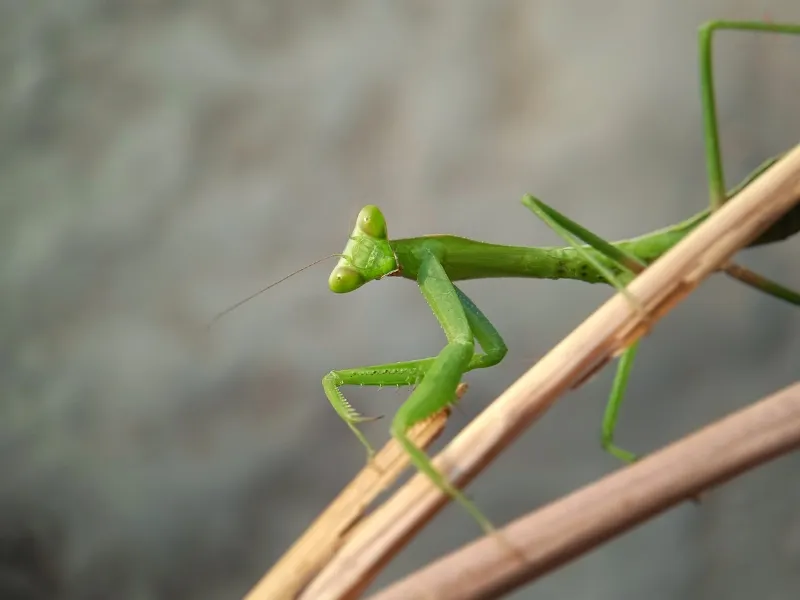
Two of the biggest concerns for North Carolina homeowners during summer are ticks and mosquitoes, and it is tempting to hope that a yard full of mantises means those threats are being handled. That hope runs ahead of what the evidence actually supports.
Start with ticks. Ticks are arachnids, not insects, and the reliable extension sources reviewed here do not identify mantises as meaningful tick predators or tick-control agents. No credible source in the current body of evidence supports treating mantis presence as a substitute for the established tick-prevention practices that protect families and pets: reducing brush and leaf litter near activity areas, using appropriate repellents, and checking people and animals after time outdoors. Mantises in your yard do not change any part of that routine.
The mosquito picture is slightly more nuanced, but the practical conclusion is the same. A peer-reviewed study on mantis predation found that tested mantises could and did consume Aedes and Anopheles mosquitoes under controlled laboratory conditions. That is a real finding, and it confirms that mantises are physically capable of eating mosquitoes when the opportunity arises.
What that laboratory result does not show is that backyard mantises reduce household mosquito abundance to a level that lowers disease risk. UC ANR’s natural enemies guide characterizes mantises as broad, opportunistic predators rather than mosquito specialists. A mantis perched on your porch railing will eat a mosquito if one lands nearby, but it is not patrolling for them, and a handful of mantises cannot meaningfully reduce a mosquito population around a North Carolina home.
Mantis presence is compatible with a wildlife-friendly yard, and that is worth appreciating on its own terms. For actual protection against ticks and mosquitoes, ordinary household precautions remain the reliable choice.
Inspect plants before deciding whether to act

Mantis sightings are a prompt to look more carefully at your yard, not a signal to start treating it. The most useful thing you can do after noticing an increase in mantises is to walk your garden and look at the plants themselves.
Check leaves, stems and the undersides of foliage for actual evidence of chewing, stippling, or sap-sucking damage. If you find something, try to identify the insect responsible before deciding whether any response is needed. Minor cosmetic damage on a few leaves rarely justifies intervention, and tolerating some insect activity is part of maintaining the kind of yard that supports wildlife.
NC State Extension’s integrated pest management handbook frames this as the foundation of sound yard management: monitor first, confirm a problem, assess whether the damage actually warrants a response, and then choose the least-disruptive option that addresses the confirmed issue. Mantis numbers are not part of that calculation.
The reason mantis counts cannot substitute for plant inspection comes down to how these insects move and live. Mantises are mobile, cryptic and unevenly distributed across a landscape. NC State’s Carolina mantid resource makes clear that a few visible individuals cannot measure total insect abundance or tell you whether pest or pollinator populations have shifted in any direction. Seeing three mantises near your roses does not mean rose pests are up, down, or under control.
Confirmed plant damage, caused by an identified pest, at a level that genuinely threatens plant health or harvest, is the threshold that should trigger a management decision. That determination comes from looking at your plants carefully, not from counting the predators nearby.
Leave mantises alone and keep treatments narrow
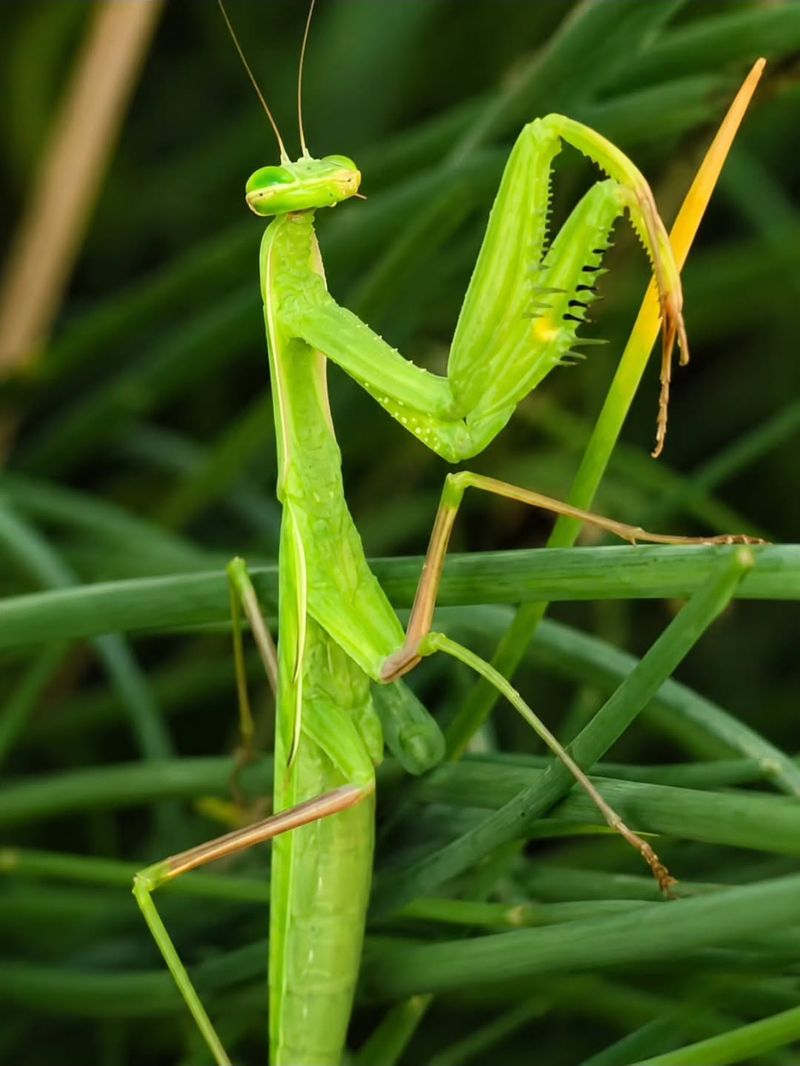
When no confirmed pest problem exists, the right response to mantis sightings is straightforward: leave them where they are. Mantises are doing what they do naturally, and disrupting that with broad insecticide applications around shrubs, flower beds and garden borders would cause more harm than the mantises ever could.
University of Maryland Extension recommends avoiding residual broad-spectrum insecticide use when mantises are present, a recommendation that aligns with the NC State IPM handbook’s guidance to support naturally occurring predators and parasitoids rather than disrupting them. A yard that hosts mantises is already doing something right ecologically, and blanket spraying would undercut that.
Buying or releasing mantises or egg cases for pest control is also a practice worth skipping. NC State Extension discourages relying on commercially sold mantises for home-garden biological control because they are mobile, nonselective and prone to cannibalism, making them poor investments as targeted pest-management tools. If you find an egg case outdoors on a plant or fence, leave it there. NC State’s Chinese mantid resource warns that bringing an egg case into a warm house can trigger premature hatching, leaving newly emerged nymphs with no prey and nowhere to go.
If plant inspection does reveal a genuine pest problem that requires treatment, keep the response narrow. Follow the product label exactly, apply only to the confirmed affected area, and minimize drift to surrounding plants and soil. EPA pollinator protection guidance and EPA tips for reducing pesticide impacts on wildlife both identify label compliance, avoiding blooming plants while pollinators are foraging, and timing applications carefully as the most important risk-reduction steps. A targeted, well-timed treatment protects your plants without wiping out the insects, including mantises, that belong in a healthy North Carolina yard.
Treat the sighting as information, not an instruction
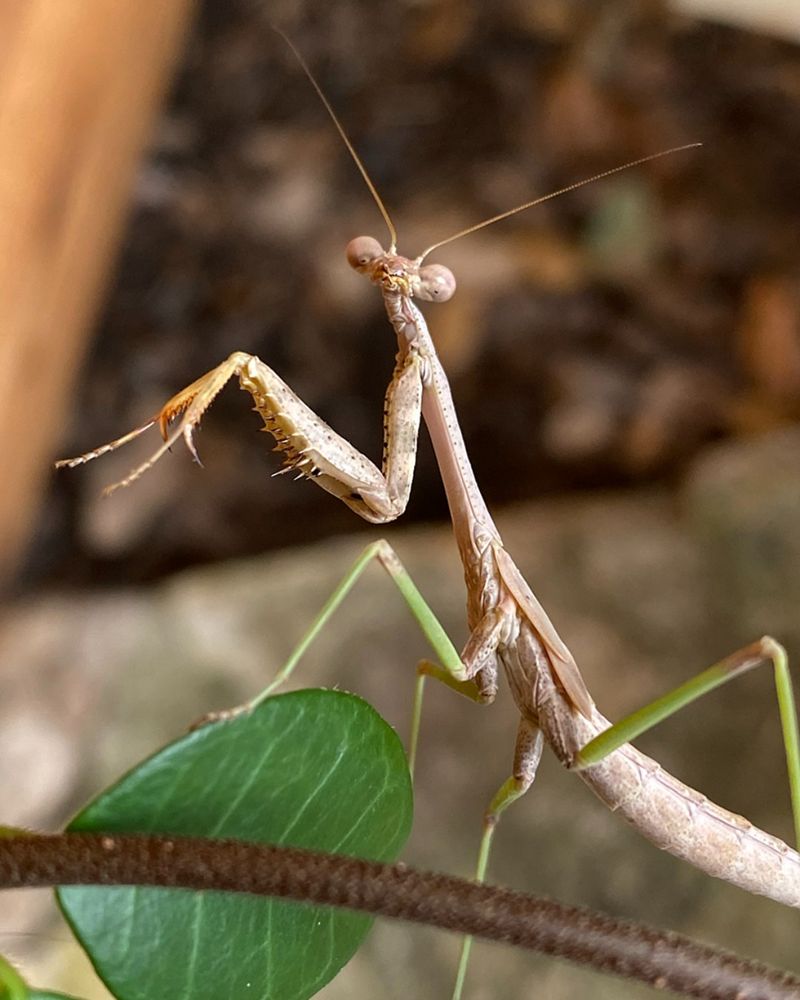
A summer wave of praying mantises is genuinely interesting, and it deserves a thoughtful response rather than a panicked one. NC State’s mantid resource points to seasonal egg-case hatching and summer development as the strongest explanation for a sudden increase in North Carolina, and that explanation does not require a pest outbreak to hold up.
The sighting may also be compatible with a yard that offers suitable prey or hunting habitat, but that remains a plausible inference rather than a confirmed diagnosis. A few visible mantises cannot measure insect abundance, prove that pests have risen, or demonstrate that any biological control is taking place. NC State’s IPM handbook puts the right sequence plainly: observe first, verify any plant problem before acting, use the least-disruptive response when action is genuinely needed, and keep ordinary household precautions against ticks and mosquitoes in place regardless of what predators are visible.
The mantis is not a yard manager. Treating it as one sets up expectations the insect cannot meet. Treating it as a seasonal visitor that belongs in a North Carolina summer, on the other hand, is both accurate and a reasonable reason to enjoy the view.