
Spotted lanternflies have been turning up in parts of North Carolina, and if you live in one of the affected counties, seeing one on your property is worth paying attention to. The insect is an invasive pest from Asia that feeds on a wide range of trees and plants, and it has been spreading since its first confirmed foothold near Kernersville back in 2022. Understanding where it has actually been documented, which plants to check first, and what to do next will help you respond calmly and effectively without overreacting or accidentally harming local wildlife.
North Carolina is seeing expansion in specific counties, not a statewide yard invasion
North Carolina’s first established spotted lanternfly population was confirmed near Kernersville in June 2022, making this pest a known presence in the state for several years now, not a brand-new arrival. Since that initial confirmation, the insect has continued to spread, but the spread has been documented in specific counties rather than across every backyard in the state.
According to a February 10, 2026 NCDA&CS press release, established populations have now been confirmed in seven North Carolina counties: Forsyth, Guilford, Rockingham, Caldwell, Davidson, Rowan, and Caswell. Three of those counties were added in that same release, showing that the range is still actively expanding within the state.
Homeowners outside those seven counties should not assume they are completely in the clear. Spotted lanternflies can hitchhike on vehicles, outdoor equipment, and transported goods, which means a sighting can occur far from a known established population.
Where your sighting happens matters to officials trying to map the insect’s spread. A report from inside a known county still helps track population density, while a report from an unconfirmed county could alert the state to a new establishment point. Either way, suspected sightings should be documented and submitted according to current NCDA&CS reporting guidance, with particular urgency if you are outside the seven known counties.
Because the situation is actively changing, the live NCDA&CS reporting page is the most reliable place to check for the latest county-level information. The NC State Forest Service spotted lanternfly resource page also tracks developments and is worth bookmarking for updates as the summer progresses.
Tree-of-heaven is the first tree to inspect
When you spot a suspected spotted lanternfly on your property, tree-of-heaven is the first place to look nearby. Late-stage nymphs and adults are drawn to it more consistently than to most other plants, making it a useful early-warning indicator when trying to determine whether a population has established itself in your yard or neighborhood.
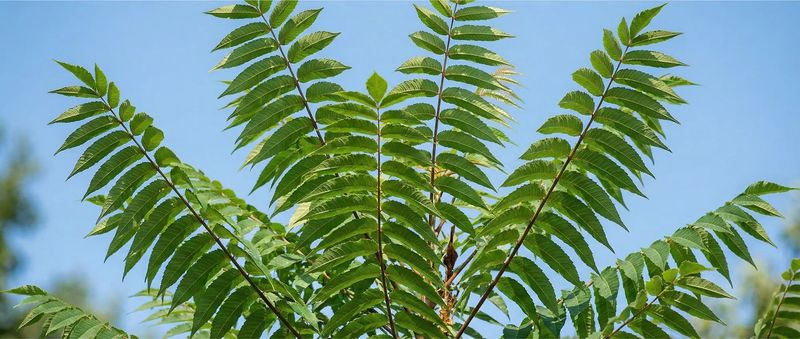
Tree-of-heaven (Ailanthus altissima) is itself an invasive species from China, and it is not a plant you want to encourage. According to NC State Extension’s tree-of-heaven profile, it grows rapidly, spreads aggressively, and tends to colonize roadsides, fence lines, vacant lots, and disturbed ground. Its large compound leaves can stretch two feet or more in length, carrying anywhere from 11 to 41 pointed leaflets arranged in pairs along a central stem. The base of each leaflet typically has one or two small notched lobes, which is one of the more reliable identification details.
Spotted lanternfly finds tree-of-heaven particularly attractive during the later nymph stages and into adulthood. Inspecting one of these trees during a warm-season walk can reveal clusters of insects, sticky residue on bark or surrounding surfaces, and the black powdery growth of sooty mold that follows heavy feeding.
That said, tree-of-heaven is not the only host and not a required stop in the insect’s life cycle. According to NC State’s spotted lanternfly fact sheet, the pest feeds on more than 100 plant species, so its presence near your yard does not automatically mean a tree-of-heaven is involved. Think of it as the best first clue, not the only one.
Before removing any tree you suspect is tree-of-heaven, confirm the identification carefully. Several native trees, including black walnut and staghorn sumac, share compound-leaf characteristics and can look similar at a glance. Cutting the wrong tree harms your landscape unnecessarily, and cutting tree-of-heaven without a follow-up plan can make the problem worse, as explained in the next section on controls.
The insect and its feeding damage leave recognizable clues
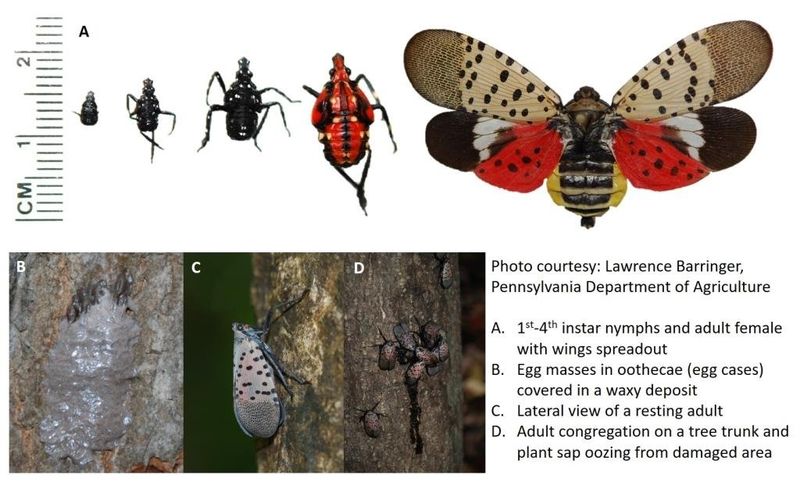
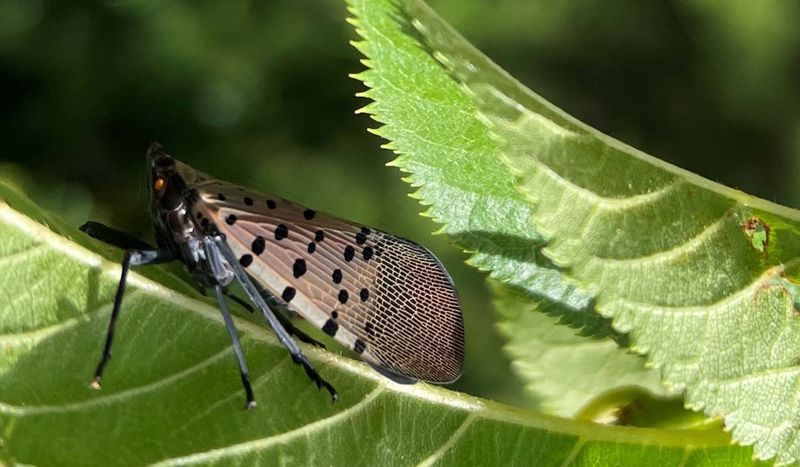
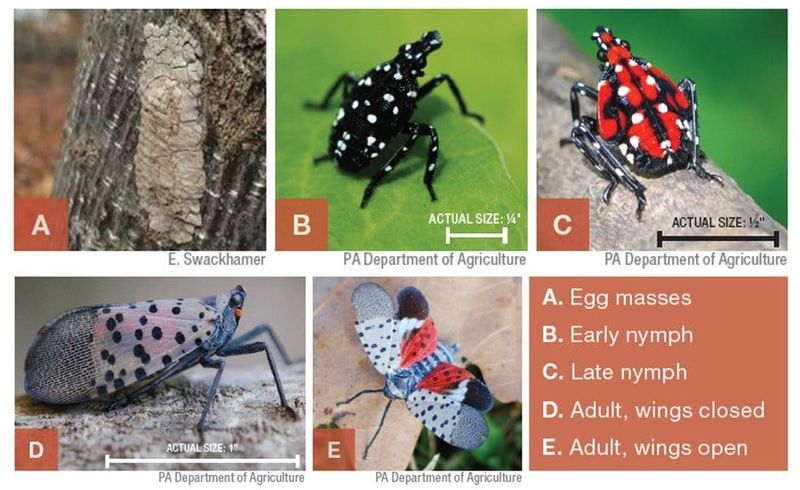
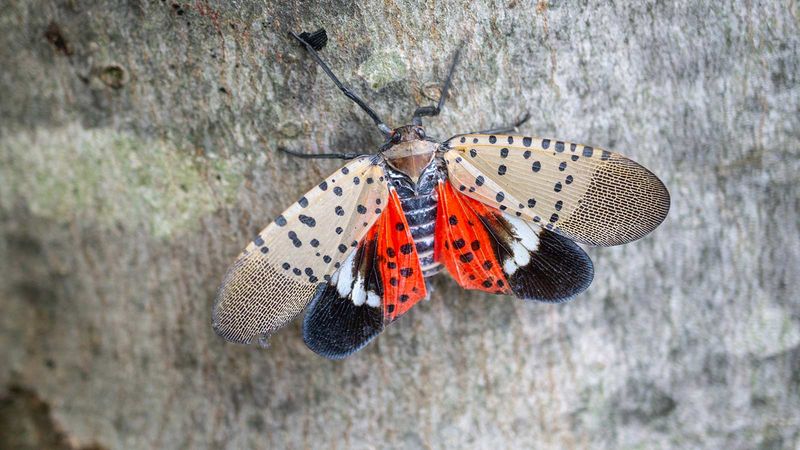
Learning to recognize spotted lanternfly at different life stages makes a big difference when you are doing a yard inspection. Adults are roughly one inch long and, when resting with wings folded, show gray-brown forewings covered in black spots. Open those wings and you see a striking pattern: red hindwings marked with black and edged in white. That combination is fairly distinctive once you have seen it.
Nymphs go through several stages before reaching adulthood. Early-stage nymphs are black with white spots and are quite small. As they mature into the final nymph stage, they develop bold red patches alongside the black-and-white markings. According to USDA APHIS spotted lanternfly identification guidance, that red coloration in the last nymph stage makes them easier to spot against bark and foliage.
Feeding signs can sometimes alert you to a problem before you ever see the insect itself. Spotted lanternfly uses piercing-sucking mouthparts to extract sap, and the sugary waste it excretes, called honeydew, collects on bark, leaves, and surfaces below the feeding site. That sticky coating attracts ants and wasps, both of which may gather in unusual numbers around an infested plant.
Left unchecked, the honeydew supports black sooty mold, a fungal growth that coats surfaces and can interfere with a plant’s ability to photosynthesize. Sap oozing from bark at feeding sites is another sign worth noting, particularly on smooth-barked trees where it shows up clearly.
Timing matters for what you are likely to find. NC State Forest Service life-cycle information places nymphs from approximately spring through summer, with adults appearing from summer into fall. North Carolina’s warmer climate means these windows may run earlier than in more northern states, and weather variations from year to year can shift the timing further.
A sighting does not identify the whole infestation
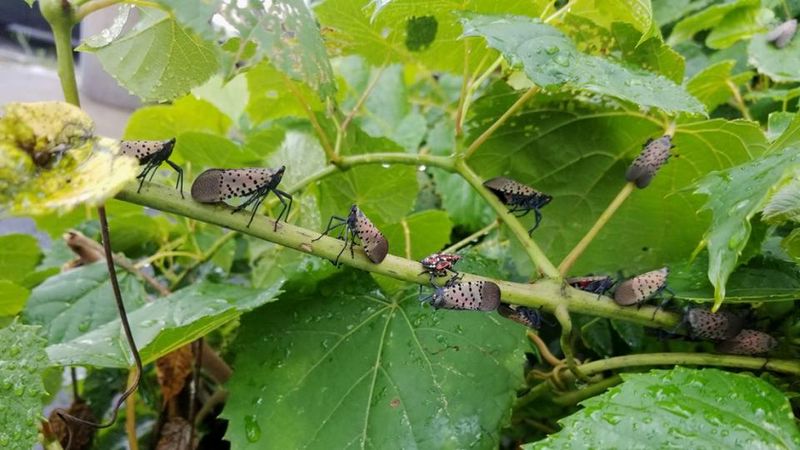
Finding one or a handful of spotted lanternflies on a plant is genuinely worth documenting and reporting, but it does not tell you the size, source, or likely trajectory of a local population. Insects can arrive by hitchhiking on car bumpers, trailers, patio furniture moved from an infested area, or firewood transported from another county. A single insect on your fence post may have ridden in from miles away rather than hatching nearby.
The host range of spotted lanternfly is broad enough that limiting your inspection to tree-of-heaven would leave a lot of ground unchecked. USDA APHIS documentation puts the known host list above 100 plant species. Grapes are among the most economically significant, but the insect also feeds on walnuts, maples, willows, hops, fruit trees, and a range of ornamental plants. Early nymphs in particular use a wide variety of plants before the population shifts toward tree-of-heaven and other preferred late-season hosts.
Plant risk is real but varies considerably depending on the host, the feeding pressure, and the plant’s existing health. Penn State Extension’s spotted lanternfly FAQ explains that heavy feeding weakens plants, can contribute to branch dieback, and compounds stress from drought, disease, or other pests. The most serious documented plant mortality has involved grapevines, tree-of-heaven, and young black walnut saplings.
Established ornamental trees in a healthy yard are not generally at the same level of risk as a commercial vineyard or a newly planted black walnut. That does not mean ignoring the situation, but it does mean that a measured response based on what you actually observe is more useful than assuming the worst from a single sighting. Check the full range of likely hosts, look for the feeding signs described in the previous section, and let what you find guide your next step rather than letting the initial discovery set the tone.
A focused inspection tells you what to do next
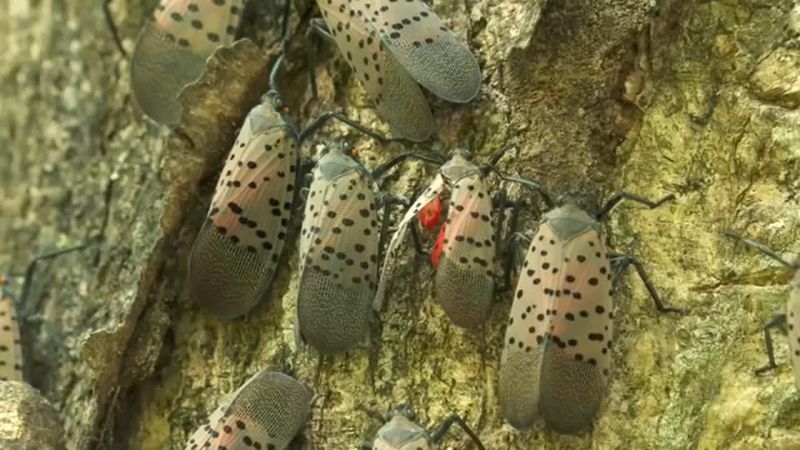
Once you suspect spotted lanternfly activity, a short, systematic inspection gives you something concrete to act on. Start with any tree-of-heaven on or near your property, checking the trunk, branches, and undersides of leaves for clusters of nymphs or adults, sticky honeydew residue, sooty mold, or sap weeping from feeding sites. Then move outward to other likely hosts: grapevines, walnut trees, maples, willows, fruit trees, and ornamental plants that show unexplained wilting, mold, or unusual insect activity.
Hard surfaces deserve attention too. Egg masses show up on fences, decks, outdoor furniture, vehicles, and almost any smooth outdoor surface, not just on tree bark. Walking the perimeter of your yard and checking these non-plant surfaces takes only a few minutes and can turn up evidence that a plant-only inspection would miss.
Photograph everything you find before disturbing it. A clear photo of the insect or egg mass, combined with your location, is exactly what state officials need to assess a possible new population. The NCDA&CS spotted lanternfly reporting page provides current guidance on how and where to submit suspected sightings. Reporting is especially important if you are outside the seven counties identified in the February 2026 NCDA&CS release, where your observation could flag a previously unknown population.
Residents in known established counties should still report, since tracking density within those counties helps officials understand how the population is behaving. Documentation and reporting are more strategically useful than simply crushing every insect you encounter, though squashing adults and nymphs you can safely reach is a reasonable supplement to other actions. The goal is to give state and extension professionals the information they need to respond effectively.
Egg masses require seasonal action and a safe reach limit
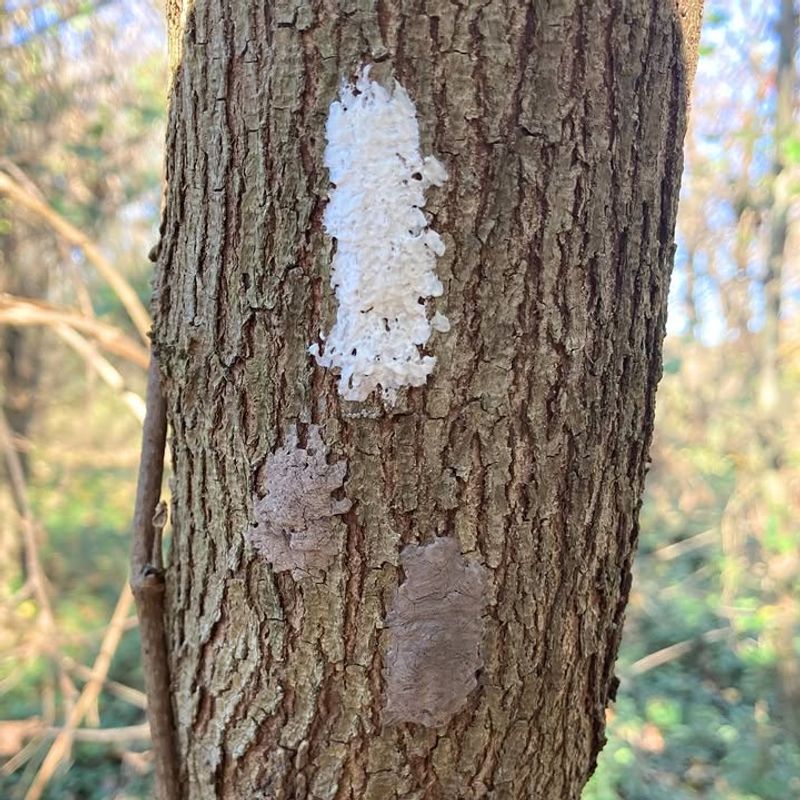
Egg masses are the stage where a homeowner can make a direct dent in the local population without any special equipment. Each mass is a gray or brown patch that looks something like dried mud or a smear of putty, typically running about one to one and a half inches long. USDA APHIS guidance confirms that masses appear on tree bark but also on fences, decks, rocks, vehicles, trailers, grills, outdoor furniture, and other hard surfaces. Checking all of these during your inspection, especially on vehicles that have traveled through known affected counties, is worth the few extra minutes.
The window for handling egg masses runs roughly from September through May, covering the period after adults have laid eggs and before the following spring’s hatch. Penn State Extension’s egg mass guidance recommends scraping reachable masses into a container filled with rubbing alcohol or hand sanitizer and leaving them submerged permanently. Alternatively, crushing the entire mass thoroughly until no intact eggs remain is also effective.
Two disposal mistakes are worth avoiding. Scraping egg masses onto the ground and leaving them there is not sufficient because the eggs may still hatch and the nymphs can survive. Pouring liquid over a mass without collecting it is similarly unreliable.
The other firm limit is height. Penn State’s management guide notes that the majority of egg masses found on trees are above a practically reachable height. Do not climb trees or use ladders to reach high masses. Work only at ground level or on surfaces you can safely access without leaving the ground, and let the masses out of reach remain until professionals or natural mortality address them.
Choose controls that limit wildlife harm and prevent tree-of-heaven regrowth
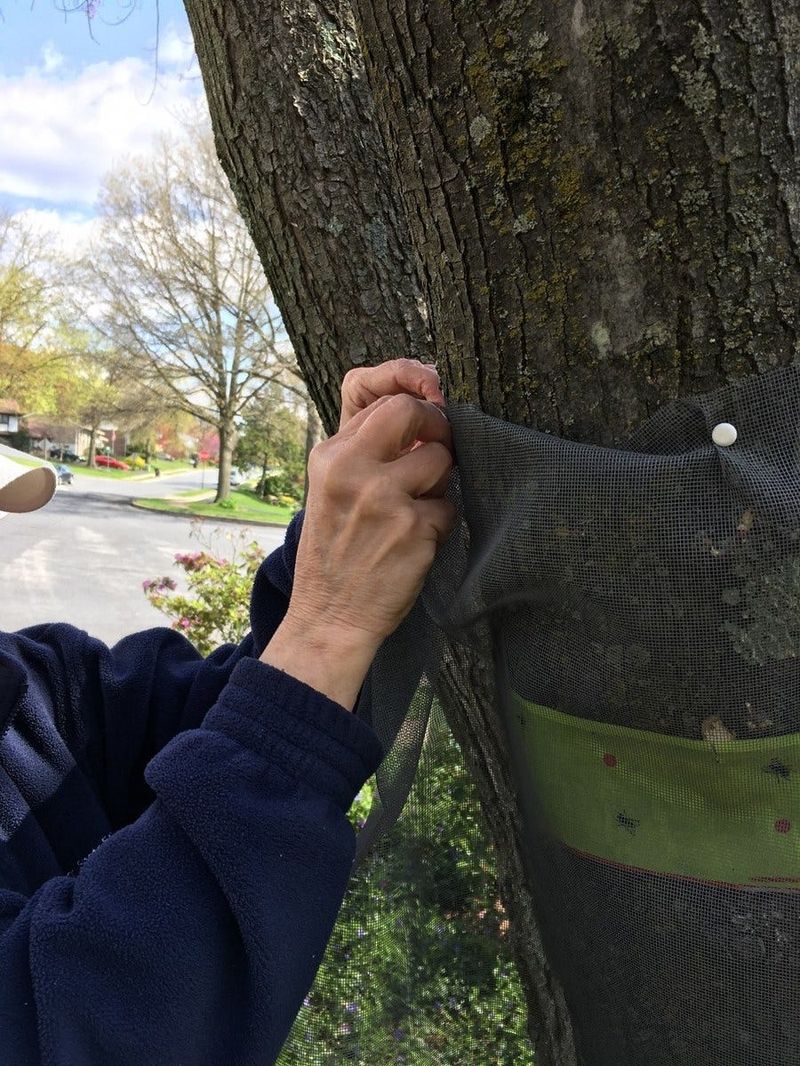
Trapping is one option for reducing spotted lanternfly numbers on a specific tree, but the type of trap and how it is maintained make a significant difference for the wildlife sharing your yard. Exposed adhesive bands wrapped around tree trunks are effective at catching the insects but have a documented record of trapping birds, bats, squirrels, lizards, butterflies, and beneficial insects that contact the sticky surface.
Protected circle-style traps offer a lower-risk residential alternative because their design reduces the chance that non-target animals will contact the adhesive directly. If you use any sticky band, a wildlife barrier is not optional. Penn State Extension’s wildlife barrier instructions walk through building a simple mesh screen that keeps larger animals away from the adhesive while still allowing the insects to pass through. Daily inspection is also required so that any non-target animal caught can be freed promptly.
The Penn State management guide reinforces both requirements for any adhesive trap setup.
Tree-of-heaven removal is a separate decision that needs its own careful planning. The tree is invasive and its removal can benefit native plant communities, but cutting the trunk alone often backfires. According to NC State Extension’s tree-of-heaven management guidance, cutting stimulates vigorous stump and root sprouts that can spread the plant further rather than eliminating it. Effective removal typically requires treating the root system with an appropriate herbicide, and large trees or situations requiring herbicide application are best handled by a qualified professional.
Native plants removed by mistake because of misidentification are a real loss for local wildlife habitat. NC State’s native plant landscaping resource is a helpful reference for confirming that the trees and shrubs in your yard are what you think they are before taking any removal action.
Pesticide treatment depends on the plant and the pressure
Seeing spotted lanternflies on a plant does not automatically call for a pesticide application. Chemical treatment is a tool that makes sense under certain conditions, and applying it without considering those conditions can harm beneficial insects, pollinators, and other wildlife while providing limited benefit to the plant.
Before reaching for a product, work through a short checklist. What life stage are you seeing – eggs, nymphs, or adults? How many insects are present, and on which plants? Is the affected plant already stressed by drought, disease, or poor soil conditions?
Is it a particularly vulnerable species like a grapevine or a young black walnut sapling? Penn State Extension’s ornamental plant treatment guidance frames these questions as the starting point for any treatment decision, because the answers determine whether treatment is warranted and which approach fits the situation.
Household mixtures, essential oils, dish soap sprays, and other improvised remedies are not supported by reliable evidence and may constitute illegal pesticidal use. Penn State Extension’s guidance on home remedies is direct on this point: skip them entirely.
Any pesticide must be registered for use on the intended site and applied strictly according to its label. The label is a legal document, and deviating from it is not permitted. NCDA&CS pesticide product registration information covers what products are approved for use in North Carolina. When the situation involves a large tree, difficult access, or uncertainty about identification, a licensed pest management professional is the appropriate resource.
The right response starts with inspection, not panic
A spotted lanternfly sighting in one of North Carolina’s seven documented counties, or anywhere else in the state, calls for a measured, step-by-step response rather than an emergency reaction. Start with tree-of-heaven if one is growing nearby, since it is the most reliable early indicator, but work through the rest of your likely hosts as well: grapes, walnuts, maples, willows, and fruit trees all deserve a look. Check hard outdoor surfaces for egg masses at the same time.
Photograph what you find, note your location, and report suspected sightings through the NCDA&CS spotted lanternfly reporting page. Scrape reachable egg masses into rubbing alcohol and dispose of them properly. Avoid unprotected sticky traps, improvised sprays, and any control method that puts wildlife at risk or exceeds your safe working height. Reserve pesticide treatment for situations where the host plant, insect pressure, and product label all support it.
Tree-of-heaven is a useful clue, not a guaranteed source. According to NC State Extension’s spotted lanternfly guidance, this insect uses a wide range of hosts, and its presence near your yard may reflect hitchhiking as much as local establishment. Staying observant, reporting accurately, and acting on what the evidence actually shows keeps both your landscape and the wildlife depending on it in better shape than a reactive approach ever could.