
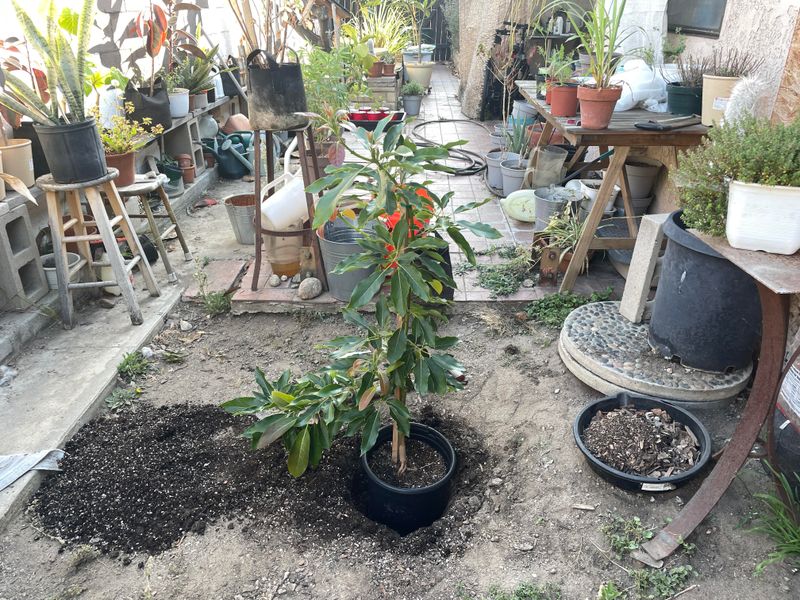
You water your container avocado, and by 3 p.m. the leaves are hanging down again. By morning they look fine, which makes the whole thing even more confusing.
That daily slump can point to what is going on in the pot, not just in the watering can. A few quick checks can tell you whether to water or to look somewhere else.
Afternoon droop is a clue, not a watering signal
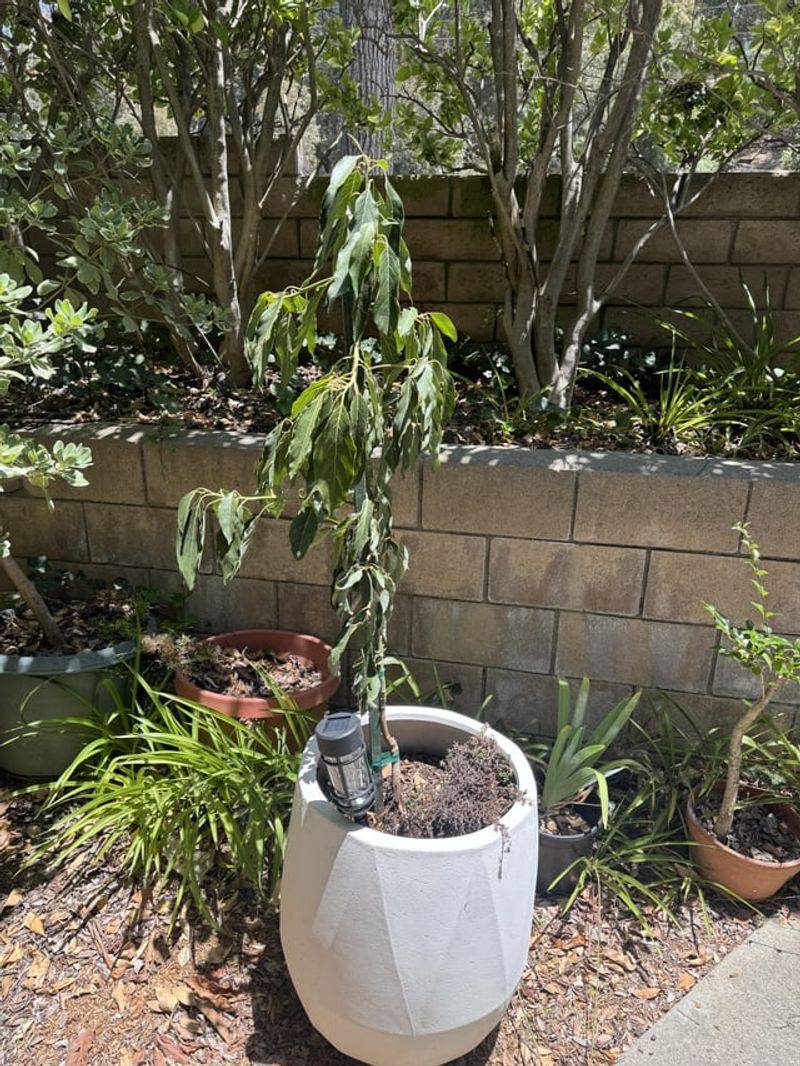
Picture a hot July afternoon in Riverside or San Diego County. Your avocado leaves sag and curl, and every instinct says the tree is thirsty.
Sometimes it is, but the droop alone cannot tell you that.
On a hot day, leaves can lose water faster than roots can replace it. According to Virginia Cooperative Extension guidance on water stress in container plants, a plant that wilts in the heat of the day and perks up at night is not necessarily short on water.
The roots may simply be unable to keep pace with what the leaves are losing.
Several things can slow that supply. The potting mix may be dry, the container may be baking in the sun, the roots may be packed tightly, or some roots may be damaged.
Each one looks the same from across the patio, which is why a droop is a clue and not a verdict.
So the plan here is simple. Check the root zone first, then look at the tree as a whole.
A tree that slumps for a few hours and bounces back by morning is in a different situation than one that stays limp, drops leaves, or stops growing.
Nothing about this pattern means you did something wrong. Container avocados live in a small, hot, fast-changing environment, and even careful growers see afternoon slumps.
The goal is to match the fix to the actual cause instead of reaching for the hose by reflex.
The next sections walk through each possibility in the order that is easiest to check, starting with the mix itself.
Is the potting mix actually dry?
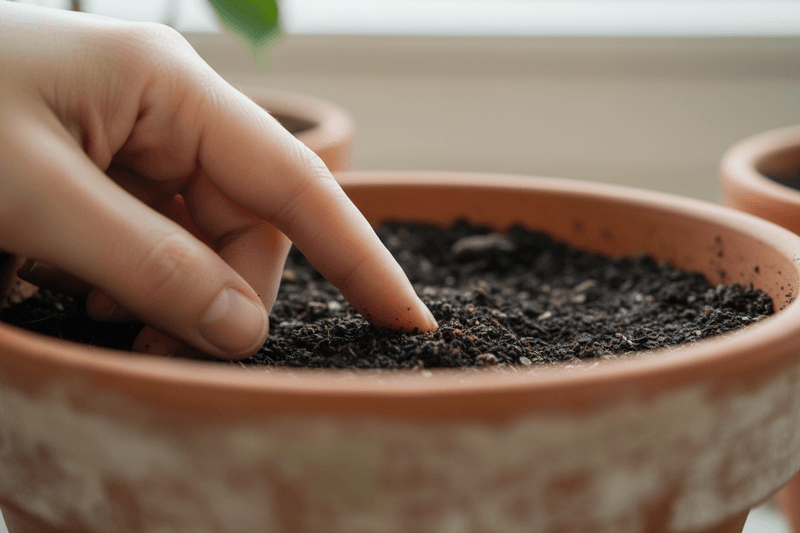
Before you water again, put a finger or a wooden dowel several inches into the mix. The top layer can look dry while the root zone below is still damp, or the other way around.
What you feel a few inches down is far more useful than what you see on the surface.
Next, tilt or lift the pot if you can. A container that feels light for its size is likely dry, and one that feels heavy is probably holding plenty of water.
Try this on a morning when you know the mix was recently watered so you learn what each feels like.
If the mix is dry, water slowly and thoroughly until water runs out of the bottom holes. Then empty the saucer so the pot does not sit in a puddle.
A quick sprinkle only wets the top and leaves the lower roots dry.
Resist the urge to turn this into a fixed schedule. As NC State Extension’s container guidance explains, how often a pot needs water shifts with heat, wind, pot size, the mix, and how much of the pot is filled with roots.
A Santa Ana wind week can dry a pot in a day, while a cool coastal morning fog may stretch it much longer.
If the mix turns out to be dry, you have likely found at least part of the answer. If it is moist, hold off on watering and move on to the next checks.
When the mix is moist, cool the pot—not with more water
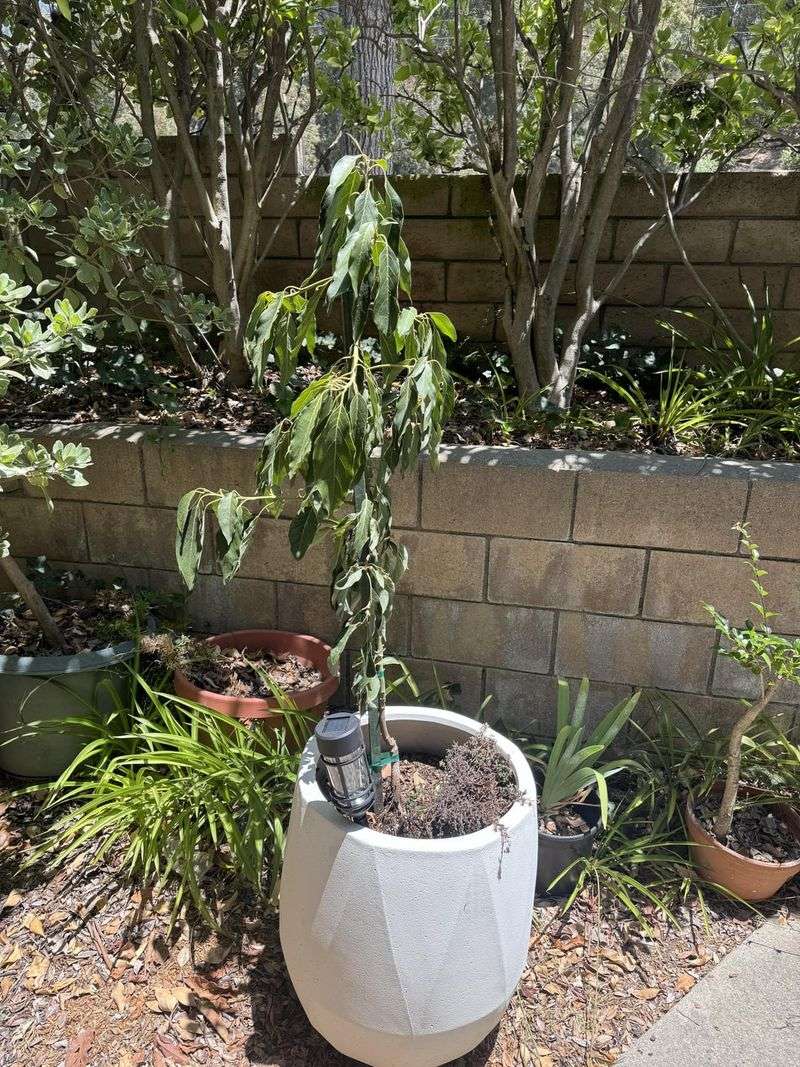
Say you checked and the mix is damp a few inches down, yet the leaves still sag at 3 p.m. A hot container may be part of the story.
Dark pots in full sun can heat up enough to stress roots and dry the mix quickly, as noted in Illinois Extension’s container guidance.
It is tempting to water again to cool things off. That is not a reliable fix.
Virginia Tech warns that repeated watering just to cool plants can add up to overwatering and root dieback.
Try shading the pot instead, or move it out of the harshest afternoon exposure. A few easy options:
Slide the container so a fence, wall, or larger plant shades the pot’s west side. Wrap the pot in a light-colored cover, or set a second pot in front of it.
Use a board or shade cloth to keep direct sun off the container walls.
Keep the foliage in good light, though. Avocados generally do best in full sun, as UF/IFAS avocado guidance describes, so the point is to protect the container and the roots, not to put the whole tree in the dark.
If a tree is brand new or recently moved, some temporary leaf shade during an extreme heat wave may help, but that is a separate call from cooling the pot.
Open drainage holes matter more than a gravel layer
Tip the pot slightly and look underneath. Are the drainage holes open, or are they plugged with roots, compacted mix, or a pot feet that covers them?
Poke a pencil or stick through each hole to clear it.
Then look at where the pot sits. A container resting in a full saucer, a decorative outer pot, or a patch of pooled water may be staying wetter than you think.
After watering, let the excess drain and tip out whatever collects.
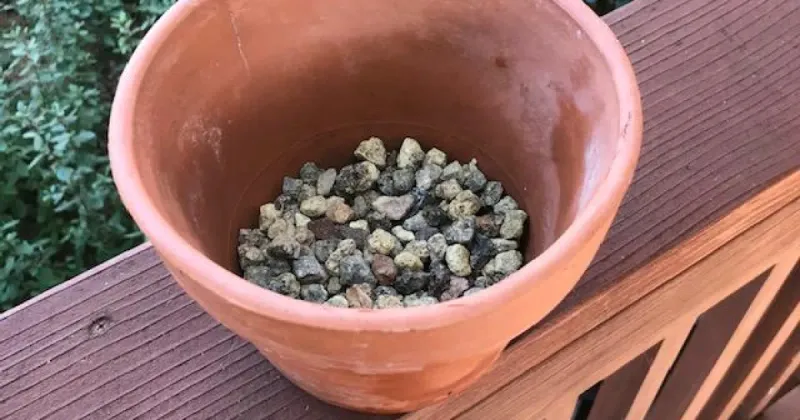
One common habit is worth dropping: adding a layer of gravel at the bottom for drainage. It sounds sensible, but UC Master Gardeners of Santa Clara County explain that it can leave the saturated layer of mix sitting closer to the roots.
Water tends to hang in the finer mix above the gravel before it moves down, so the gravel takes up room that roots could use.
If your pot already has gravel, you do not need to panic. Next time you repot, simply fill with a good container mix all the way down and let the holes do the work.
Practical corrections are small ones. Raise the pot on feet or bricks so water can leave freely.
Enlarge or add holes if there are only one or two tiny ones. Switch to a well-draining mix if the current one stays soggy for days.
A crowded root ball can make the pot dry unusually fast
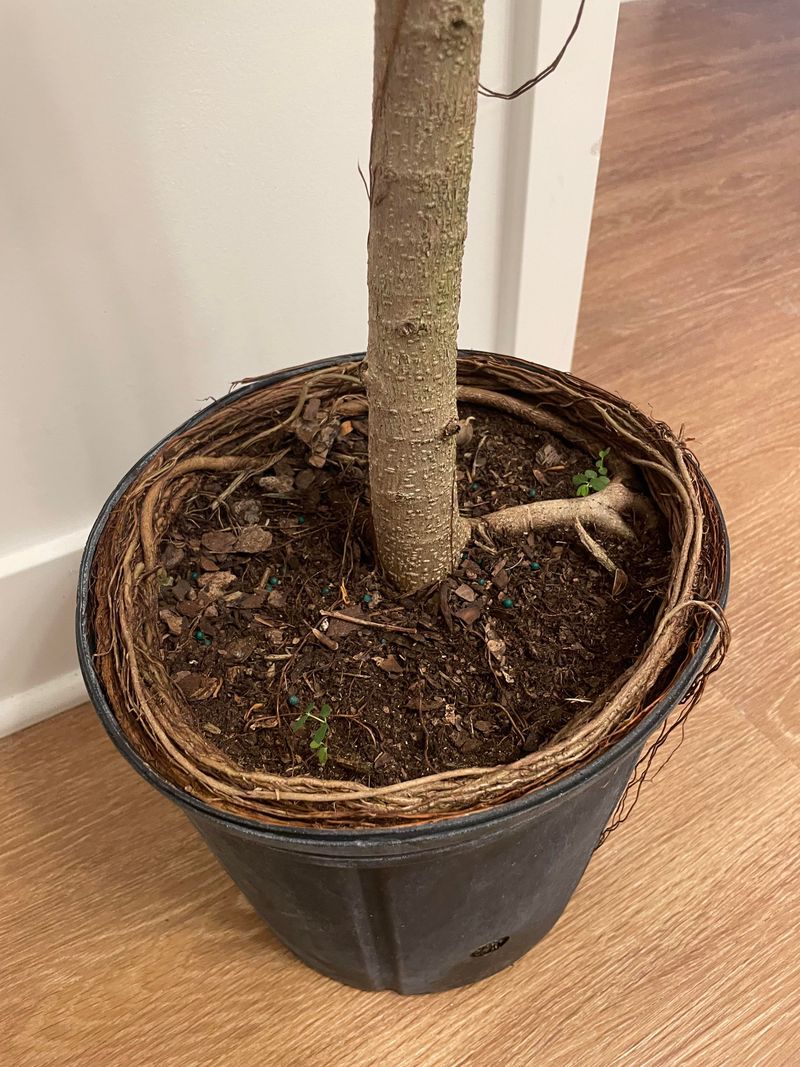
Sometimes the pot is simply full of roots and not much else. When that happens, there is little mix left to hold water, so the container can dry out far faster than it used to.
You may find yourself watering and still seeing a slump a few hours later.
To check, gently slide the tree out of the pot, or peek at the drainage holes and the soil surface. Look for a tightly packed mass of roots, roots circling the inside wall, or roots poking out the bottom.
Pots that dry unusually quickly are a common sign.
In that case, a larger pot is worth considering. Move up just one size, use fresh container mix, and loosen circling roots gently as you go.
This is an option for a root-bound pattern, not a cure for every afternoon wilt.
The NC State guidance mentioned earlier, on plants grown in containers, notes that frequent wilting that improves after watering can occur when a plant is root-constricted. Wilting that continues even though the mix stays moist raises more concern about root damage.
That difference gives you a useful test. If a thorough watering perks things up and the pot dries again fast, crowding is a good suspect.
If the leaves stay limp in damp mix, look more closely at root health and drainage instead of repotting by reflex.
Root rot becomes more concerning when the whole tree declines
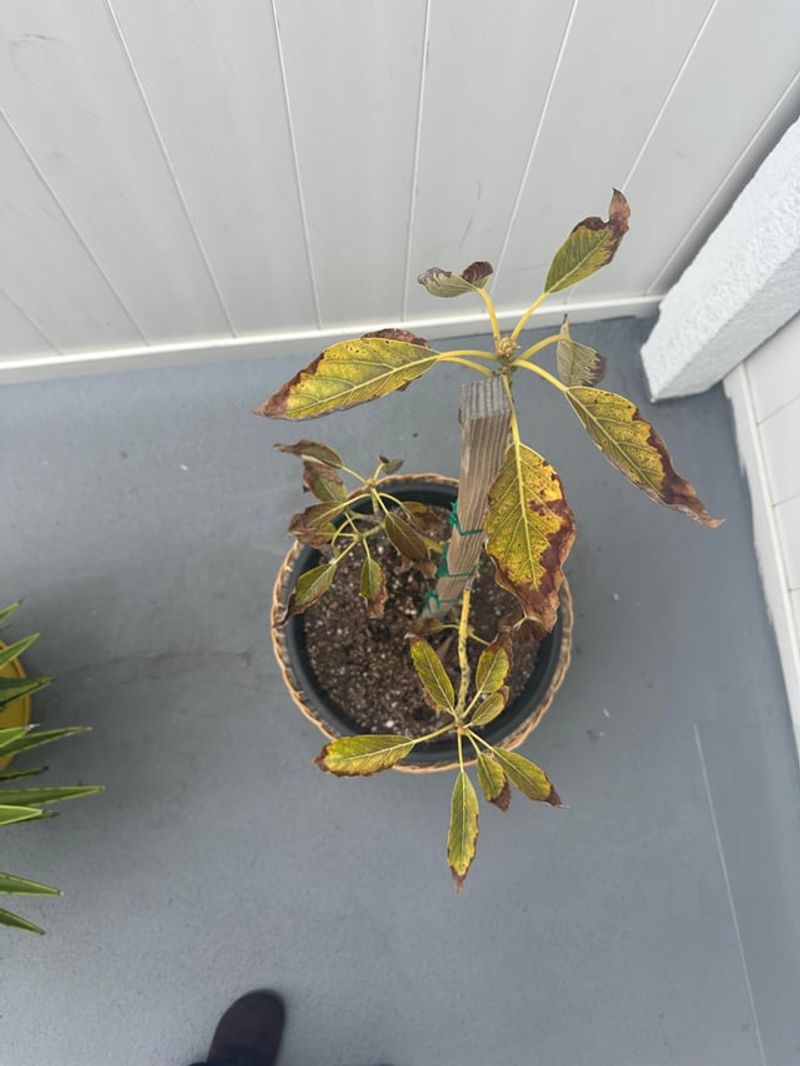
A daily droop that eases overnight is not the same as a tree in decline. Root rot enters the conversation when the plant shows more than a brief afternoon slump.
The UC IPM page on avocado root rot describes a broader pattern. Leaves may look pale or smaller than normal, with brown tips.
The canopy can thin out, new growth may be scarce, and branches may die back. If you inspect the roots, the small feeder roots may be dark and brittle.
Those signs are consistent with Phytophthora root rot, but they are not proof on their own. One afternoon wilt, even a repeated one, is not enough to diagnose the disease.
Root rot can cause wilting even when the mix is wet, which is part of why persistent limpness in damp mix deserves attention, as Virginia Tech’s water stress publication also points out.
If several of these signs show up together, focus on what you can control. Avoid keeping the mix soggy for long stretches, make sure drainage holes are open, and adjust watering to match what the mix feels like.
UC IPM describes careful irrigation as central to prevention and management.
Fungicide is not a simple first fix. Some systemic products are restricted to professional applicators, so if the tree keeps declining, a local UC Master Gardener program or a certified arborist can help you sort out next steps.
Use the next afternoon slump to choose your next step
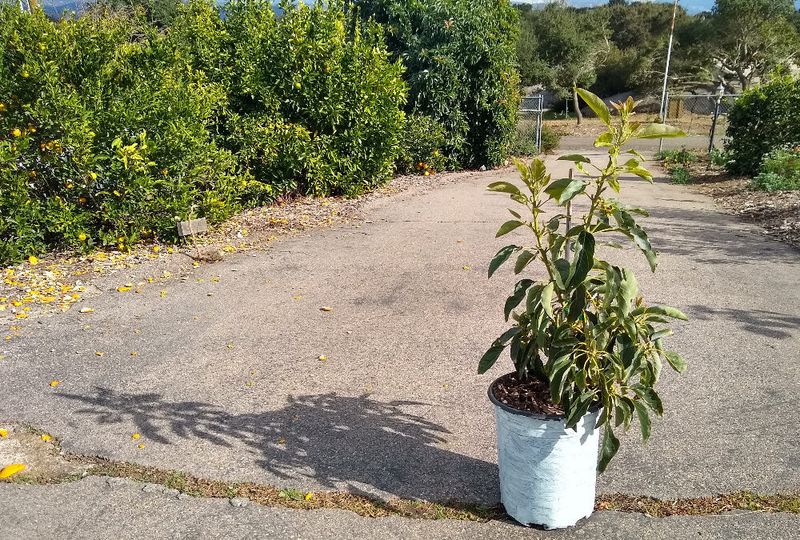
When the leaves sag again, start with the mix. Push a finger a few inches down and feel the pot’s weight.
If it is dry, water until it drains from the bottom and empty the saucer.
If the mix is moist, skip the hose. Shade the pot, check the drainage holes, and look at root crowding.
Watch for persistent decline, or several warning signs at once, which calls for a closer look at the roots.
Think of each slump as a free diagnostic test, and the pot will tell you what it needs if you check before you pour.