
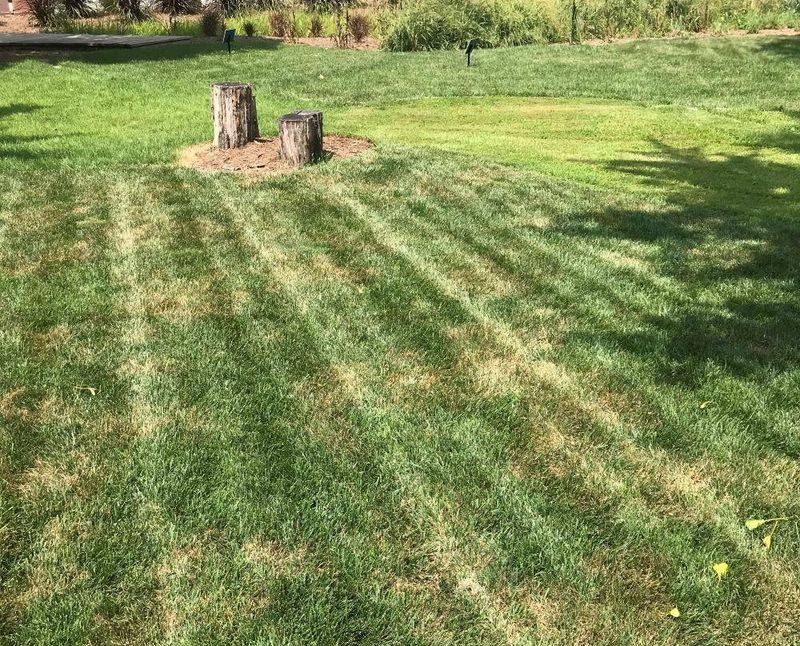
When your lawn turns brown the moment summer heat arrives, the first instinct is usually to grab the hose. But reaching for more water before you know what’s actually wrong can make things worse, not better.
Summer heat doesn’t just dry out grass – it acts like a stress test that can expose several different lawn problems at once, from shallow roots to pest damage to poor soil. Knowing how to read what your lawn is telling you is the fastest way to bring it back.
Heat Reveals Several Lawn Weaknesses
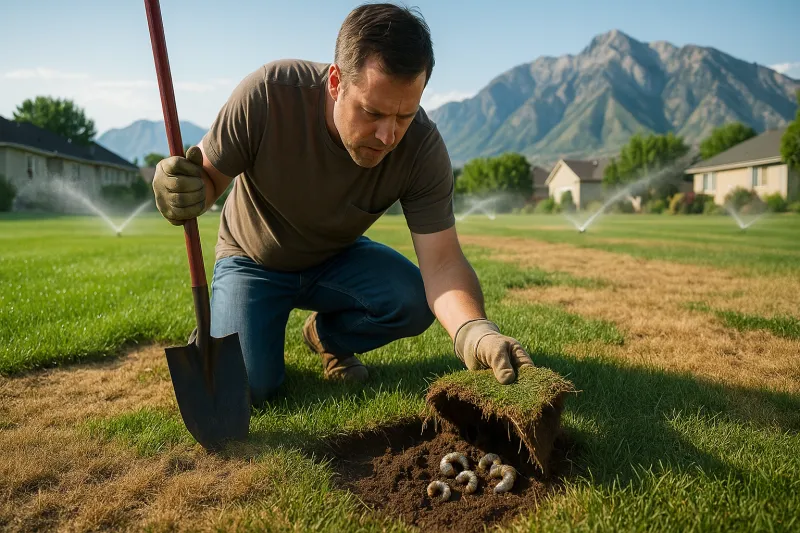
Summer heat doesn’t cause browning all by itself – it acts more like a magnifying glass, exposing weaknesses that were already present in the lawn. Shallow roots, compacted soil, poor irrigation coverage, a recent scalping, pest damage, and disease can all produce brown grass when temperatures climb.
UGA Extension research on abiotic turfgrass injuries confirms that heat-related browning often reflects an underlying management or root-zone problem rather than simple water deficit alone.
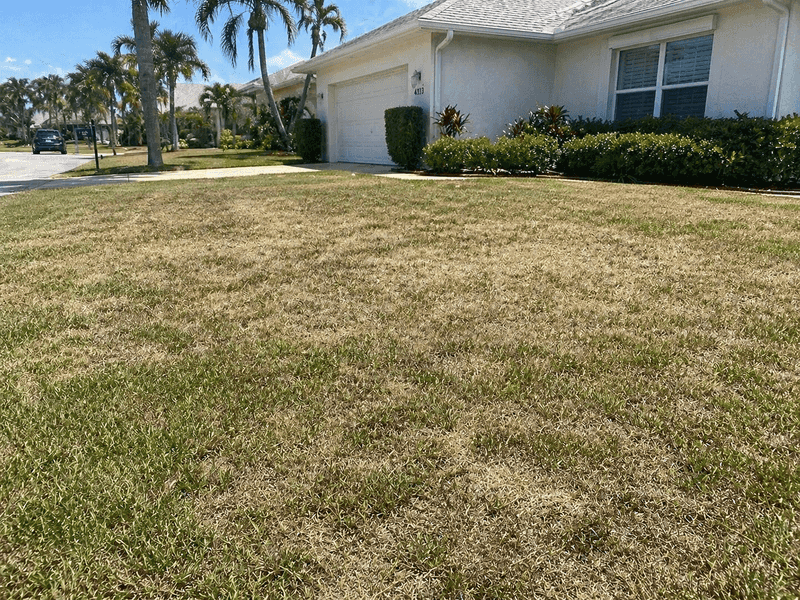
Color alone cannot tell you what’s wrong. A lawn that turns uniformly dull or tan across most of its surface is more likely dealing with drought stress, natural dormancy, or a broad irrigation shortfall.
That kind of whole-lawn fading looks different from isolated patches that keep expanding, or brown areas that follow the path of a mower or a fertilizer spreader.
Brown warm-season grass is not necessarily dead grass. Bermudagrass, for example, Texas A&M AgriLife notes can enter drought dormancy and recover once moisture returns.
What warrants closer attention is browning that happens unusually fast, follows a distinct pattern, or appears in specific zones of the yard rather than evenly. UC IPM guidance on lawn problems reinforces that timing, location, and the shape of brown areas carry as much diagnostic weight as the color itself.
Identify the Grass Before Adjusting the Mower
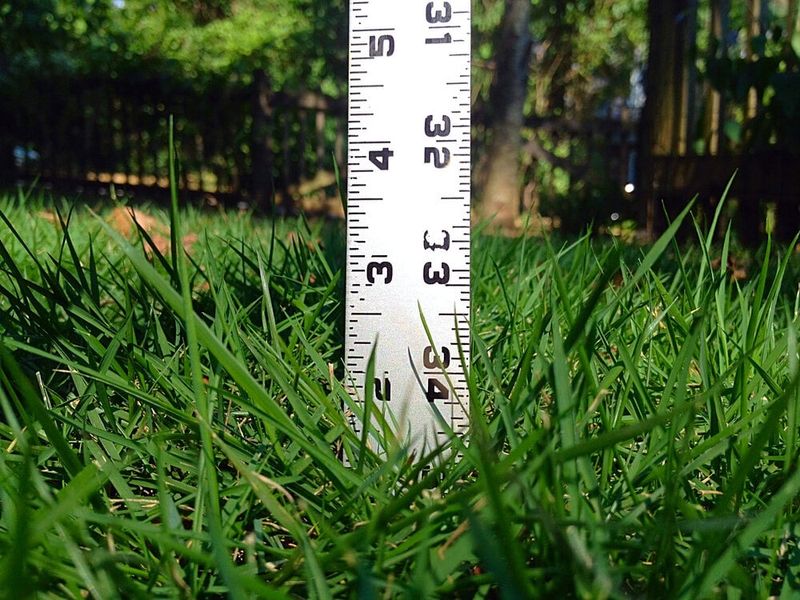
Grass type is the first checkpoint because mowing height, drought tolerance, and pest risk all vary by species. UF/IFAS mowing guidelines for Florida lawns list approximate target ranges of 3 to 4 inches for bahiagrass, 0.5 to 2 inches for bermudagrass, 1.5 to 2 inches for centipedegrass, 2 to 4 inches for St. Augustinegrass, and cultivar-dependent heights for zoysiagrass.
Mowing outside these ranges for your specific grass type can add stress before summer even arrives.
For standard St. Augustinegrass, UF/IFAS St. Augustinegrass care guidance recommends keeping the mowing height at roughly 3.5 to 4 inches. Dwarf cultivars such as Seville and Captiva have different targets, generally around 2 to 2.5 inches, so cultivar identification matters.
Bermudagrass under typical home-lawn management performs well at about 1 to 2 inches, according to UF/IFAS bermudagrass management guidance, though lower heights require more frequent mowing and higher water and fertilizer inputs.
Cutting too short removes photosynthetic leaf tissue, reduces the plant’s energy reserves, and discourages the deep root growth that helps grass survive dry spells. The one-third rule applies across all species: never remove more than one-third of the leaf blade in a single mowing.
During moisture stress, raise the mowing height rather than holding to a routine setting. Texas A&M AgriLife points out that browning immediately after mowing is a strong clue that too much green tissue was removed.
Dull blades also matter – UF/IFAS notes that shredded leaf tips from dull mower blades can give St. Augustinegrass a brownish cast even when nothing else is wrong.
Read the Browning Pattern Before Treating
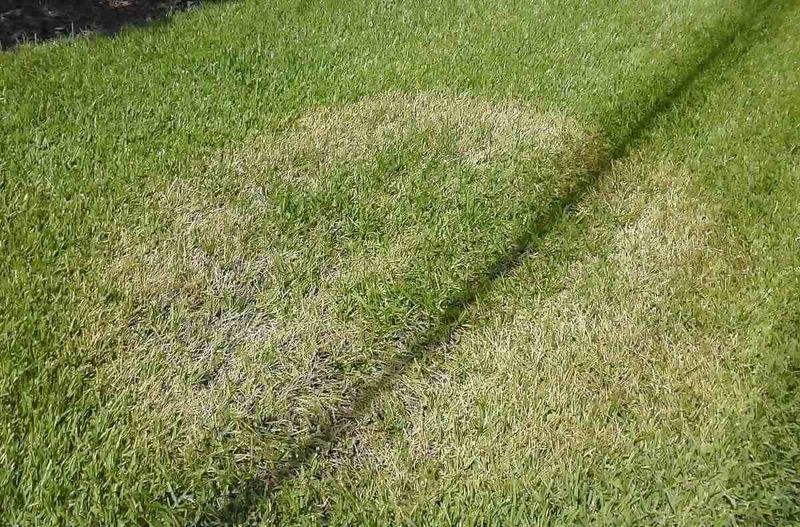
Mapping the symptom before changing any lawn routine can save time and money. UC IPM’s lawn problem guide emphasizes that the shape, location, and spread pattern of browning are as diagnostically useful as the color.
A fairly uniform, whole-lawn dulling that develops gradually across the entire yard points more toward drought stress, dormancy, or a widespread irrigation shortfall than toward a localized problem.
Expanding patches that grow outward from a central point, or that appear in hot, sunny sections of the yard, raise the possibility of insect activity or disease. UGA Extension’s turfgrass disorder reference notes that sharp-edged bands, streaks, or geometric shapes that align with the path of a fertilizer spreader or sprayer are more consistent with chemical injury than with pest or drought damage.
For St. Augustinegrass specifically, chinch-bug injury tends to appear as irregular, expanding brown areas in the hottest and sunniest parts of the lawn. Brown patch and related fungal diseases more often produce circular or semicircular patches.
Texas A&M entomology guidance on chinch bugs cautions that drought and other disorders can produce similar-looking damage, so the pattern provides a clue to investigate rather than a confirmed diagnosis. Walk the lawn, note where the browning starts, how fast it spreads, and whether it follows any obvious feature like a path, slope, sprinkler head, or shade line.
Check Whether Irrigation Reaches the Roots
Folded or rolled grass blades, a blue-gray tint, wilting in the heat of the day, and footprints or tire tracks that stay visible after you walk across the lawn are all signs that the turf is under moisture stress. These clues are more reliable than a calendar or a fixed run-time schedule.
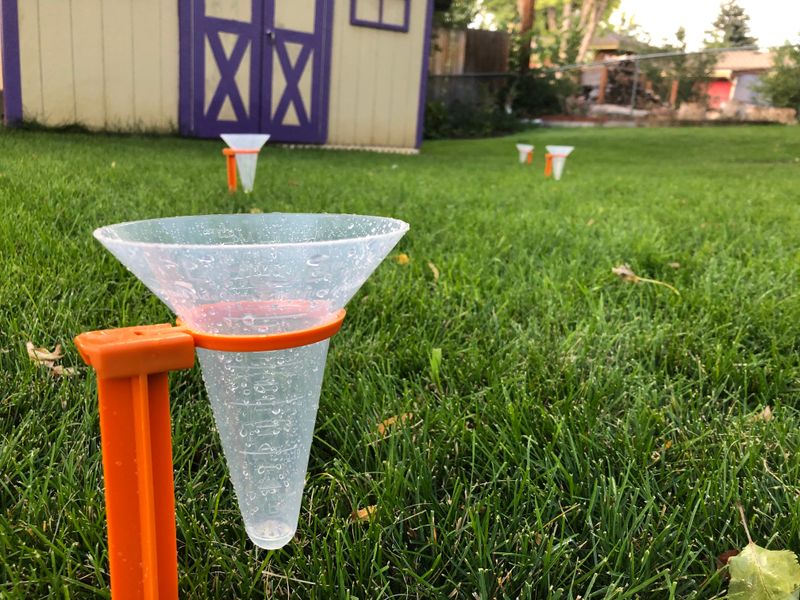
Before extending the irrigation timer, UF/IFAS irrigation guidance for Florida lawns recommends placing straight-sided cans – tuna cans work well – throughout each irrigation zone to locate dry spots and measure how much water each area actually receives.
Regional guidance differs because soil conditions differ. In Florida, UF/IFAS suggests applying roughly one-half to three-quarters of an inch when visible drought stress appears, then waiting until stress shows again before the next cycle.
Florida’s sandy soils hold less water than heavier clay soils, so the interval between waterings may be shorter even when the per-cycle amount is sound. UF/IFAS St. Augustinegrass care recommendations also warn that light, frequent watering keeps roots shallow and near the surface, where they are most vulnerable to heat and dry spells.
Texas guidance, from Texas A&M AgriLife’s bermudagrass management calendar, emphasizes deep, infrequent watering that wets the soil to roughly 4 to 6 inches and allows it to dry between cycles. Saturated soil reduces the oxygen available to roots and can damage the lawn just as surely as drought.
Slope, shade, rooting depth, and sprinkler head uniformity all change the right schedule for a specific yard, which is why a can audit is more useful than simply running the system longer.
Inspect the Root Zone for Compaction and Thatch
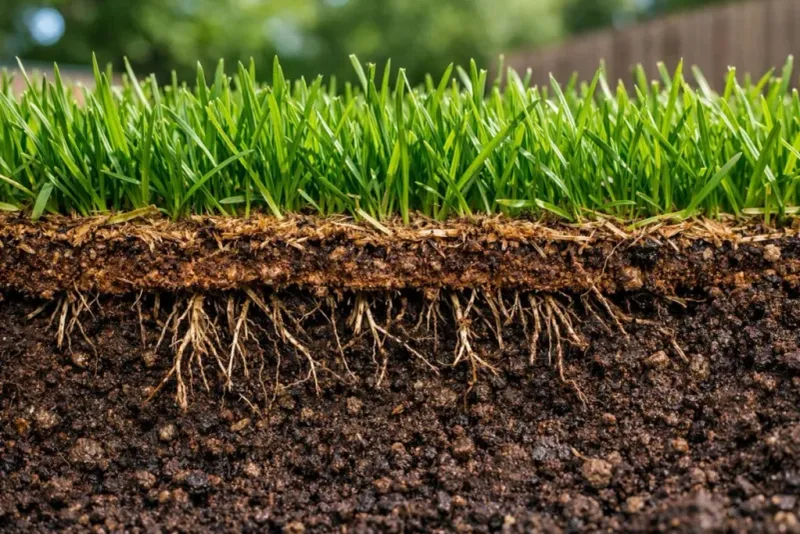
A lawn can look thirsty even when the sprinkler is running if water cannot move through the soil to reach the roots. Compaction restricts water infiltration, limits oxygen exchange, and stunts root growth.
UGA Extension’s turfgrass disorder guide and University of Nevada Extension compaction resources both identify foot traffic, driveways, mower routes, and heavily used play areas as the most common locations for compaction. After watering, try pushing a screwdriver or probe into the soil in a brown area – resistance that makes it difficult to push in more than a couple of inches is a possible indicator of compaction or a thatch problem, though it is not definitive proof on its own.
Thatch is a separate issue. Penn State Extension’s thatch management guide defines thatch as the layer of slowly decomposing stems, crowns, and roots that accumulates between the soil surface and the green grass blades.
Grass clippings are not the usual culprit – University of Minnesota Extension notes that clippings decompose quickly and typically do not contribute to thatch buildup. Heavy nitrogen programs, compaction, and poor oxygen conditions promote the slow decomposition that lets thatch accumulate.
When thatch grows thick, roots can end up living mostly in that dry, spongy organic layer instead of in the soil, making the turf far more vulnerable to summer heat.
The remedies for compaction and thatch are different. Core aeration improves air and water movement through compacted soil; UGA Extension recommends aerating warm-season turf while the grass is actively growing and soil temperatures are at least about 65 degrees F.
Dethatching removes the excessive organic layer above the soil. Penn State Extension’s seasonal lawn care guidance cautions against scheduling either mechanical operation during severe heat or drought, when the additional stress can delay recovery rather than help it.
Confirm Chinch Bugs Before Using Insecticide
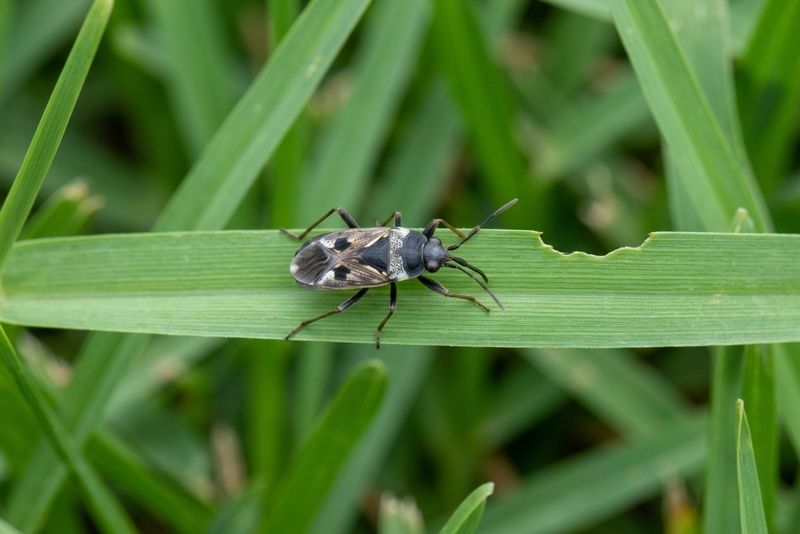
Southern chinch bugs are one of the more important alternative explanations for summer browning in Florida St. Augustinegrass lawns because their damage starts in exactly the areas that look most like drought stress – the hottest, sunniest, and most water-stressed sections of the yard. The border between still-green grass and the advancing brown area is where to begin the inspection.
Parting the grass at that edge and looking closely at the thatch layer and soil surface will often reveal the insects if they are present.
A simple field test can help confirm their presence. UF/IFAS St. Augustinegrass management guidance describes a coffee-can flotation method: remove both ends of a large metal can, press it firmly into the soil at the green-brown border, fill it with water, and watch for insects floating to the surface within about five minutes.
Repeat the test in two or three spots along the damage edge before drawing conclusions.
Finding a few insects does not automatically mean the lawn needs treatment. Texas A&M entomology chinch-bug guidance reports that meaningful damage is generally associated with roughly 20 to 25 bugs per square foot; brown areas without significant insect numbers are more likely caused by something else.
Drought, disease, and other disorders can produce damage that looks nearly identical to chinch-bug injury. UC IPM’s lawn insect guidance advises confirming the pest and establishing that damaging population levels are present before choosing any pesticide, since an unconfirmed application wastes money and may not address the real problem.
Follow a Low-Stress Recovery Sequence
Once you have identified the grass type and studied the browning pattern, the recovery process follows a logical order rather than a single fix. Stop any mowing practice that removes more than one-third of the blade, raise the cutting height if it has been set too low for the species, and sharpen or replace dull mower blades.
Verify irrigation coverage with a can audit before adjusting run times, and water according to visible stress signs rather than a fixed daily schedule. UF/IFAS irrigation guidance and UF/IFAS St. Augustinegrass recommendations both support watering in the early morning to reduce prolonged leaf wetness.
A stressed lawn should not receive a fertilizer application intended to force quick greening. Excess nitrogen can push lush, water-hungry growth, increase mowing demand, and raise the risk of disease.
Texas A&M AgriLife’s bermudagrass calendar links fertilizer timing to active growth periods rather than to visible stress. If summer browning includes circular patches with a distinct edge, check UGA Extension’s turfgrass disease quick-reference guide and confirm the disease and its seasonal pattern before considering a fungicide.
UC IPM’s lawn disease management guidance notes that fungicide cannot correct poor watering practices, so correcting irrigation problems first is a necessary step.
Aeration or dethatching can address confirmed root-zone problems, but Penn State Extension’s seasonal guidance is clear that neither belongs during a heat wave or drought. Schedule those operations for a period when the grass is actively growing and moisture is adequate.
Any pesticide decision requires identifying the pest, using a product labeled for that turf and pest combination, and following all label directions. The EPA states that the pesticide label is legally enforceable, and state or local restrictions may apply beyond what the label specifies.
Diagnose Before You Add Water or Products
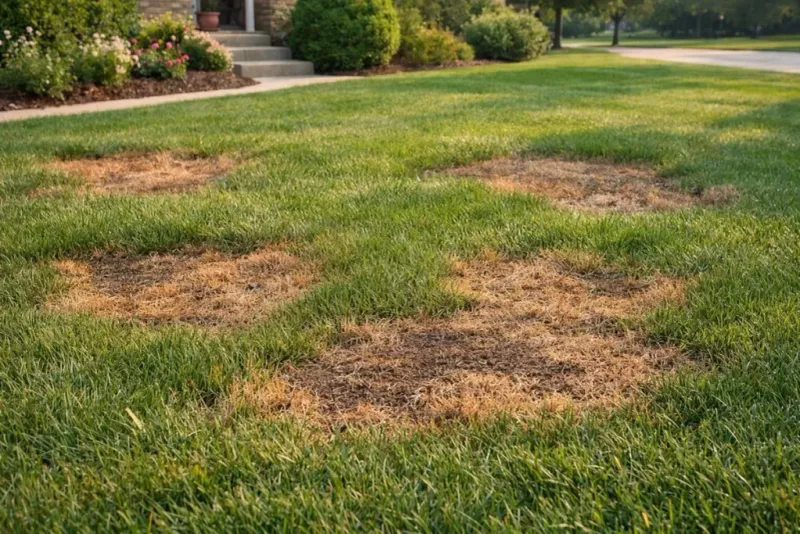
Summer heat is the trigger, not always the root cause. Use timing, pattern, grass type, mowing history, irrigation coverage, soil feel, and confirmed pest presence to identify the actual weakness before reaching for a hose, a fertilizer bag, or a spray bottle.
UGA Extension’s turfgrass disorder reference reinforces that abiotic and biotic causes of browning require different responses, and applying the wrong one can delay recovery.
No single remedy fits every Southern lawn. Brown turf may recover on its own from dormancy once conditions improve, and UF/IFAS irrigation guidance and Texas A&M AgriLife recommendations both caution against blind watering or unconfirmed product applications as avoidable risks.
A measured diagnosis protects the lawn, avoids unnecessary expense, and often reveals that the grass needs less intervention than it first appears. The homeowner who slows down to read the pattern usually spends less and fixes more.