
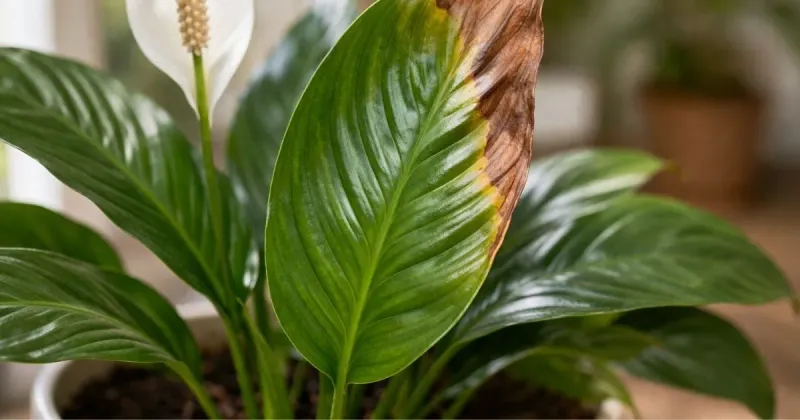
Crispy brown tips on a peace lily are one of the most common reasons indoor plant owners start to worry. The good news is that the plant is usually sending a clear signal about its growing conditions, and most of those conditions are fixable once you know where to look.
Before you change everything at once, it helps to understand what the browning actually tells you and what it does not.
Repeated severe drying is one watering mistake to check
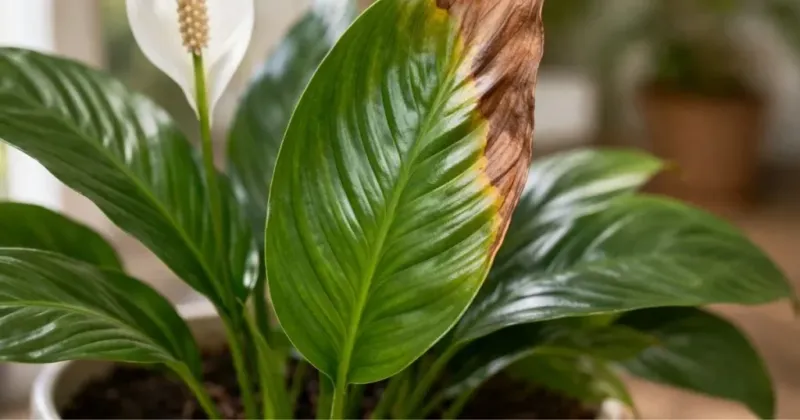
Brown leaf tips on a peace lily can send a homeowner straight to the watering can, and that instinct is worth following up on, but with some important qualifications. UF/IFAS Spathiphyllum production guidance notes that frequent drooping can lead to brown tips and edges, making repeated severe drying one watering pattern worth checking first.
That said, the same brown-tip symptom can also develop from saturated roots, fertilizer or mineral-salt buildup, low humidity, harsh light, cold or hot drafts, or poor water quality.
Letting a peace lily wilt dramatically before each watering is a common mistake, but calling it the usual or dominant cause of brown tips goes further than the evidence supports. NC State’s peace lily profile lists underwatering as one of several established causes, not the only one.
Extension diagnostic guides consistently describe brown tips as a nonspecific symptom, meaning the visible damage alone cannot tell you which stressor is responsible.
A safer starting point is this: replace emergency watering with a soil-based routine, water when the mix has begun to dry, and let excess drain completely. UC IPM’s houseplant problem guide reinforces that environmental and cultural causes are common, and that a methodical check of moisture, light, drainage, and other conditions is the most reliable path forward when browning persists.
Check the potting mix instead of following a calendar
Watering a peace lily on a fixed weekly schedule is one of the easiest habits to fall into, and one of the least reliable ways to keep the plant healthy. Drying speed depends on pot size, potting mix composition, light intensity, temperature, humidity, root mass, and the season, so a schedule that worked in March may leave the soil soggy by July or bone-dry by January when the heat runs constantly.
University of Maryland Extension’s indoor watering guide recommends checking soil moisture rather than following a calendar, and points out that peace lilies may wilt when they need water but that overwatered plants can also wilt. That overlap is the reason a drooping plant cannot reliably tell you whether it needs more water or less.
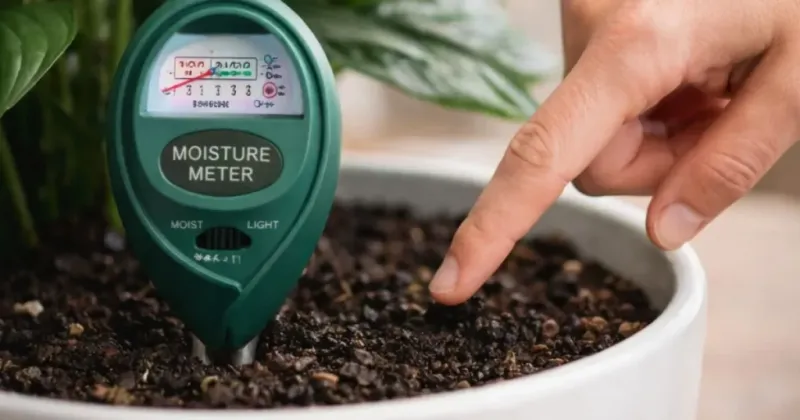
Pressing a finger an inch or two into the mix gives you actual information.
In Southern homes, air conditioning runs for months at a stretch, which can dry containers faster than expected, while a cool spell with lower light slows drying considerably. University of Illinois Extension’s houseplant care resource echoes the advice to observe how quickly your specific container dries under your specific conditions rather than relying on a general rule.
When the top inch or two of mix has started to dry out, that is a reasonable prompt to water, and checking consistently prevents the soil from swinging between soaking wet and completely dry.
Water thoroughly, then let the container drain
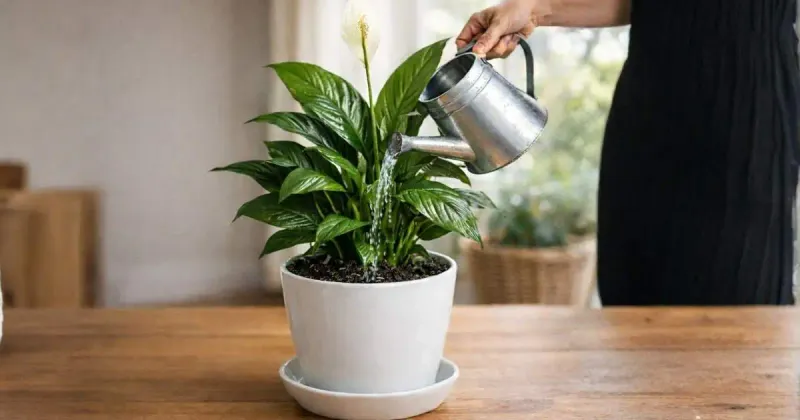
Once the potting mix has begun to dry and it is time to water, the method matters as much as the timing. Water from the top, moving slowly around the surface of the mix, and continue until water flows steadily from the drainage holes at the bottom of the container.
That steady outflow is the signal that the entire root zone has been moistened, not just the top layer.
University of Maryland Extension specifies thorough top-watering until drainage occurs, and UF/IFAS container plant guidance is explicit that Spathiphyllum should not sit in water. After the pot drains, empty the saucer or decorative cover completely.
Leaving roots standing in collected water for hours encourages root damage, which can ironically cause the same wilting and browning that underwatering causes.
A quick splash of water after a dramatic wilt is not the same as evenly rewetting the mix. Dry potting media can pull away from the sides of a container, allowing water to run straight down the gap and out the bottom before the root zone absorbs much at all.
University of Illinois Extension’s container watering guidance notes this channeling problem and suggests watering slowly or in passes to give the mix time to rehydrate. The goal is moist but not waterlogged media throughout the pot, and that result takes a deliberate pour, not a rushed one.
A wilted plant may recover while brown tissue remains
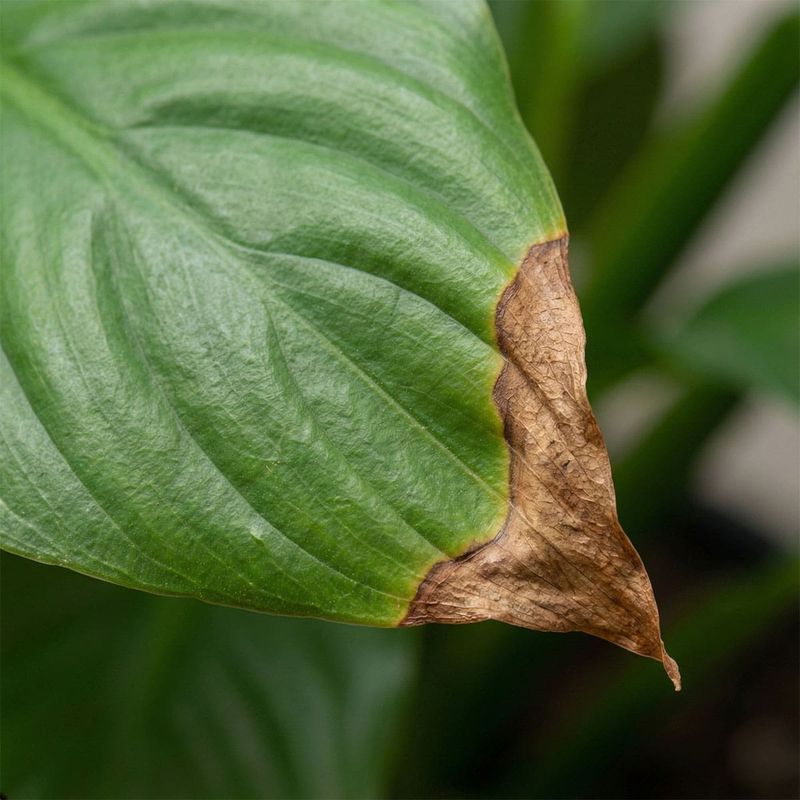
Watching a drooped peace lily perk back up after a thorough watering feels like a rescue, and in one sense it is. The plant has pulled water back into its cells and resumed normal function.
What that recovery does not do is restore the tissue that already turned brown.
Colorado State Extension’s leaf scorch resource documents that scorched or dried leaf tissue will not turn green again once the cells have been damaged. The brown tips stay brown regardless of how well the plant is cared for afterward.
UF/IFAS notes that a thoroughly watered plant may bounce back from a crash within hours, but that repeated drooping episodes can contribute to brown tips and edges over time, meaning each severe wilt carries a small cumulative cost.
Clean scissors or pruning shears can trim the brown portions away for a neater appearance, and that cosmetic step is worth taking if the damaged tips bother you. Just understand that trimming does not fix whatever caused the browning in the first place.
Judge the plant’s progress by new growth instead: fresh leaves that emerge green and healthy are a sign that current conditions may be working better, even if the older leaves still carry the record of past stress.
Persistent wet soil points to a different watering problem
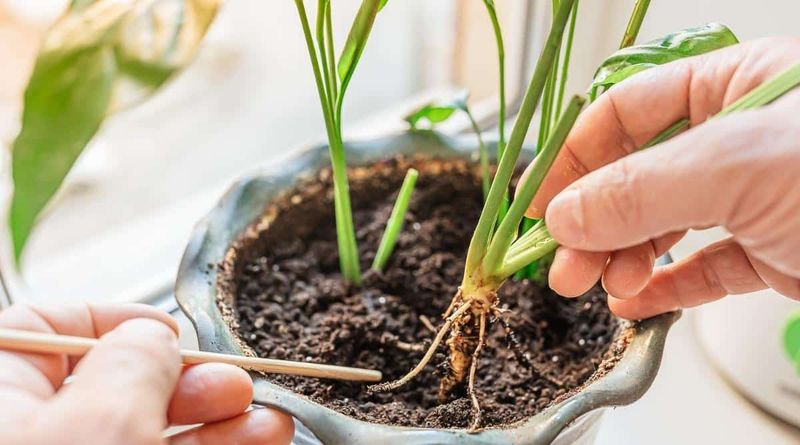
Some peace lily owners find that brown tips keep appearing even though they water frequently and the soil never seems to dry out. That pattern deserves a different diagnosis entirely, because persistently wet media create a different set of problems than dry ones.
Saturated potting mix reduces the oxygen available to roots, and roots that cannot breathe begin to break down.
Root damage from overwatering disrupts the plant’s ability to take up water, which can cause wilting, marginal browning, or even collapse that looks a lot like drought stress. University of Illinois Extension’s houseplant basics identifies soggy soil and poor drainage as common causes of houseplant decline, and UC IPM’s houseplant guide lists excessively wet soil alongside dry soil as a brown-tip trigger.
The fix for soggy roots is better drainage and less frequent watering, not more.
Check the saucer or decorative cover first: if water has been sitting under the pot between waterings, that is a straightforward correction to make. Then look at the drainage holes themselves to confirm they are open and unobstructed.
If the mix stays wet for a week or longer after watering, consider whether the pot is too large for the root mass, whether the mix has compacted and is holding water poorly, or whether the container lacks adequate drainage. Adding water to an already-saturated root zone will deepen the problem rather than solve it.
Check fertilizer and mineral salts for burned tips
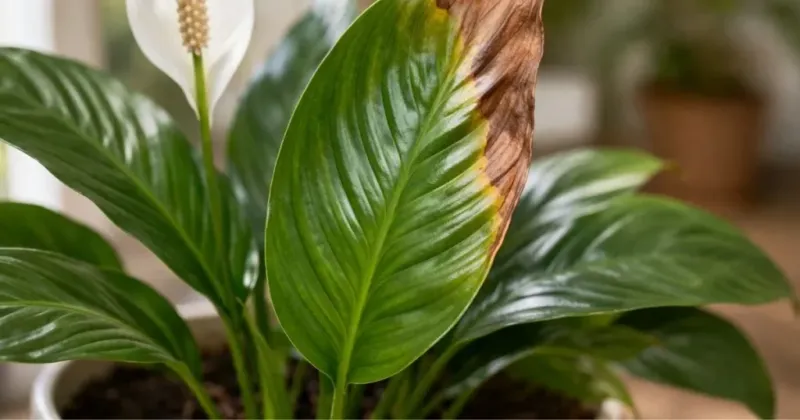
Fertilizer and mineral salts are worth investigating when brown tips appear despite consistent watering and good drainage. Dissolved salts from fertilizer or from tap water can accumulate in the potting mix over time and damage the fine root tips that absorb water and nutrients.
When those root tips are injured, the outer leaves and leaf tips are often the first places to show it.
University of Maryland Extension’s mineral deposit guide describes white or yellowish crusts on the soil surface or on the pot itself as a visible sign of salt accumulation, and lists brown tips, reduced growth, wilting, and damaged root tips as associated symptoms. UF/IFAS recommends using fertilizer at roughly one-quarter of commercial greenhouse strength for interior plants and warns that excess fertilizer burns both tips and roots.
When salt buildup is suspected, periodically flush the container with ample plain water, pouring slowly and allowing it to drain fully each time. University of Maryland Extension’s watering guide recommends leaching houseplants every four to six months and suggests using at least twice the pot’s volume of water, while its mineral-deposit page recommends at least three times the pot volume for a thorough flush.
Keep in mind that flushing addresses salt accumulation specifically. If the real cause of browning is drought stress, saturated roots, harsh light, low humidity, or drafts, flushing alone will not correct it, and a broader check of growing conditions remains necessary.
Review light, humidity, drafts, and water quality
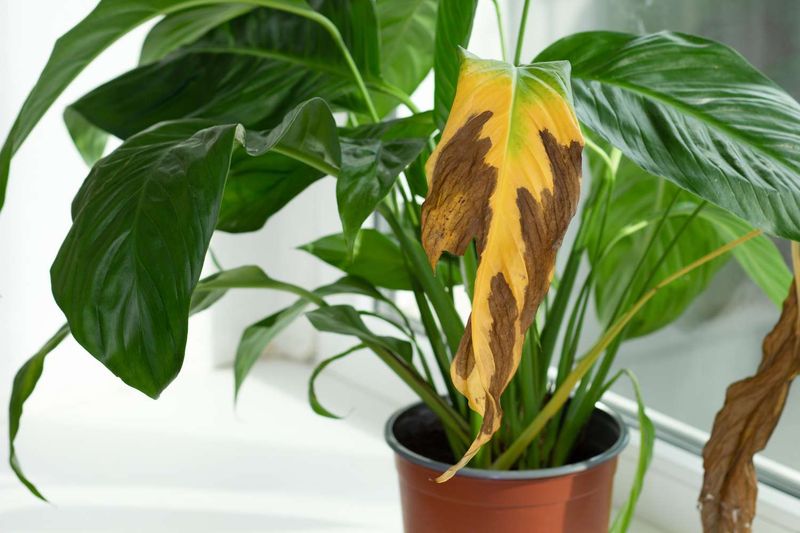
When moisture and drainage look appropriate but brown tips keep appearing, the next step is a systematic check of the plant’s immediate environment. Start with light: peace lilies prefer bright, indirect light, and placement near a south- or west-facing window in a Florida or Texas home can mean several hours of direct sun hitting the leaves.
NC State’s peace lily profile lists excessive direct sunlight as a cause of browning, and UF/IFAS reports that sun and temperature injury can produce burned margins and tips. If browning is accompanied by bleaching, curling, or damage across larger leaf areas rather than just the tips, moving the plant to a spot with filtered or indirect light is a reasonable first adjustment.
Drafts from air-conditioning vents, heating registers, and cold windows create localized stress that shows up as tip or edge damage. Check whether the plant sits in the direct airflow of a vent, especially in summer when central air runs steadily.
Low humidity is another realistic factor in air-conditioned and heated homes. Iowa State Extension notes that misting raises humidity only briefly and can encourage disease, so a humidifier or grouping several plants together provides more lasting relief.
UF/IFAS Baker County guidance also flags low humidity as a winter concern for indoor plants.
Water quality is a legitimate secondary factor for some households. Fluoride, sodium, chloride, and dissolved mineral salts from tap water can contribute to tip burn in sensitive container plants, as noted in NC State’s Extension Gardener Handbook.
However, not every tap water source causes problems, and not every pitcher filter removes fluoride. CDC fluoride data identifies fluoride as a dissolved water constituent with regulated concentrations, and letting water stand overnight reduces some chlorine but does not remove fluoride or dissolved minerals.
If water-quality injury is strongly suspected, check your filter’s specifications or consider distilled, reverse-osmosis, or suitable rainwater. Softened water is not automatically a better choice: University of Maryland Extension advises against softened water for houseplants because sodium-based softeners can add dissolved material rather than reduce it, a point reinforced by Penn State Extension’s irrigation water guide.
Healthy new growth can signal improving conditions
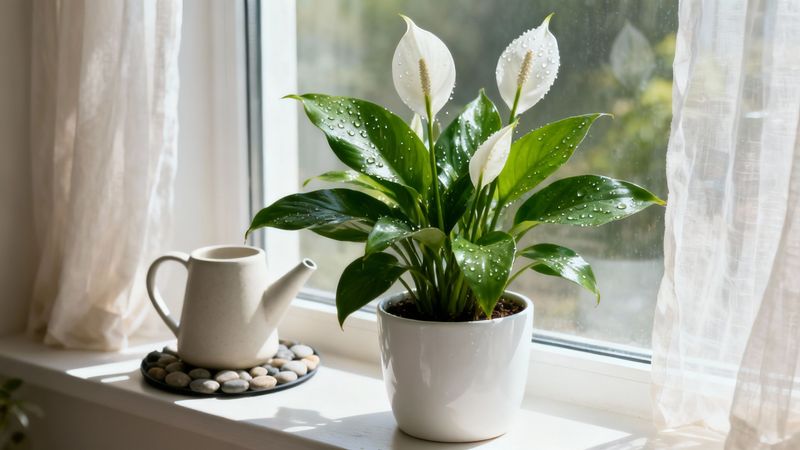
Once you have worked through the checklist, the most useful thing to watch for is what the plant does next. Check the potting mix before severe wilting occurs, water thoroughly when the top inch or two has started to dry, drain the container completely, and empty the saucer.
University of Maryland Extension and UC IPM both support this soil-based approach as more reliable than calendar watering or waiting for dramatic wilting.
Fresh leaves that emerge green and undamaged are a sign that conditions may be improving, not definitive proof that a single correction solved everything. University of Illinois Extension’s troubleshooting guide recommends continued observation rather than declaring success after one adjustment.
Old brown tissue will not recover; as Colorado State Extension documents, scorched leaf cells are gone for good, so judge progress by new growth only.
If fresh browning appears on new leaves, go back through the list: drainage, salt buildup, light, humidity, drafts, and water quality are all worth reassessing. A peace lily that keeps producing clean new leaves is telling you the environment has improved enough to support healthy growth, and that steady output matters more than any single dramatic recovery.