
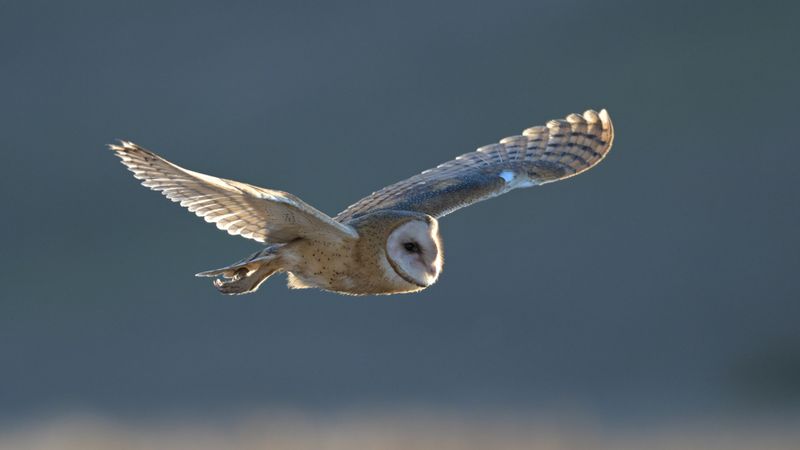
Pocket gophers can wreck a California yard fast, chewing through roots, collapsing irrigation lines, and leaving mounds of bare soil across a lawn you worked hard to establish. Barn owls have a real reputation as rodent hunters, and some homeowners are putting up nest boxes hoping to let nature handle the problem.
The idea has genuine science behind it, but the full story is more complicated than the popular version suggests. Understanding what owls can actually do, and what one common box placement problem looks like, helps you make a smarter decision before you spend money on a box or wait for an owl that may never arrive.
Barn owls may help, but they are not a guaranteed gopher cure
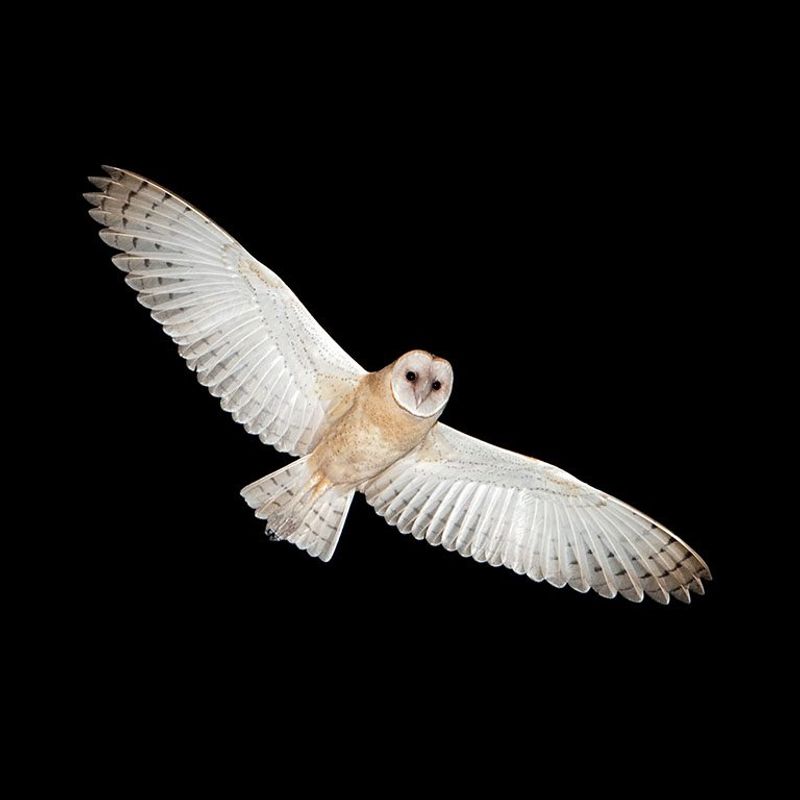
Barn owls are genuine gopher hunters. In California agricultural settings, researchers have found pocket gophers among the owls’ most common prey, and UC Agriculture and Natural Resources notes that in one California diet study, 99.5% of identified prey items were classified as agricultural pests.
That is an impressive statistic, but it describes what owls eat, not what a nest box will do for your yard.
Eating gophers and reducing gopher damage are two different things. An owl that hunts across a large open territory may consume dozens of rodents a week without making a dent in the population living under your garden beds.
UC IPM is direct about this: nest boxes are unlikely to reduce gopher numbers enough to prevent plant and irrigation damage in small areas such as yards. The owls are real, the predation is real, but the yard-level result is not guaranteed.
A peer-reviewed analysis, Gopherbusters: A Review of the Candidacy of Barn Owls as the Ultimate Natural Pest Control Option, concluded that California evidence was insufficient to prove sustained rodent control by barn owls alone. That does not mean a box is useless.
Across a suitable open landscape with adequate prey and hunting habitat, a nest-box program may support natural rodent control over time.
The practical takeaway for a California homeowner is this: a nest box may be a worthwhile addition to a broader pest-management plan, but it should not replace immediate action when gophers are actively damaging your plants or irrigation. Owls are a long-game ecological tool, not an overnight fix.
Why vineyard results do not transfer neatly to a backyard
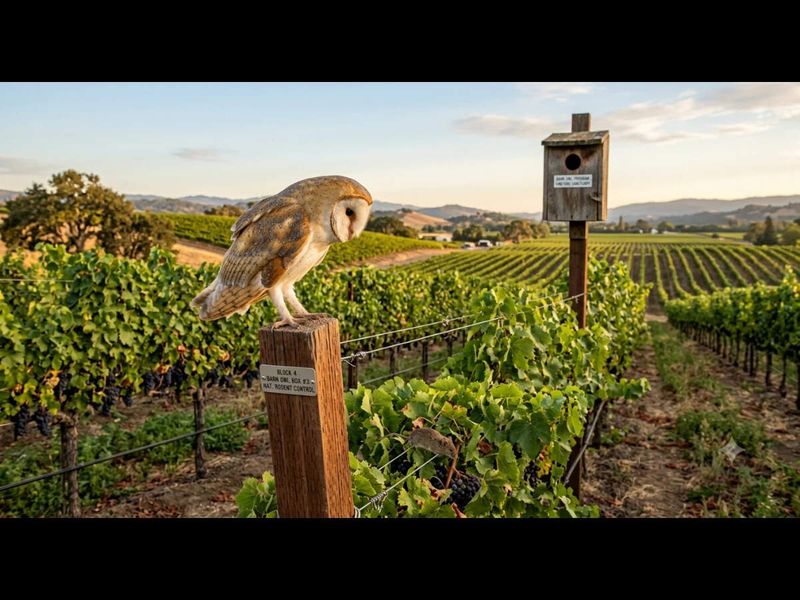
Much of the strongest California evidence for barn owl predation on gophers comes from large agricultural operations, not residential properties. A California vineyard study tracking prey consumption by a large barn owl aggregation found that pocket gophers and California voles made up the majority of prey delivered to nestlings.
The study’s cost estimate suggested a lower cost per rodent removed by owls compared with trapping, which sounds compelling until you read the fine print.
That vineyard covered roughly 40 hectares, and trapping and poisoning were suspended during the study period. Removing competing control methods and scaling up to a large agricultural landscape creates conditions that simply do not exist in a typical quarter-acre backyard.
Presenting that cost comparison as proof that owls beat every trap in every yard would misrepresent what the research actually measured.
Barn owls also do not confine their hunting to the area around the box. They range across broad territories and shift toward whichever prey happens to be most available at a given time.
A box in your yard does not guarantee the owl hunts your yard. Habitat around the box matters enormously.
Research published in a peer-reviewed journal on habitat selection by barn owls in a Napa Valley vineyard agroecosystem found that surrounding uncultivated habitat influenced nest-box selection and owl use. The box alone was not the deciding factor.
Open hunting space, prey density, and landscape context all shaped where owls chose to nest and forage.
For a homeowner with a small yard bordered by fences, buildings, and ornamental plantings, those conditions are hard to replicate. UC IPM’s conclusion stands: owls are not a reliable standalone solution for yard-level gopher control, and vineyard findings should not be treated as a promise that applies to every California property.
A common placement problem is obstructed flight access or weak predator protection
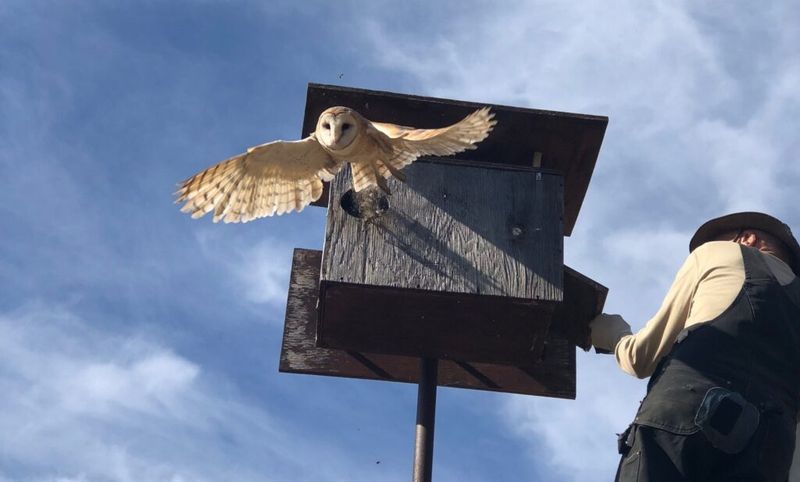
Among the documented reasons barn owl boxes go unused, two stand out consistently in the guidance literature: obstructed flight access and inadequate protection from predators. Neither one is a guarantee that owls will stay away, but both reduce the odds that a box will attract and hold a nesting pair.
A box tucked into a dense stand of trees or surrounded by branches on all sides creates a problem before any owl even shows up. Utah State University Extension guidance on attracting wildlife for farmland pest control recommends placing boxes away from large tree stands and locating them where owls have a clear, unobstructed approach.
Barn owls are low-flying hunters. They need open space to approach and depart without threading through canopy.
Branches are also a predator highway. Raccoons, snakes, and cats can use overhanging limbs to reach a box mounted in or near a tree, threatening eggs, nestlings, and incubating adults.
California Department of Pesticide Regulation guidance on owl boxes for biological pest management favors a stand-alone pole placement in appropriate settings, paired with a predator guard or metal baffle that prevents climbing animals from reaching the box.
The contrast between a hidden, vulnerable placement and an open, protected one is fairly clear on paper. In practice, many homeowners mount a box on a fence post near a shrub border or on a tree limb near the house and then wonder why it sits empty.
The flight path and the predator exposure are the first things to evaluate, not the last.
Fixing those two problems still does not guarantee occupancy. Owls are selective, territories overlap unpredictably, and a well-sited box in a neighborhood with few open hunting areas may simply not attract a pair.
Good placement improves the odds; it does not write a contract.
Build a site around open hunting space, shade, and local exposure
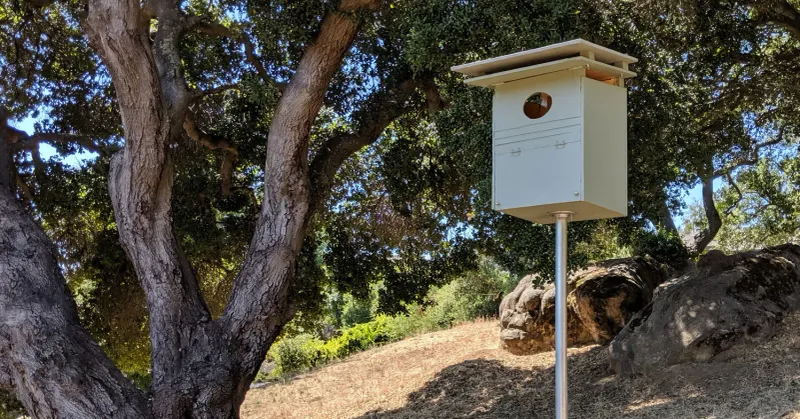
Choosing a spot for a nest box works better as a checklist than as a recipe, because no single compass direction or height applies to every California property. Start with the big picture: the box needs to overlook open hunting habitat.
Low grass, open ground cover, and minimal dense shrub cover give owls the visibility and maneuverability they need to hunt effectively at night.
Height guidance from the two most-cited California and regional sources lands in a similar range but differs slightly. California DPR guidance recommends a height of about 10 to 12 feet, an open location, and afternoon shade, with the entrance facing away from prevailing winds.
Utah State University Extension suggests 15 to 30 feet where feasible and recommends locating boxes away from large tree stands and busy roads. Both sources agree that open access and wind protection matter; they differ on orientation because local conditions vary.
On orientation, California guidance emphasizes facing the entrance away from the direction of prevailing winds to reduce chilling drafts on nestlings. Utah guidance leans toward north or east to limit afternoon heat buildup inside the box.
Neither is wrong. In California’s inland valleys, afternoon heat can be punishing, so shade and ventilation deserve as much attention as compass heading.
Check your local prevailing wind direction and the afternoon sun angle before you commit to an orientation.
Keep the box away from busy roads. Owls hunting near traffic face collision risk, and road noise may discourage use.
Distance from large tree stands reduces both predator access and flight obstruction. A clear, low-obstacle approach path from at least one direction is more important than hitting an exact height or bearing.
Think of the checklist as: open habitat nearby, clear flight path, wind protection, afternoon shade or ventilation, predator-guarded pole, and reasonable distance from roads and dense vegetation. Checking all of those boxes gives a nest box its best realistic chance of being chosen.
Protect the nest after an owl chooses it
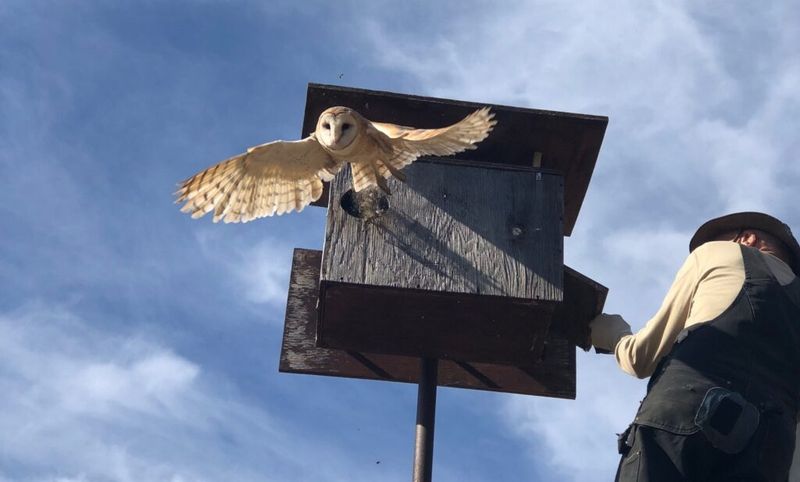
Once a pair of barn owls claims a box, the homeowner’s role changes. The most important rule is simple: do not open or disturb an active nest.
Owls can abandon eggs or young if the nest is disrupted, and barn owls are protected under California and federal law. Leave the box alone from the time nesting begins through fledgling departure.
California DPR guidance on owl boxes recommends cleaning boxes between mid-August and November, after the breeding season ends and before the next nesting cycle begins. When you do clean, wear gloves and a mask.
Owl pellets and debris can carry pathogens, and the accumulation in a used box can be substantial after a full breeding season.
A used box also comes with some side effects worth knowing before you put one up. UC Cooperative Extension guidance on barn owls and raptors notes that boxes generate noise during nesting, along with droppings, pellets, and prey remains below the box.
Owlets are vocal, adults are active at night, and the area under a busy nest box can get messy. Placing the box away from your home’s entry, outdoor seating areas, and driveways reduces the nuisance impact without sacrificing owl habitat.
Predator protection does not end at installation. Check the metal baffle or predator guard periodically to make sure it has not shifted, rusted, or been bypassed.
USU Extension notes that raccoons and other climbing animals are persistent, and a guard that worked at first may need adjustment over time. Keeping the pole clear of nearby branches and structures is an ongoing task, not a one-time fix.
Active gopher damage still calls for immediate control
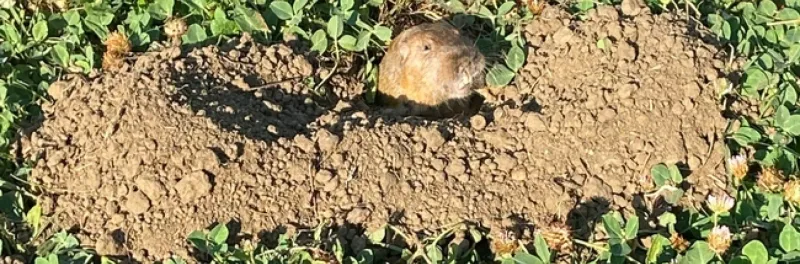
Gophers work fast. A single animal can push up multiple mounds in a day, sever drip irrigation lines, and kill established plants by destroying their root systems before most homeowners realize what is happening.
Waiting for a nest box to attract a pair of owls, and then waiting for those owls to reduce the local gopher population, is not a practical response to that kind of active damage.
UC IPM’s pocket gopher guidance is clear: when gophers are causing damage, use immediate control rather than relying on predators to arrive and take effect. Properly set traps can be placed and checked within days, and a single gopher causing rapid damage in a small yard is exactly the scenario where trapping is most appropriate and effective.
Trap placement matters. UC IPM recommends locating the main tunnel by probing near a fresh mound, then setting two traps facing opposite directions inside the tunnel so the gopher encounters a trap regardless of which direction it travels.
Wire each trap to a stake so a caught gopher cannot pull it deeper into the tunnel. Cover the opening to block light, since gophers often respond to light by pushing soil to seal the entrance, which can dislodge an unset trap.
Check traps frequently, ideally within 24 hours of setting them. If there is no catch after one or two days, relocate the trap to a fresh active tunnel rather than leaving it in place and hoping.
Where children or pets have access to the yard, use a covered trap box or block trap access with a wire cage to prevent accidental contact.
Trapping and an owl box are not mutually exclusive. UC IPM and UC ANR both frame barn owl nest boxes as one component of integrated pest management, not a competing approach.
Address the active damage now with trapping, and consider the box as a long-term ecological addition once the immediate problem is under control.
Use the owl box as one part of safer pest management
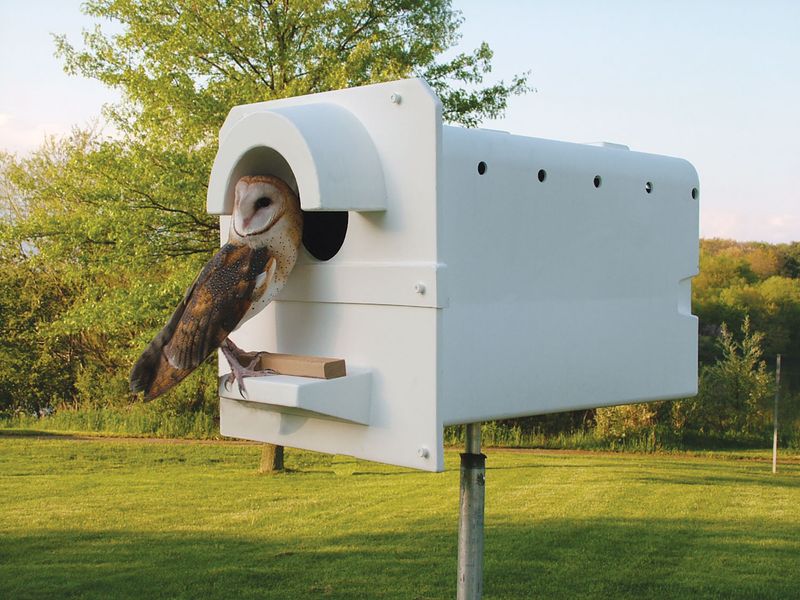
Putting up a nest box and then reaching for a bag of rodent poison is one of the more counterproductive things a California homeowner can do. Barn owls eat rodents that have eaten bait, and that pathway exposes the owls to whatever the rodents consumed.
California Department of Fish and Wildlife wildlife health investigations report that roughly 70 to 90 percent of tested raptors showed exposure to second-generation anticoagulant rodenticides through poisoned prey. A nest box does not protect an owl from that exposure; it concentrates the owl in the area where the poisoning is happening.
Integrated pest management offers a more defensible path. UC Agriculture and Natural Resources recommends treating barn owl nest boxes as one component of a broader management plan rather than a standalone solution, and that framing applies equally to avoiding practices that undermine the owl’s safety.
Careful box placement, predator protection, habitat modification such as reducing dense cover that shelters rodents, and trapping for urgent problems all fit together without putting a nesting owl at risk.
If a rodenticide feels necessary for a severe infestation, consult a licensed pest control professional about label-compliant options that carry lower secondary toxicity risk, and keep that use away from areas where owls or other raptors are known to hunt. UC IPM does not recommend poison as a first response for typical residential gopher problems and favors trapping as the more targeted, wildlife-safer choice.
A nest box installed thoughtfully, sited in open habitat, protected from predators, and paired with responsible trapping when needed can provide genuine long-term ecological value. Barn owls that nest successfully in a yard may reduce rodent pressure across the surrounding landscape over multiple seasons.
That is a realistic and worthwhile outcome. It just takes longer than a trap set on a Tuesday, and it works best when you do not poison the very prey the owls depend on to survive.