
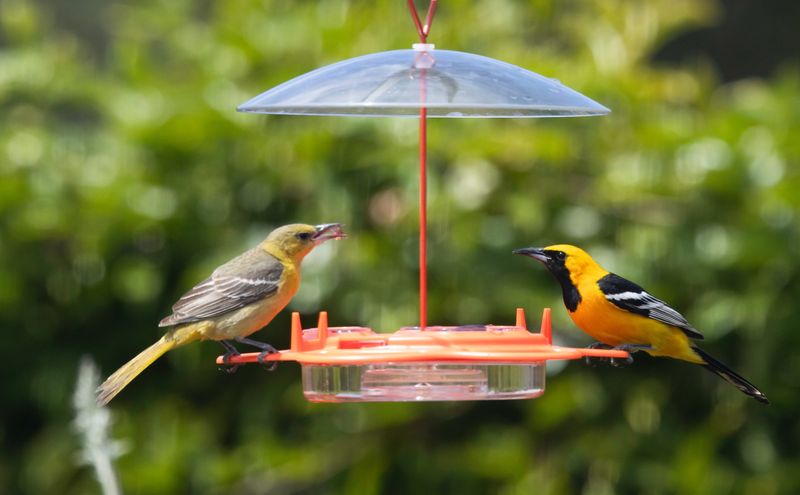
A flash of yellow and black moving through your citrus or fig tree is not just a pretty sight. Hooded Orioles are active foragers that search foliage for insects, and a bird working through your canopy may be doing more than passing through.
California homeowners sometimes discourage these visitors without realizing it, often through a single feeder habit that makes the station unsafe or unappealing. Understanding what the bird actually does, and what it genuinely needs, helps you make smarter choices for your yard and your fruit trees.
Hooded Orioles search the canopy for insects
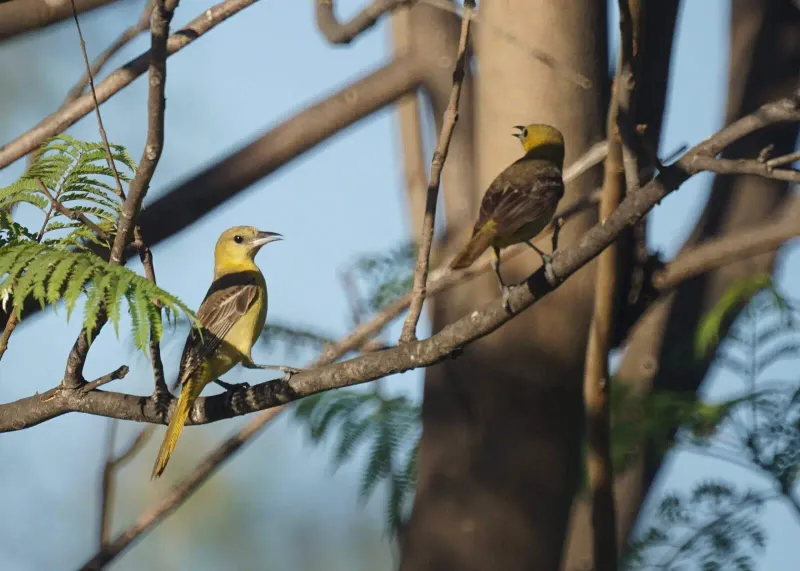
Watch a Hooded Oriole work through a tree and you will notice something methodical about it. The bird moves branch by branch, pausing to peer at the undersides of leaves, probing bark crevices, and picking off small insects that most casual observers never spot.
Cornell Lab’s life-history account for the Hooded Oriole describes the species as a foliage gleaner that collects caterpillars, beetles, ants, wasps, and other arthropods from leaves, branches, and flowers. Spiders and larvae are also part of the diet.
Nectar and fruit round out what the bird eats, and those food sources can lead it to flowering plants, feeders, and cultivated trees. But the insects come first in California.
California Department of Fish and Wildlife’s wildlife account for the species identifies insects as the primary food, with fruit and nectar also significant during summer months.
A Hooded Oriole visiting a fruit tree is not necessarily after the fruit. It may be hunting the insects living in and on the foliage, making the tree a food source in a way most homeowners do not picture.
Audubon’s field guide entry confirms that the species takes a wide range of arthropods and occasionally eats cultivated fruit as well, so the same bird can be both a forager and, at times, a fruit consumer.
Recognizing the foraging pattern matters because it changes how you think about the bird’s role. A Hooded Oriole gleaning insects from your lemon tree is doing something ecologically real, even if the scale of any pest-control benefit is hard to measure from your backyard.
That distinction, between genuine foraging behavior and a guaranteed pest-control outcome, is where realistic expectations begin.
Their pest-control value is possible, not guaranteed
Broader research does support the idea that insect-eating birds can reduce arthropod populations in orchard and farm settings. A review published in Pest Management Science found evidence that birds can suppress arthropod pest pressure in agricultural systems.
A separate study in Agriculture, Ecosystems and Environment documented measurable reductions in pest damage in plots where bird foraging activity was higher.
Those findings apply to bird communities generally, not to Hooded Orioles specifically. No published study has measured what Hooded Orioles do to pest populations in California residential orchards, and the research that does exist tends to examine multiple bird species working together across larger agricultural landscapes.
A meta-analysis in PLOS ONE found that bird predation reduced herbivore numbers in many study systems, but the effect varied widely depending on bird diversity, pest type, and habitat context.
A UC Davis review of birds as integrated pest management agents, summarized by Karp and colleagues, also noted that birds can cause fruit damage alongside any pest-suppression benefit. Hooded Orioles are no exception.
Audubon’s species account notes that the bird sometimes eats cultivated fruit, which means welcoming it into your yard involves accepting that trade-off.
The practical takeaway is that a Hooded Oriole foraging through your fruit trees may contribute to a healthier garden ecosystem, but it is not a substitute for identifying what pest you actually have and managing it with targeted methods. Counting on any single bird species to protect a harvest is not a strategy the evidence supports.
Treat the possible pest-suppression effect as a welcome bonus, not a guaranteed service.
Spoiled food can make a feeder unsafe or unsuitable
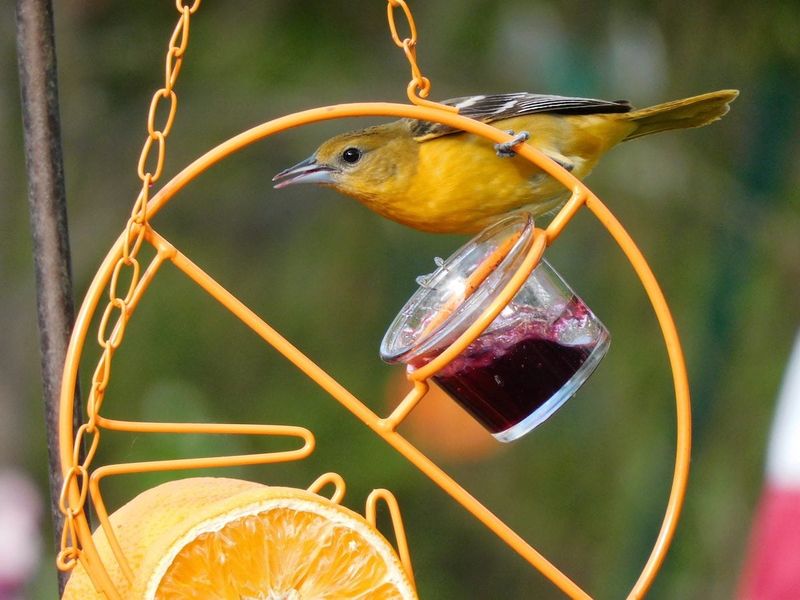
Leaving nectar or fruit in a feeder past its useful life is the habit most likely to make the station unsafe or unappealing. Nectar that turns cloudy, develops a sour smell, or shows any visible film has already begun to ferment.
Fermented sugar water can carry harmful microbial growth, and a bird that drinks it is exposed to something that was meant to be a food source.
Birds Canada’s oriole feeding guidance recommends replacing nectar every two to three days at minimum, and more often during warm weather, because heat accelerates the fermentation process. An orange half left on a feeder tray past the point of freshness presents the same problem: once it dries out or develops mold, it is no longer an attractive food item and may expose visiting birds to fungal growth.
Audubon’s guide to attracting hummingbirds and orioles also cautions against leaving nectar out until it deteriorates, emphasizing that cleanliness is the most important factor in maintaining a safe feeding station. When food goes bad, the right response is to discard it entirely, scrub the feeder with hot water, and start fresh.
Topping off old nectar with new solution does not fix the underlying problem; it just dilutes it.
No published experiment has directly measured whether Hooded Orioles abandon a specific feeder because of spoiled nectar, so the behavioral claim should stay qualified. What is clear is that deteriorated food creates a health risk and makes the station less suitable.
Cornell Lab’s Hooded Oriole species page also notes that moldy fruit should be discarded promptly. Feeder color, red dye, and feeder type are not the issue here; fresh food and a clean container are.
A feeder requires a small, clean, optional routine
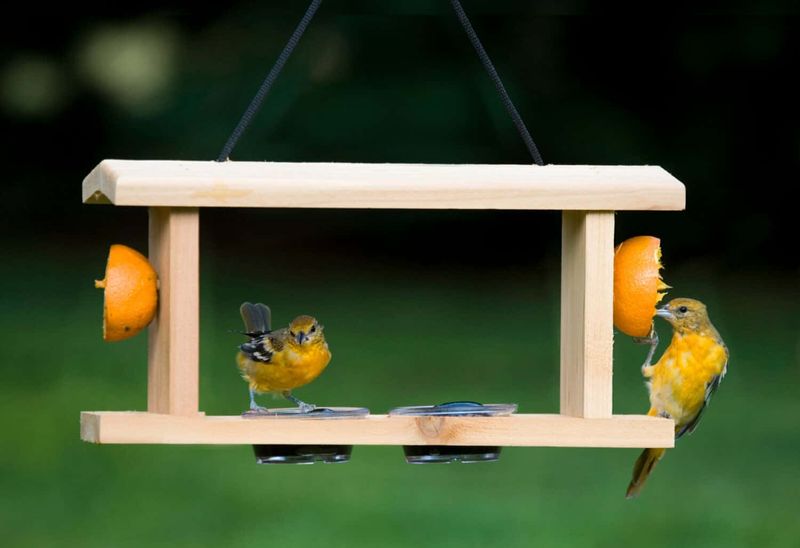
If you decide to offer food, the recipe is straightforward: one part plain white granulated sugar dissolved in four parts water. Cornell Lab’s Hooded Oriole page gives this as the standard sugar-water ratio.
Skip honey entirely. Birds Canada’s feeding guide explains that honey can promote bacterial and fungal growth and is not appropriate for oriole or hummingbird feeders.
Red food coloring is also unnecessary; authoritative bird-feeding sources recommend avoiding it because it adds nothing useful.
Make small batches so you are not storing large quantities of sugar water in hot weather. Keep the feeder in a shaded spot when you can, since shade slows fermentation.
Replace the nectar every two to three days, or sooner if temperatures are high, and scrub the feeder with hot water before each refill. Audubon’s attracting guide reinforces that regular cleaning, not just refilling, is what keeps a station safe.
Fresh orange halves can attract orioles, but pull them before they dry out or show any mold.
Oriole feeders with larger openings and sturdy perches are easier for the bird to use than narrow hummingbird feeders, though Hooded Orioles are known to use hummingbird feeders when nothing else is available. Perch stability matters more than feeder color.
Before setting up any feeder, consider that California Department of Fish and Wildlife’s Wildlife Health Lab recommends against providing artificial food or water to wild birds because feeders and birdbaths can increase close contact and disease transmission among wild populations. That is a real concern, not a minor footnote.
If you maintain a feeder, treat sanitation, small quantities, low crowding, and prompt removal of spoiled food as non-negotiable. A feeder is optional; if keeping it clean feels difficult to sustain, habitat is a more ecologically sound alternative.
Habitat offers a durable alternative to sugar water
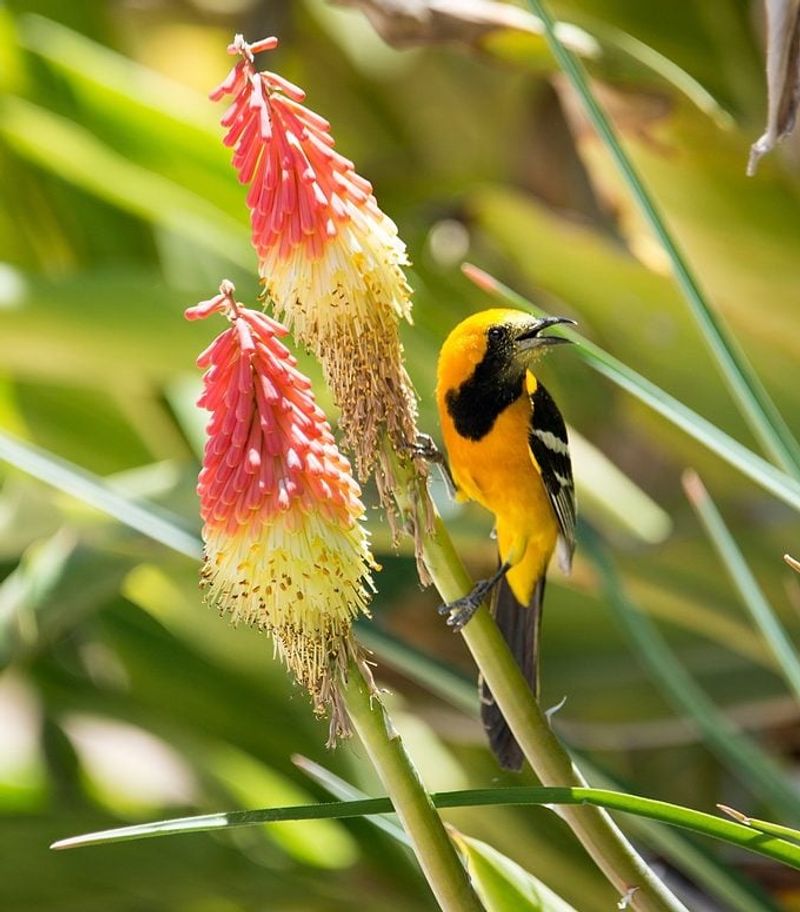
A well-planted yard can support Hooded Orioles without requiring any feeder at all. The species uses tall trees, riparian vegetation, palms, sycamores, willows, cottonwoods, live oaks, and eucalyptus for foraging, perching, and nesting.
California Department of Fish and Wildlife’s species account describes the Hooded Oriole as closely associated with these taller trees and with the insect-rich foliage they produce. A yard that retains or adds even one or two of these trees provides something a feeder cannot: actual foraging habitat and potential nesting structure.
Flowering plants also matter. Hooded Orioles visit flowers for nectar and for the insects that congregate around blooms.
Native flowering shrubs, salvias, penstemons, and other plants that attract pollinators also attract the arthropods the oriole is hunting. Audubon’s yard-bird attraction guide recommends flowering plants and insect-rich vegetation as core elements of any yard designed to support orioles and related species.
Fruit trees fit into this picture, but they are not the whole picture. An orange or fig tree provides foraging opportunities and some shelter, but a yard that also includes taller canopy trees and diverse flowering plants gives the bird more of what it needs across the season.
Relying on fruit trees alone, especially if they are regularly treated with pesticides, may not create the kind of habitat that keeps insect-eating birds returning.
Habitat also sidesteps the disease-transmission concern tied to feeders. A functioning insect community, a mix of native and adapted plants, and a canopy layer that provides shade and nesting sites can support orioles year after year without the maintenance burden or the public-health trade-off that a sugar-water station carries.
That is what makes habitat a more durable ecological strategy, not a minor upgrade to what a feeder already does.
Protect the bird without abandoning pest management
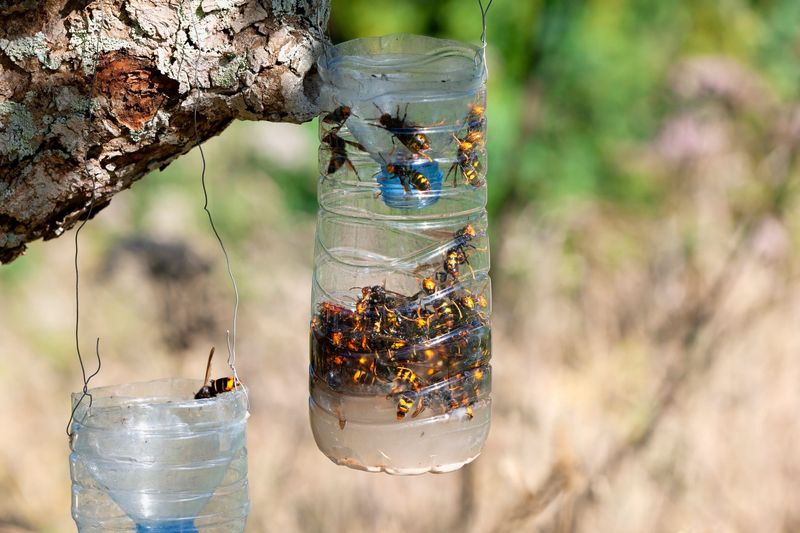
Real pest problems on fruit trees still need real solutions, and the presence of foraging birds is not a reason to tolerate an infestation that is damaging your harvest. The goal is to manage pests in ways that do not undermine the ecological benefit the birds may be providing.
UC IPM’s integrated pest management overview lays out the standard sequence: identify the pest accurately, use physical or cultural controls first, and reach for a treatment only when the pest pressure is high enough to justify it.
Physical controls include things like hand-removing egg masses, pruning out infested branches, using sticky barriers on trunks, or covering fruit with exclusion bags. Cultural controls include timing irrigation to reduce conditions that favor certain pests, cleaning up fallen fruit, and choosing pest-resistant rootstocks or varieties.
Many fruit-tree problems can be managed at a tolerable level through these methods alone, which means fewer chemical inputs and less risk to birds and other beneficial organisms.
When a treatment is necessary, the choice of product matters. UC IPM’s guidance on protecting natural enemies and pollinators recommends selecting the least-toxic, most targeted option available, following label directions precisely, and applying treatments when pollinators and foraging birds are least active.
Broad-spectrum or persistent insecticides can kill the arthropods that birds are hunting, removing a food source and potentially harming birds that eat contaminated prey.
Systemic pesticides present a separate concern. Products that move into plant tissues can end up in flowers and nectar, exposing any bird or insect that visits the bloom.
EPA guidance on reducing pesticide impacts on wildlife advises avoiding systemic treatments on flowering plants when possible and reading labels carefully for food-crop restrictions and application timing. Audubon’s attracting guide also notes that birds foraging near treated trees can ingest contaminated insects.
The answer is not to ban every treatment, but to treat deliberately and protect the insects and birds that make your yard ecologically functional.
The advice depends on where the yard is
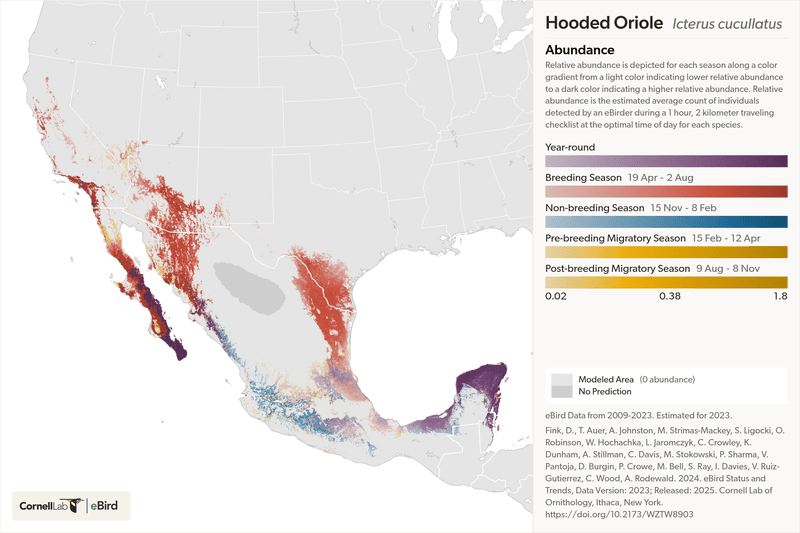
Hooded Orioles are not uniformly present across every state that claims them. In California, they are primarily summer residents, with most birds arriving around March and departing by mid-September, though local timing varies by latitude, elevation, and year.
California Department of Fish and Wildlife’s species account describes the statewide pattern as a breeding summer presence, not a year-round one. A few individuals may overwinter in the southernmost parts of the state, but expecting a Hooded Oriole at a feeder in January is not a realistic goal for most California yards.
Outside California, the species is associated with the Southwest and parts of Texas and Mexico. Audubon’s field guide and USGS range data both show the core U.S. range centered on California, Arizona, New Mexico, and southern and western Texas.
The species is more regionally concentrated than many people assume. Cornell Lab’s range maps confirm that Texas relevance is strongest in the southern and western portions of the state, not statewide.
Florida is a different matter. The Florida Ornithological Society’s checklist classifies Hooded Oriole as a review species, meaning any sighting requires documentation for the record to count.
It is not a routine backyard bird across Florida, and Florida gardeners reading general oriole advice should not assume it applies to their yards without checking local records first.
For California homeowners, the seasonal gap is worth planning around. A missing bird in October or February is almost certainly a migratory absence, not a feeder problem.
Adjusting habitat and pest management for the months when the birds are actually present makes more practical sense than maintaining a feeder year-round.
Keep feeder food fresh, but set realistic expectations
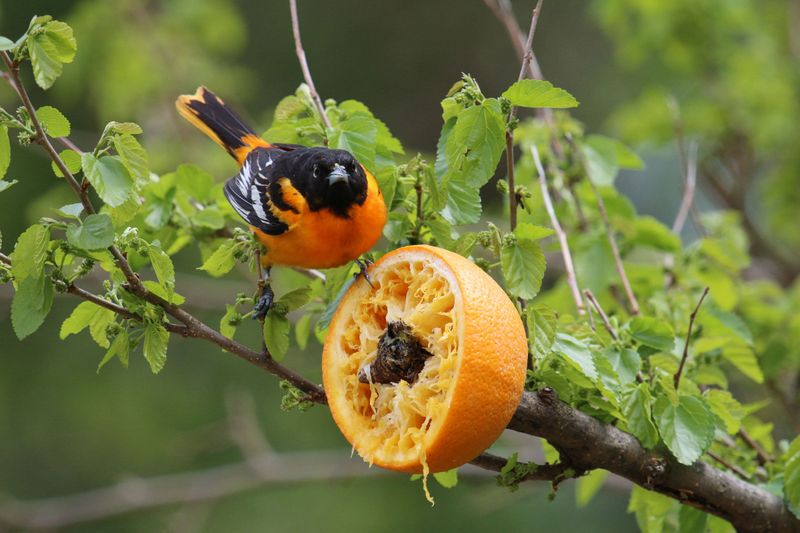
Fresh food and a clean feeder are better than spoiled nectar or dried-out fruit, full stop. If you maintain a station, replace the nectar on schedule, pull fruit before it deteriorates, and scrub the container before refilling.
Cornell Lab’s Hooded Oriole page and California Department of Fish and Wildlife’s Wildlife Health Lab both point in the same direction: sanitation protects the birds and reduces disease risk at gathering points.
No feeder is required. A yard with suitable trees, insect-rich foliage, and cautious pest management may attract foraging Hooded Orioles on its own.
UC IPM’s integrated pest management framework gives you the tools to manage real fruit-tree problems without dismantling the ecological conditions that support insect-eating birds.
Expect a possible contribution to natural pest suppression, not a guaranteed pest-free harvest or a larger crop. The bird is a real forager doing real work in your canopy.
That is worth appreciating on its own terms, without inflating it into something the evidence cannot support. A yard that works with seasonal visitors rather than depending on them tends to stay healthier long after the orioles head south.