
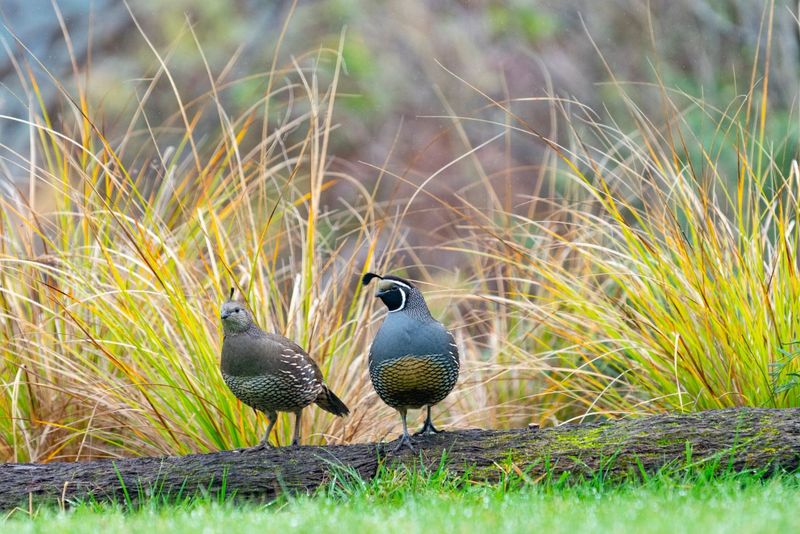
Spotting a group of California quail scratching through your garden is one of those backyard moments that stops you in your tracks. These plump, topknot-wearing birds move together in tight social groups called coveys, and when they show up in numbers, it usually means your yard is quietly offering something they need.
Understanding what draws them in, and what they are actually doing there, helps you support them safely without accidentally making things harder for the birds or yourself.
First confirm what kind of quail you are seeing
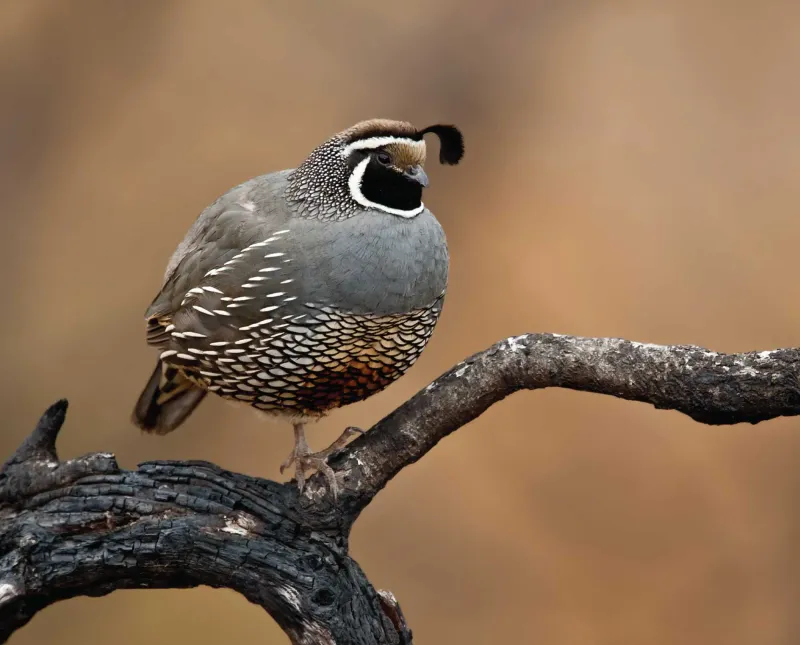
Before drawing conclusions about which species has moved into your yard, take a closer look at the birds themselves. A group of quail in a California backyard is most likely a California quail covey, but readers in southeastern California, especially in desert communities near the Colorado River corridor, should also consider Gambel’s quail.
The two species look similar at a glance, and the advice that follows applies specifically to California quail, so a confident identification matters before you act on species-specific guidance.
California quail males carry a distinctive forward-curving black topknot plume, a black face framed by white lines, and a scaled pattern across the belly. Females are less boldly marked but share the scaled belly and a shorter, brownish plume.
Audubon’s California quail field guide includes photographs and range maps that make it easier to confirm what you are seeing. Gambel’s quail males also carry a topknot, but their belly scaling is less pronounced and they typically show a rusty crown and a dark belly patch.
The ranges of the two species do overlap in parts of Southern California, so geography alone does not settle the question.
The group you are watching is almost certainly a covey, which is a social flock that California quail form outside the breeding season and maintain loosely even during it. Cornell Lab’s California quail life history account describes coveys as the bird’s normal social unit, not an unusual gathering.
Seeing several birds together is expected behavior, not a sign that something unusual has happened in your yard. And one more thing worth clearing up early: a covey visiting your garden is not the same as a group of quail nesting together, a distinction the rest of this article will explain fully.
CDFW’s quail identification guidance can also help you distinguish California quail from related species found across the state.
The yard probably offers a connected habitat patch
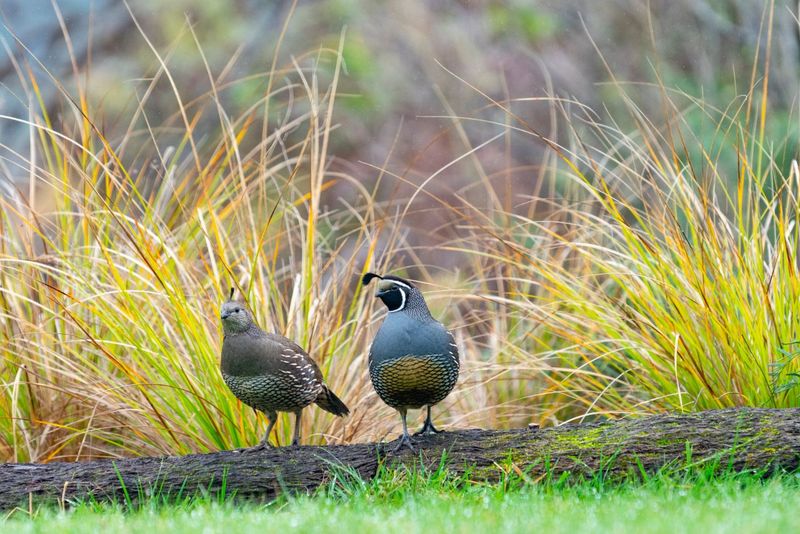
When a covey of California quail starts using your yard regularly, the most likely explanation is that your property happens to combine several things the birds need within a short distance of each other. Quail are not responding to one standout feature.
They are responding to a combination of low protective cover, nearby open ground for scratching and feeding, and accessible water, all placed closely enough together that the birds can move between them without crossing large exposed areas.
California quail are habitat-mosaic birds. CDFW’s California quail life-history account describes their preferred landscape as a patchwork of shrubs, grasses, forbs, and open ground rather than any single uniform planting.
A yard that happens to sit beside a brushy fence line, a neighbor’s dense shrubs, or a remnant wildland edge may function as one piece of a larger connected habitat corridor that the covey travels through on a regular circuit.
Quail presence is evidence of use, not a complete ecological report card. Research published in the Journal of Applied Ecology on urban habitat suitability for California quail found that persistence in urban settings depends on surrounding habitat connectivity and landscape context, not just on what one yard provides.
A covey might visit briefly to drink, forage for an hour, and move on, or it might return daily if the resources are reliable. Either way, the birds are telling you that your yard fits into a broader habitat network, which is genuinely useful information for anyone who wants to maintain or improve what the property offers.
CDFW’s guide to quail habitat also emphasizes that the arrangement of resources matters as much as their presence. Cover next to open foraging ground is more useful than the same two features separated by a wide lawn or bare bed.
If your yard is drawing a covey, the geometry of what you have planted, cleared, or left alone is probably doing more work than any single plant or feeder.
Quail need feeding ground beside protection
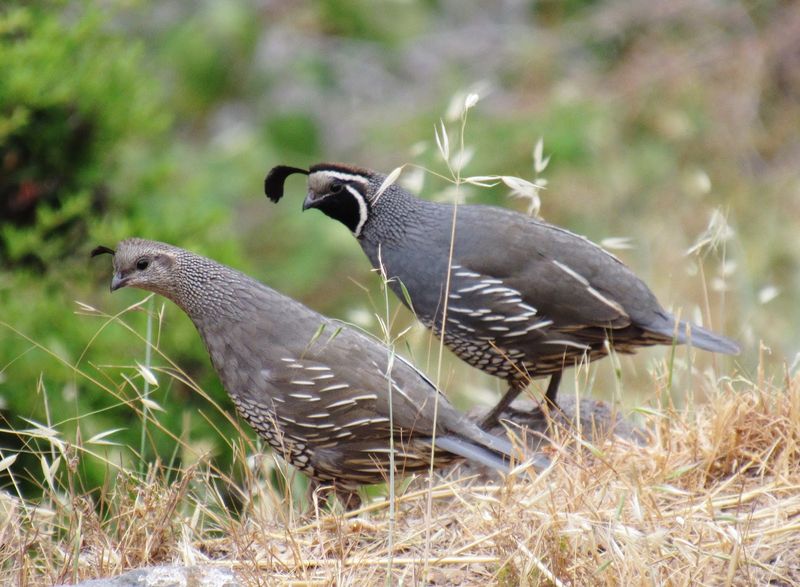
Watch a covey feed for a few minutes and you will notice they rarely stray far from the nearest shrub. California quail are ground foragers that scratch through leaf litter, loose soil, and low vegetation for seeds, green shoots, berries, acorns, and flower parts.
Chicks depend heavily on arthropods, particularly small insects, in their first weeks of life, so a yard with some insect activity in the leaf litter or soil is providing food that a birdseed feeder simply cannot replicate.
CDFW’s California quail life-history account notes that the birds seldom venture more than about 15 to 30 meters from cover, and a related CDFW quail habitat guide puts the figure closer to 20 yards during fall and winter. The practical meaning of those numbers is straightforward: quail will not cross a large open lawn to reach a feeder or water source on the far side.
Open foraging space needs to sit right beside the shrubs, not across an exposed gap.
The useful yard structure is a layered patchwork rather than a single uniform planting. Dense low shrubs or a brushy fence line serve as escape cover and a travel corridor.
Taller shrubs or trees nearby provide shade and roosting perches. Immediately adjacent to that cover, open patches of grasses, forbs, native annuals, or leaf litter give the birds room to scratch without feeling exposed.
Cornell Lab’s California quail life history describes this edge-and-cover structure as central to how the birds use both wild and suburban landscapes.
A large mowed lawn with shrubs only along the perimeter is harder for quail to use confidently, because the birds have to cross too much open ground to reach the center. A bare raised bed with no adjacent cover is similarly unattractive.
If your yard is drawing quail, it likely has at least one zone where dense low vegetation meets a more open foraging surface within a few steps, even if that arrangement happened by chance rather than by design.
Water helps most when the yard stays hot and dry
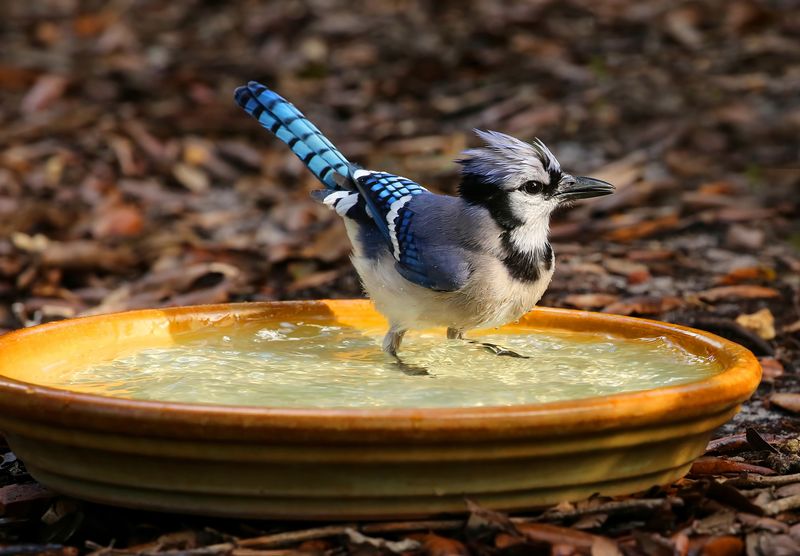
Free water can be a meaningful draw for quail in California yards, especially once the spring rains stop and temperatures climb. CDFW’s California quail life-history account notes that during hot, dry weather, the birds generally need free water daily.
That said, some coastal populations obtain moisture from dew, succulent plants, and the arthropods they eat, so water access is not an absolute requirement in every season or location. In inland valleys, foothill communities, and desert-adjacent areas, though, a reliable water source during summer can make the difference between a yard the covey passes through and one it returns to consistently.
The setup matters as much as the water itself. Quail are ground birds and they need to stand securely while drinking.
A shallow saucer or basin no deeper than about two inches works better than a tall pedestal bath. Add flat stones, a few smooth river pebbles, or a short branch across the basin so the birds have stable footing without having to lean over deep water.
UC Marin Master Gardener guidance on quail-friendly yards and Cornell Lab’s BirdNote guidance on providing water both recommend shallow designs with textured surfaces for exactly this reason.
Placement is a safety question as well as a convenience one. Set the basin near enough to protective shrubs that birds can retreat quickly if startled, but not so close to dense vegetation that a cat could crouch undetected within striking distance.
A few feet of clear sightline around the water source lets quail approach and leave without being ambushed.
Maintenance is non-negotiable. Stagnant water grows algae quickly and can become a source of bacterial contamination.
Cornell Lab’s birdbath maintenance guidance recommends refreshing the water at least every three days, and more often in warm weather. For a hot California yard in summer, daily or every-other-day emptying and refilling is a reasonable habit.
Scrub the basin with a stiff brush weekly to remove biofilm. CDC-linked research on disease transmission at bird feeding and watering stations supports at least monthly disinfection and more frequent cleaning whenever the basin looks visibly soiled.
A sudden appearance may reflect timing or visibility
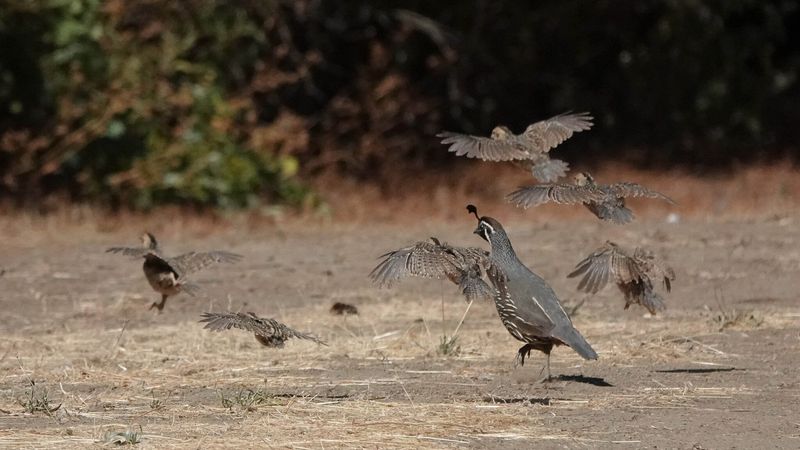
Quail can seem to appear out of nowhere, but the yard’s useful features probably did not change overnight. California quail are year-round residents that move through broader home ranges on loosely regular circuits, and several factors can shift when or where a covey becomes easy to spot, even when the habitat has been in place for months.
Seasonal changes in food and water availability are among the most common triggers. After summer grasses dry out and seed heads drop, a yard with reliable shade and water may suddenly become more attractive relative to surrounding areas.
Conversely, a wet spring that produces abundant seeds across an open hillside might keep quail away from the same yard for weeks. CDFW’s quail life-history account describes seasonal shifts in home range use that correspond directly to changes in food and water distribution.
Disturbance in nearby habitat can redirect a covey as well. Construction on a neighboring lot, brush clearing on an adjacent parcel, or an increase in predator pressure can push birds into yards they had previously visited only occasionally.
The Journal of Applied Ecology study on urban quail habitat found that surrounding landscape context, including connectivity and disturbance history, plays a substantial role in where quail appear within a fragmented urban environment.
Visibility changes within your own yard can also create the impression of a sudden arrival. A covey that was already moving through dense shrubbery along your back fence may become visible for the first time after you trim a hedge, remove a section of overgrown border, or simply start spending more time near a window or patio that overlooks a part of the yard you did not watch before.
The birds were there. You just have a better view now.
A covey is not a communal nest
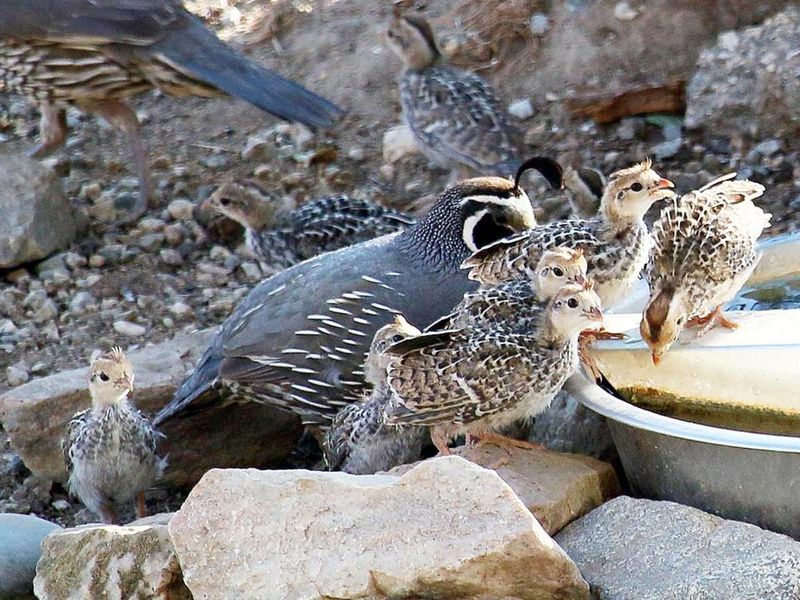
Several quail moving and feeding together in your yard is a normal, healthy social behavior, not evidence that multiple females have chosen your garden as a shared nesting site. The distinction matters because it changes how you interpret what you are seeing and what, if anything, you should do about it.
California quail form coveys as their primary social unit. Outside the breeding season, a covey typically contains anywhere from a handful of birds to several dozen, and even during breeding season, family groups often stay loosely connected.
Cornell Lab’s California quail life history explains that coveys break into pairs for nesting and then reassemble into larger groups once chicks are mobile, which is why late-summer coveys can look especially large and active. A big group in August or September is often a sign that several family units have merged after successful broods, not that they all nested in one place.
Nesting itself is a much quieter, more hidden affair. Females typically build shallow, cup-shaped ground nests concealed in grasses, dense herbage, or beside a log, rock, or low shrub.
Audubon’s California quail field guide describes nest sites as well-hidden and often difficult to locate even when you know the general area. Each female selects and builds her own individual nest.
Multiple females do not share a nest or coordinate nesting locations the way colonial waterbirds might.
CDFW’s quail life-history account and related published research on California quail reproductive ecology both confirm that ground nesting is individual and concealed, with females incubating clutches of roughly 12 to 16 eggs on their own. Seeing ten quail in your yard at once is not proof that ten nests are hidden there.
The covey may be using your yard as a foraging and resting stop while individual females nest in several different locations across a wider area.
Support the habitat without feeding or disturbing the birds
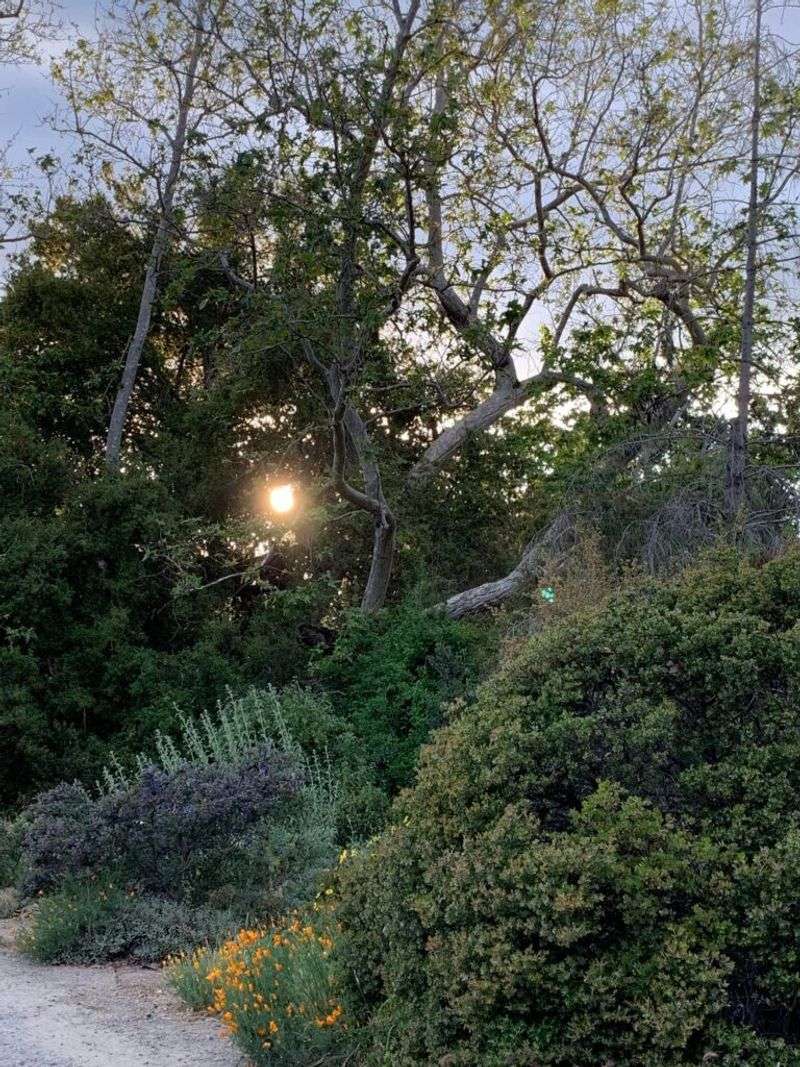
The most useful thing most homeowners can do is maintain the habitat conditions that drew the covey in rather than adding supplemental food or intensifying activity near the birds. A quiet, less-manicured corner with dense low shrubs, some leaf litter, and open foraging ground nearby gives a covey what it actually needs without creating new problems.
If you want to add plants that support quail, UC Marin Master Gardener guidance on quail-friendly California gardens lists native shrubs and seed-producing plants that can work well, including ceanothus, sagebrush, buckwheat, lupine, clover, deerweed, bush sunflower, toyon, coffeeberry, currants, and manzanita. These are examples to consider, not a universal recipe.
Match any plant choice to your local soil type, water budget, fire-safety zone, and existing plant community. A plant that thrives in a coastal Marin garden may be poorly suited to a hot inland valley or a hillside in a fire-prone watershed.
Ground-level birdseed is worth avoiding. Scattering seed on the ground can attract rats, and CDFW’s Wildlife Health Lab avian investigations program has documented how supplemental feeding concentrates birds and rodents in ways that increase disease transmission risk, encourage rodenticide use, and expose predators and scavengers to secondary poisoning.
The quail in your yard are already finding food. The habitat structure you have is doing the work.
During the breeding season, treat any area where quail are repeatedly active with extra care. CDFW quail habitat guidance recommends avoiding routine disturbance of dense ground vegetation during the breeding period.
Check before mowing, trimming, or clearing any brushy area where quail have been seen regularly. If you find what looks like a ground nest, the right response is to back away quietly, keep people and pets at a distance, and observe from inside.
CDFW’s native wildlife rehabilitation guidance is clear: do not remove or disturb active ground nests, and do not handle healthy precocial chicks, which may be moving away from the nest while parents remain close by. California law protects native bird nests and eggs from needless destruction, and CDFW’s guidance on wildlife disturbance reinforces that protection applies on private property as well.
If a bird appears genuinely injured or in distress, contact a permitted wildlife rehabilitator or your regional CDFW office. The covey you are watching is doing fine on its own.
Your job is mostly to leave the conditions in place that made your yard worth visiting.