
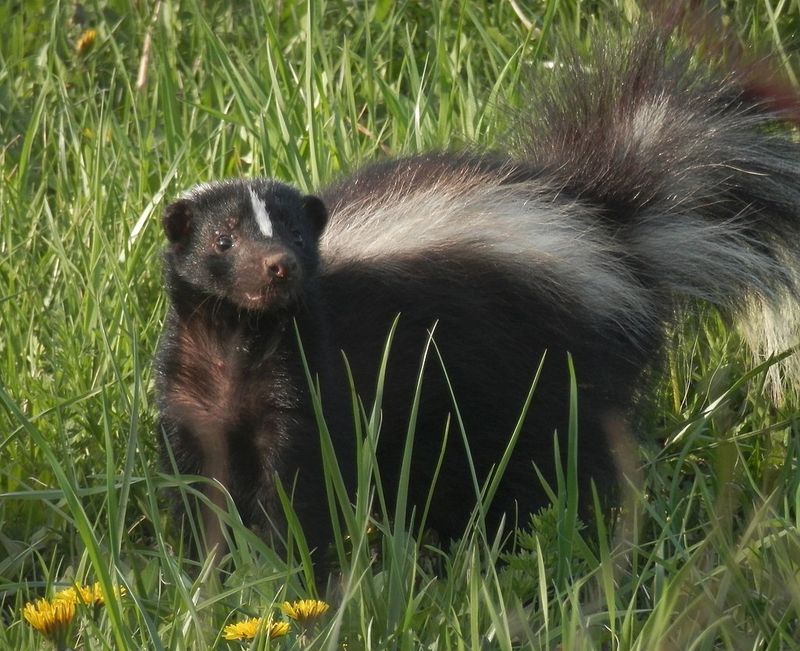
If a skunk has been digging up your lawn at night, your first reaction might be to reach for a pest spray or call an exterminator. Before you do either, it helps to understand what the animal is actually after and whether its presence is a problem worth solving.
California skunks do eat soil-dwelling insects including white grubs, but that foraging can also tear up your turf and does not mean the grubs are destroying your lawn. A few straightforward steps can reduce conflict without harming a native animal that is simply doing what comes naturally.
A skunk may be hunting grubs—but digging does not prove it
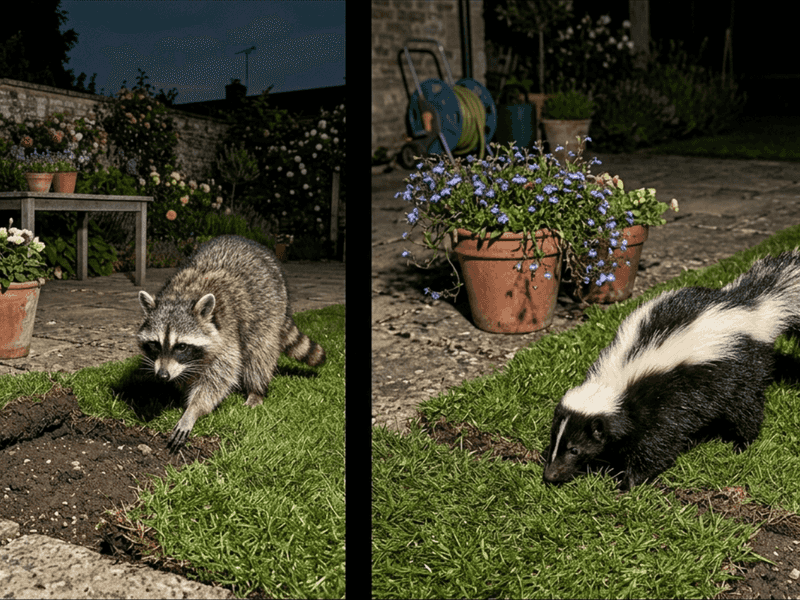
California is home to two native skunk species: the striped skunk and the smaller western spotted skunk. Striped skunks are the ones most likely to show up in suburban yards across the state, partly because they adapt well to neighborhoods and partly because residential lawns offer a reliable buffet.
California Department of Fish and Wildlife guidance confirms that both species eat insects and a wide mix of other foods, including earthworms, small rodents, fruit, and garbage.
Grubs are a legitimate part of that diet. UC IPM’s skunk guidance identifies grubs among the prey skunks dig for and notes that foraging activity tends to peak in late summer and autumn when white grubs are near the soil surface.
The same guidance describes the physical signs: small cone-shaped depressions roughly 3 to 5 inches across, or sections of sod rolled back as the animal roots beneath the turf.
Here is the part the headline version of this story often skips. A skunk eating some grubs is not the same as a skunk controlling a grub infestation.
Skunks also eat foods that have nothing to do with turf health, and their digging can uproot grass, leave bare patches, and make a lawn look worse than it did before. The foraging is opportunistic, not systematic.
Allowing a skunk to visit freely may reduce a few grubs while also creating visible turf damage, and there is no way to predict which outcome dominates on a given lawn.
Treating skunk activity as a free pest-control service misses the more useful question: are there actually damaging numbers of grubs under that turf, or is the skunk finding something else entirely?
Treat the digging as a clue, not a diagnosis
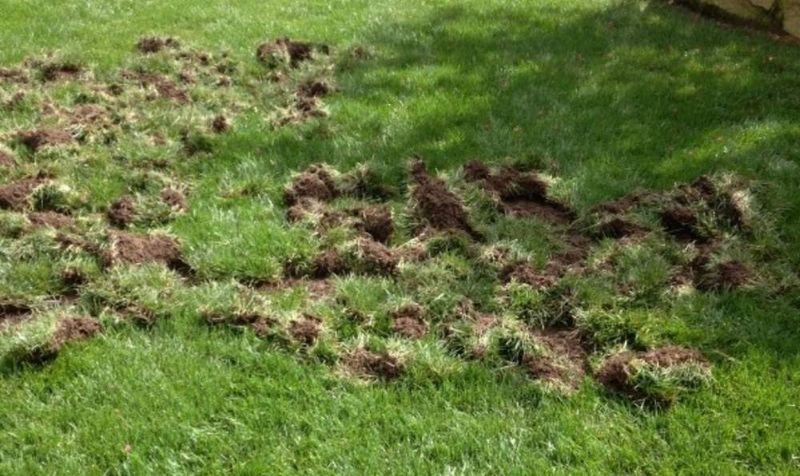
Skunk holes in the lawn are easy to read as evidence of a grub problem, but that conclusion can send a homeowner straight to the pesticide aisle for no good reason. The digging tells you prey may be present somewhere in the soil profile.
It does not confirm which prey, how many, or whether the population is large enough to harm the turf on its own.
UC IPM’s lawn-insects overview points out that several conditions can produce brown patches, thinning grass, or areas of spongy turf that look like grub damage but are not. Disease, poor drainage, compacted soil, inappropriate grass selection for the local climate, overfertilizing or underfertilizing, herbicide drift, and dog urine can all create symptoms that mimic what grubs do to a root zone.
The practical problem with skipping the inspection step is that insecticides applied to a lawn without confirmed damaging pest levels do nothing useful and carry real costs. They can harm beneficial soil organisms, kill bees that forage on lawn flowers, and add chemicals to the local watershed.
California’s integrated pest management framework is built around the idea that treatment follows monitoring, not suspicion.
UC IPM’s skunk guidance reinforces this point by framing grub management as a way to reduce the food source that attracts skunks, but it does not recommend automatic treatment whenever a skunk visits. The skunk’s presence is a prompt to look more carefully at the lawn, not a reason to spray it.
Spend fifteen minutes with a trowel before making any other decision.
Inspect the root zone before using insecticide
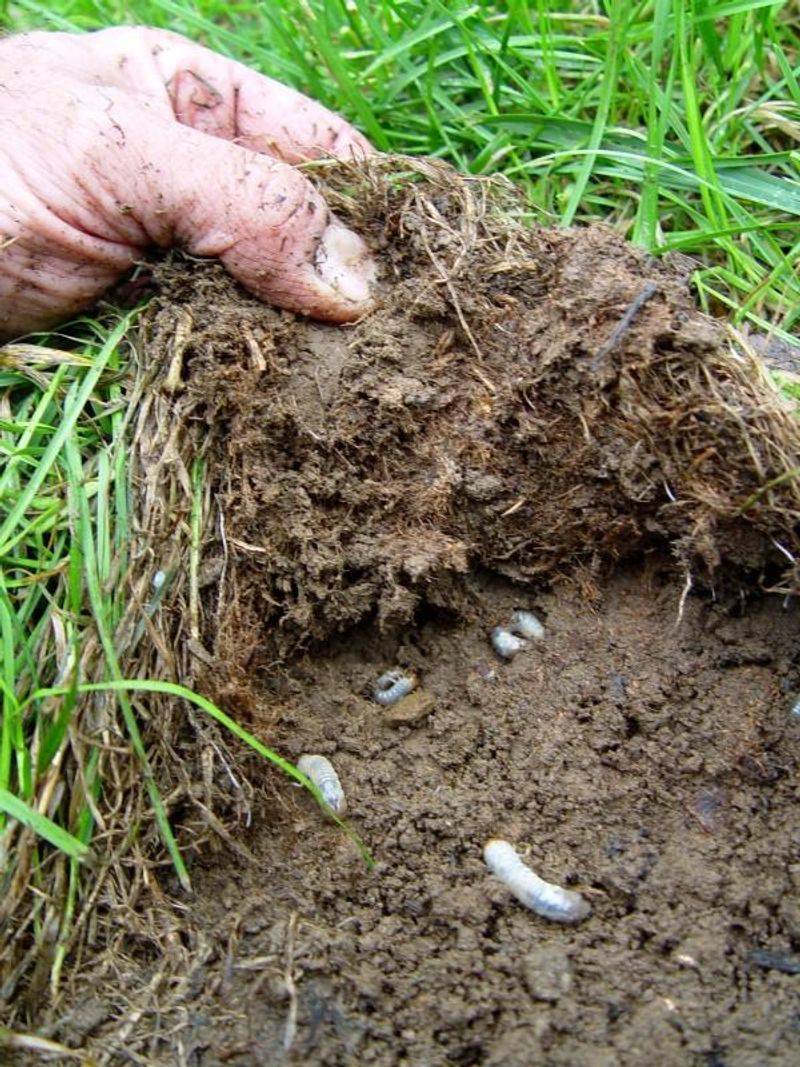
Pulling back a small section of turf takes about five minutes and gives you real information. Use a sharp knife or flat spade to cut a square roughly one foot on each side, then fold the sod back and look at the top two to three inches of soil and roots.
White grubs are C-shaped, cream-colored, and have six legs near the head end. They are hard to miss once you know what to look for.
UC IPM’s turfgrass monitoring guidance recommends checking several spots across the lawn rather than a single sample, because grub populations are often patchy. Dig where the turf looks worst and also in areas that appear healthy, so you get a realistic picture of what is happening across the yard.
For general California turf settings, UC IPM’s masked-chafer guidance lists six white grubs per square foot as a suggested curative-treatment threshold. That figure applies to general turf in typical residential settings and is not a universal rule for every grass type, grub species, or lawn condition.
A lawn with strong, deep roots may tolerate more grubs than one already stressed by drought or compaction. If your counts are well below six per square foot and the turf looks reasonably healthy, insecticide is unlikely to help and may cause unintended harm.
UC IPM is direct on this point: insecticides are infrequently needed in California lawns, and only a small percentage of California turf is infested with white grubs at damaging levels in any given year. If inspection does confirm damaging populations, timing matters.
Early larval stages are generally more vulnerable to treatment, and some products can harm bees or other nontarget organisms. Follow the product label closely and use California-specific IPM guidance to choose the right product at the right time.
Remove the food and shelter that keep attracting skunks
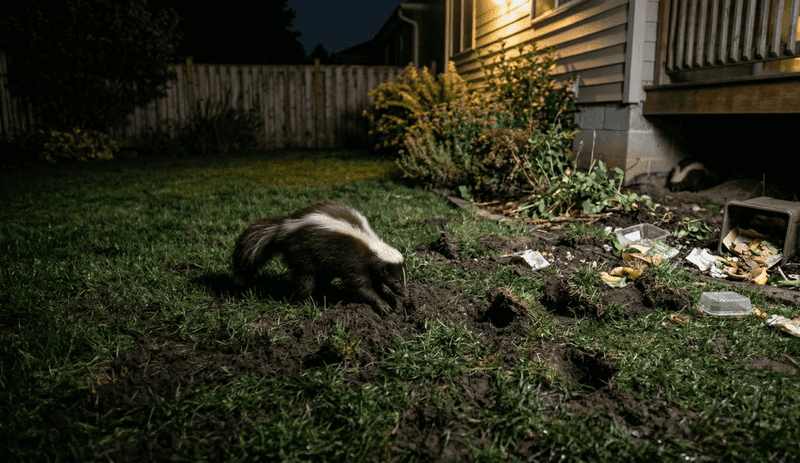
Grubs are one item on a skunk’s menu, but they are far from the only reason a skunk keeps coming back to a yard. Unsecured garbage cans, fallen citrus or stone fruit, spilled birdseed under feeders, outdoor pet food left out overnight, and compost piles with food scraps can all pull skunks in repeatedly.
Rodent populations around a property add another draw, since skunks eat mice and voles as readily as they eat grubs.
UC IPM’s skunk management guidance and local nuisance wildlife guidance both identify habitat modification as the primary recommended approach for reducing skunk conflicts. The logic is straightforward: if the food and shelter disappear, the motivation to visit fades.
Concrete steps that make a real difference include bringing pet food and water bowls inside before dark, using a bungee cord or locking lid on garbage cans, picking up fallen fruit daily during the summer and fall, and moving bird feeders to a pole with a baffle or switching to nyjer seed, which is less attractive to ground-foraging animals. Woodpiles, brush piles, and stacked lumber near the house should be moved away from the structure or secured so they cannot serve as cover.
CDFW’s human-wildlife conflict page notes that a skunk passing through a yard is not necessarily a problem requiring action. The management priority is conflict reduction, which means addressing the specific attractants that bring an animal back night after night, rather than assuming every skunk in the neighborhood needs to be driven away.
Use motion lights as a limited, targeted deterrent
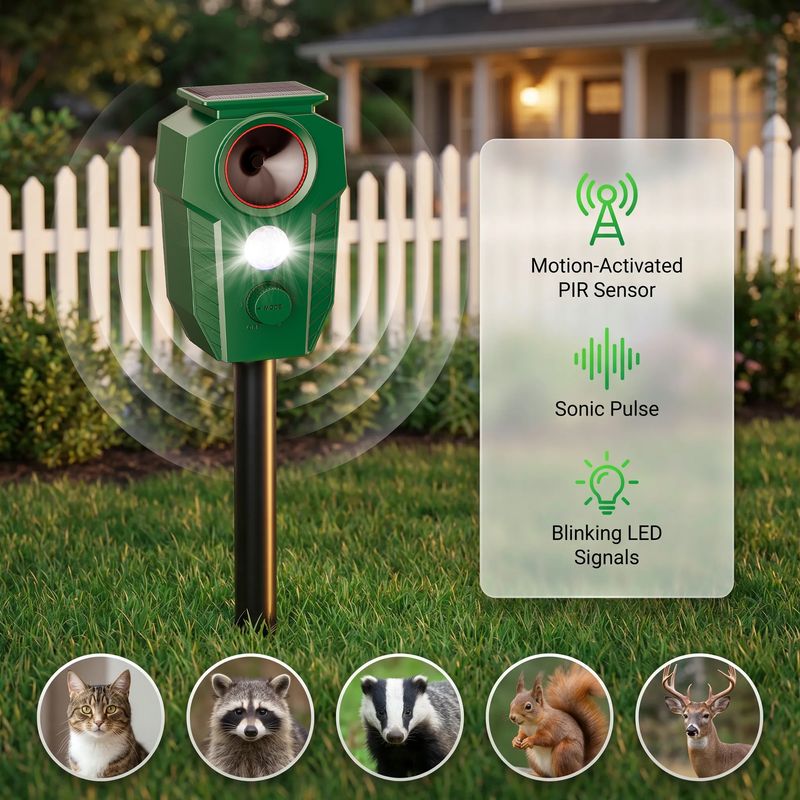
Motion-activated lighting gets a lot of credit in backyard wildlife advice, and it can play a useful role under the right conditions. The key word is targeted.
A motion light mounted near a porch opening, deck gap, or crawl-space vent where a skunk has been entering may startle the animal and make that specific spot feel less appealing. UC IPM notes that floodlights directed outward from beneath a structure can help encourage a denning skunk to leave voluntarily.
That is a narrow, practical use case.
Extending that recommendation to mean that lights will stop a skunk from foraging across your entire lawn is a bigger claim than the evidence supports. Penn State Extension describes lights and radios as options that may deter skunks but carry a low success rate.
Wisconsin DNR guidance similarly frames motion lighting as a possible, temporary measure rather than a reliable solution. When food or shelter remains available nearby, skunks can habituate to repeated light triggers within days or weeks.
If you do use a motion light, choose a fixture that faces downward and activates only on movement rather than staying on all night. DarkSky International’s guidance on outdoor lighting recommends downward-aimed, motion-triggered fixtures used only when needed and for limited duration, because artificial light left on all night can disrupt insects, birds, and other wildlife that have nothing to do with your skunk situation.
Think of a motion light as one tool in a larger plan, useful near a specific problem entry point and for a limited period, but not a substitute for removing attractants or blocking access. A skunk that can still find food and a comfortable den spot will eventually work around a light.
Add exclusion when a skunk is denning
Occasional foraging visits are one thing. A skunk that has moved in under your porch, deck, or garden shed is a different situation that calls for a more durable response.
Exclusion, meaning physically blocking access to the space, is the approach that UC IPM and most California wildlife guidance consistently recommend when an animal is actively denning.
Before sealing any opening, confirm that no young are inside. Striped skunks typically give birth in spring, and the kits remain dependent for several weeks.
Sealing an entrance while young are present traps them and can create a worse problem. UC IPM’s exclusion guidance recommends installing a one-way door or flap over the primary opening for several days first.
The adult skunk can push out to forage but cannot re-enter, and once you have confirmed the space is empty, you can seal the opening permanently.
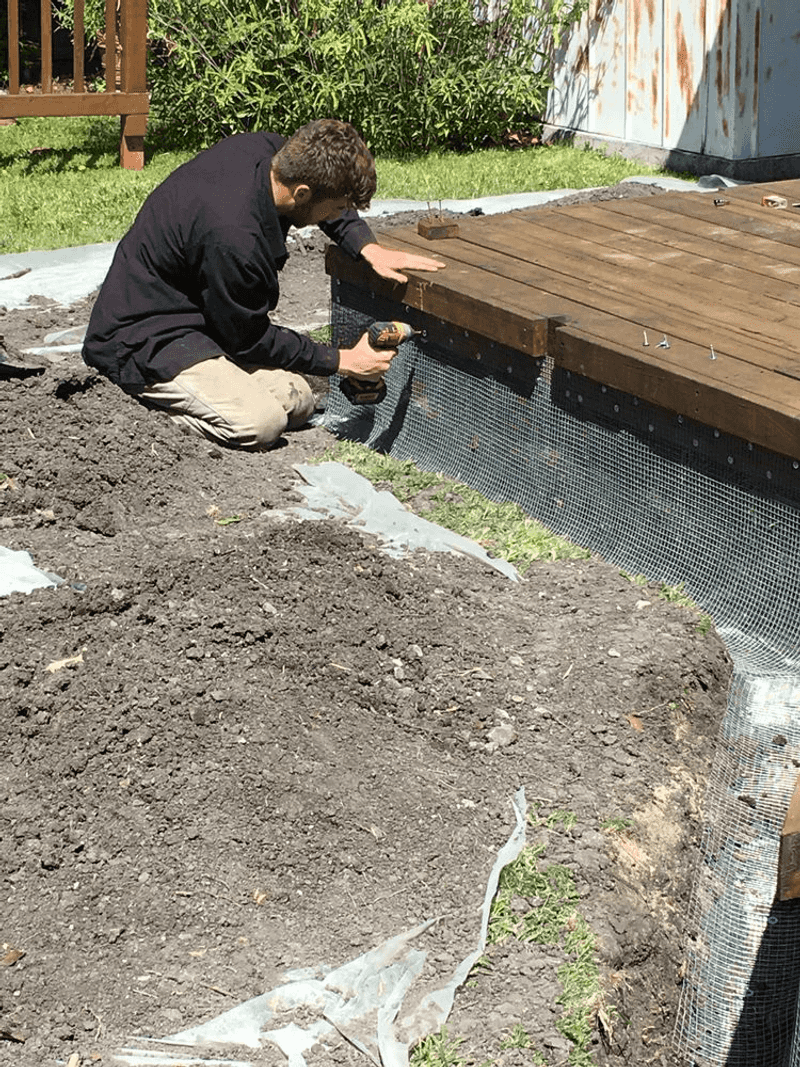
The exclusion material matters. Skunks dig, so a simple board or lightweight mesh laid flat against the ground will not hold for long.
Hardware cloth buried in an L-shape, with the footer extending outward at least 12 inches underground, makes digging around the barrier much harder. Attach the vertical portion firmly to the deck or foundation so there are no gaps at the top.
Motion-activated sprinklers are sometimes mentioned as an additional deterrent during the exclusion period. UF/IFAS extension guidance notes that sprinklers can provide a tactile surprise that lights cannot, but cautions that the effect can be short-lived.
Moving the sprinkler to a slightly different position every few days helps prevent the animal from simply learning to walk around it. Treat a sprinkler as a short-term complement to exclusion work, not a replacement for it.
Protect people, pets, and skunks during conflict reduction
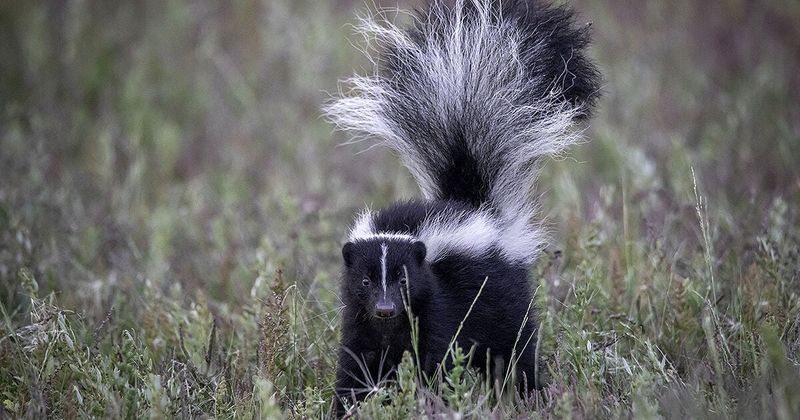
Skunks are not aggressive animals by nature, but they do have two defenses worth respecting: their spray and their status as a rabies-reservoir species. Skunk spray causes severe eye irritation and can temporarily affect vision.
Keeping a safe distance, never cornering an animal near a fence or structure, and supervising pets outdoors after dark are basic precautions that make conflict far less likely.
UC IPM’s skunk page advises keeping pets vaccinated against rabies and bringing them inside before dark when skunk activity has been observed. CDFW notes that striped skunks can occasionally be active during daylight hours, especially in areas with heavy human use.
Daytime activity alone is not a reliable sign of rabies. Abnormal behavior, such as disorientation, unprovoked aggression, circling, or approaching people without hesitation, is a more meaningful warning sign.
If you observe those behaviors, keep people and pets away and contact your local animal services agency.
CDC rabies prevention guidance recommends keeping pets currently vaccinated and avoiding contact with any wild mammal. For a skunk that is injured, inaccessible in a structure, or behaving in a genuinely alarming way, the right call is to contact local animal services, the California Department of Fish and Wildlife, or a licensed wildlife control professional.
CDFW’s living-with-wildlife guidance is clear that trapping and relocating a skunk in California can require authorization, and relocation without written permission is prohibited. Do not attempt to trap, handle, or relocate a skunk on your own.
Nonlethal deterrence, exclusion, and professional assistance when needed are the legally sound and humane path forward.
Let evidence determine the next step
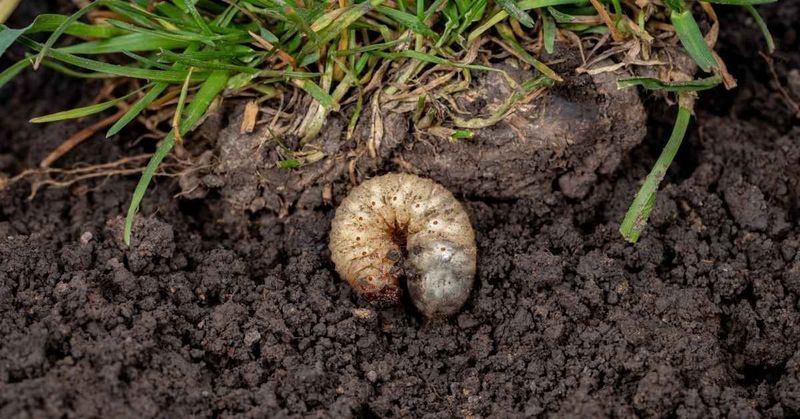
When you find skunk holes in the lawn, the most useful first move is observation, not treatment. Look at where the digging is concentrated, check whether the turf nearby is pulling up easily or staying rooted, and then take a trowel to the root zone.
UC IPM’s white-grub guidance gives you a starting framework for deciding whether what you find actually warrants treatment, or whether the lawn is handling the pest load on its own.
If the soil sample shows few or no grubs, redirect your attention to the other attractants: the garbage can lid that does not quite seal, the fallen oranges along the fence line, the dog bowl left out after dinner. UC IPM’s habitat-modification guidance puts food and shelter removal ahead of any deterrent device, and that priority holds whether or not grubs are part of the picture.
Reserve motion lighting and exclusion for specific, defined conflicts: a skunk entering a crawl space, repeatedly visiting one corner of the yard near a den, or creating a safety concern for a pet that uses the yard at night. A skunk that passes through occasionally, digs a few holes, and moves on is doing what the species has always done in California’s residential landscapes.
Brief foraging visits are tolerable; denning under the house or repeated damage to turf is the kind of specific problem that calls for a specific, targeted response. The clearest thing the evidence shows is that a yard with fewer attractants and sealed access points rarely needs anything else.