
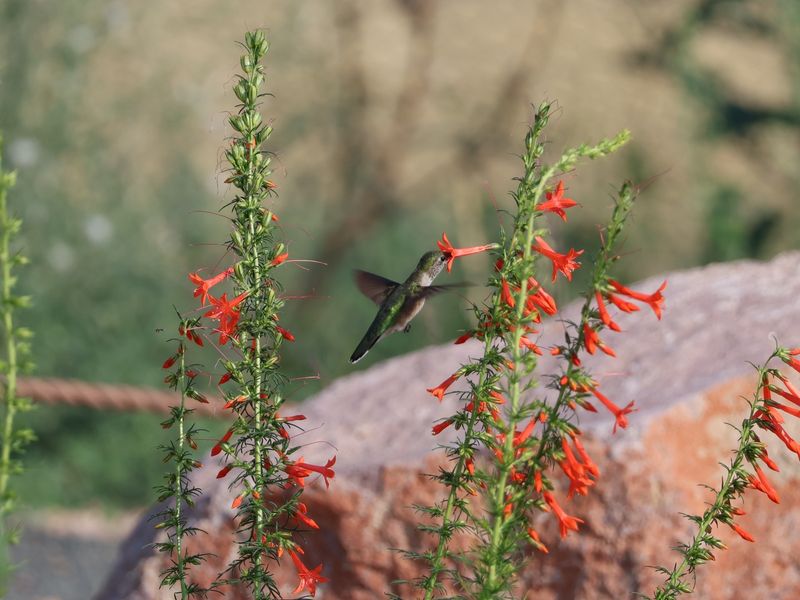
A native Texas vine called coral honeysuckle has been making the rounds online with some bold claims about roadrunners and scorpions, and the real story is worth knowing before you head to the nursery. The plant itself is genuinely useful for Texas yards, attracting hummingbirds, pollinators, and songbirds while handling summer heat without much fuss.
Roadrunners do eat scorpions, and they can show up in suburban yards across Texas, but the connection between a single vine planting and either of those outcomes is more complicated than a headline can capture. Here is what the evidence actually supports and how to put it to work in your yard.
Coral honeysuckle is the likely vine behind the claim
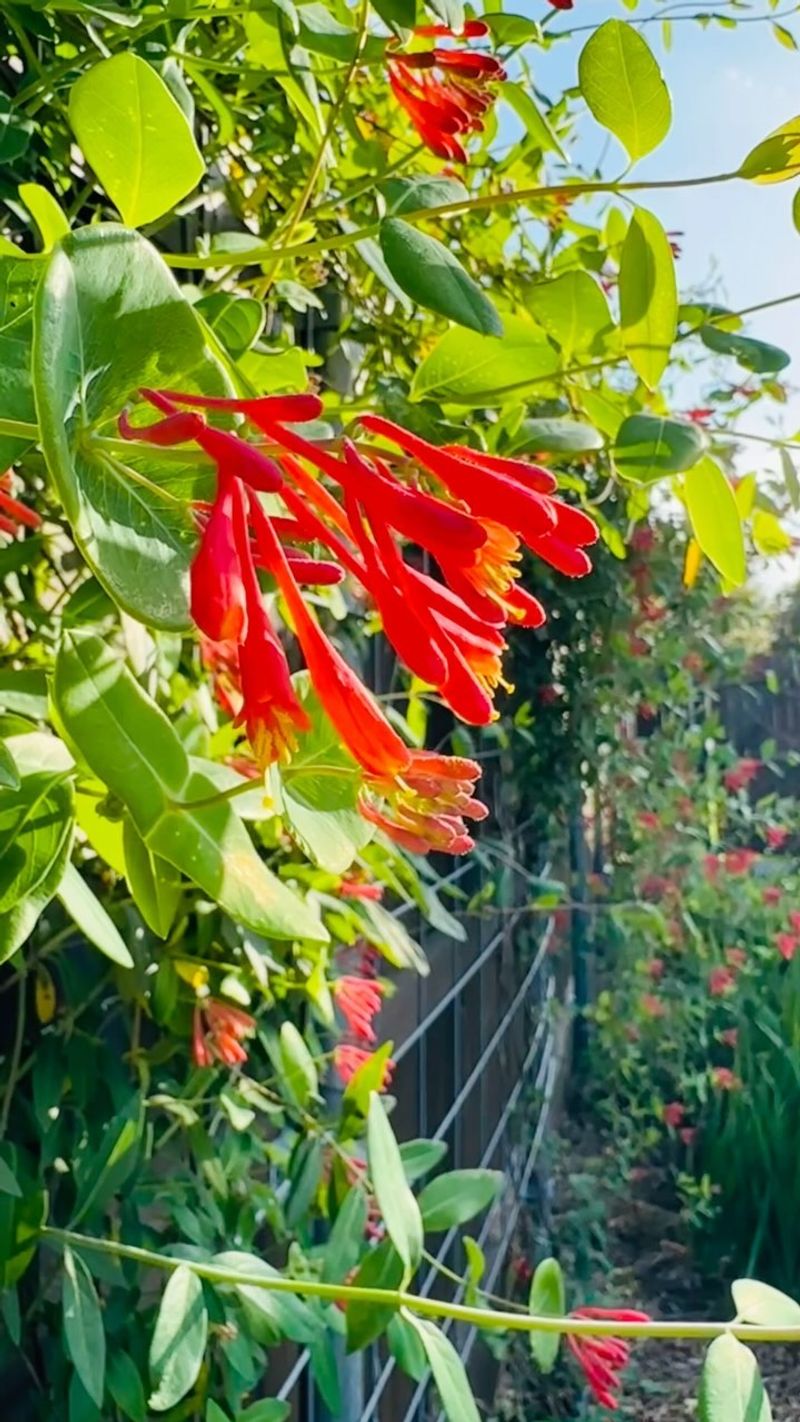
Most of the online buzz about a Texas native vine that supposedly lures roadrunners and discourages scorpions points to one specific plant: coral honeysuckle, known botanically as Lonicera sempervirens. Texas A&M AgriLife’s native plant list confirms it as a true Texas native, and that distinction matters because the honeysuckle genus also contains nonnative species that have become serious weeds across North America.
Before you buy anything labeled “honeysuckle” at a nursery, check the botanical name on the tag and make sure it reads Lonicera sempervirens.
As a perennial twining vine, coral honeysuckle can reach roughly 10 to 20 feet when given a support to climb. It needs a trellis, fence, arbor, or similar structure because it does not cling to flat surfaces on its own.
A Texas A&M gardening newsletter describes it as an evergreen vine that is both drought-tolerant and cold-tolerant, making it a reasonable fit for the wide range of conditions Texas homeowners deal with from the Panhandle to the Gulf Coast.
The NC Extension Gardener Plant Toolbox profile for Lonicera sempervirens adds that it is considerably less aggressive than Japanese honeysuckle and less likely to spread beyond where you plant it. That said, the full honeysuckle genus is large and uneven, so verifying the species before purchase is a concrete step that protects your yard from accidentally introducing a weedy look-alike.
The genus overview for honeysuckles makes clear that some relatives are considered invasive in parts of the U.S., which is exactly why the species name is the detail to confirm.
Roadrunners eat scorpions without becoming pest-control specialists
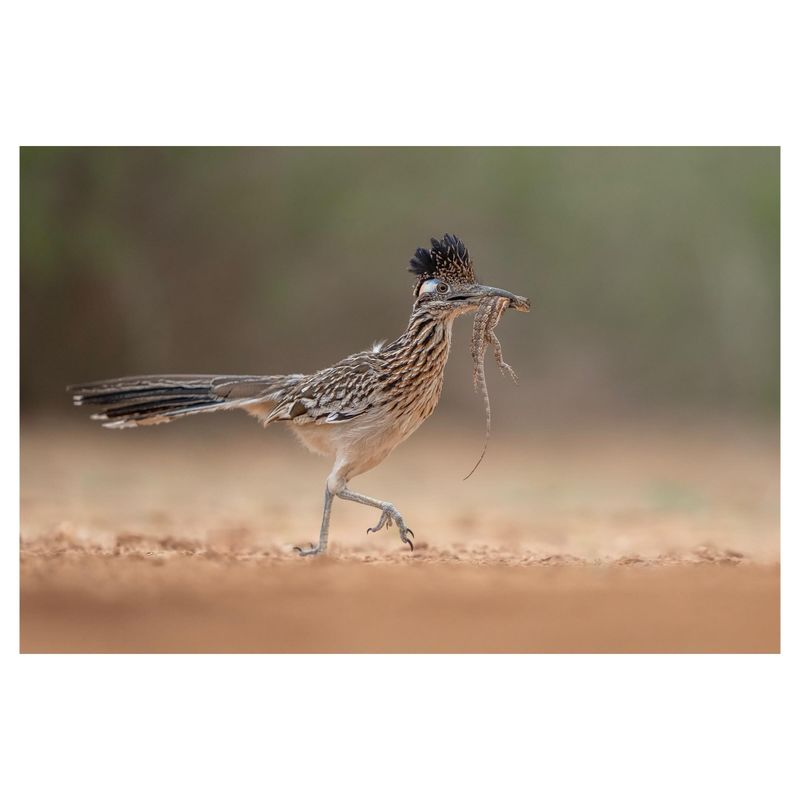
Greater roadrunners are year-round Texas residents, and Texas Parks and Wildlife confirms they eat scorpions as part of a broad, opportunistic diet that also includes insects, centipedes, lizards, snakes, and small mammals. That list is worth reading carefully: roadrunners are generalist hunters, not scorpion specialists.
A roadrunner foraging through your yard on a Tuesday morning is just as likely to snatch a lizard or a large grasshopper as it is to dig out a scorpion hiding under a rock.
The birds occur throughout Texas and can adapt to suburban settings, but the Texas Breeding Bird Atlas notes that roadrunners generally favor semi-open landscapes with bare or sparsely vegetated ground for hunting, combined with scattered shrubs, small trees, cactus, or other sturdy cover nearby. A yard that is entirely fenced, densely planted, or covered with thick groundcover is harder for them to use.
Their hunting style depends on open surface area where they can sprint after prey.
Cornell Lab of Ornithology’s life history account reinforces that scorpions are one item among many on the menu. No source reviewed for this article establishes that a roadrunner will clear a property’s scorpion population or that inviting one bird into a yard produces a measurable reduction in scorpion numbers.
Roadrunners are genuinely welcome wildlife in a Texas yard, but framing them as a targeted extermination service sets an expectation the birds cannot realistically meet.
Think of a roadrunner sighting as a sign that your yard has enough open structure and prey diversity to support a capable, wide-ranging predator. Texas Parks and Wildlife wildlife research treats them as one part of a functioning habitat, not as a biological control agent you can deploy on demand.
That framing is both more accurate and, honestly, more interesting.
Pair the trellis with an open hunting strip
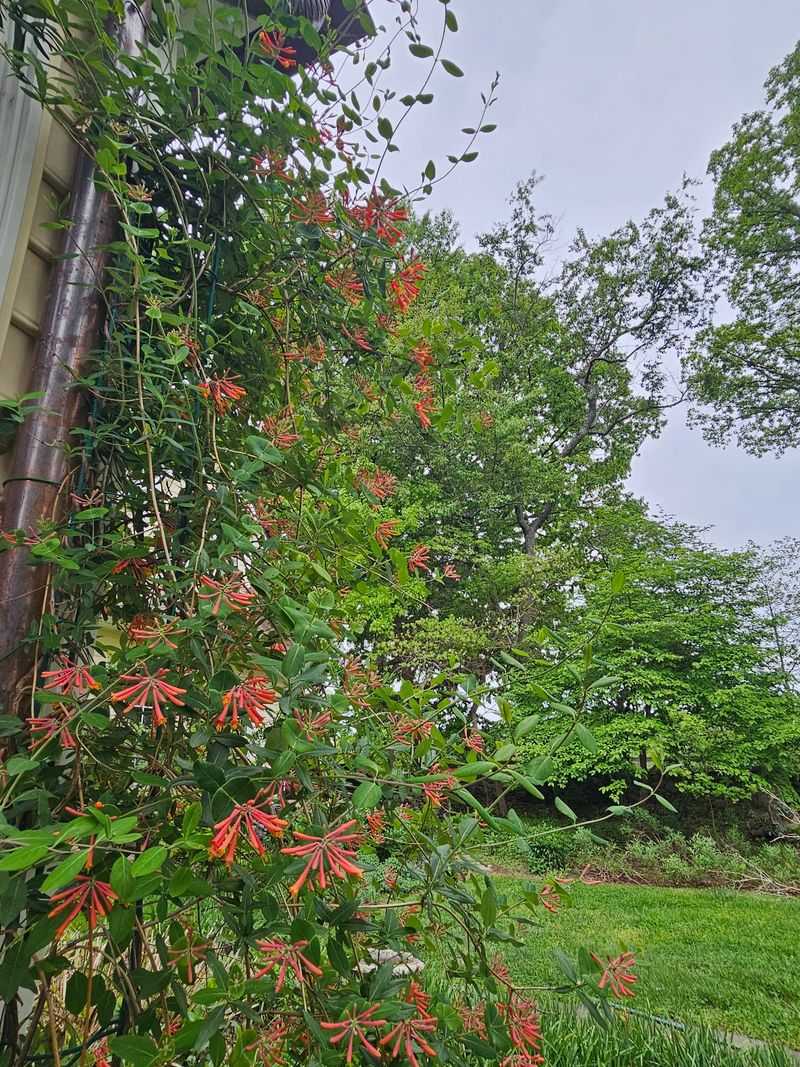
The most practical thing you can do with coral honeysuckle in a Texas yard is place it on a trellis or fence along the property edge, then deliberately keep the ground in front of that structure open. Short grass, sparse groundcover, or a strip of relatively bare soil gives any roadrunner moving through the area a usable hunting surface.
The Texas Breeding Bird Atlas’s roadrunner account describes this kind of edge structure, open ground adjacent to scattered cover, as characteristic habitat for the species.
The layout works like this in practice: run the vine along a back or side fence rather than across the interior of the yard. Anchor it to a sturdy trellis or fence panel so it climbs vertically and stays off the ground.
Leave a mow-able strip of grass or cleared soil between the vine and the center of the yard. That strip does not need to be wide to be useful; even a modest open corridor gives a foraging bird room to move and spot prey.
Texas Parks and Wildlife’s roadrunner resource emphasizes that the birds need open areas for hunting and scattered cover for perching and shelter. Letting the vine sprawl across the ground or allowing it to form a dense mat along the entire border works against that need.
The vine’s job in this layout is to add vertical structure and wildlife value at the edge, not to replace the open ground that makes the space functional for ground-foraging birds.
One honest note: this recommendation is an inference drawn from roadrunner habitat descriptions, not a result from a controlled study of coral honeysuckle plantings. The Texas 4-H Wildlife Habitat Education Project manual describes the general habitat components that support wildlife like roadrunners, and the trellis-plus-open-strip idea applies those principles to a residential lot.
No published source guarantees that this arrangement will produce a roadrunner visit or reduce scorpion numbers.
Maintain cover without closing the foraging lane
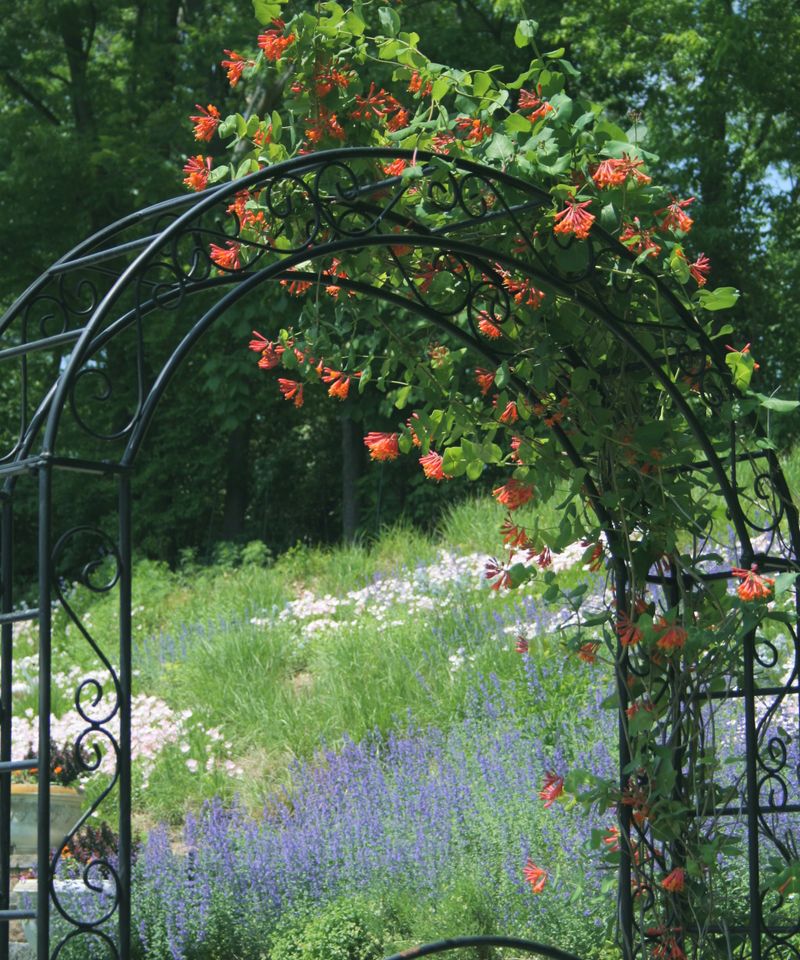
Coral honeysuckle grows vigorously once established in Texas conditions, and that growth is something to manage rather than simply admire. Keep the vine trained upward on its support so stems do not trail across the ground and gradually close off the open strip you preserved.
A vine that creeps outward across the soil creates exactly the kind of dense, low cover that makes a yard harder for roadrunners to hunt through.
Annual pruning after the main bloom period keeps the plant tidy and prevents it from overwhelming nearby shrubs or spilling onto fences in directions you did not intend. The Texas Breeding Bird Atlas account reinforces that roadrunners use scattered shrubs, small trees, cactus, and other sturdy cover for perching and shelter, so a few well-spaced native shrubs near the trellis contribute more to usable habitat than a single unmanaged thicket would.
Retaining that variety of cover types at different heights serves the bird better than letting one vine dominate the border.
Texas Parks and Wildlife’s roadrunner guidance consistently pairs open hunting ground with accessible cover, treating both as necessary rather than optional. An overgrown border that looks lush from the street may actually reduce the habitat quality for ground-foraging birds because the open surface disappears.
Maintenance is what keeps the two elements, edge cover and open ground, working alongside each other rather than one slowly defeating the other.
No source reviewed here connects a specific pruning schedule for coral honeysuckle to changes in roadrunner visits or scorpion counts. The Texas 4-H wildlife habitat manual frames maintenance as a way to sustain habitat quality over time, which is the honest goal: a yard that stays structurally suitable, not one that is managed around a guaranteed wildlife outcome.
Let the vine support a broader wildlife garden
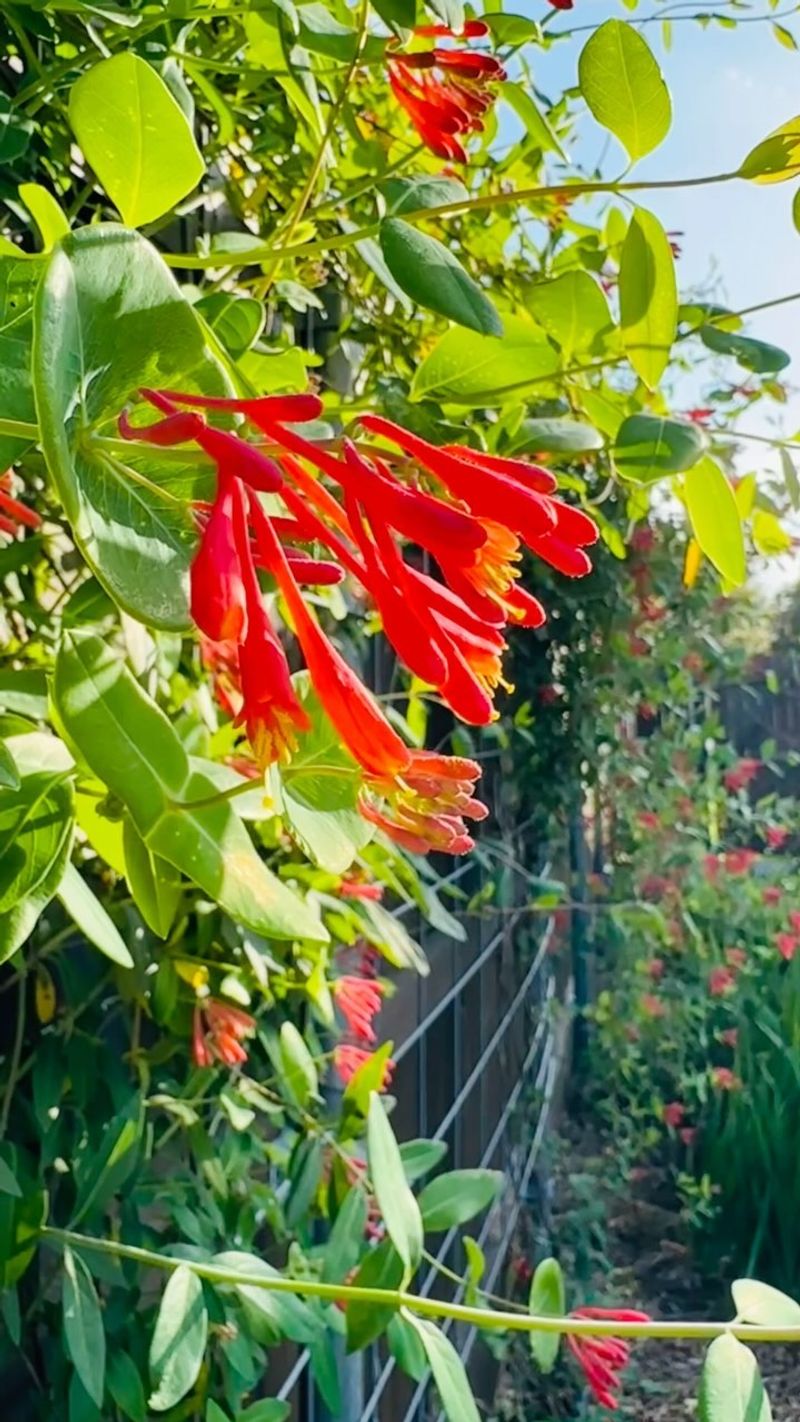
Coral honeysuckle earns its place in a Texas yard based on what it actually does well, and that starts with its flowers. The NC Extension Gardener profile documents that the tubular red flowers attract hummingbirds and other pollinators, and the red berries that follow are eaten by songbirds.
Those are real, observed benefits supported by horticultural sources, and they give the plant a legitimate role in a wildlife-friendly yard regardless of whether a roadrunner ever shows up.
Growing conditions are straightforward for most Texas homeowners. The vine performs in full sun or partial shade, but flowering is noticeably better in full sun.
A south- or east-facing fence panel with at least six hours of direct light will produce more blooms than a shaded corner. Soil drainage matters more than soil richness; coral honeysuckle tolerates the rocky or sandy soils common across much of Texas better than it handles consistently wet roots.
Adding a shallow, regularly cleaned bird bath near the trellis is an optional step that supports birds broadly during hot Texas summers. Texas Parks and Wildlife’s habitat resources page recommends shallow basins and regular cleaning to limit algae and reduce standing water that could attract mosquitoes.
Roadrunners obtain a large share of their water from the prey they eat, so a bird bath is not a targeted roadrunner lure. The Texas 4-H wildlife habitat manual frames clean, accessible water as one component of a complete habitat rather than a single-species draw.
Taken together, the vine’s documented benefits create indirect ecological value: more hummingbirds and pollinators mean more activity and insect diversity in the yard, which supports a broader food web. That is a genuine payoff, even without a roadrunner sighting.
Use proven scorpion defenses around the home
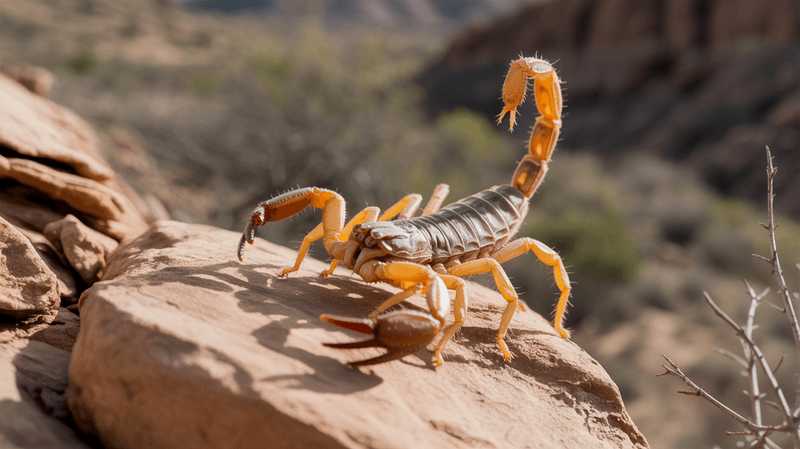
Habitat gardening and household scorpion management are two separate jobs, and it helps to keep them that way. A coral honeysuckle trellis along the back fence does not make the area around your foundation any less attractive to scorpions.
Texas Parks and Wildlife’s arachnid safety resource describes scorpions as nocturnal animals that shelter under rocks, boards, firewood, and other debris during the day. A vine-covered fence may add shade or structural cover near the ground, but no evidence connects coral honeysuckle to reduced scorpion activity in the surrounding area.
Texas Parks and Wildlife’s guide to interacting with urban wildlife and Utah State University Extension’s scorpion management resource both point to the same practical measures: remove debris and refuse from around the home, keep grass short near the foundation, store firewood off the ground and away from the house wall, and seal cracks and gaps in the structure where scorpions can enter. These steps address the actual conditions scorpions need to shelter and move indoors.
Personal protection matters too. Wear gloves and closed boots when moving firewood, turning over boards, or working in areas where scorpions are likely to hide.
Never handle debris or firewood bare-handed in scorpion country, and shake out shoes left on the floor or porch before putting them on.
On the medical side, most Texas scorpion stings produce pain and swelling comparable to a bee sting and resolve without serious complications. That said, allergic reactions can occur, and individual responses vary.
Anyone who develops symptoms beyond local pain after a sting, particularly difficulty breathing, significant swelling, or systemic reactions, should seek medical attention promptly. Treating all stings as automatically minor understates the real range of outcomes.
Pesticides are sometimes used around scorpion-prone areas, but applying them near a wildlife-attraction planting requires reading the label carefully and accounting for possible effects on birds and beneficial insects. Label compliance is not optional, and spraying near flowering plants that support pollinators carries real trade-offs.
Treat coral honeysuckle as habitat, not a scorpion solution
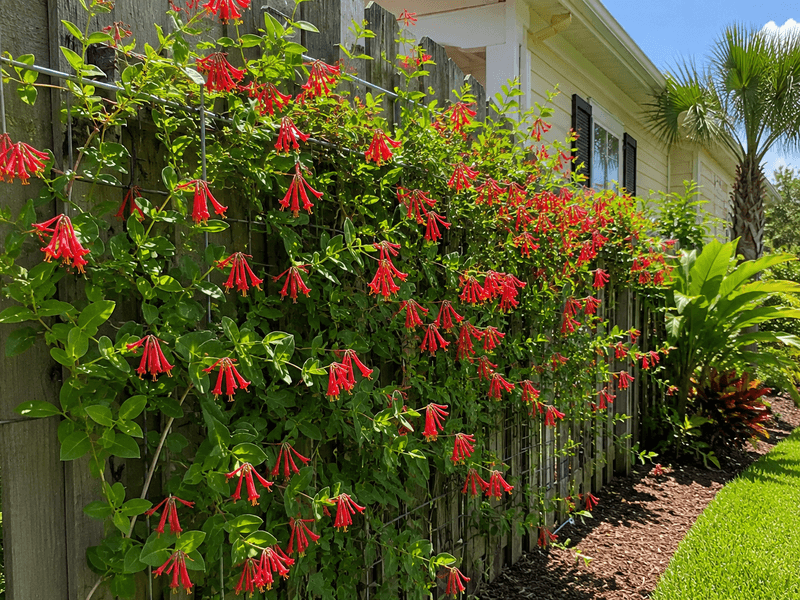
Pulling this together into a yard plan comes down to five steps. First, confirm the botanical name before buying: look for Lonicera sempervirens specifically and avoid unlabeled honeysuckles or nonnative species.
Second, install the trellis or fence support at the property edge, in a spot that gets full sun if possible. Third, keep the ground in front of that trellis open, mowed short, or sparsely planted so any roadrunner moving through the area has usable hunting surface.
Fourth, retain a few scattered native shrubs, small trees, or cactus nearby for cover, and prune the vine annually so it stays on its support rather than sprawling across the ground. Fifth, continue using the household exclusion and cleanup measures described in the previous section as your primary scorpion defense: debris removal, short grass, sealed cracks, and protective gear are the tools that actually reduce scorpion contact.
The vine can contribute to a Texas yard where roadrunners might find useful structure and enough prey to make a visit worthwhile. Neither the plant nor the bird guarantees that scorpions will leave, and no source reviewed here supports that claim.
What coral honeysuckle genuinely offers is a heat-tolerant, drought-tolerant native that feeds hummingbirds, pollinators, and songbirds across a long Texas growing season. A yard built around that kind of ecological function is worth having on its own terms, roadrunner sighting or not.