
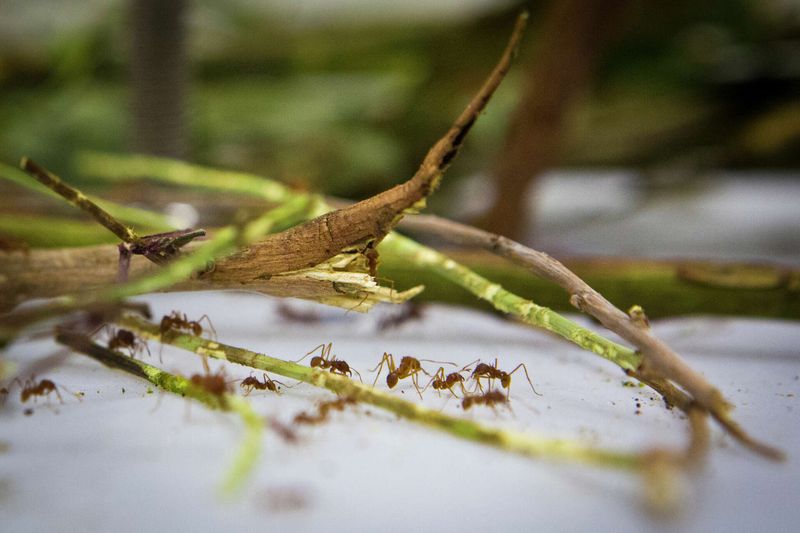
Something unsettling happens when you walk out to your garden one morning and find a rose bush that was full of leaves the night before now standing nearly bare. Trails of leaf fragments crossing your flower bed, each piece carried by a rust-brown ant, point toward one likely suspect in Central Texas: the Texas leafcutting ant, Atta texana.
Knowing what you are actually dealing with before you reach for a pesticide or start digging around a mound could save your plants, protect local wildlife, and keep you from making the problem worse.
Could Texas leafcutting ants explain the overnight damage?
Waking up to a rose bush that looks like it lost a fight overnight is alarming, and the first instinct is usually to assume the worst. Before blaming any single pest, though, the missing foliage alone cannot tell you what caused it.
Several chewing insects, caterpillars, and even leafcutting bees can produce similar-looking damage, so a closer look at what is actually happening around the plant matters far more than the bare stems themselves.
When Central Texas gardeners spot rust-brown ants actively carrying leaf pieces along an organized trail toward soil mounds, the Texas leafcutting ant, Atta texana, becomes the leading explanation. Texas A&M’s field guide to common Texas insects identifies this species as occurring mainly in south-central and eastern Texas, which puts the broader Central Texas region squarely within its range.
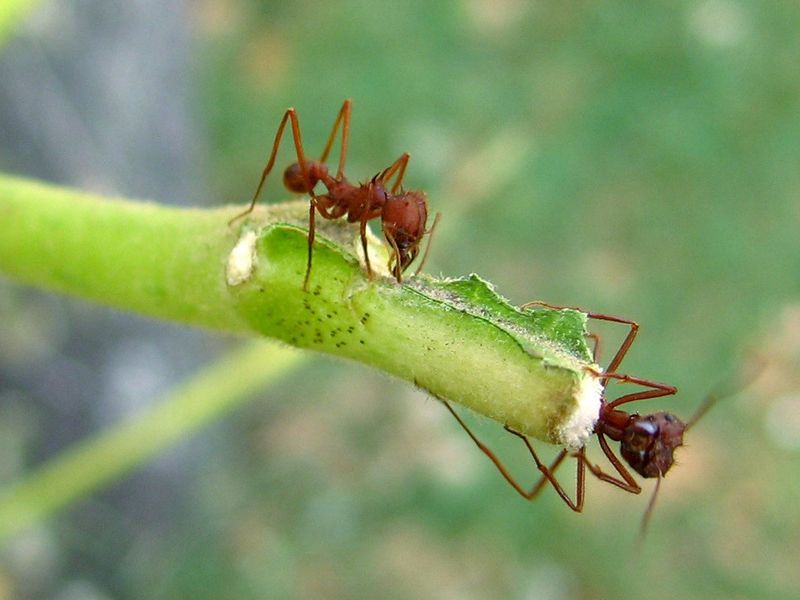
Workers remove leaves, buds, and flowers from ornamental plants, and their activity can leave a healthy shrub looking stripped in a matter of hours.
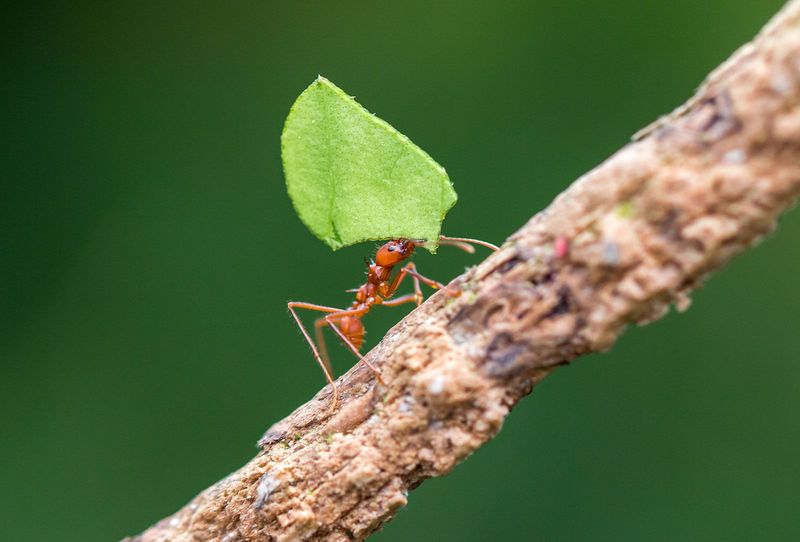
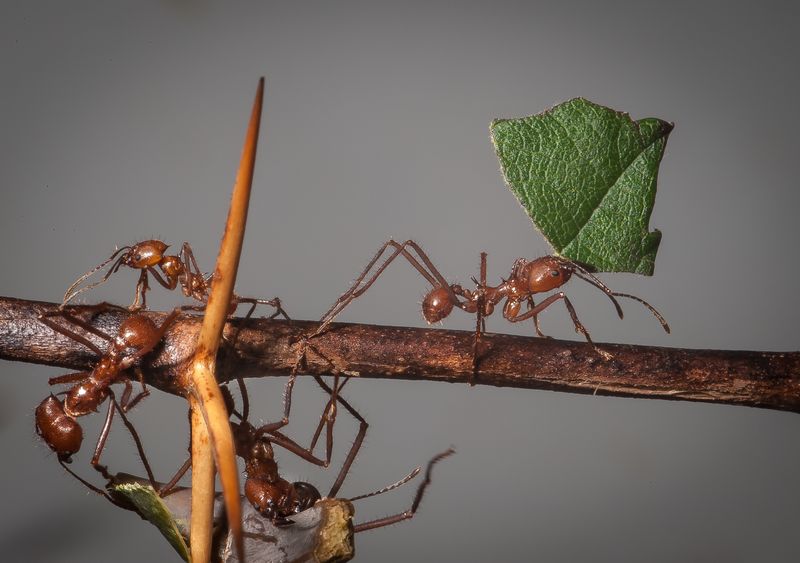
The workers themselves are distinctive once you know what to look for. They are rust-brown, vary considerably in size within a single colony, and carry three prominent pairs of spines on the thorax.
Their size variation is actually part of the identification: a foraging trail may show tiny workers alongside much larger ones, all moving in the same direction with leaf pieces held overhead like tiny sails.
Timing adds another layer to the picture. Workers forage mainly at night during warm weather, generally staying active between roughly 45 degrees F and 80 degrees F, which explains why damage appears to accumulate invisibly between dusk and dawn.
Research sampling Atta texana nests in Austin and Bastrop County confirms the species is well established in Central Texas habitats. Still, overnight defoliation on its own does not confirm the identification.
The ants, the carried fragments, and the mounds all need to be present together before the picture becomes clear.
Three clues strongly support the leafcutting-ant identification
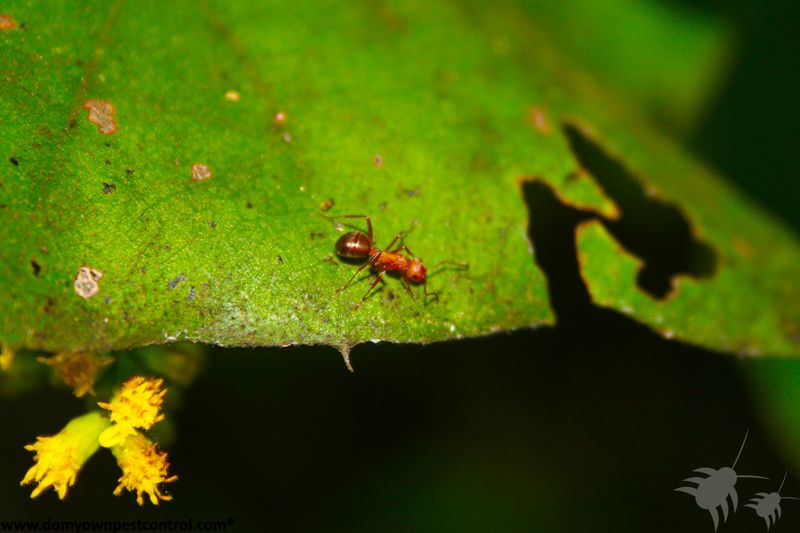
After dark is when the evidence becomes easiest to read. Grab a flashlight and head out to the damaged plant about an hour after sunset on a warm night.
What you are looking for is not just a few stray ants wandering near the roots, but an organized, purposeful column of workers moving in a clear direction, many of them holding leaf fragments overhead.
The first clue is the workers themselves carrying cut leaf pieces. A single ant hauling a fragment is interesting; a continuous stream of them moving along the same path is something else entirely.
Texas A&M’s leafcutting ant identification guidance describes workers as rust-brown and variable in size, with three pairs of thoracic spines, which sets them apart from the black or dark-brown ants more commonly found around homes.
The second clue is the trail itself. Texas leafcutting ants often maintain cleared, well-worn paths between their foraging sites and the nest.
These trails can extend a surprising distance across a lawn or garden bed, and they tend to look almost swept compared to the surrounding soil. Following the trail away from the damaged plant, rather than toward it, often leads toward the mounds.
The third clue is those mounds. Texas A&M’s Urban Entomology program describes leafcutting ant colonies as associated with multiple loose-soil mounds, generally with central openings, rather than a single compact hill.
When all three signs appear together, the combination strongly supports the leafcutting-ant identification, though it does not constitute a formally confirmed diagnosis. Observe from a comfortable distance without kicking, flooding, or probing the mound.
Disturbing it during your inspection can scatter workers, obscure the trail, and create risks you do not need while you are still gathering information.
The ants carry leaves to cultivate a fungus garden
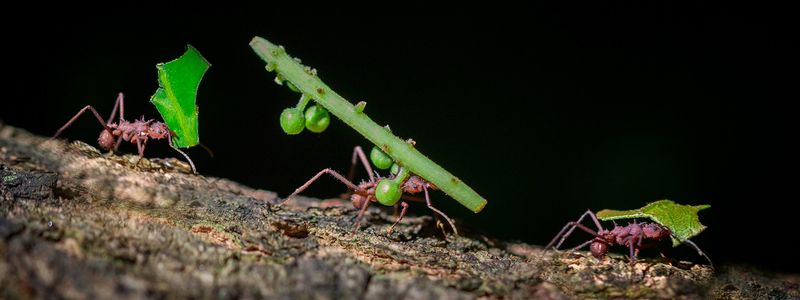
Watching a parade of leaf pieces march across a garden bed raises an obvious question: what are the ants actually doing with all that foliage? The answer is more surprising than most people expect.
The workers are not eating the rose leaves. They are farming.
Once workers cut a piece of leaf and carry it back along the surface trail, they deliver it to other workers inside the nest. Those workers chew and process the plant material into a pulpy substrate, then use it to grow a specialized fungus.
Texas A&M’s Urban Entomology program describes this clearly: the ants cultivate the fungus as their primary food source, not the leaves themselves. The foliage is the growing medium, not the meal.
The nest that houses this operation is far more complex than a typical ant hill. A USDA Forest Service excavation of a Texas leafcutting ant nest documented multiple distinct chamber types arranged deep underground: fungus gardens where the cultivated growth is tended, brood areas where eggs and larvae develop, detritus chambers where spent and exhausted substrate is deposited, and ventilation structures that regulate airflow through the whole system.
Fungus chambers can sit deeper than eight feet below the surface in mature colonies.
The phrase “marching the leaves underground” captures the visible part of this process, but the full journey is worth understanding. Workers carry fragments along surface trails and then down through nest openings, where the processing begins.
Not every fragment disappears underground the moment it is cut; the surface trail is the visible bridge between the cutting site and the nest entrance. Research on Atta texana fungus gardens in Central Texas has examined the microbial communities that share this underground agricultural system, underlining just how sophisticated and biologically active these colonies are beneath the soil.
A distant, extensive colony can affect many ornamental plants
One detail that surprises most homeowners is that the nest causing the damage may not be anywhere near the rose bush. Texas leafcutting ant workers can travel hundreds of feet along foraging trails, which means the nearest mound visible in your yard might not be the colony’s main structure at all.
Following the trail away from the damaged plant is a better clue to where the nest sits than looking directly beneath the stripped shrub.
The scope of potential damage reflects the colony’s size. Texas A&M’s field guide notes that foliage around a colony can be stripped across an area exceeding an acre under some conditions.
Workers remove leaves, buds, flowers, and other tender plant material from a wide range of ornamental plants, so a single active colony can affect roses, crape myrtles, fruit trees, and other garden plants in the same season. No evidence from the reviewed Texas sources establishes that roses are uniquely preferred; they fall within the broader category of ornamental plants that workers harvest.
Mature colonies compound this challenge by persisting for years and growing structurally extensive over time. Texas A&M’s Urban Entomology program reports that nest structures can cover more than half an acre in some cases, with chambers extending many feet underground.
The USDA Forest Service excavation study documented the sheer number of chambers and the depth of the network in a single nest, making clear why a surface treatment aimed at one mound opening is unlikely to reach the heart of the colony.
Understanding the colony’s scale helps set realistic expectations. A quick spray or a single mound drench is not going to resolve an established leafcutting ant infestation, and attempting one without the right product and label guidance can create new problems without solving the original one.
Leafcutting bees leave a different pattern
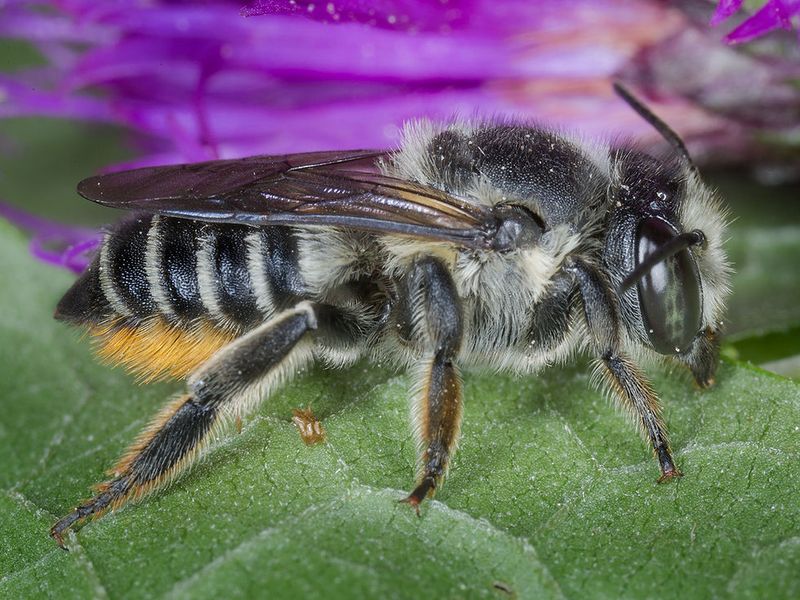
Before settling on any response, ruling out the most common look-alike is worth a few minutes of careful observation. Leafcutting bees, which belong to the family Megachilidae, also cut pieces from rose leaves and other garden plants, and at first glance the damage can seem similar to what ants produce.
The key differences show up quickly once you know what to compare.
Texas A&M’s field guide entry for leafcutting bees describes their cuts as neat, circular or oval notches taken from leaf edges, typically with clean, smooth margins. The bees are solitary, not colony-forming, and they use the cut pieces to construct small nest cells inside existing cavities such as hollow stems, holes in wood, or similar sheltered spaces.
There are no organized trails, no mounds, and no coordinated column of workers. A single bee makes its cuts and flies off alone.
Ant damage, by contrast, tends to involve larger quantities of foliage removed more rapidly, with workers moving in a visible organized stream. The rust-brown, spine-bearing workers and the surface trail are not features of bee activity at all.
If you check the plant after dark and find no ants carrying fragments, but the leaf edges show clean, rounded notches, a leafcutting bee becomes the more likely explanation.
University of Florida IFAS guidance on leafcutting bees notes that their damage is generally cosmetic and rarely causes serious harm to the plant. Insecticides are usually ineffective for stopping the cutting because the bees do not feed on the leaves; they collect the pieces for nesting material.
Physical barriers such as row cover or fine netting may offer more practical protection when the cutting is severe enough to warrant intervention. That said, a categorical claim that treatment is never warranted would go too far; if protection is necessary, the choice of method should reflect the specific situation rather than a blanket rule.
Choose cautious plant protection instead of an improvised mound treatment
Once observation strongly supports a leafcutting ant identification, the temptation to do something immediately is understandable. Resisting the urge to improvise is the most important step you can take at that point.
Gasoline, bleach, boiling water, kerosene, and fire are not safe or supported treatments for any ant nest, and Texas A&M’s Urban Entomology program specifically cautions that treating the nest is difficult and carries a risk of contaminating accessible water given the depth and complexity of the structure. None of those household options belong near a garden bed or a nest opening.
The safer first actions are documentation and restraint. Photograph the ants, the trail, the mounds, and the plant damage before doing anything else.
Note the trail’s direction and approximate length. This record helps a Texas AgriLife Extension agent or a licensed pest management professional assess the situation accurately, especially if the damage is recurring, severe, near a structure, or close to a waterway.
For those situations, professional help is not just convenient; it is genuinely the lower-risk path given how difficult large, mature colonies are to treat effectively.
If protecting a specific plant while you gather more information is a priority, any product you consider must carry a current label that explicitly covers ornamental roses or the relevant ornamental plant, lists leafcutting ants as a target pest, specifies the application site, and includes dosage instructions, pollinator precautions, and reentry requirements. EPA guidance on pesticide labels makes clear that the label is a legally enforceable document and that users must follow it exactly.
Reading and following the current label is not optional.
A historical Texas supplemental label for one granular bait product did list Texas leafcutting ants as a target pest, but that document specified bait stations and agricultural sites such as orchards, pastures, and forage fields. It was not written as a general recommendation for residential rose beds, and its historical scope does not translate automatically to a current homeowner solution.
Always verify that any product’s current label covers your specific situation before purchasing or applying it.
Use the evidence to decide what to do next
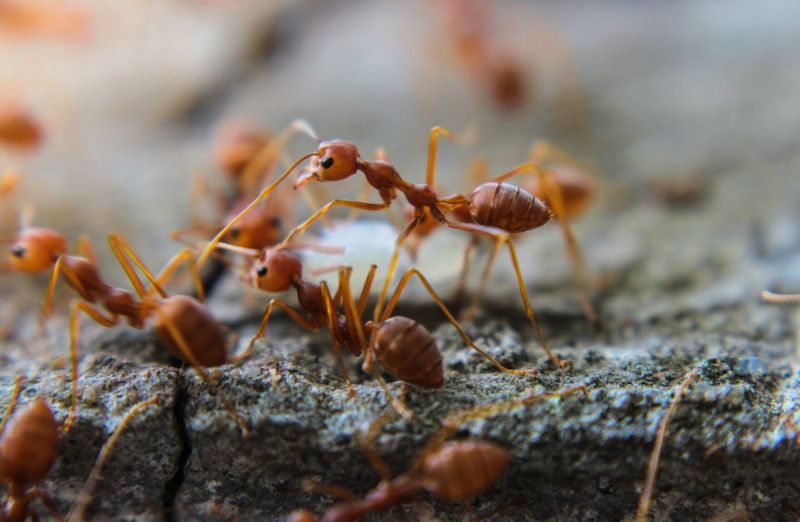
Putting the full picture together comes down to what you actually see. Nighttime or warm-weather leaf-carrying ants, an organized surface trail, and several loose-soil mounds with central openings make Texas leafcutting ants the leading identification in Central Texas.
Missing leaves alone, or clean circular notches with no ants in sight, point toward uncertainty or a different cause entirely, and treating for the wrong pest wastes time and money while leaving the real problem untouched.
Texas A&M’s identification and behavior descriptions support using the ant-plus-trail-plus-mound combination as the most reliable diagnostic pattern available to a homeowner without laboratory tools. Even when all three signs are present, the pattern is consistent with the identification rather than a formally confirmed diagnosis.
For consequential treatment decisions, especially near water, structures, or in cases of repeated severe damage, confirmation from a Texas AgriLife Extension agent or licensed professional is the safer standard. Texas A&M’s Urban Entomology program documents why improvised nest treatments often fail and can create new risks.
Careful observation costs nothing and protects your options. What you find after dusk, followed methodically and documented clearly, gives you and any professional you consult the best possible starting point.
A colony that farms fungus eight feet underground is not a problem that rewards impatience.