
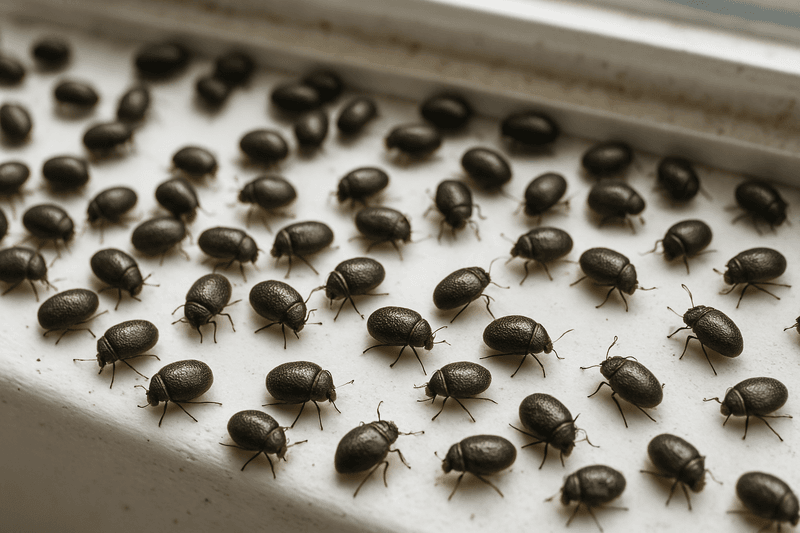
Stepping outside on a cool fall evening in Central Texas and finding a cluster of dark beetles battering your porch light can stop you in your tracks. Many homeowners immediately call them June bugs, but the timing raises a real question worth exploring before jumping to conclusions.
Getting the identification right matters, because the steps you take for a harmless light-attracted beetle are very different from what you would do if your lawn were harboring a damaging grub population below the surface.
A late-fall porch swarm is not automatically a June-bug flight
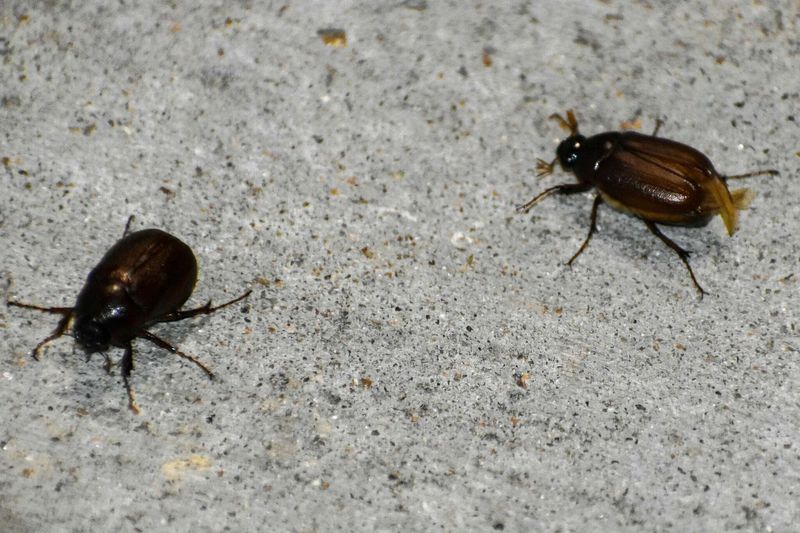
Seeing beetles pile up around a porch light in October or November in Central Texas does not automatically make them June bugs. According to Texas A&M AgriLife Extension’s field guide to common Texas insects, Texas June beetles are indeed strongly attracted to outdoor lights, but their principal adult flights run from late May in South Texas through early July in North Texas, with the Central Texas peak concentrated in mid-to-late June.
That timing puts a late-fall swarm well outside the typical window for this species.
What you are actually looking at in late fall could be any number of things: a different beetle species that happens to fly at night, a highly localized or unusually late emergence tied to specific microclimate conditions, or simply a case of mistaken identity based on size and color. Texas has more than 100 species in the scarab beetle family alone, and plenty of other beetle families also show up at artificial lights after dark.
None of those possibilities can be ruled out by looking at the cluster from across the porch.
The practical implication is that a late-fall observation should be treated as uncertain rather than confirmed. Texas A&M Extension entomology resources on hay and pasture insects reinforce that May and June beetle adults are associated with spring and early summer light activity, not fall flights.
Before labeling the insects and deciding on any response, photograph them up close or collect a specimen in a jar. A clear image showing body shape, leg arrangement, and surface texture gives you something to work with, rather than a guess made in the dark.
Use appearance as a clue, not a diagnosis
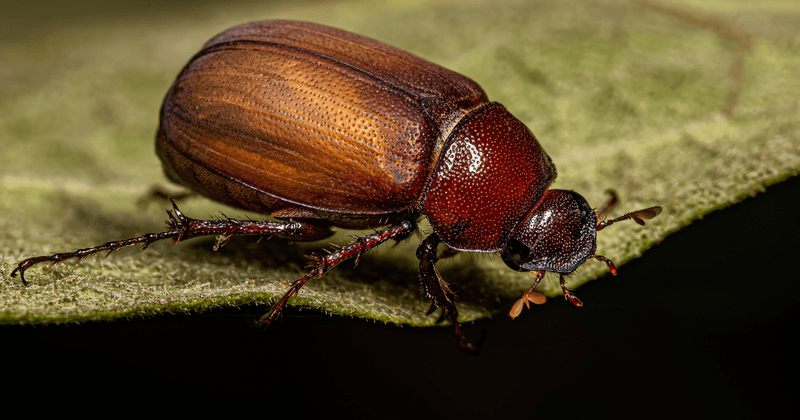
Color is one of the first things people notice, but color alone cannot close the case on beetle identification. A typical Texas June beetle is reddish-brown to brown and measures roughly one-half to five-eighths of an inch long, with a smooth, somewhat glossy surface.
If the beetles at your light look uniformly black rather than reddish-brown, that difference is worth noting before you settle on a species name.
The phrase “June bug” is a common name applied to several different scarab beetles, and the Texas A&M field guide to June beetles points out that Texas alone has more than 100 species in the relevant scarab groups, with only a few regularly damaging turf. One beetle that often causes confusion is the green June beetle, which is metallic green and feeds on overripe fruit as an adult.
Its larvae generally consume decaying organic matter rather than living turf roots, so it represents a different management situation entirely. A beetle that appears black at night under artificial light could be a dark-colored scarab, a ground beetle, or something else altogether.
Texas A&M AgriLife Extension guidance on white grubs in Texas turfgrass emphasizes that species identification matters for management decisions, because different beetles have different larval habits and damage potential. When the identification genuinely affects what you plan to do next, photograph the beetle in good light, note the body length, surface texture, and any sheen, and submit the image or a specimen to your county Texas A&M AgriLife Extension office.
County agents can often confirm or narrow the identification quickly.
One safety note worth keeping in mind: avoid picking up unidentified dark beetles with bare hands. Some Texas blister beetles are attracted to lights and produce a compound called cantharidin that can raise painful blisters on skin.
Texas A&M’s guide to venomous terrestrial animals of Texas notes that blister beetles are a real concern in the state. Use gloves, a jar, or a piece of stiff cardboard to handle any unidentified beetle until you know what you are dealing with.
Porch lights can concentrate beetles without causing a lawn problem

Adult beetles that fly at night use light as a navigational reference, which is why a bright porch fixture can pull them in from a surprising distance. Male scarab beetles are especially drawn to windows and outdoor lights during mating flights, so a large congregation on the porch does not necessarily mean the beetles are feeding, breeding, or establishing a population in your immediate area.
They may simply be disoriented travelers passing through.
Reducing that attraction is the most straightforward first step. Texas A&M Extension’s white grub identification and control guide notes that turning off unnecessary porch lights, adding timers or motion sensors so fixtures stay on only when needed, shielding the bulb so light does not spill outward, and choosing warmer-colored or lower-intensity bulbs are all reasonable ways to reduce beetle congregation.
None of these steps will guarantee a beetle-free porch, but they can make the fixture considerably less attractive.
For beetles that make it inside, Texas A&M AgriLife Extension advice on bugs in windowsills recommends vacuuming or sweeping individual beetles rather than crushing them, and keeping screens tight and door seals in good condition to reduce entry points. Closing blinds or curtains when interior lights are on also limits the glow that reaches outside and pulls insects toward the glass.
DarkSky International’s home outdoor lighting assessment recommends useful, targeted, low-level, controlled, and warm-colored lighting as a general framework for reducing unwanted insect attraction while still meeting practical outdoor lighting needs. Warmer amber tones emit less of the short-wavelength blue and ultraviolet light that many beetles and moths find most compelling, though no bulb eliminates attraction entirely.
Brightness, placement, shielding, and how long the light stays on all factor into how many insects end up at your door.
Adult beetles and lawn grubs are separate questions
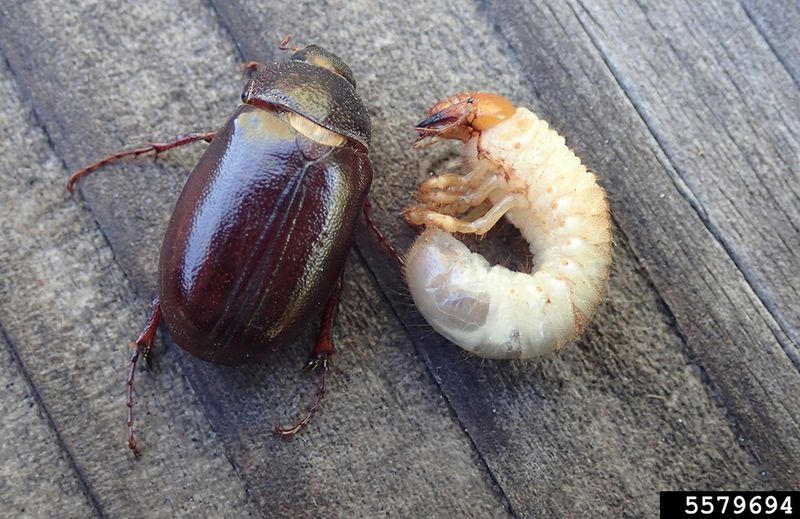
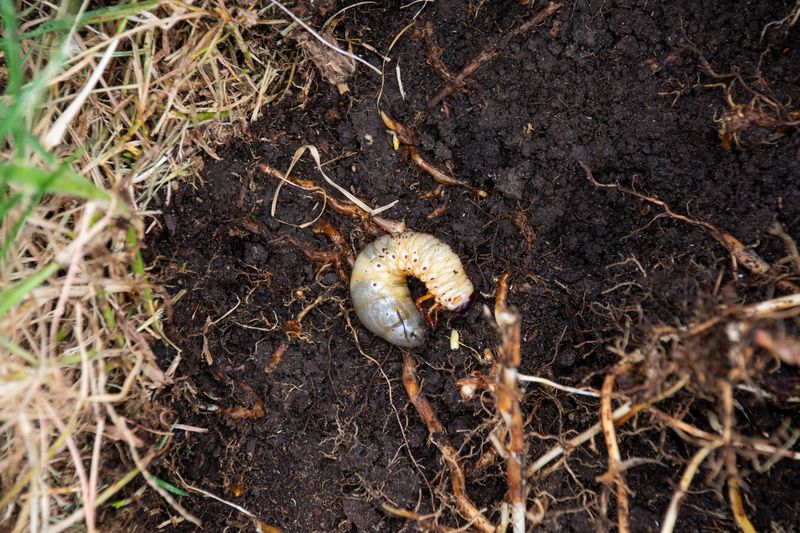
Adult beetles flying around a porch light and white-grub larvae feeding below the lawn are two completely separate life-cycle stages, and one does not automatically prove the other is a problem. Texas A&M’s June beetle field guide describes the larvae as cream-colored, C-shaped grubs with brown head capsules and three pairs of legs near the head.
These larvae live in the soil and feed on grass roots during summer and fall, while adults emerge earlier in the year to mate and are then attracted to lights at night. The two stages overlap in time only loosely, and the adults you see in late fall may not even belong to the same local population as any grubs living in your soil.
Texas A&M AgriLife Extension guidance on June bugs and grubs makes the point clearly: seeing adult beetles around a light does not establish that the lawn has a damaging grub population. Texas has more than 100 related scarab species, and only a few of them commonly cause turf damage.
Some scarab larvae feed primarily on decaying organic matter and leave living grass roots largely untouched. The beetles at your light could belong to one of those non-damaging groups, or they could be a completely different beetle family with no soil-feeding larval stage at all.
There is also a practical limit to what porch-side intervention can accomplish. University of Minnesota Extension’s guidance on turf-damaging beetles notes that adult beetles are mobile and can fly in from neighboring properties or unmanaged areas, so addressing adults at the light does not reliably prevent larvae from developing in your soil, and treating grubs in your lawn will not stop adults from flying in from elsewhere.
Managing the porch nuisance and managing a turf grub problem are two distinct tasks that call for different approaches.
Inspect the turf before blaming grubs
Brown or thinning grass in a Central Texas yard during fall can have a long list of causes, and grubs are only one of them. Drought stress, irrigation problems, fungal disease, billbugs, and other soil insects can all produce irregular yellow or brown patches, weakened turf, and grass that looks like it is giving up.
Blaming grubs without checking the soil first risks missing the real cause and spending time and money on the wrong fix.
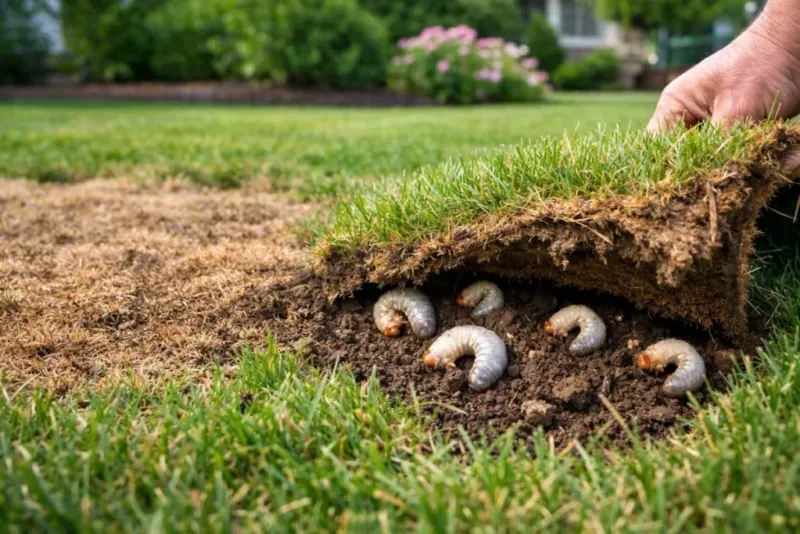
The most reliable way to know whether grubs are present is to look for them directly. Texas A&M AgriLife Extension’s June bugs and grubs guidance recommends inspecting the boundary between healthy turf and declining turf, where grub feeding is most likely to be active.
Dig several samples roughly 6 inches across and 4 inches deep in the upper root zone, then sift through the soil and thatch looking for the cream-colored, C-shaped larvae. Also look at the roots themselves: turf damaged by grubs often has roots that have been eaten away at the crown, and grass in those spots will pull up easily, almost like lifting a loose mat.
Texas A&M AggieTurf’s white grub resource lists bermudagrass, zoysiagrass, buffalograss, St. Augustinegrass, and some cool-season grasses as principal turf hosts in Texas. Damage is most often noticed in summer and fall when larvae are actively feeding below ground, even though the adult beetles emerged months earlier.
Checking multiple spots across the lawn, not just one area, gives a more accurate picture of grub density across the property.
Birds pecking at the lawn or mammals digging shallow holes overnight can signal grub activity below the surface, but wildlife digging is a clue rather than confirmation. Utah State University Extension’s May/June beetle guide notes that animals foraging for grubs can create their own visible damage on top of whatever the larvae have already done.
If you see digging, follow up with a soil inspection rather than assuming the digging itself proves a June beetle infestation.
Base treatment on evidence and local timing
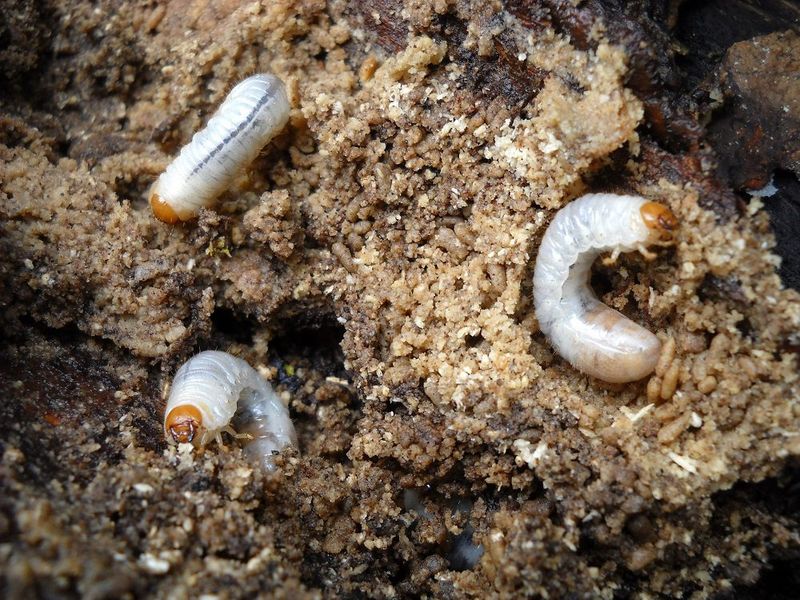
Finding some grubs in the soil does not automatically mean a treatment is necessary. Texas A&M AggieTurf’s white grub page presents roughly 5 to 10 grubs per square foot as a practical range above which turf damage becomes more likely.
That range is not a universal trigger, because turf health, grass species, soil type, and how recently the lawn has been stressed all affect how much root loss the grass can tolerate before it shows visible decline. A dense, well-irrigated St. Augustine lawn in good health may handle a moderate grub load better than a drought-stressed bermudagrass lawn under water restrictions.
Timing matters as much as density. Texas A&M AgriLife Extension’s white grubs in Texas turfgrass publication identifies June as the general treatment window in South Texas and early July in North Texas, when young grubs are still small, feeding close to the surface, and easier to reach with an applied product.
By late fall, grubs in many areas have grown larger, moved deeper in the soil profile, and may have slowed or stopped feeding in response to cooling temperatures. A treatment applied at that point may not reach the larvae or find them in a vulnerable feeding stage, which limits its practical value.
Texas A&M Extension’s white grub identification and control guide emphasizes that any chemical or biological treatment needs irrigation to move through the thatch layer and into the root zone where grubs live. Product choice, application rate, watering instructions, re-entry intervals, and precautions for runoff and non-target organisms must all come from the current product label and current local Extension recommendations, which can be updated as new resistance patterns or environmental concerns emerge.
Routine preventive applications based only on the number of beetles seen at the porch light are not supported by Texas A&M’s guidance on June beetles. Treatment decisions should rest on confirmed grub presence, observed turf symptoms, larval density above the practical risk threshold, and current local advice, not on how many beetles circled the light the previous evening.
Use a measured plan for the porch and lawn
Keeping the porch nuisance and the turf question separate from the start makes both problems easier to manage. For the porch, the first moves are practical and low-cost: reduce unnecessary light by putting fixtures on timers or motion sensors, shield the bulb so light does not spill outward in all directions, and switch to a warmer, lower-intensity bulb where that is feasible.
Texas A&M Extension’s white grub identification and control guide and DarkSky International’s home lighting assessment both support targeted, shorter-duration, warmer lighting as a way to reduce insect congregation without eliminating outdoor lighting entirely.
For beetles that make it inside, vacuum or sweep them up rather than crushing them against your skin. Texas A&M’s venomous terrestrial animals guide notes that blister beetles present in Texas can cause skin reactions on contact, so handling unidentified dark beetles bare-handed is not worth the risk.
Keep screens tight, seal gaps around doors, and close blinds when interior lights are on. These steps, combined with Texas A&M Extension’s windowsill bug guidance, address the congregation problem without requiring any chemical application.
For the lawn, photograph the beetles and collect a specimen if you can, then inspect the turf with a trowel before reaching for any product. Let grub count, visible root damage, turf symptoms, and current local Extension guidance drive that decision, not the size of the cluster at the light.
The beetles on your porch and the grubs in your soil may not even be the same species, and a yard that looks healthy after a proper inspection rarely needs treatment just because the light was busy one October night.