
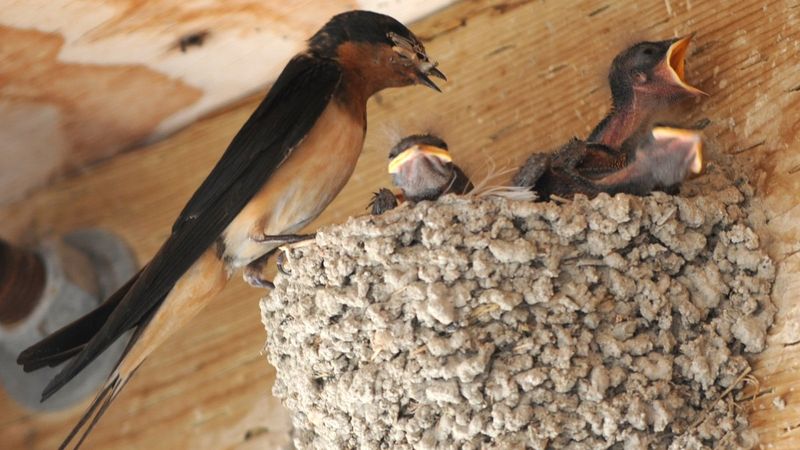
Barn Swallows swooping under a Texas porch or eave are one of summer’s more striking sights, and plenty of homeowners assume the birds are quietly clearing out every mosquito in the yard. That assumption is understandable, but the full picture is more complicated and more interesting. Understanding what these birds actually eat, how they behave around nests, and what Texas law says about them gives you a much more useful guide than a simple promise of a bug-free summer.
What Barn Swallows actually eat
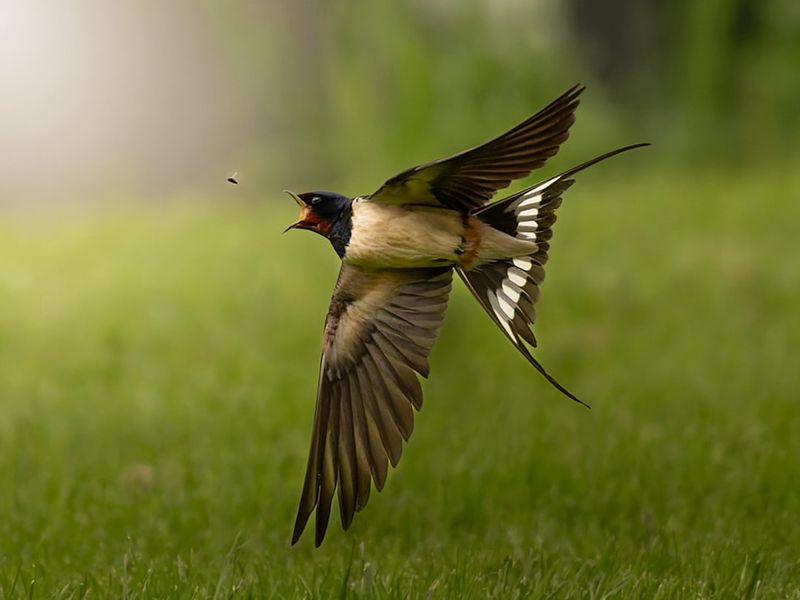
Barn Swallows (Hirundo rustica) are built for one job: catching insects while airborne. Their wide, flat bills, long pointed wings, and deeply forked tails let them maneuver quickly through open air, snapping up prey without ever landing. Nearly every calorie they consume comes from flying insects, and University of Maryland Extension puts the insect share of the diet at roughly 99.8 percent.
Flies make up the largest documented portion of what Barn Swallows eat. Cornell Lab of Ornithology identifies flies as the dominant prey group, with beetles, moths, wasps, true bugs and other flying invertebrates filling out the rest. Mosquitoes can appear in that mix, but they are one possible prey type among many rather than a target the birds reliably pursue.
Texas Parks and Wildlife recognizes the species as genuinely useful around homes and farms precisely because of this broad appetite for flying pest insects. That ecological value is real. What it does not mean, though, is that a nest under your eave will produce a measurable drop in the number of insects flying around your yard. The birds consume what is available and abundant, and in most Texas settings that means flies far more often than mosquitoes.
Texas Parks and Wildlife’s backyard wildlife guide describes Barn Swallows as beneficial consumers of flying pests without making a specific claim about how many insects disappear from any given property. That careful framing is worth keeping in mind whenever you read a stronger promise about what nesting swallows will do for your outdoor comfort.
Why eating mosquitoes does not prove mosquito control
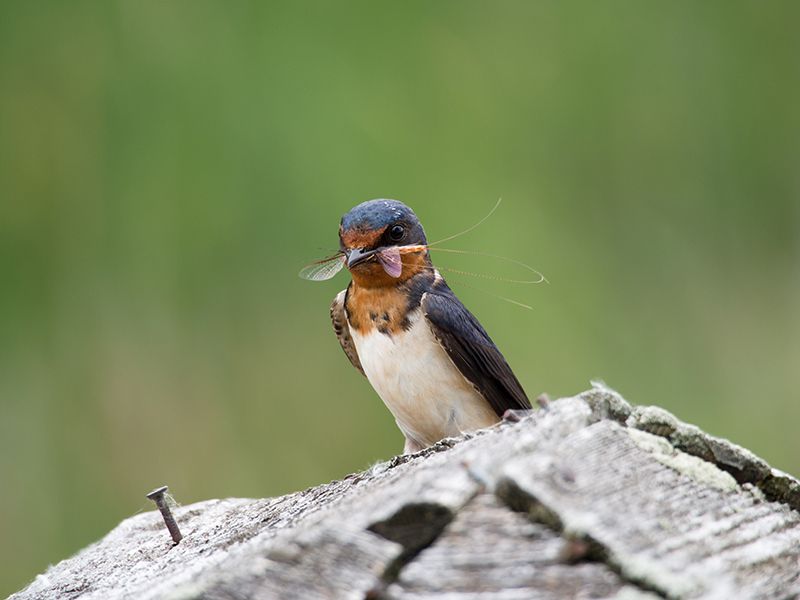
Capturing a mosquito occasionally is not the same thing as keeping mosquito numbers down. That distinction matters more than it might seem, and the research on bird diets backs it up clearly.
DNA-based diet studies on Barn Swallow nestlings show a broad, flexible menu dominated by terrestrial flies, with the exact mix shifting depending on what insects happen to be available at a given time and place. Researchers found that larger prey items were selected more often when they were accessible, and that the overall diet composition changed with local conditions. None of those studies produced a mosquito-removal rate or showed that nesting birds reduced mosquito populations around a home.
A wider review of the evidence on mosquito predators found that insectivorous birds generally consume mosquitoes as a small fraction of their total diet and often shift to other invertebrates when those are more abundant. That review, published in peer-reviewed form and summarized in an evidence synthesis on mosquito predators and ecological control, concludes that predator pressure from birds does not reliably suppress mosquito abundance at the landscape or household level.
The reason is straightforward: mosquitoes breed in standing water, and a bird eating adults at dusk does not prevent larvae from developing in a clogged gutter or forgotten bucket fifty feet away. A Barn Swallow nest could coincide with a summer that feels less buggy for all kinds of reasons, including weather, wind, and how much standing water you happen to have on your property. Attributing that outcome to the swallows alone would be a mistake.
Treating the birds as one helpful part of a yard ecosystem is accurate and fair. Treating them as a dependable mosquito-control system is a different claim, and the available research simply does not support it for Texas homeowners or anyone else.
The habitat Barn Swallows need near Texas homes
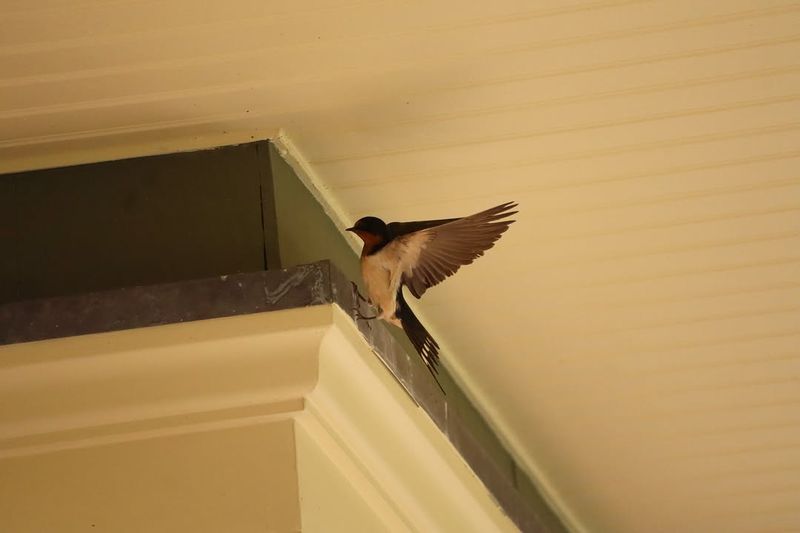
A Barn Swallow does not show up under your eave by accident. Three conditions generally need to be in place at the same time: a sheltered structure suitable for attaching a mud nest, open space nearby where flying insects are accessible, and a source of wet mud or similar material for building the nest cup itself.
According to the Government of Canada’s Barn Swallow residence description, suitable foraging habitat typically includes fields, pastures, water bodies and woodland edges where flying insects concentrate close to ground level. Barn Swallows hunt low over open terrain, so dense tree canopy or enclosed spaces are not useful foraging areas for them. A Texas property with a mix of open lawn, adjacent pasture or a nearby pond or creek edge is a much better candidate than a heavily wooded suburban lot.
The nesting structure itself needs a horizontal ledge or surface protected from rain, usually under a roof overhang, bridge, or similar shelter. The birds construct cup-shaped nests from mud pellets mixed with grass and feathers, so a patch of bare, moist soil or a muddy bank within reasonable flight distance matters too. Without accessible mud, nest construction stalls or does not start.
Recognizing those three requirements helps set realistic expectations. A nest under your eave tells you that your property currently meets the birds’ basic needs. It does not tell you that your yard will have noticeably fewer mosquitoes this summer. Swallows nest where conditions suit them, and they forage across whatever insects are locally abundant, not specifically where mosquitoes breed.
Texas Parks and Wildlife’s guidance on backyard wildlife treats those conditions as worth supporting for their ecological value, not as a pathway to mosquito suppression.
Ways to support nesting without promising results
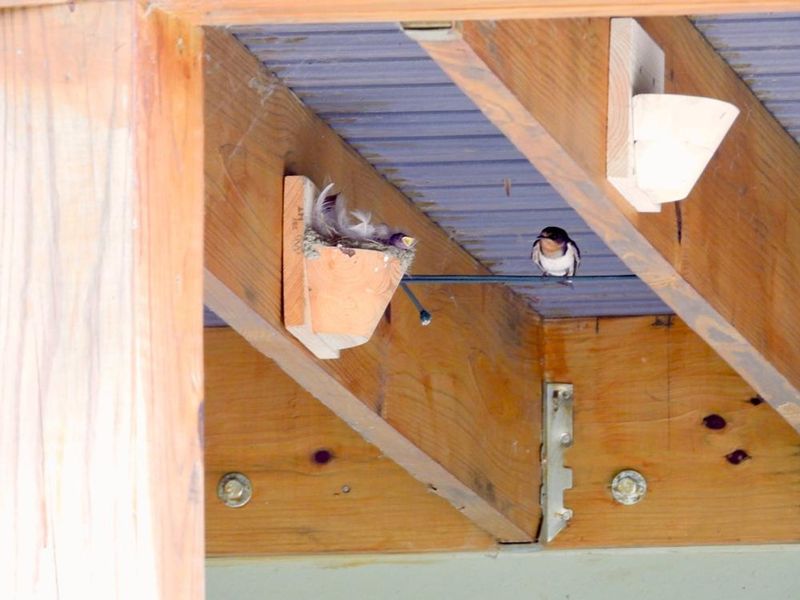
Homeowners who want to encourage Barn Swallows have a few practical options, none of which come with a guarantee that birds will actually use them. The most straightforward is simply leaving a suitable eave undisturbed if you can tolerate the nesting activity and the cleanup it involves. Birds that have used a site before are more likely to return to it, so avoiding unnecessary disturbance during the nesting season helps.
If you would rather redirect nesting away from a high-traffic entry or a spot where droppings cause problems, a wooden nesting shelf or platform mounted in a quieter location is worth trying. Rutgers New Jersey Agricultural Experiment Station guidance on supporting Barn Swallow colonies suggests mounting artificial nest cups with roughly three inches of clearance between the top of the cup and the ceiling or overhang, positioning them at least six feet above ground, and placing them away from areas where predators can easily reach the nest. Their suggested wooden platform dimensions run approximately three to five inches wide and six to eight inches long. Those figures are general wildlife-management guidance, not a promise that Texas swallows will accept a structure.
Texas Parks and Wildlife specifically recommends nesting platforms as an alternative location for Barn Swallow nests near buildings, which is a useful middle ground for homeowners who appreciate the birds but need to protect a particular surface.
A few things are not worth trying: planting specific flowers, adding feeders, or setting out a birdbath will not draw Barn Swallows. They are attracted by nesting structure, open aerial-foraging habitat, and mud access, not by garden plantings or supplemental food. An unmanaged birdbath can also create the standing water that mosquitoes need to breed, which works directly against your other management goals. Keep any water feature clean and refreshed at least weekly if you choose to have one.
Understand the mess and protect active nests
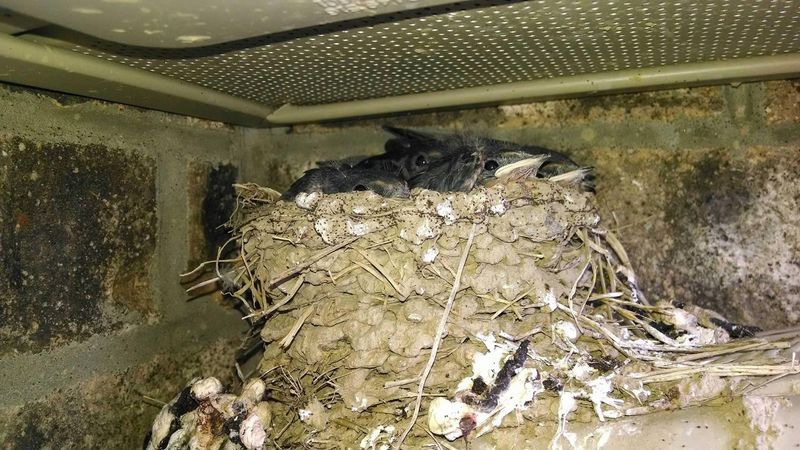
Sharing your eave with a nesting pair of Barn Swallows comes with real trade-offs that are worth knowing before the birds arrive rather than after. Mud is the first issue: the birds carry wet mud pellets to the nest site repeatedly during construction, and some of that material lands on walls, trim and surfaces below. Droppings accumulate under an active nest throughout the season, and in a busy spot that can mean a noticeable deposit by the time the young fledge.
Noise and activity pick up when nestlings are being fed, and parent birds may fly close to people who approach the nest area. That defensive behavior is normal and typically stops short of contact, but it can be startling near a doorway or frequently used path. Choosing a platform location away from high-traffic areas, as discussed in the previous section, reduces how often that happens.
More critically, once eggs or chicks are present, the nest cannot legally be touched. The U.S. Fish and Wildlife Service states clearly that active nests containing eggs or young may not be disturbed or destroyed without a federal permit under the Migratory Bird Treaty Act. Texas law adds a parallel layer of protection: the Texas Parks and Wildlife Code prohibits disturbing or destroying the nest, eggs, or young of nongame birds, including swallows.
Violating either law can result in significant penalties.
If a nest is causing a genuine safety hazard, the right step is contacting the U.S. Fish and Wildlife Service or Texas wildlife authorities for guidance, not attempting a DIY solution. USFWS is direct on this point: repellents are ineffective against nesting swallows, and no toxicants or pesticides are registered for controlling them. Texas Parks and Wildlife’s nesting swallows guide notes that the most effective management involves preventing nest establishment before eggs are laid, using physical barriers installed outside the nesting season.
An inactive nest from a previous year can generally be removed once the birds have departed, but confirm the nest is truly empty before doing so.
Set realistic Texas timing and identification expectations
Knowing when Barn Swallows are actually present in Texas matters if you are trying to set realistic expectations about any benefit they might provide. Texas Parks and Wildlife lists early March to early April as the migration timing for Barn Swallows across most of Texas. That is a useful general window, but it describes when migrants are moving through or arriving, not a complete statewide nesting and foraging calendar. Local nesting start dates, peak foraging periods, and departure timing all vary by region, habitat quality, and year-to-year weather conditions.
The Gulf Coast, the Hill Country, and the Panhandle can behave quite differently.
A Barn Swallow nest under a particular eave does not tell you that a large colony is operating nearby. The species often nests singly or in small groups, while other swallow species, including Cliff Swallows, tend toward larger colonial arrangements. UC IPM’s profile of Cliff Swallows illustrates how different the nesting habits and colony sizes of related species can be. Applying Barn Swallow-specific expectations to a Cliff Swallow colony, or vice versa, leads to incorrect assumptions about behavior and legal obligations.
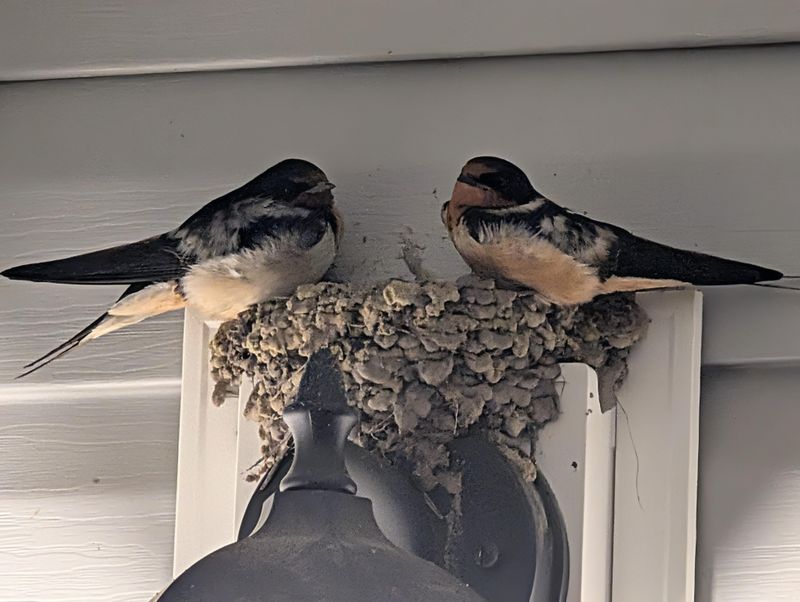
Before acting on any species-specific advice, confirm which swallow is actually nesting at your property. Barn Swallows have a distinctive rusty-orange throat patch and a deeply forked tail that sets them apart from most other swallows found in Texas. If identification is uncertain, a local birding group, the Cornell Lab’s All About Birds resource, or a Texas Master Naturalist can help. Getting the species right first means the guidance you follow actually applies to the birds on your eave.
Control mosquitoes where they breed
Whatever Barn Swallows eat on any given evening, they cannot reach the mosquitoes that have not hatched yet. Mosquito control that actually works starts at the water surface, and that part of the job belongs entirely to the homeowner.
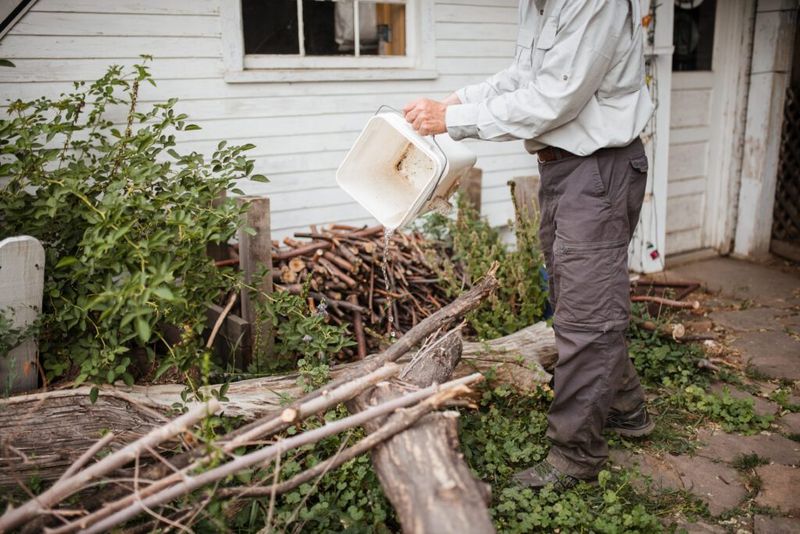
CDC guidance on mosquito control at home centers on a weekly routine: empty and scrub, cover, turn over, or remove any container that holds water. The list of likely culprits in a Texas backyard is longer than most people expect. Buckets, planters, children’s toys, old tires, flowerpot saucers, trash container lids, tarps that collect rain, and ornamental pots with drainage trays all qualify. A birdbath left unchanged for more than a week can become a productive breeding site.
Even a small amount of standing water, enough to fill a bottle cap, is sufficient for some mosquito species to complete their early life stages.
Scrubbing container walls matters as much as dumping the water. Mosquito eggs can stick to surfaces and survive drying, so rinsing alone is not sufficient. Getting into the habit of doing a weekly walk-around of your property, especially after Texas summer rainstorms refill containers you thought were empty, removes breeding habitat before the next generation of adults emerges.
Inside and around the home, screens on windows and doors, keeping doors closed when not in use, and wearing EPA-registered insect repellent during peak mosquito activity hours add up to meaningful bite reduction. Those measures work regardless of whether Barn Swallows are nesting nearby. Supporting the birds and following source-reduction practices are not competing choices; they can coexist. The critical point is that swallow activity is not a reason to skip any step of the routine that CDC recommends, because the birds operate on a completely different part of the mosquito life cycle than any of those measures address.
The useful answer is support, not a mosquito guarantee
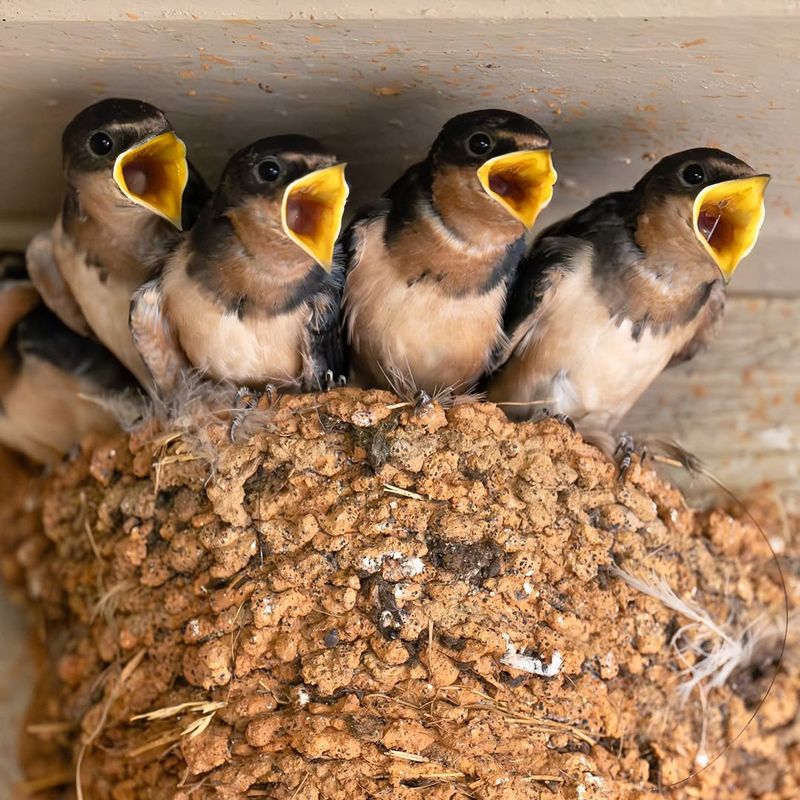
Barn Swallows are genuine aerial insect predators, and their appetite for flies and other flying insects makes them a welcome part of a healthy yard ecosystem in Texas. Texas Parks and Wildlife recognizes that value in its backyard wildlife guidance, and it is a reasonable basis for choosing to support nesting birds when your property and tolerance for the associated mess make that practical.
What the birds cannot do is serve as a reliable mosquito-control system. The research on insectivorous birds and mosquito predation does not establish that nesting Barn Swallows reduce mosquito abundance around homes, and their diet shifts with whatever prey is locally available rather than tracking mosquito populations specifically. Counting on swallows to keep your evenings comfortable is not a plan the evidence supports.
The practical answer for Texas homeowners is to do both things separately. Support nesting when you can accept the legal responsibilities and the physical realities of mud and droppings. At the same time, follow CDC’s source-reduction and bite-prevention steps every week through the summer, because standing water removal and personal protection are the measures that actually move the needle on mosquito exposure. A yard with nesting swallows and no standing water is a better place to spend a July evening than a yard with swallows and a forgotten bucket of rainwater by the fence.