
Spotted lanternflies are spreading across North Carolina, and homeowners are right to look for practical ways to fight back. One idea making the rounds is that a single native tree can starve the pest right out of your yard, but the science tells a more complicated story.
The real opportunity is removing the invasive tree that lanternflies love most, then replacing it with a native tree that genuinely belongs in a North Carolina landscape. Eastern redbud fits that role well, and this article explains exactly how to use that swap as part of a broader, realistic yard strategy.
Eastern redbud is a replacement, not a starvation tool
The idea that one native tree can starve spotted lanternflies out of your yard is appealing, but no reliable evidence supports it. NC State Extension’s spotted lanternfly guidance documents more than 100 host plant species, including native North Carolina trees such as black gum, black walnut, maple, oak, dogwood, sassafras, serviceberry, tulip poplar, ash, and sycamore.
Replacing one tree, however well-chosen, does not remove the pest’s other options in or around your yard.
Eastern redbud earns its place as a native replacement candidate on horticultural grounds, not pest-control grounds. NC State’s plant profile for eastern redbud describes it as a native, low-maintenance understory tree suited to a wide range of North Carolina conditions.
Those qualities make it a sound choice when you are looking to fill the gap left by a removed invasive tree, but they do not give it any special ability to block lanternfly visits or feeding.
The narrower, defensible benefit works like this: NC State Extension identifies tree-of-heaven as invasive and a preferred spotted lanternfly host, so removing it reduces one major food source while improving native-plant composition. Planting redbud in its place improves habitat and landscape character.
What it cannot do is prevent lanternflies from arriving, feeding on other plants, or moving through the yard from neighboring properties. The rest of this article covers host reduction, correct removal, and monitoring, because those steps carry the real pest-management weight.
Tree-of-heaven is the higher-priority target
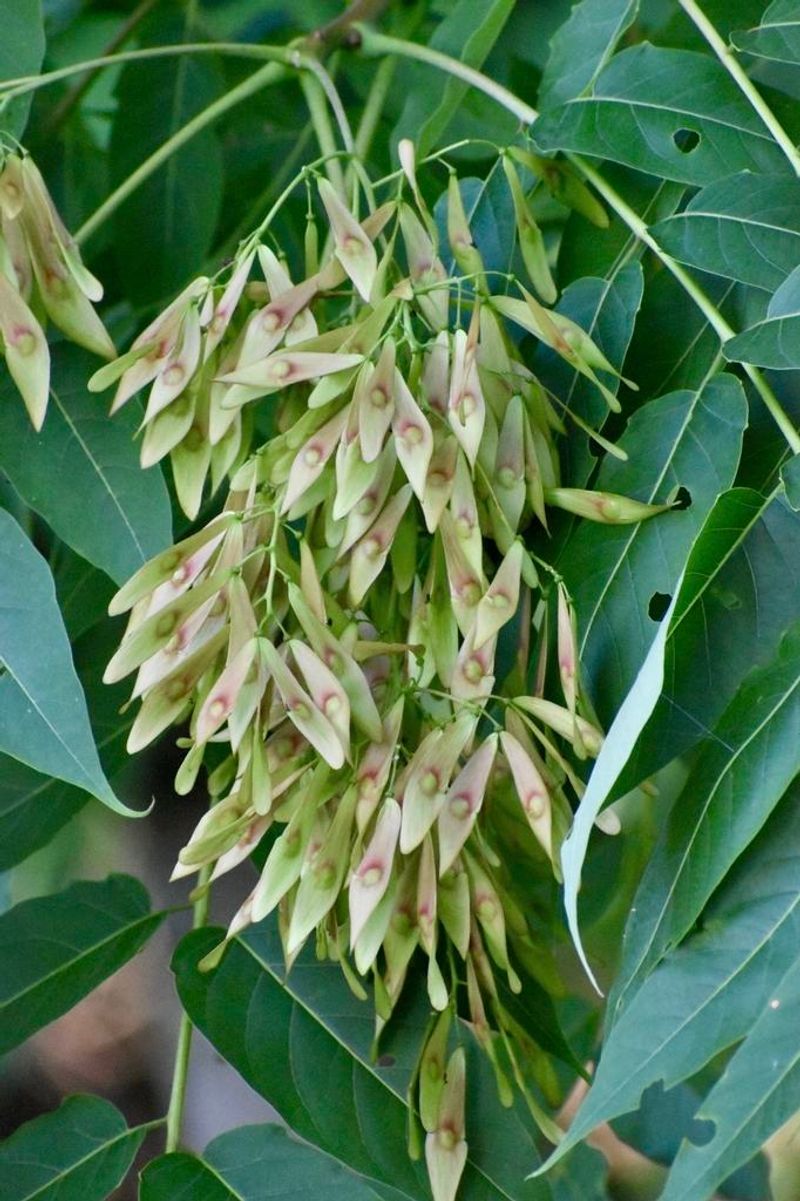
Before choosing a replacement tree, the priority is identifying and removing the plant that makes your yard most attractive to spotted lanternflies in the first place. Tree-of-heaven (Ailanthus altissima) is an invasive species that has spread across North Carolina roadsides, fence lines, and disturbed areas, often going unnoticed until it is well established.
NC State Extension’s tree-of-heaven guide confirms that removing it can eliminate a preferred host and give native plants a better chance to fill the space.
Research published and summarized in a peer-reviewed study on spotted lanternfly host performance shows that tree-of-heaven is a highly preferred host, particularly for later-stage nymphs and adults. That preference matters because a yard with tree-of-heaven in it is likely drawing more lanternfly pressure than a yard without it.
Removing the tree reduces that pull even if it does not eliminate the pest entirely.
The important qualifier is that “preferred host” is not the same as “required host.” Spotted lanternflies can survive and develop on other plants when tree-of-heaven is absent, though performance and egg production may vary. Nearby grapes, fruit trees, maples, walnuts, and other common landscape plants can still support or attract the insect after tree-of-heaven is gone.
Penn State Extension’s spotted lanternfly management guide describes SLF management as site-specific, with adults capable of flying in from surrounding properties. The right frame is not finding a magic replacement tree but rather removing a problematic invasive host as the first concrete step, then assessing the rest of the landscape.
Spotted lanternflies can use more than one kind of tree
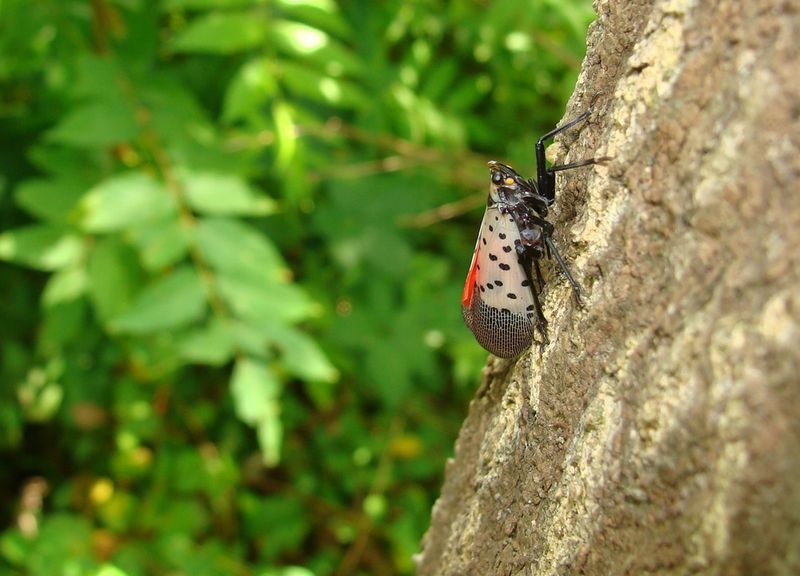
Spotted lanternfly earns the label “generalist feeder” for good reason. A study published in Environmental Entomology on SLF distribution, survival, and development across North American host plants documents feeding associations across dozens of woody species, including black walnut, willow, maple, tulip tree, oaks, birches, grapes, fruit trees, and common ornamentals.
That list keeps growing as researchers observe the insect in new areas and on new plants.
Several native North Carolina trees that are often promoted as replacements for invasive species also appear on host or observation records. Black gum, sassafras, serviceberry, red maple, black walnut, dogwood, and tulip poplar have all been noted in NC State Extension’s spotted lanternfly publication as species the insect has been observed on.
Seeing a tree on that kind of list does not automatically mean lanternflies will thrive on it or complete their full life cycle there, but it does mean no native tree should be marketed as guaranteed pest-proof.
Three categories matter here, and keeping them separate helps homeowners set realistic expectations. A “reported host” is any plant where eggs, nymphs, or adults have been observed, even briefly.
A “preferred host” is one the insect consistently seeks out and feeds on heavily. A plant that supports complete development through all life stages is rarer still and represents the highest level of concern.
Most plants on broad observation lists fall into the first category, not the third.
Adults are capable fliers and can arrive from neighboring properties that still have tree-of-heaven, grapes, or other attractive plants. Nymphs move readily among multiple plant species within a single yard.
The host-performance research reinforces what Penn State Extension notes: there is no single-plant solution, and a whole-landscape view is the more useful approach.
Eastern redbud fits many North Carolina landscapes
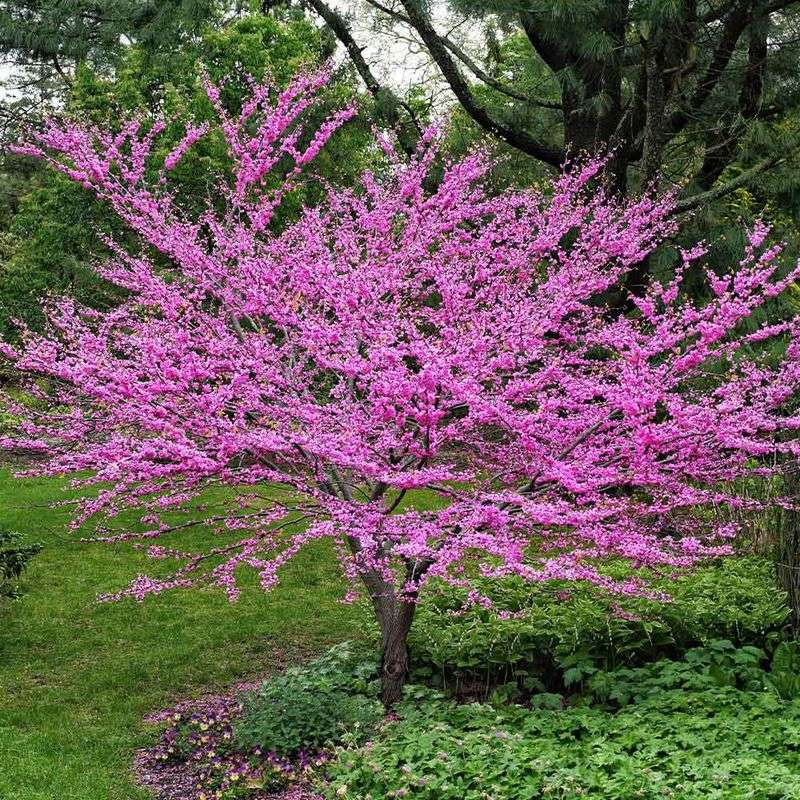
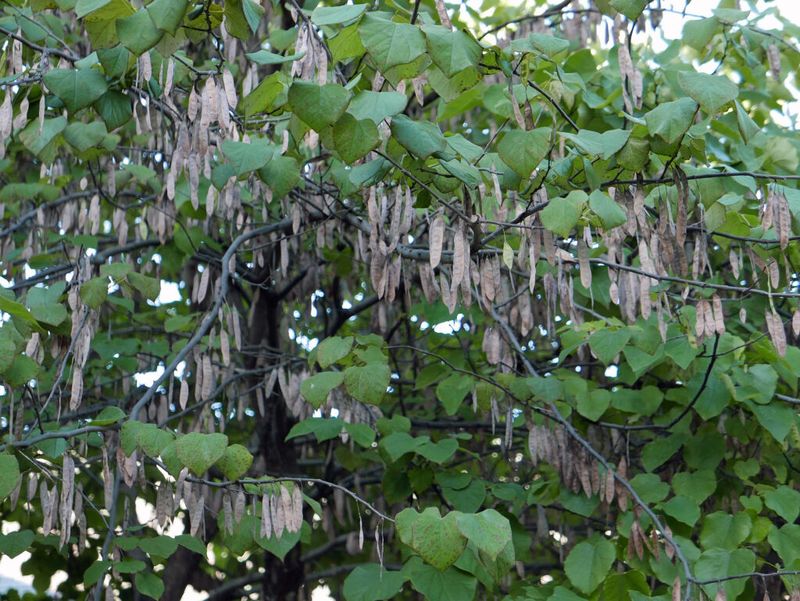
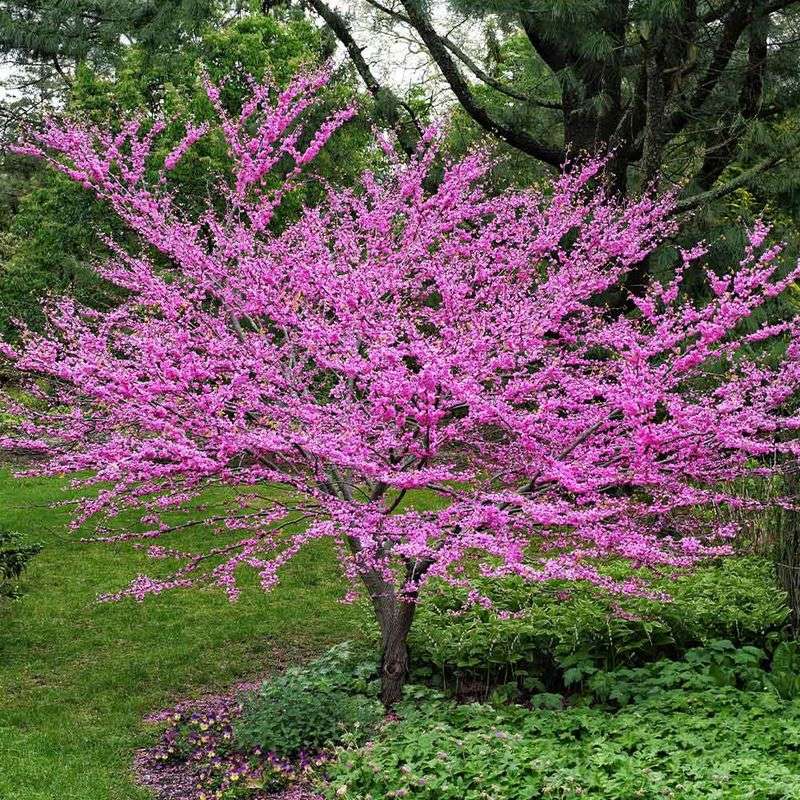
Once tree-of-heaven is gone, eastern redbud gives homeowners a native ornamental that genuinely belongs in a North Carolina yard. NC State’s plant toolbox profile for eastern redbud describes it as a small understory tree found throughout the state, typically reaching 20 to 30 feet tall with a spreading, multi-branched form.
That manageable size suits most residential lots far better than a large canopy tree would, and it fits neatly into the gap left by a removed invasive.
Spring is when redbud earns the most attention. Clusters of bright pink-purple flowers open directly on the branches and trunk before the leaves emerge, creating one of the most distinctive early-season displays of any native tree in the region.
Those flowers attract early pollinators, including native bees that are active before most other flowering trees have opened. Later in the season, the heart-shaped leaves provide light filtered shade, and seed pods offer some food value for birds and small mammals.
Adaptability is one of redbud’s practical strengths. The tree tolerates full sun or partial shade, making it useful at a woodland edge, near a fence line, or as a standalone specimen in an open lawn area.
NC State notes that it performs best with good drainage and consistent moisture during its first few years while the root system is getting established. Heat and drought can stress young trees, so supplemental watering in dry summers is worth the effort in the first two to three seasons.
A few site conditions warrant caution. Wet, poorly drained soil shortens the tree’s lifespan, and root disturbance during construction or grading can set it back significantly.
Plant redbud for the yard you want to build, in a spot where its light and drainage needs are actually met, rather than as a quick fill for whatever gap is available. Chosen correctly, it rewards the planting with decades of wildlife value and seasonal color.
Remove tree-of-heaven without triggering new growth
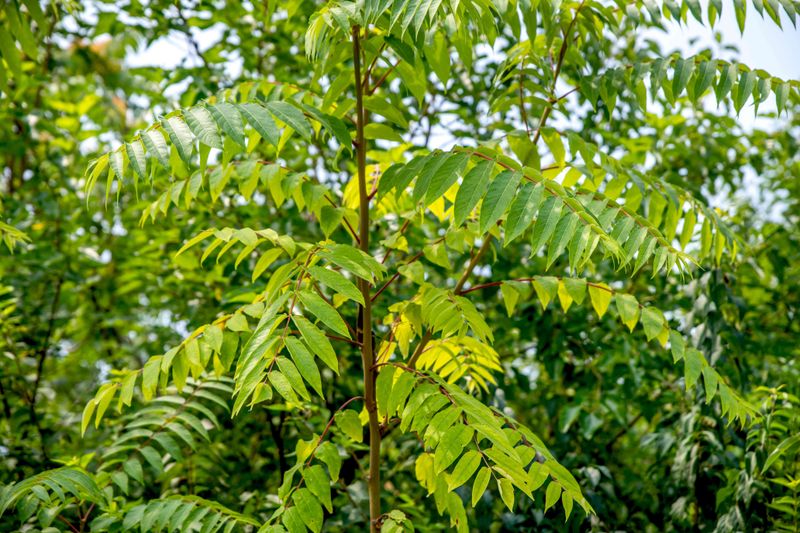
Cutting tree-of-heaven down and walking away is one of the most common mistakes homeowners make with this plant. NC State Extension’s tree-of-heaven guide warns that the plant resprouts aggressively from its root system after the trunk is removed.
In some cases, a single cut stump can send up dozens of new shoots, effectively multiplying the problem rather than solving it.
Small seedlings, generally those with stems thinner than a pencil, can sometimes be removed successfully by hand-pulling the entire root system when the soil is moist. Every piece of root left behind can regenerate, so thorough extraction matters.
Larger seedlings and saplings that resist hand-pulling should be treated rather than simply cut.
Mature trees almost always require a targeted herbicide treatment to prevent resprouting. NC State Extension describes several approaches suited to different situations: cut-stump treatment applies concentrated herbicide directly to a freshly cut surface; basal-bark treatment coats the lower trunk without cutting; hack-and-squirt (also called frill treatment) involves notching the bark and applying herbicide into the wound; and foliar spraying reaches smaller stems and seedlings during the growing season.
The right method depends on tree size, location, and the time of year.
Choosing the correct product and following the pesticide label exactly are non-negotiable steps. Labels specify application rates, timing, protective equipment, and restrictions near water bodies or sensitive areas.
North Carolina Forest Service and NC State Extension both publish guidance on tree-of-heaven control that homeowners can follow for smaller trees. When a tree-of-heaven is large, leaning toward a structure, located near utility lines, or close to a neighboring property line, a qualified tree care professional should handle the removal.
Improvised cutting without root treatment or herbicide follow-up rarely solves the problem and often makes the next season harder.
Monitor the yard instead of expecting eradication
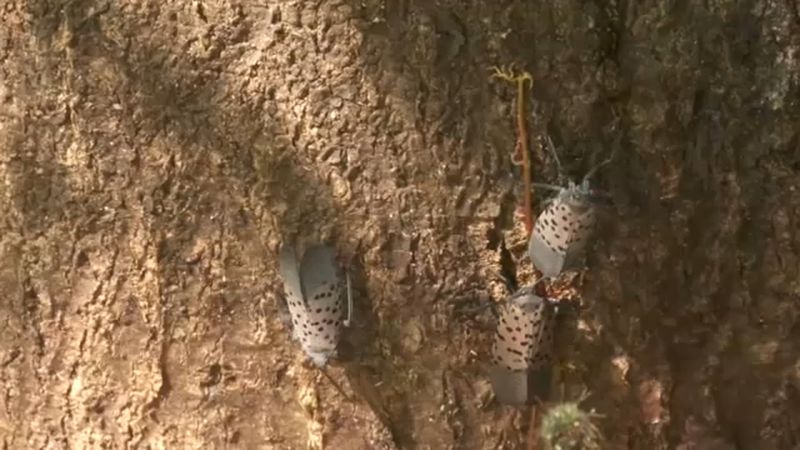
A practical monitoring routine does more for spotted lanternfly management than any single planting decision. Egg masses are the easiest life stage to find and destroy, and they are present from roughly October through June, making fall through early spring the prime window for inspections.
USDA APHIS guidance on cleaning outdoor items recommends scraping egg masses off surfaces, smashing them thoroughly, and sealing them in a plastic bag before disposal. Rubbing alcohol or hand sanitizer applied to the scraped material can help kill any eggs that survive the scraping process.
Egg masses look like smears of brownish-gray putty, roughly an inch long, and they can appear on tree trunks, fence posts, outdoor furniture, stone walls, vehicles, and almost any smooth hard surface. Checking all of these during fall and winter, not just trees, is the habit that catches the most masses before they hatch in spring.
Knowing where the pest currently stands in North Carolina helps homeowners decide whether to report a sighting. NCDA&CS confirmed established populations in seven counties as of February 10, 2026: Forsyth, Guilford, Rockingham, Caldwell, Caswell, Davidson, and Rowan.
Homeowners outside those counties who spot a suspected lanternfly or egg mass should report it to NCDA&CS so the state can track the spread.
Traps can supplement inspections when managed carefully. Penn State Extension’s management guide notes that funnel-style circle traps can capture lanternflies without the wildlife risks associated with exposed sticky bands.
Bare sticky bands should be avoided because they trap birds, squirrels, butterflies, pollinators, and other animals that are not the target.
When chemical control is warranted, use only products registered for the specific site and follow the label precisely. Penn State Extension specifically cautions against homemade sprays involving dish soap, vinegar, salt, essential oils, garlic, or chili products, noting that these mixtures can injure plants, people, pets, and wildlife and may be illegal when used as pesticides.
Systemic insecticide treatments carry their own tradeoffs, including potential residue in flowers and nectar, so Penn State’s management guide supplement advises considering bloom timing, nearby water, children, and wildlife before treating.
Build a better yard with realistic expectations
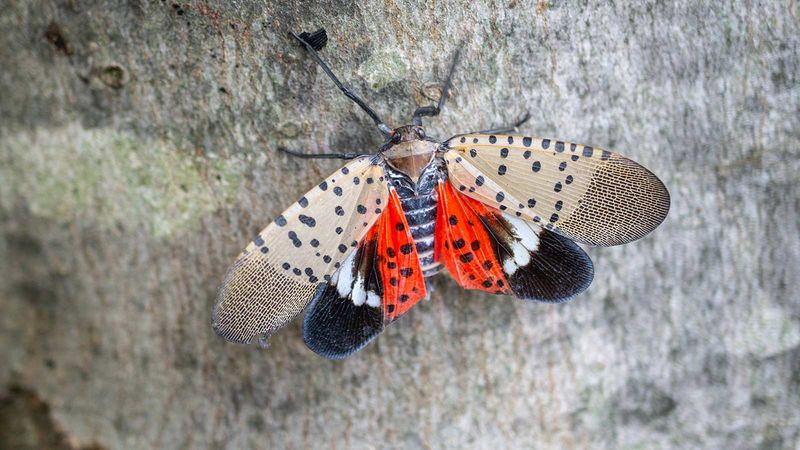
A workable action sequence starts with identification. Walk the property and look for tree-of-heaven, paying attention to fence lines, disturbed edges, and any fast-growing tree with large compound leaves that have a faint peanut-butter smell when crushed.
Once located, NC State Extension’s tree-of-heaven guidance provides removal methods matched to tree size, from hand-pulling small seedlings to herbicide treatments for larger specimens.
After removal, inspect the cleared area and the rest of the yard for egg masses on trunks, furniture, and hard surfaces, then plan the replacement planting. Eastern redbud is a strong native candidate for spots with good drainage, reasonable moisture, and full sun to partial shade.
Where those conditions fit, redbud brings wildlife value, spring color, and a manageable size that suits most residential lots without outgrowing the space.
Keep the two goals separate in your mind: removing tree-of-heaven and monitoring for egg masses address spotted lanternfly pressure, while planting redbud improves native habitat and landscape character. Penn State Extension’s management framework reinforces that no single action eliminates a generalist pest with more than 100 documented hosts.
A carefully chosen native tree cannot starve out a pest that feeds across dozens of species, but it can anchor a yard strategy that is genuinely more resilient, more useful to local wildlife, and better positioned for the long term.