
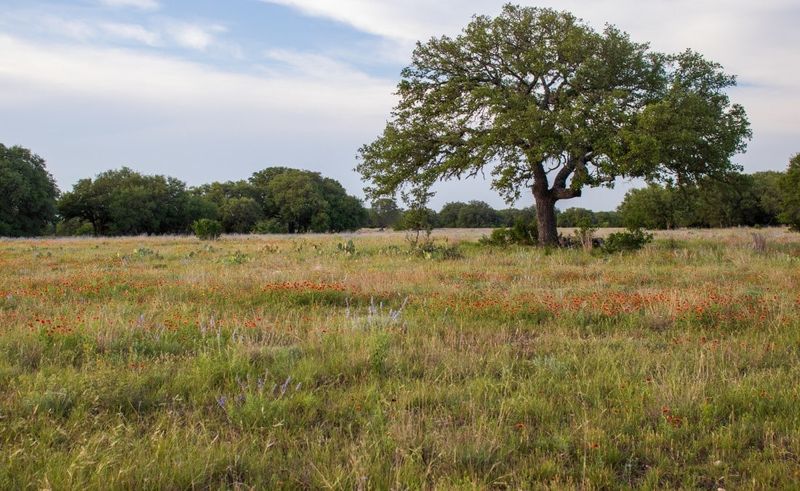
Central Texas oaks are some of the most valued trees in any yard, and watching one drop leaves early or show dead limbs can be alarming. A claim circulating this fall suggests an invasive beetle is boring through oak trunks faster than homeowners can keep up, but the evidence behind that warning does not hold up.
What fall does offer is a useful window to check your oaks for real problems – drought stress, oak wilt, trunk injuries, and secondary borer activity – before any of those issues quietly get worse.
Fall inspection is useful; an invasive oak-borer outbreak is not established
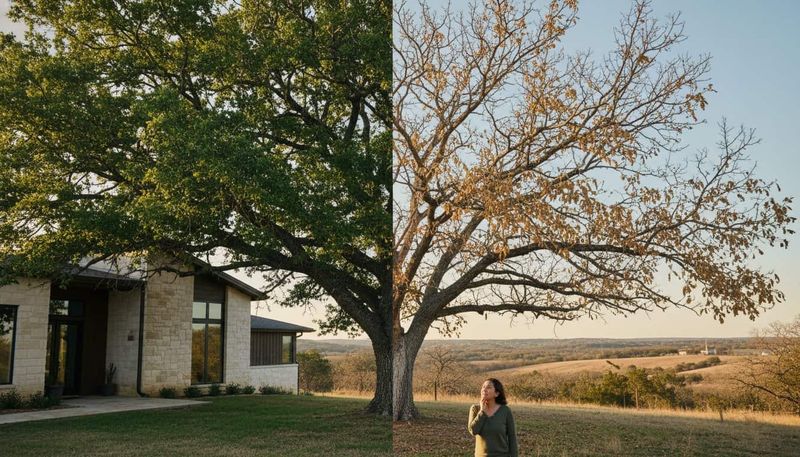
Before pulling out a spray can or calling for tree removal, Central Texas homeowners deserve a straight answer: the authoritative Texas sources reviewed for this article do not establish that a newly invasive beetle is currently boring through local oak trunks at an accelerating fall rate. That claim does not have documented support.
What is well-established is that oak wilt, confirmed in 76 Texas counties, remains the major biological threat to Central Texas oaks, caused by the fungus Bretziella fagacearum and spread primarily through interconnected root systems among live oaks and through small sap-feeding beetles that carry fungal spores to fresh wounds.
Several native or established wood-boring beetles can also attack Texas oaks, but Texas A&M’s borer guidance describes them largely as secondary invaders – insects that target trees already weakened by drought, disease, injury, or other stress. Treating a borer problem without addressing the underlying cause rarely saves a tree that is already in serious decline.
Fall does offer a practical advantage for yard inspection. Texas A&M Forest Service has noted that prolonged drought and extreme heat can push some Central and East Texas oaks into premature dormancy, making canopy thinning, early browning, and bark damage easier to spot than they would be mid-summer.
That seasonal visibility is the real reason to inspect now – not because a particular invasive beetle is suddenly accelerating. Redirecting attention from an unsupported beetle alarm toward a methodical inspection of drought stress, oak wilt patterns, trunk injuries, and exit holes gives homeowners a far more useful and honest starting point.
The sections below walk through that inspection step by step, starting with the biological distinctions that matter most before you ever look at the trunk.
Separate trunk-boring insects from oak-wilt vectors

Trunk borers and oak-wilt vectors are two entirely different groups of insects doing entirely different things to your tree, and mixing them up leads to the wrong response. Wood-boring beetles – the kind that leave exit holes and frass – lay eggs in bark and send larvae tunneling beneath the surface or deep into the heartwood.
Oak wilt, by contrast, is spread above ground by small sap-feeding nitidulid beetles that pick up fungal spores from infected trees and deposit them into fresh wounds on healthy oaks. Neither group is the other; calling an oak-wilt vector a “trunk borer” points homeowners toward the wrong problem.
Among the documented Texas wood-boring species, red oak borer (Enaphalodes rufulus) is a real and confirmed presence. Texas A&M AgriLife Extension’s wood-boring insect guide notes that adults lay eggs in bark crevices during July and August, with larvae then tunneling beneath the bark and into the heartwood.
Frass around buckled bark and girdling scars on trunks or branches can indicate activity. That timing and biology is worth knowing – but red oak borer is not a newly invasive Central Texas species arriving faster this fall.
It is an established part of the Texas landscape, most problematic in trees already under stress.
The two-lined chestnut borer (Agrilus bilineatus) has also been found in Texas oak-wilt trees, though historical U.S. Forest Service research concluded these borers were not likely vectors of oak wilt and generally attacked trees already weakened by disease or other problems.
They follow stress; they typically do not create it from scratch in a healthy tree.
One species worth clarifying by name is the goldspotted oak borer. It draws attention because it has caused serious damage in some oak forests, but USDA Forest Service documentation places its confirmed invasive population in California, with specimens also collected in Arizona and Mexico.
It has not been established as a confirmed Central Texas threat based on the sources reviewed here. Similarly, emerald ash borer is invasive in Texas but attacks ash trees, not oaks – any headline that transfers its invasive status to oak species is simply inaccurate.
Start with the canopy and the pattern of decline
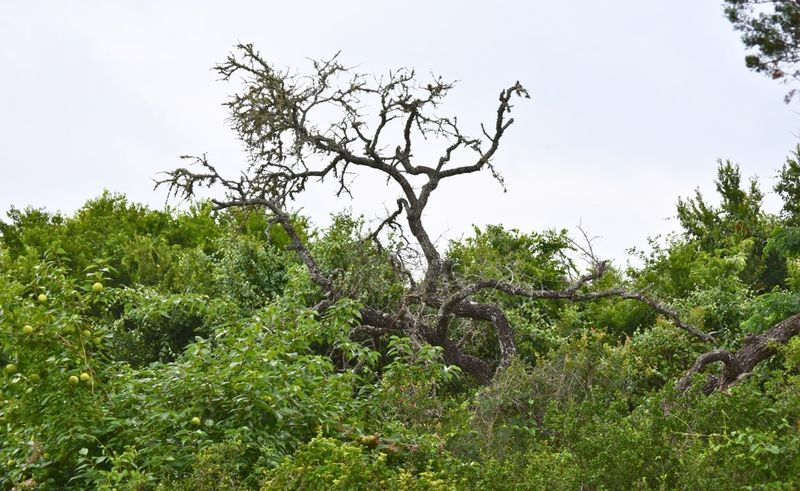
Grab a pair of binoculars or simply step back far enough to take in the full crown before you ever walk up to the trunk. The canopy tells the first and often most important part of the story.
Look for foliage that seems thinner than it should be for the season, sections of the crown where dieback begins on one side before spreading, premature browning or early color change that does not match the rest of the yard, and dead leaves that cling to branches or accumulate beneath the tree in unusual amounts.
Live oaks and red oaks show decline differently, and knowing which you have helps you read the signs. Texas Oak Wilt Information Partnership’s identification guide describes live-oak warning signs as including veinal necrosis – yellow or brown discoloration along the leaf veins – along with tip or margin burn and rapid defoliation.
Red oaks can show rapid browning, bronzing, or “flagging” of individual branches and may decline within roughly four to six weeks after symptoms first appear. If several connected live oaks in a cluster are all showing similar symptoms at the same time, that spatial pattern raises more concern than a single struggling tree.
The critical caution here is that none of these canopy signs confirm oak wilt on their own. The Texas Oak Wilt drought comparison resource makes clear that drought stress and heat injury can produce canopy thinning, early browning, scorch, and leaf drop that look very similar to early oak-wilt symptoms.
Central Texas has faced sustained drought and extreme heat events that pushed trees into early dormancy, so brown leaves in fall do not automatically point to a beetle or a fungus.
Record which part of the crown is affected first, how fast the symptoms are spreading, and whether neighboring oaks show any of the same signs. That pattern of decline – single tree versus cluster, slow versus rapid, one crown section versus whole canopy – is exactly what a qualified arborist or extension specialist will want to know when you reach out for help.
Inspect the trunk and major limbs without damaging them
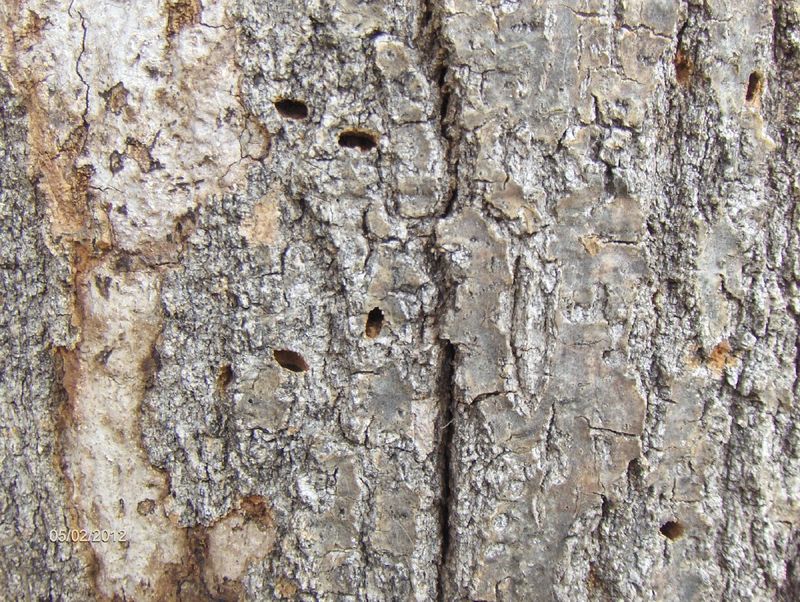
Once you have documented the canopy, move to the trunk and major limbs for a hands-on but non-destructive look. You are searching for evidence of existing stress or injury, not trying to excavate the tree.
Work slowly around the entire base of the trunk and up as high as you can safely see, using a flashlight if the bark is deeply furrowed.
The signs worth recording include small, round or oval exit holes in the bark; loose or buckled bark that lifts away from the wood; sawdust-like frass piled at the base of the trunk or caught in bark crevices; galleries or tunnels visible where bark has already separated at an existing opening; and dark staining or wet-looking streaks on the outer wood. AgriLife Extension’s wood-boring insect guide identifies thin-bark crotches, broken branches, pruning wounds, sunscald, bird damage, and lawn-equipment injuries as common entry or attack sites for borers.
Any of those locations deserves a careful look.
Pay special attention to the trunk near the soil line and to any spots where a mower, string trimmer, or construction equipment may have scraped the bark. Even a small wound at the base of a large tree can be an entry point for both borers and the sap-feeding beetles that spread oak wilt.
Fresh wounds, broken limbs hanging in the canopy, and old pruning scars that were never sealed are all worth photographing and noting.
One firm guideline: do not peel away bark or use a tool to dig into the trunk looking for larvae. Texas A&M’s landscape IPM borer resource points out that creating new wounds on a stressed tree can make the situation worse and may open additional entry points.
Photograph what you can see at existing openings, record the location and approximate size of each sign, and note the date. Check whether any neighboring oaks on the same root system or nearby in the yard show similar marks on their trunks.
A hole does not identify the cause of decline
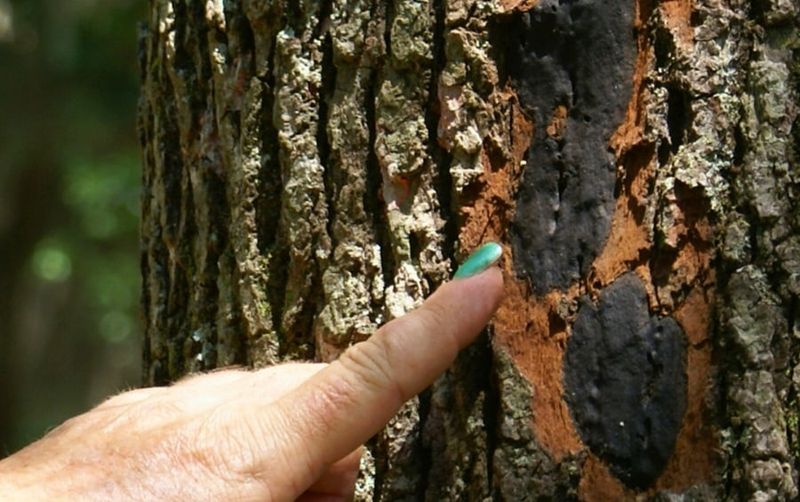
Finding a hole in the bark feels like finding a culprit. The reality is more complicated, and acting on that assumption without more information can lead to treatments that do not help – or that actively harm – the tree.
Several completely different problems can produce the same visual symptoms in the canopy and on the bark: drought, extreme heat, oak wilt, Hypoxylon canker, root damage from construction or compaction, herbicide injury, and other fungal diseases can all cause canopy thinning, browning, dead limbs, and compromised bark. A hole by itself does not sort through that list.
Borers frequently arrive after a tree has already been weakened. Texas A&M’s borer IPM guidance is direct on this point: many wood-boring beetles are secondary invaders, and insecticide applications may not save a tree that is already severely stressed or dying from another cause.
Treating for borers when oak wilt or Hypoxylon canker is the primary driver wastes time and money and does nothing to stop the real problem from progressing.
Hypoxylon canker deserves a specific mention because it is an opportunistic disease of stressed oaks that can compromise structural integrity and is sometimes confused with borer damage when bark begins to slough off. The underlying wood may show dark discoloration.
Like borers, Hypoxylon canker tends to follow trees already weakened by drought or other stress – it is a consequence of decline more often than the original cause.
Pattern recognition helps more than any single symptom. One tree with a few exit holes and a dry summer behind it suggests localized stress worth monitoring.
Several connected live oaks declining together with similar canopy symptoms raises a different concern – the kind that warrants professional assessment for oak wilt rather than a trip to the garden center for a spray product. Both situations call for documentation and qualified review when decline progresses, affects multiple trees, or creates a safety concern.
Protect the tree while arranging the right diagnosis
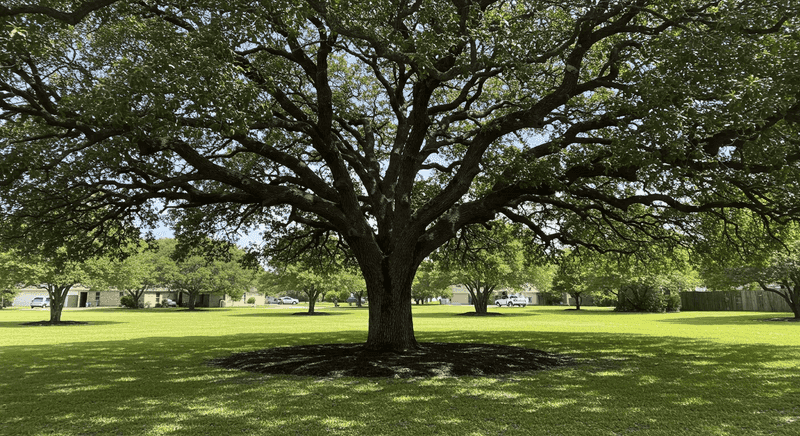
While you are gathering information and arranging a professional review, several low-risk actions can reduce stress on the tree right now. Water deeply during dry conditions rather than watering frequently and shallowly – mature oaks benefit from slow, deep soaking that reaches the full root zone rather than surface irrigation.
Keep mulch two to three inches deep over the root zone but pulled back several inches from the trunk itself; mulch piled against bark traps moisture and can invite rot and additional pests.
Protect roots from compaction, soil disturbance, and excavation. Parking vehicles under the drip line, allowing heavy equipment nearby, or cutting trenches through the root zone can all weaken an oak and make it more vulnerable to the secondary borers described throughout this article.
Mower and string-trimmer injuries at the trunk base are among the most common and preventable wounds on residential oaks; AgriLife Extension’s borer guide identifies equipment injuries as significant entry points, so even a thin ring of mulch or a physical guard around the base can make a difference.
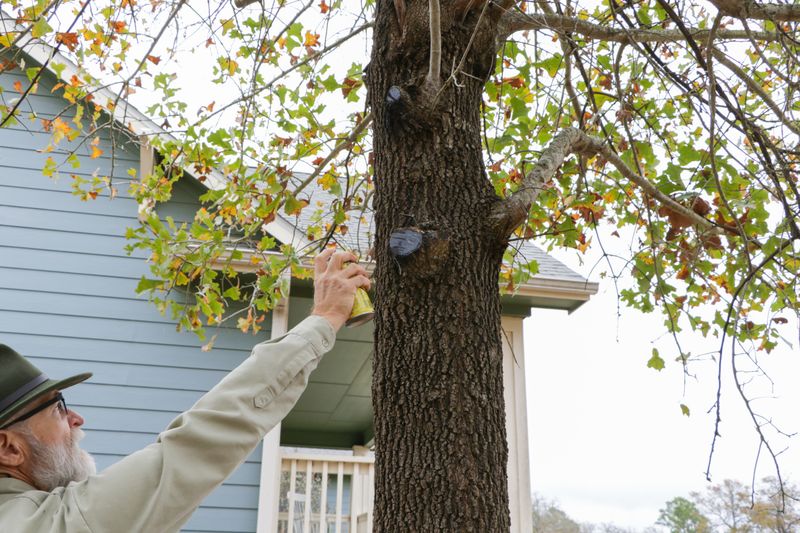
Oak-wilt wound precautions are non-negotiable regardless of season. Texas A&M Forest Service guidance is clear: avoid unnecessary pruning or wounding of oaks from February through June, when sap-feeding beetles that carry oak-wilt spores are most active.
Outside that window, pruning is lower-risk but still carries some risk – paint any fresh cut, storm break, or other wound immediately after it occurs, regardless of the time of year. Do not leave a fresh wound unpainted overnight.
When symptoms are progressing, when multiple oaks are affected, or when the tree poses a structural hazard, reach out for qualified help before taking further action. Oak-wilt management options depend on diagnosis, tree species, symptom pattern, and site conditions – they are not one-size-fits-all.
Contact Texas A&M Forest Service, your county AgriLife Extension office, or an ISA Oak Wilt Qualified arborist. Laboratory confirmation through the Texas Plant Disease Diagnostic Laboratory may be needed because drought, overwatering, herbicide injury, and other diseases can closely mimic oak wilt’s appearance.
Do not remove an oak, inject fungicides, trench roots, excavate large sections of bark, or apply broad-spectrum insecticides based only on a photograph or a handful of exit holes. Responsible pest-control decisions require correct identification, product-label compliance, and often professional equipment – especially for large trees.
Use the fall checklist to gather evidence, not panic
A practical fall inspection follows a clear sequence: start with the canopy and note the pattern and speed of any decline, then move to the trunk and major limbs for a close look at wounds, exit holes, and frass – without removing bark. Check neighboring oaks for similar symptoms, especially any trees connected by a shared root zone.
Photograph each sign, record its location on the tree, and note the date so you have a timeline if things change.
Reduce stress on the tree right away by watering during dry spells, protecting the root zone, and eliminating mower injuries. Avoid new wounds, and paint any that occur immediately.
Reach out for professional diagnosis when symptoms cluster across multiple trees, when decline accelerates over a few weeks, or when the tree is large enough to pose a hazard if it fails. A hole in the bark is a data point, not a verdict.
The goal of this inspection is not to name a beetle from a single photograph – visual inspection rarely confirms species or causation. The goal is to catch serious decline early, avoid actions that could spread oak wilt or create new entry points, and get the right eyes on the tree before a manageable problem becomes an irreversible one.
An oak that has stood for decades deserves that kind of careful attention, not a rushed reaction to an alarm that the evidence does not support.