
Texas summers can push triple-digit temperatures for weeks at a stretch, and the trees in your yard are quietly fighting for their lives underground. Most watering advice you find online throws out a single depth number like it applies to every tree in every yard, and that can lead you to either underwater your trees or drown their roots.
Knowing how to check what your soil actually needs, and where to put the water, is what separates a tree that survives August from one that slowly declines and dies. This guide gives you a practical, step-by-step approach to re-wetting your established tree’s root zone during prolonged drought.
Deep watering means reaching the active root zone—not automatically three feet
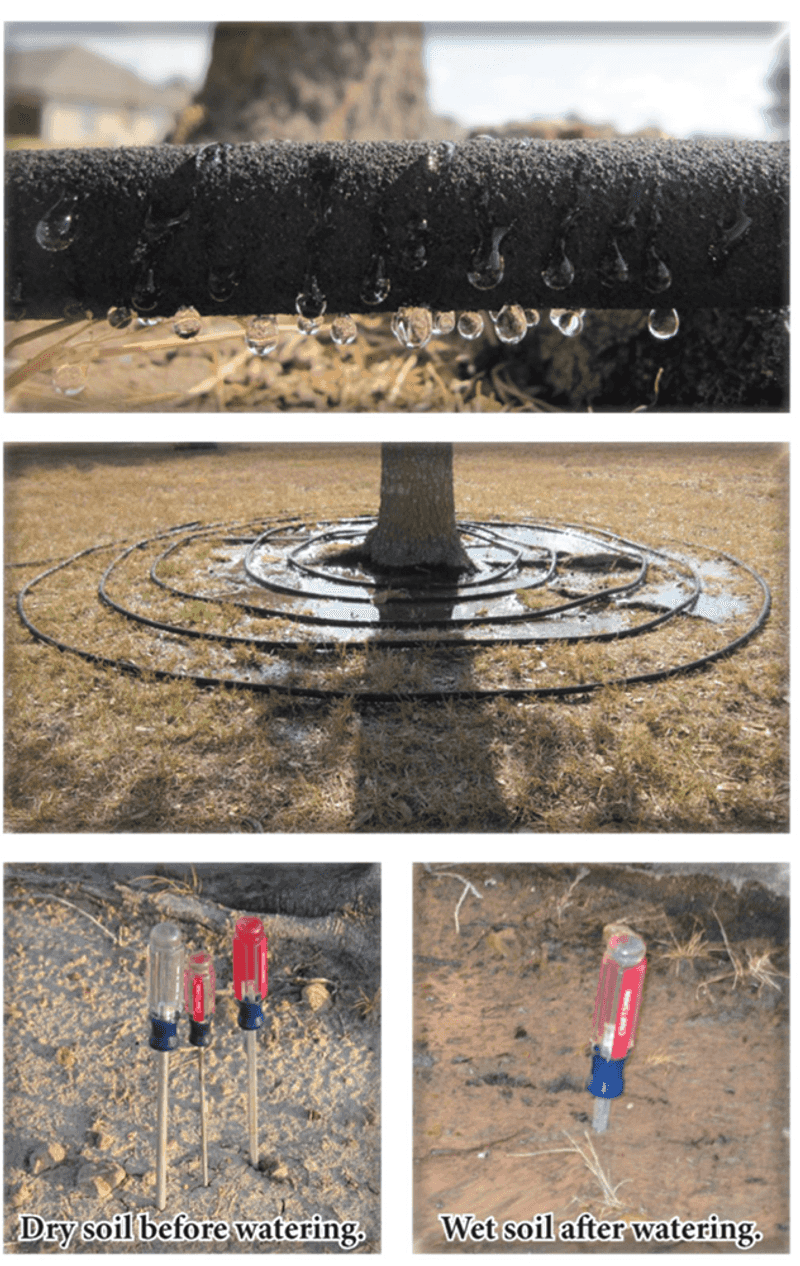
Most of the advice circulating about “deep watering” treats it as a single fixed target, and that framing causes real problems for Texas homeowners trying to save their trees. For an established landscape tree enduring prolonged heat and drought, Texas AgriLife Extension’s drought guidance recommends moving a slowly running hose around the dripline until the soil is saturated roughly 8 to 10 inches deep.
That is the clearest, most defensible immediate target for most established trees under Texas drought conditions, and it comes with a built-in requirement: you have to verify it with a probe, not a timer.
A separate AgriLife recommendation identifies 12 to 18 inches as a deeper watering target during drought. These two figures are not contradictory, but they are not interchangeable either.
The 12-to-18-inch depth applies as a conditional goal when the tree, soil type, drainage capacity, and irrigation method can actually support water moving that far down without creating runoff, ponding, or oxygen-starved roots. Forcing water to 18 inches in compacted clay or a yard with poor drainage often creates more harm than the drought itself.
Neither number is a universal requirement. Actual rooting depth varies by species, soil oxygen levels, compaction, hardscape coverage, drainage history, and how the tree has been irrigated over its lifetime.
In compacted or poorly drained soils, most feeder roots may live in the top six to eight inches. In favorable loam with good drainage, roots may occupy two to three feet.
The only way to know what your specific tree needs is to probe the soil before and after you water, note where the tool meets resistance, and adjust your approach from there.
The roots you need to wet spread beyond the trunk and dripline
Picture the roots of a mature Texas live oak or pecan. Many homeowners imagine roots growing straight down beneath the trunk like a mirror image of the canopy above ground, but that is not how most trees actually grow.
Fine feeder roots, the small hair-like structures responsible for pulling water and nutrients into the tree, spread outward through the upper soil profile, often reaching well beyond the edge of the canopy.
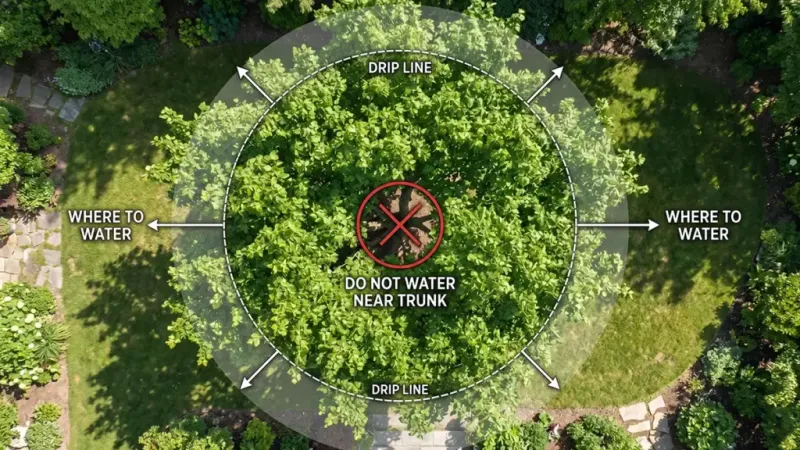
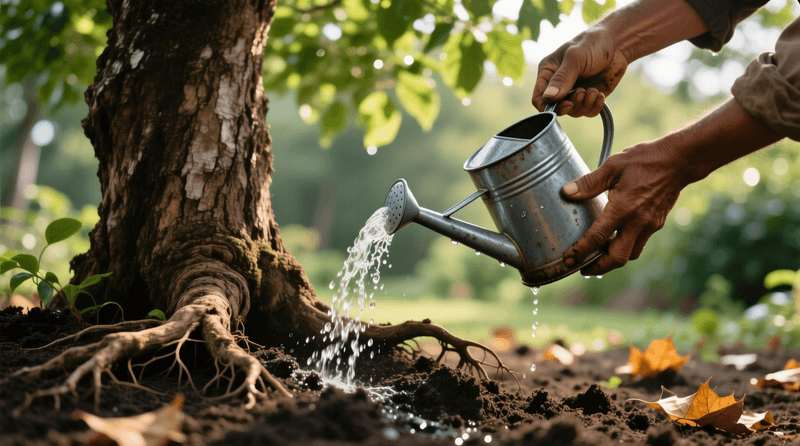
Placing a hose at the base of the trunk and letting it run is one of the most common watering mistakes in Texas landscapes. Texas AgriLife Extension specifically warns that watering at the trunk of a large tree does not adequately reach the root zone and wastes water that the tree never receives.
The zone where water actually matters starts roughly beneath the outer edge of the canopy and extends outward from there.
The dripline, the imaginary circle on the ground that follows the outer edge of the canopy, is a useful starting point for placing your hose or irrigation device, not a precise fence around the root zone. University of Arizona Cooperative Extension notes that mature tree roots commonly extend beyond the canopy edge, sometimes by a significant distance depending on species and soil conditions.
Where your yard layout, hardscape, or neighboring plants allow it, distribute water broadly across and beyond the dripline rather than concentrating it in one spot. Probe multiple locations to confirm that moisture is reaching the soil across the accessible root zone, not just in the one place you happen to stand with the hose.
A soil probe tells you when the water has reached the target depth
Wilted leaves are not a reliable watering trigger on their own. A tree can droop from heat stress, root damage, poor drainage, salt buildup, disease, or construction injury, and adding more water to a tree that is already sitting in saturated soil can accelerate the damage rather than reverse it.
Before you water, and again after you think you have watered enough, push a soil probe, screwdriver, or slender metal rod into the ground at several locations across the accessible root zone.
The physical feedback tells you what you need to know. University of Arizona Cooperative Extension explains that a probe moves relatively easily through moist soil and becomes noticeably harder to push when it hits dry, compacted ground.
If you push the tool in and it stops at four inches, the water has not reached the 8-to-10-inch target yet. If it slides in freely past 10 inches, the soil is adequately wet at that location.
Mark where you checked and move to three or four other spots around the tree.
Checking multiple locations matters because soil moisture is rarely uniform under a large tree. One side of the root zone may sit in shade and retain moisture longer, while the south-facing side bakes in direct sun and dries out first.
Compacted areas near a sidewalk or driveway may shed water quickly, leaving dry pockets even after a long watering session. A moisture meter can help you compare readings across locations, but meter accuracy varies with soil type and tool quality.
Penn State Extension notes that physical inspection of the soil, combined with observations about drainage and tree condition, gives a more complete picture than any single reading from a handheld device. Use the probe as your primary guide and treat the meter as a supplement, not a standalone decision tool.
Apply water slowly and broadly instead of soaking the trunk
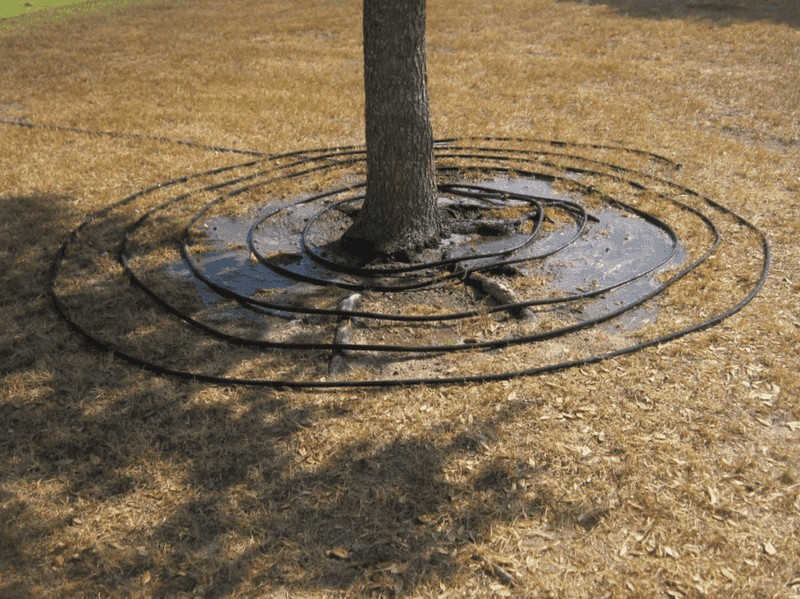
Speed is the enemy of effective tree watering. When water hits the soil faster than it can absorb, the excess runs off the surface, travels downhill, and never reaches the root zone at all.
The practical sequence for re-wetting an established tree’s root zone starts with a quick probe to confirm the soil is dry, then places the water delivery point, whether that is a garden hose, soaker hose, or drip emitter, at the outer edge of the root zone rather than against the trunk.
Move the hose position every 15 to 20 minutes to spread coverage across the accessible root zone. The Texas Water Development Board’s landscape watering guide recommends stopping and resuming after runoff begins, allowing the soil time to absorb what it has already received before adding more.
This cycle-and-pause approach is especially important in clay-heavy soils, which are common across much of Texas and absorb water slowly even when they are severely dry.
Running a hose at the base of the trunk for several hours is not a substitute for this method. Texas AgriLife Extension is direct on this point: concentrating water at the trunk of a large tree does not adequately water it, and the practice can encourage trunk rot and other problems over time.
If you rely on a lawn sprinkler system, do not assume the turf schedule is reaching the tree’s root zone. University of Arizona extension research on tree and shrub irrigation points out that sprinklers calibrated for turf often wet only the top few inches of soil, which falls short of the 8-to-10-inch target for trees.
Probe the soil under the canopy after a regular irrigation cycle to find out what the tree is actually receiving.
Deep-root watering spikes and forks are sometimes marketed as a superior solution for drought stress. Colorado State University Extension cautions that most tree roots are not located deep enough for these devices to serve as an effective general irrigation method.
A hose, soaker hose, or properly managed sprinkler that delivers water slowly across a broad root-zone area is usually the more practical and appropriate choice for established Texas landscape trees.
Soil type determines how you pause and when you water again
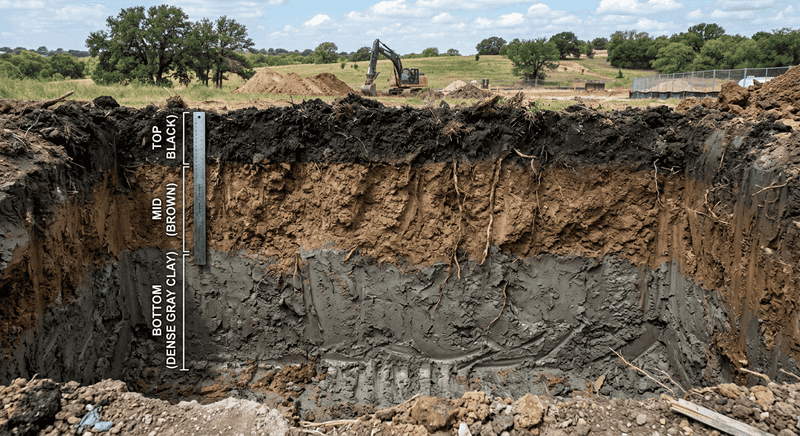
Texas soils are not uniform, and the watering approach that works in a sandy loam in one part of the state can fail completely in the heavy black clay common across the DFW Metroplex or the shallow rocky soils of the Hill Country. Soil texture controls how fast water moves in, how long it stays available to roots, and how quickly the cycle needs to repeat.
Clay soils present a particular challenge during drought because they can become hydrophobic when severely dry, meaning water beads up and runs off the surface rather than soaking in. University of Arizona Cooperative Extension recommends a cycle-and-soak method for slow-absorbing soils: water for a set period, stop and let the soil pull in what it has received, then resume.
This may take two or three cycles before the soil is adequately wet to the 8-to-10-inch target, but it prevents runoff from wasting water that never reaches the root zone.
Sandy soils drain quickly and may reach the target depth faster, but they also release moisture more rapidly between waterings. In sandy conditions, smaller applications spaced more frequently may outperform one large soaking every two weeks.
Sloped yards, regardless of soil type, lose more water to surface runoff and may need slower emitters or berms to hold water in place long enough to infiltrate.
For large established trees during continued drought, Texas AgriLife’s drought guidance suggests roughly twice-monthly watering as a starting point. Treat that as a baseline to adjust, not a fixed schedule.
Probe the soil before each watering session. If the upper root zone still feels moist, wait.
If it has dried past four to five inches, water again. Local weather, cloud cover, wind, and the tree’s own canopy shade will all shift the timing from week to week throughout a Texas summer.
Newly planted trees need a different watering plan
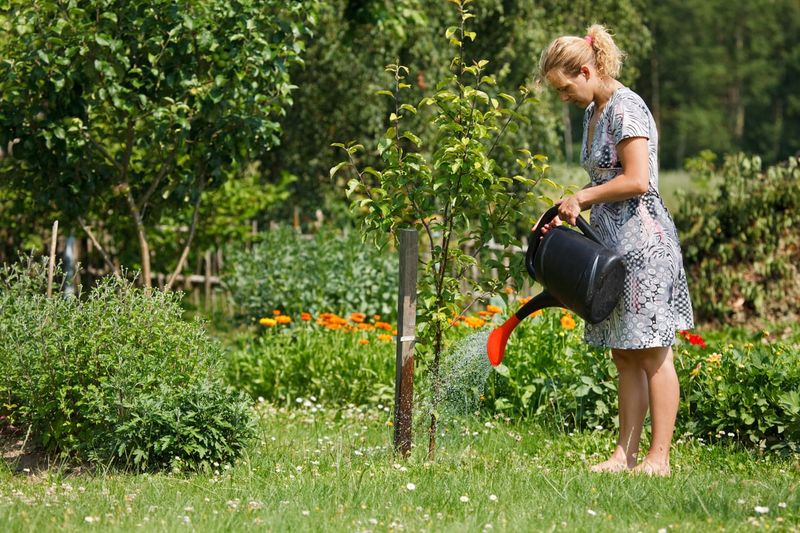
A tree you planted last fall or this spring is in a completely different situation than the 30-year-old live oak shading your back porch. The new tree’s root ball, the compact mass of roots that came with it from the nursery, is small relative to the soil volume around it and dries out far faster than the surrounding ground.
During the first one to three years after planting, the tree is still building the root system it will eventually rely on, and that process demands consistent, attentive watering.
Penn State Extension’s guidance on newly planted trees recommends wetting the entire root zone until the top 6 to 9 inches of soil is consistently moist, and offers a minimum application guideline of 1 to 1.5 gallons of water per inch of trunk diameter per watering session. A two-inch-caliper tree, for example, would need at least 2 to 3 gallons applied slowly and directly over the root ball and the soil immediately surrounding it.
Newly planted trees typically need watering more often than established trees, sometimes every few days during triple-digit Texas heat, depending on soil type, drainage, tree condition, and local weather. That said, overwatering a new tree in poorly drained soil can suffocate its roots just as quickly as drought can.
Check the top few inches of soil near the root ball before each watering session, and adjust your frequency based on what you find rather than a rigid calendar. Always confirm current city or utility watering restrictions before scheduling any additional irrigation, since restrictions in Texas can limit how often and how you may water even during a declared drought.
Mulch helps retain moisture without damaging the trunk
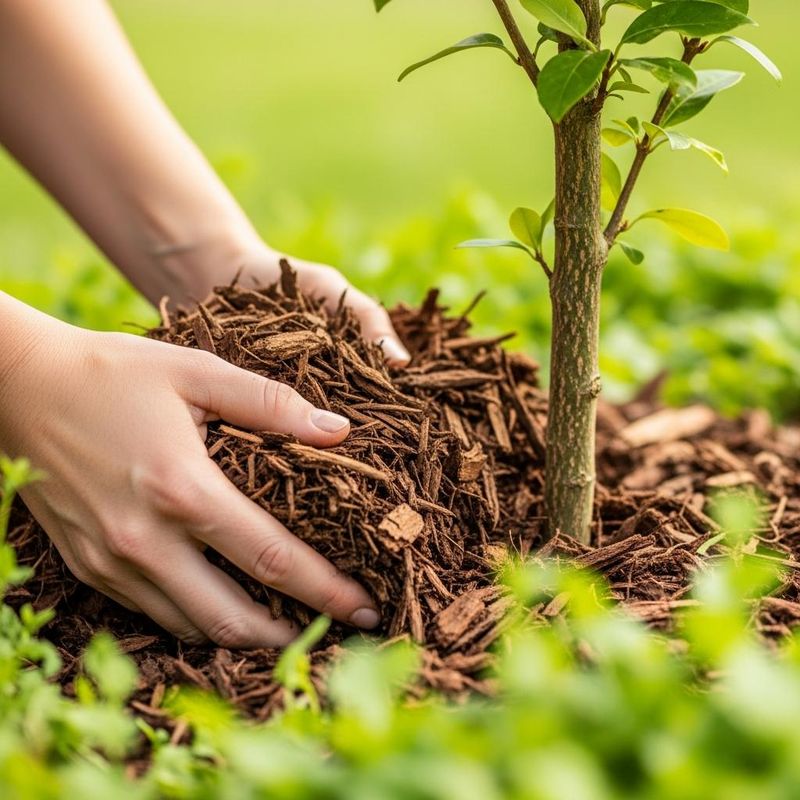
After you have re-wet the root zone, the fastest way to lose that moisture is to leave bare soil exposed to 100-plus-degree air and direct sunlight. Organic mulch slows that loss significantly by insulating the soil surface, moderating soil temperature, and reducing evaporation between watering sessions.
Texas AgriLife Extension’s mulching guide supports applying a 2-to-4-inch layer of organic material, such as shredded hardwood, wood chips, or pine bark, spread evenly across the root zone. The mulch should start several inches away from the trunk and root flare, the point where the trunk widens at ground level, and extend outward as far as practical beneath the canopy.
Piling mulch against the trunk, a practice sometimes called a mulch volcano, traps moisture against the bark and creates conditions that invite decay, pest problems, and root girdling over time.
Timing your watering session also affects how much of that effort actually reaches the roots. Early morning is the consistently recommended window because soil temperatures are lower, wind is usually calmer, and water has time to infiltrate before peak afternoon heat drives evaporation rates up.
Penn State Extension echoes this preference for morning application across both new and established trees. Spraying foliage or bark with a hose may feel like you are cooling the tree down, but wetting the canopy does not substitute for re-wetting the root zone.
The goal is always moisture in the soil where the roots can reach it.
Stop watering when saturation or tree damage points to another problem
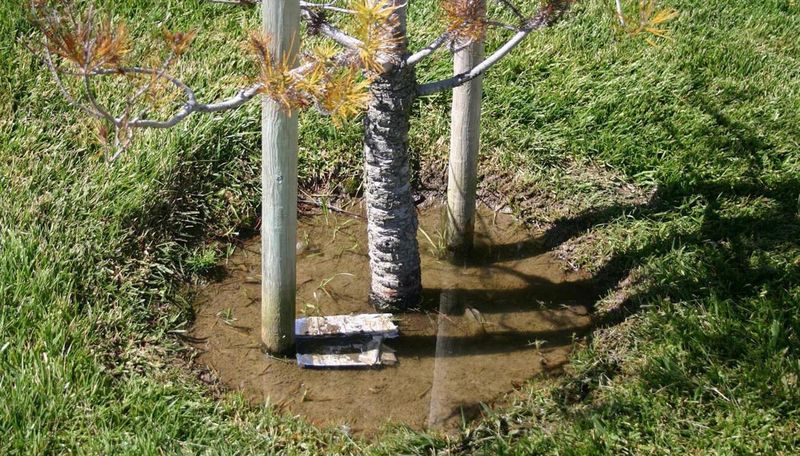
Drought stress is a real threat to Texas trees, but overwatering can be just as damaging, and the two problems can look nearly identical from the outside. When soil pores fill completely with water, oxygen is pushed out.
Tree roots need oxygen to function, and roots sitting in saturated soil can begin to die within days, leaving the tree unable to pull in water even when plenty of it surrounds the roots.
Stop adding water whenever you see runoff that is not slowing down, soil that remains soggy from a previous session, or standing water that lingers hours after you finish. The Texas Water Development Board recommends pausing irrigation any time runoff is outpacing infiltration, then resuming only after the soil has had time to absorb what it already received.
That same principle applies across multiple watering sessions: do not add more water just because the calendar says it has been two weeks.
Wilted or curled leaves are not proof of underwatering on their own. Penn State Extension’s resource on abiotic tree disorders identifies poor drainage, root damage, salt accumulation, construction injury, and disease as conditions that can produce leaf symptoms identical to drought stress.
Check the soil moisture and drainage before adding more water. If the soil is already moist and the tree still looks stressed, more water is not the answer.
Texas watering restrictions can also limit your options regardless of what the tree needs. The Texas Commission on Environmental Quality’s drought data dictionary describes restriction stages ranging from voluntary conservation to hand-held-hose-only rules and full bans on outdoor irrigation.
Check with your city, utility, or water provider before running any irrigation. For trees showing major canopy loss, widespread dieback, trunk injury, visible root damage, or girdling roots, the International Society of Arboriculture’s resources at TreesAreGood.org recommend assessment by a qualified arborist.
Those conditions call for expert diagnosis, not another round of irrigation.
Use the probe—not a promise or a calendar—to guide the next watering
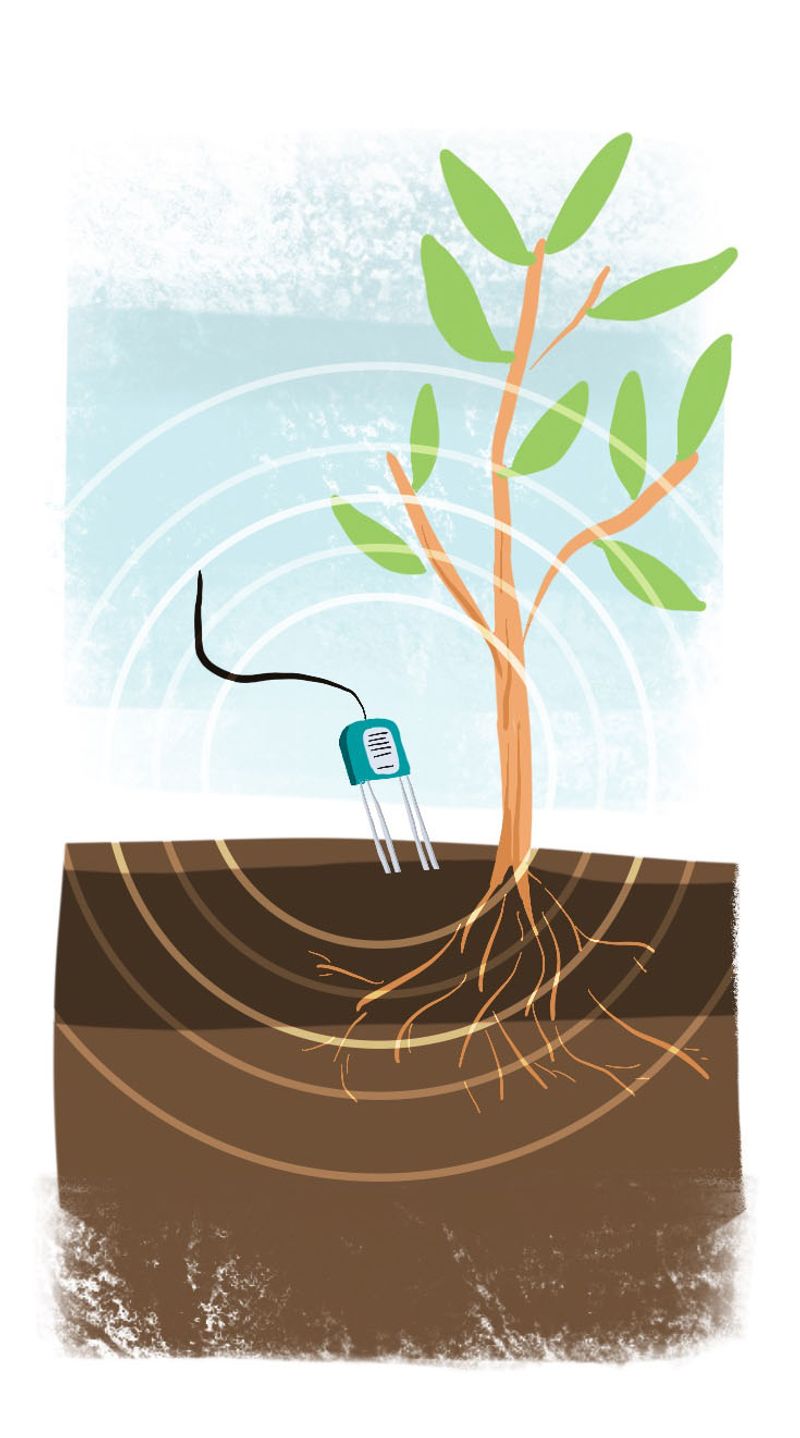
Every watering decision for a Texas tree during drought comes back to one physical check: push the probe into the soil at several spots across the accessible root zone and note where it meets dry, resistant ground. When the tool slides freely to 8 or 10 inches at most of those locations, the session has done its job.
When it stops at 3 inches, the tree still needs water, and the approach, whether that means slower application, more cycles, or moving the hose to drier areas, needs to change.
Texas AgriLife Extension’s drought guidance and the Texas Water Development Board’s landscape watering guide both point toward the same conclusion: balanced root-zone moisture across a broad area, not maximum depth or a guaranteed rescue, defines successful drought watering. Apply water slowly, distribute it broadly, pause when runoff begins, and do not repeat until the upper root zone has begun to dry.
Check local restrictions before every session, and call a certified arborist if the tree or soil responds in ways that more water cannot explain. A tree that has survived decades of Texas summers is worth the extra attention it takes to read the soil honestly.