
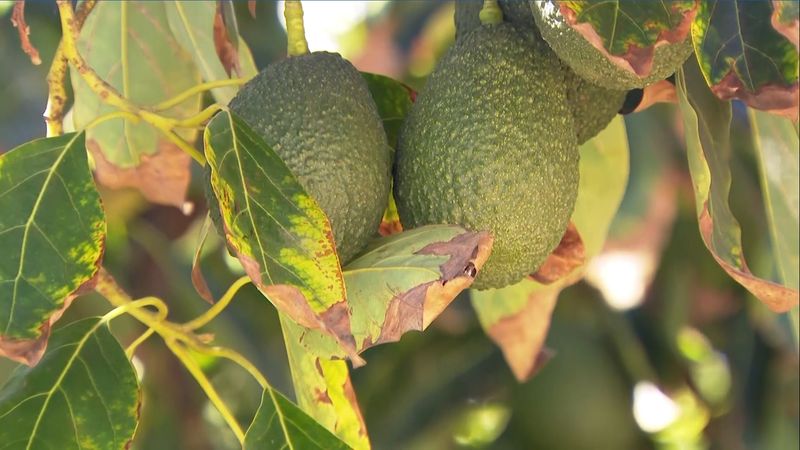
Late September heat in California can leave backyard avocado growers staring at a pile of dropped fruit and wondering what went wrong. The good news is that a few targeted steps can reduce the stress your tree is under and give the remaining fruit a better chance of hanging on.
These steps won’t guarantee a full crop, but they can stop you from accidentally making things worse during one of the toughest stretches of the growing season.
September fruit drop is a clue, not a diagnosis
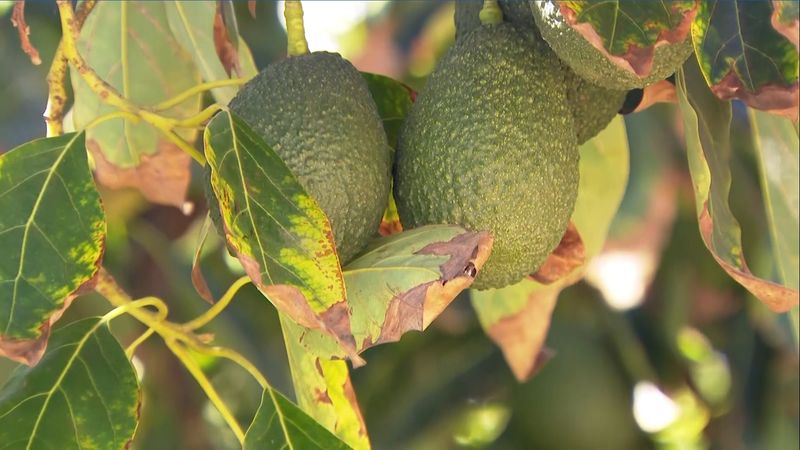
Finding avocados on the ground in September feels alarming, especially when the thermometer has been pushing triple digits for days. The instinct is to blame the heat and start watering as fast as possible, but the timing of a drop alone does not tell you what caused it.
Heat, drought, wind, sunburn, root dysfunction, salinity, pests, and disease can all contribute to fruit loss, and more than one of these problems can be happening at the same time.
Avocado trees go through a well-documented natural thinning called “June drop,” during which the tree sheds small fruit it cannot support given its available carbohydrate resources. UC IPM’s cultural tips for avocado describe this self-thinning as a normal part of fruit development, not a sign that something is wrong.
A late-summer drop is a different matter, but labeling it “normal” simply because it happens to occur in September is a mistake.
Heat-related flower abortion and early fruit drop are most clearly documented around bloom and the early fruit-set window, as UC Cooperative Extension Ventura County’s fruit-set guidance explains. By late summer, surviving fruit has already cleared that vulnerable period, which means a September heat wave may be intensifying existing water stress or sun exposure rather than acting as a single, standalone cause.
Drought stress, root disease, and salt buildup can all make a tree far more vulnerable to heat than a healthy, well-irrigated specimen would be. UC ANR drought strategies for avocados note that multiple stressors often compound each other, making it hard to separate one cause from another.
The practical goal, then, is not to prove what started the drop but to reduce any additional stress you can control and protect the fruit still on the tree.
Check the shallow root zone before adding water
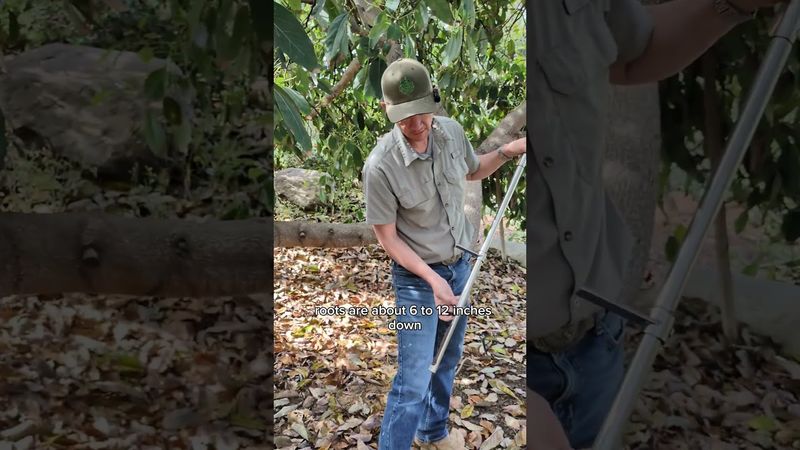
Before picking up a hose or adjusting a drip timer, take ten minutes to check what is actually happening underground. UC Master Gardener planting guidance places most avocado roots in roughly the top 6 to 8 inches of soil, which means the tree has a shallow and limited reservoir of moisture.
When hot, dry air pulls water out of leaves faster than roots can replace it, the tree can show signs of stress within a day or two of the soil drying out.
Push a finger or a thin probe several inches into the soil at three or four spots beneath the canopy, not just near the trunk. The texture and temperature at that depth will tell you more than the surface ever will.
Dry, crumbly soil that pulls away from the probe means the root zone needs water. Cool, dark, and moist soil that holds together means the tree is probably not short on moisture right now, even if the leaves look a little droopy in the afternoon heat.
Drainage matters just as much as moisture level. If water pools on the surface after irrigation, takes more than a few hours to soak in, or the soil feels waterlogged despite no recent watering, something is wrong with how water moves through the root zone.
UC Ventura’s avocado FAQ points out that a tree sitting in poorly draining soil can look drought-stressed even when the ground is wet, because damaged roots cannot move water into the tree effectively.
Broad planning benchmarks such as roughly 2 inches of water per week or 45 to 60 gallons per day under extreme drip demand are context for planning, not instructions to follow mechanically. UC IPM’s root rot guidance reinforces that soil type, tree size, canopy coverage, weather, irrigation efficiency, and water quality all shift the actual requirement.
Use those numbers to sanity-check your system, then let the soil moisture you find in the ground be the deciding factor.
Correct irrigation without saturating the tree
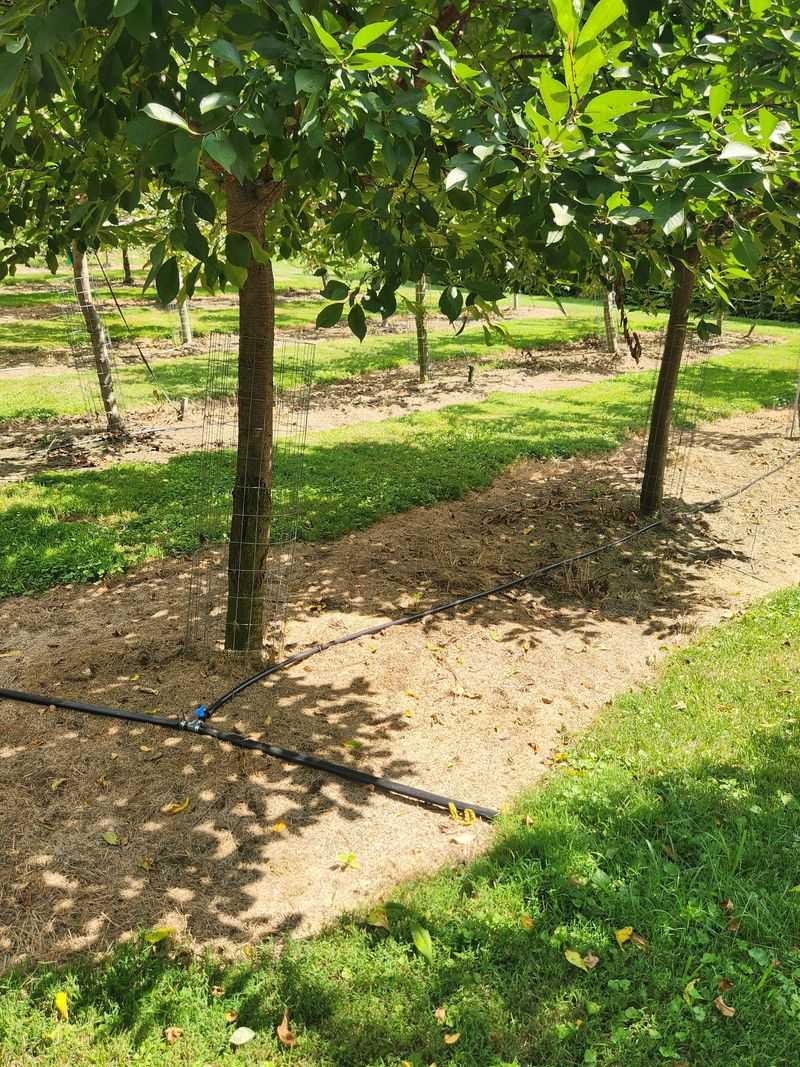
Once you know the root zone is genuinely dry, a thorough irrigation is the right response. Water slowly enough that it soaks in rather than running off, and aim to wet the active root zone across the full area beneath the canopy.
Concentrating all the water near the trunk misses most of the feeder roots, which spread outward as the tree matures.
After that irrigation, stop and monitor. Let the soil drain, check moisture again in 24 to 48 hours, and water again only when the root zone has dried to the point where the tree actually needs it.
UC IPM’s cultural tips explain that both underwatering and overwatering harm avocado trees: underwatering can produce small, sunburn-prone fruit and wilted foliage, while overwatering raises the risk of Phytophthora root and crown rots that can kill the tree outright. Repeated saturation is not a rescue strategy; it is a path to a different and potentially worse problem.
Keep water away from the trunk and crown. Routine wetting of the base of the trunk creates conditions that favor Phytophthora trunk canker and crown rot.
Distribute emitters or soaker lines out under the canopy and move them progressively farther from the trunk as the tree grows and its root spread widens.
If leaf tips and margins keep browning even after you correct moisture levels, consider testing your irrigation water quality. Chloride, sodium, boron, and general salinity can damage avocado foliage in ways that look almost identical to drought stress.
Correcting irrigation frequency and volume will not help if the water itself is carrying damaging salt loads into the root zone with every cycle.
Use coarse mulch as a root-zone buffer
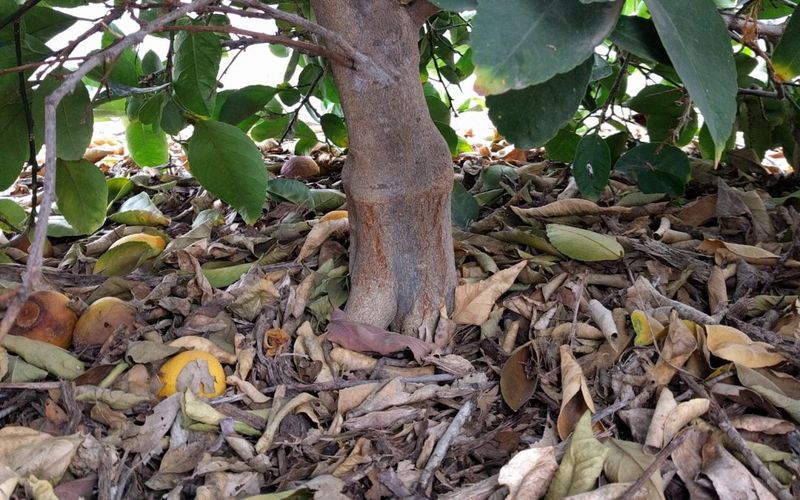
Mulch is one of the most practical tools available to a California homeowner during a heat wave, and it costs almost nothing if you already have fallen avocado leaves on the ground. Leave those leaves in place under the canopy rather than raking them away.
Then add a layer of coarse, disease-free woody mulch on top, aiming for roughly 3 to 6 inches of depth across the root zone.
UC IPM’s Phytophthora root rot resource recommends coarse organic mulch as part of an integrated root-health strategy, noting that it reduces evaporation, moderates soil temperature, and supports conditions that are less favorable to Phytophthora. That combination is especially valuable when the surface soil is baking in September sun and every degree of root-zone temperature matters for root function.
UC Master Gardener guidance on planting avocados specifically recommends coarse, disease-free woody material and warns against placing mulch against the trunk.
Keep the mulch pulled back several inches from the base of the trunk. Piling material against the bark traps moisture against the crown and creates exactly the conditions that collar and trunk diseases thrive in.
Fine, fresh, or questionable mulch materials carry their own risks, including introducing pathogens or creating an anaerobic mat that blocks drainage rather than improving it.
Mulch conserves what irrigation puts in, but it cannot fix a waterlogged or compacted root zone. If drainage is already poor, adding mulch on top of saturated soil will not help the tree.
Correct the drainage problem first, then use mulch to maintain the better conditions you have created.
Preserve canopy and shield unusually exposed tissue
Canopy is the tree’s built-in sunscreen, and removing any of it during a heat wave is one of the fastest ways to make things worse. Fruit, bark, and limbs that were previously shaded can sunburn within hours once exposed to direct afternoon sun.
UC IPM’s avocado sunburn guidelines describe sunburned fruit as showing yellow, brown, or bleached patches on the sun-facing side, and note that canopy thinning, defoliation, and water stress all increase exposure risk.
Hold off on any pruning that is purely cosmetic or tidying in nature until cooler weather arrives. A stressed tree cannot harden new growth fast enough to compensate for what you remove, and the exposed tissue left behind becomes a liability.
The only exceptions are branches that pose a safety risk or show clear signs of active disease that could spread.
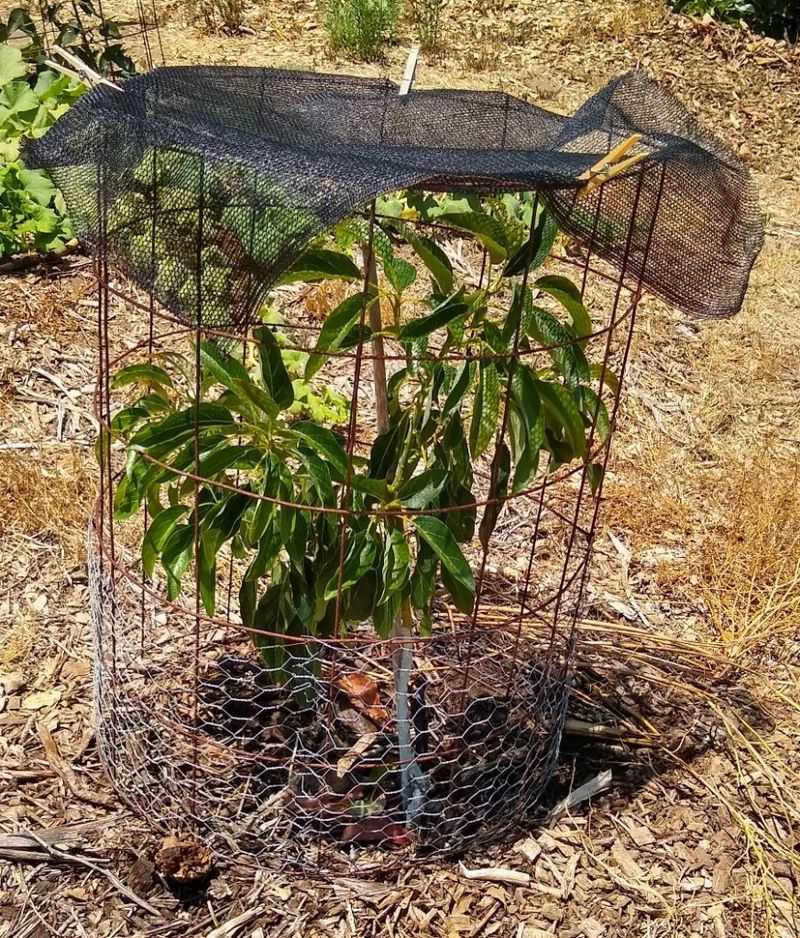
Young trees, recently planted specimens, heavily pruned trees, or any tree that has lost significant foliage to pests or disease may benefit from temporary shade during the hottest part of the afternoon. UC ANR’s comprehensive avocado resource identifies shade as a practical measure for reducing heat problems in exposed trees.
A shade cloth stretched over a simple frame on the west and south sides of the tree can lower leaf temperature noticeably without blocking so much light that photosynthesis suffers. A mature tree with a full, healthy canopy largely protects itself and does not need external shading.
If a major limb or section of trunk has already been exposed to sun, whitewashing can limit further bark damage. UC ANR’s whitewashing guidance describes diluted white latex paint or a lime-based mix applied to newly exposed woody tissue as a practical sunburn barrier.
Whitewash protects bark; it does not prevent fruit drop, correct water stress, or address root disease. Overhead sprinkling and evaporative cooling are sometimes used in commercial avocado production to reduce canopy temperature, but wetting foliage and trunks repeatedly at home carries real disease risk, particularly for Phytophthora trunk canker and crown rot.
If you try overhead cooling at all, time it carefully, avoid wetting the trunk, and do not repeat it when drainage is already compromised.
Skip emergency fertilizer and unnecessary pruning
Panic responses often create the second wave of damage during a heat event. Two of the most common are reaching for fertilizer to “help the tree recover” and grabbing pruning shears to remove what looks dead or damaged.
Both can backfire badly on a stressed avocado.
A large nitrogen application will not replace lost fruit or speed up recovery. UC Ventura’s fruit-set guidance notes that excess nitrogen tends to push vegetative growth at the expense of fruit production.
Beyond that, avocado roots are sensitive to concentrated fertilizer, salts, and ammonia, meaning a heavy application during heat stress can injure the very roots you are trying to protect. Well-mulched, mature trees in reasonably fertile California soil may not need any nitrogen at all in a given year.
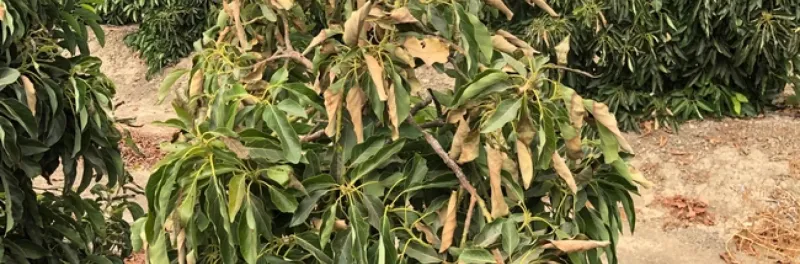
The pruning rule during a heat wave is straightforward: postpone anything that is not urgent. UC IPM cultural guidance and UC IPM sunburn guidelines both emphasize that unnecessary canopy removal exposes fruit, limbs, and trunk tissue to sunburn.
A branch that looks brown or stressed may still be protecting the fruit cluster attached to it. Remove it now and that fruit is sitting in full afternoon sun by tomorrow.
The immediate job is to stabilize moisture, keep living canopy intact, and avoid exposing more tissue to heat. Forcing new growth or reshaping the tree can wait until fall temperatures arrive and the tree has a real chance of responding productively.
Recognize signs that point beyond heat
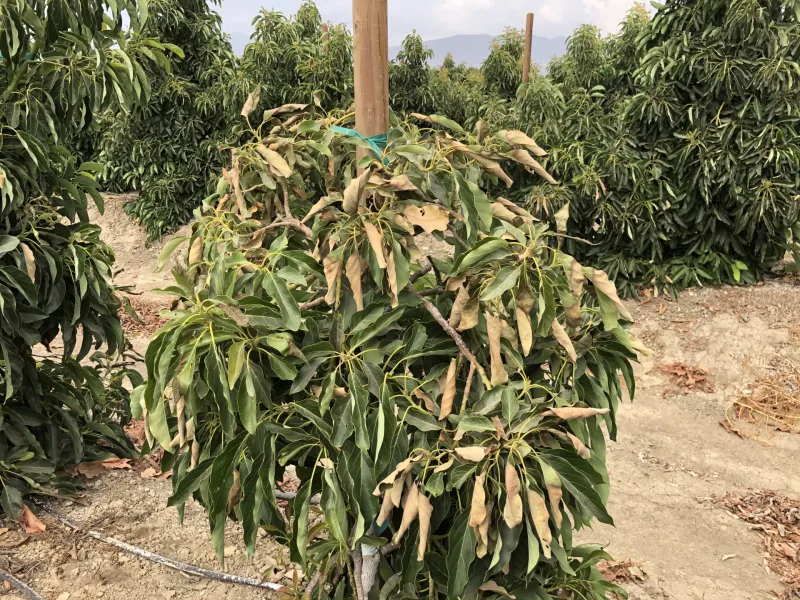
Ordinary heat protection has limits, and a few specific symptoms tell you when something more serious is going on. A tree that keeps declining after you correct irrigation, or one that shows extensive and rapid drop accompanied by canopy thinning and dieback, deserves closer investigation rather than another round of watering adjustments.
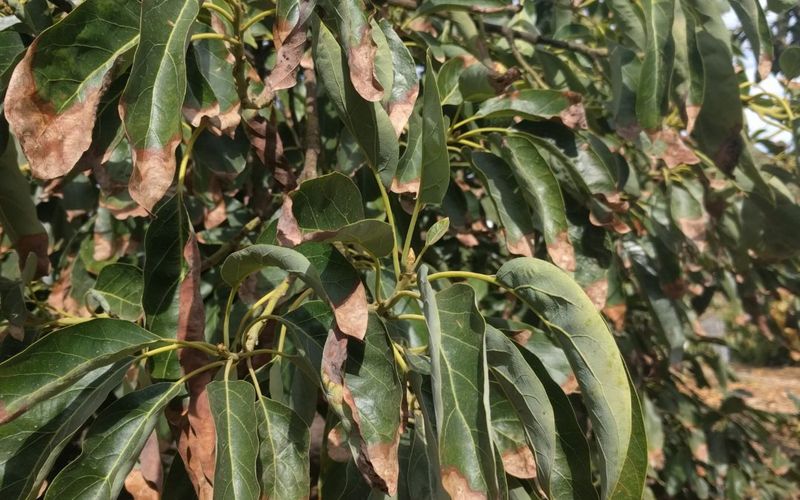
Root rot caused by Phytophthora is the most common serious problem that mimics drought stress in California avocados. UC IPM’s root rot resource describes the key clues: a sparse, thin canopy with small pale leaves, progressive dieback from branch tips inward, brown leaf tips even when the soil is wet, and feeder roots that are black and brittle rather than white and pliable.
If you dig carefully at the edge of the canopy and find those black roots, more water will not save the tree. The problem is that damaged roots cannot absorb moisture regardless of how much is available.
Irrigation correction and, in serious cases, professional diagnosis are the right next steps.
Salinity and water quality problems produce symptoms that overlap significantly with drought and root disease. Chloride, sodium, and boron all cause leaf tip and margin burn that can look identical to what heat stress produces.
If browning keeps returning after you improve irrigation timing, get your water tested before assuming the tree simply needs more of it.
Pests and diseases add another layer of complexity. Avocado lace bugs and other canopy pests cause stippling, bronzing, and leaf drop that can look like heat or drought damage from a distance.
UC IPM’s avocado disease monitoring resource provides a reference for distinguishing disease signs from abiotic stress symptoms. Persistent decline, fruit drop that continues after soil moisture is corrected, or symptoms that do not match what you find in the ground are all reasons to consult a UC Cooperative Extension advisor or a certified arborist rather than guessing.
Timing a drop to a heat wave does not prove the tree is dying, but it also does not mean the problem will resolve on its own.
Stabilize the tree and reassess the remaining crop
An ordered approach is more useful than a frantic one when heat is still pressing down. Start by inspecting the soil at several points beneath the canopy.
If the root zone is dry, irrigate thoroughly, then give the water time to drain before checking again. If the soil is already wet or draining poorly, hold off and focus on understanding why drainage is failing before adding anything more.
Once moisture is on track, pull any mulch that has crept against the trunk back several inches, top up the layer to 3 to 6 inches of coarse material across the root zone, and leave the canopy alone. UC IPM’s cultural tips and UC IPM’s root rot guidance both support this sequence as the foundation of avocado care under stress.
If you have a young or sparse tree, add temporary shade on the west and south sides for the hottest afternoon hours.
Over the next week, monitor for the symptoms described in the previous section: pale or sparse new growth, continued dieback, or browning that does not match soil moisture. Those patterns call for diagnosis, not more irrigation.
The steps above aim to prevent compounding stress and improve the remaining fruit’s prospects, not to guarantee that every avocado stays attached through the heat.
Cultivar and horticultural race shape how much heat a tree can absorb before fruit quality and retention suffer, and site conditions matter just as much. UC IPM’s avocado overview notes that avocados thrive in coastal and selected inland California areas but are not reliably adapted to desert-interior heat.
A tree in a well-suited location with healthy roots, good water, and intact canopy has a real chance of holding its remaining crop; a tree fighting poor drainage, salt, or disease in an extreme-heat site may need long-term site reassessment more than any single-season fix.