
Weeds in a Central Texas gravel driveway are not just an eyesore – they can crack edges, trap moisture, and turn a low-maintenance surface into a full-time chore. The combination of heat, heavy rain, and wind means seeds arrive constantly, and the organic matter that collects between stones gives them exactly what they need to root.
No single spray or trick will keep a gravel driveway permanently clean, but a practical system of renovation and regular monitoring can cut the workload down dramatically and keep the surface looking far better for much longer.
Replace the permanent promise with a durable-control plan
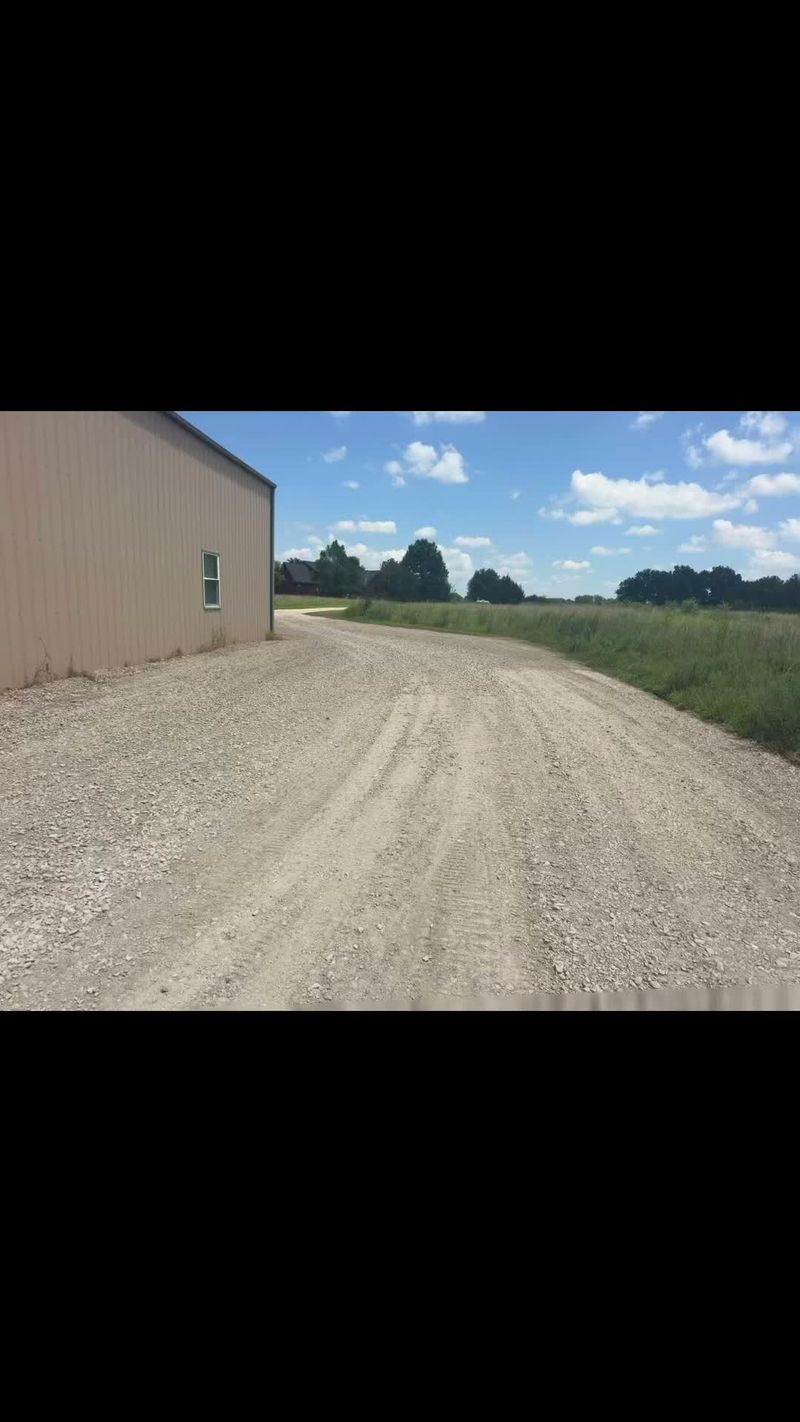
Gravel driveways have a reputation for being easy, but anyone who has spent a Central Texas summer pulling weeds out of crushed limestone knows the reality is messier. Utah State University Extension guidance on yard and garden weed control describes gravel driveways as labor-intensive to maintain and draws a clear line between killing weeds that are already there and stopping the next round of seedlings from germinating.
Those are two separate problems that need two separate responses.
The honest starting point is that no one-time treatment can sterilize a gravel surface permanently. Wind carries seeds in from neighboring yards, trees drop them, birds deposit them, and organic matter that blows in between stones creates a thin but workable growing medium.
A driveway that looks clean after a single herbicide application can be green again within weeks once conditions favor germination.
For a driveway that is already heavily infested, the most defensible approach is a renovation-plus-maintenance plan. That means clearing established weeds and as much accumulated soil, leaf litter, and organic debris as practical, addressing perennial roots rather than just the visible tops, and then restoring a proper gravel surface before switching to a monitoring routine.
Whether full reconstruction makes sense depends on how much soil and debris has built up, how the surface drains, how much vehicle traffic it handles, and what the rebuild would cost. Renovation is a likely longer-lasting option for badly contaminated surfaces, not a guaranteed universal winner.
The realistic goal is fewer recurring weeds and less repeat labor, not a driveway you never have to touch again.
Clear roots, weeds, and the growing material between stones
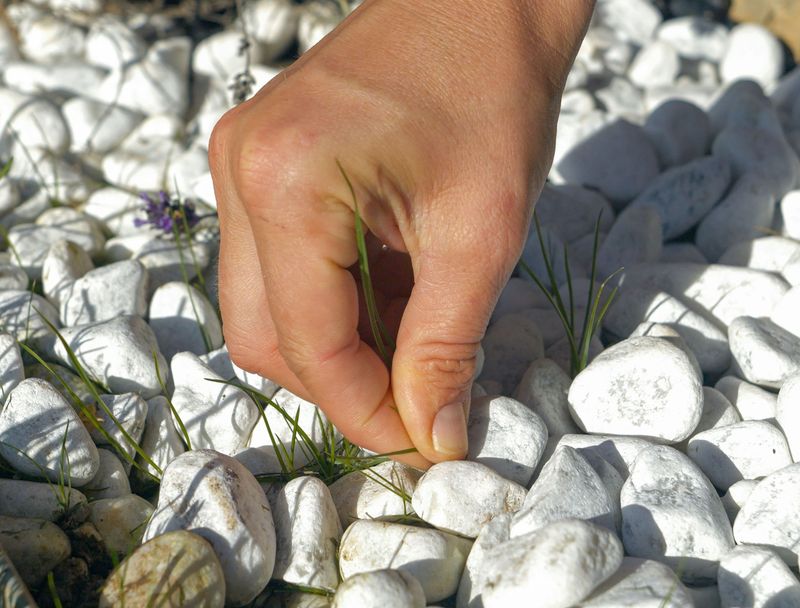
Pulling weeds before they flower is one of the highest-return tasks in driveway maintenance, and University of Minnesota Extension guidance on controlling weeds in home gardens is direct about why: a single weed that sets seed can leave behind hundreds of future plants. For a Central Texas driveway, where warm soil temperatures extend the growing season deep into fall, that multiplication happens fast.
Annual weeds are the easier target. Young plants with shallow roots pull cleanly by hand, especially after a rain when the soil beneath the gravel is soft.
Perennial weeds are a different problem. Species like nutsedge, bindweed, or dallisgrass anchor themselves with rhizomes, tubers, or deep taproots.
Pulling the top growth off a mature perennial without getting the root system underneath is essentially a haircut – the plant regrows from whatever is left in the ground. During a renovation, dig as much of the root system out as the site allows, especially for species you recognize as repeat offenders.
The material between the stones matters as much as the weeds themselves. Gravel is not a sealed surface.
Airborne seeds settle between stones, dust accumulates, and decomposing leaves create a thin layer of organic matter that functions as a growing medium. Raking, blowing, or sweeping accumulated debris out of the driveway removes both the seedbank sitting on the surface and the growing material that lets new seeds establish.
Dispose of that debris away from garden beds and storm drains rather than just pushing it to the edge of the driveway, where seeds can wash back in with the next rain.
Rebuild for the driveway you actually use
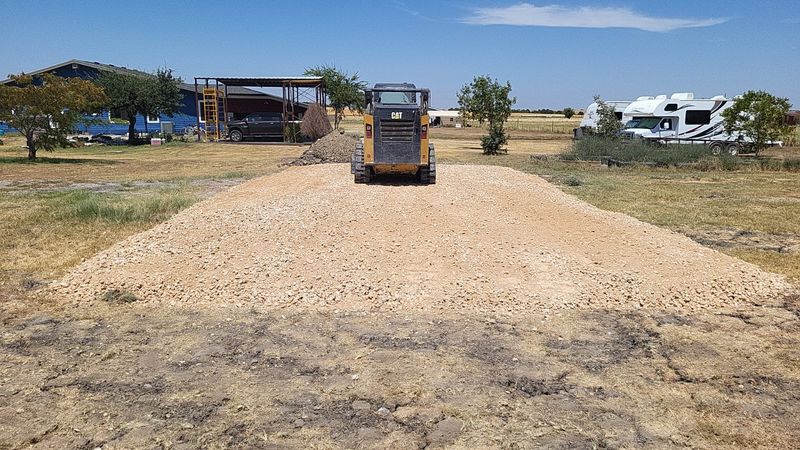
Adding fresh gravel on top of a contaminated surface is a short-term fix. The soil, roots, and debris underneath stay in place, the weed seed bank remains intact, and the new stone sinks into the old mess within a season or two.
If a driveway has accumulated significant organic material or has obvious drainage problems, ruts, or soft spots, a proper rebuild addresses those issues at the same time rather than covering them up.
Gravel depth figures from extension research are useful as weed-suppression context but should not be confused with a construction specification. Colorado State University Extension guidance on mulching notes that gravel smaller than about one-half inch can suppress weeds, and recommends roughly four inches for mulch applications – but that figure addresses weed suppression in landscape beds, not the load-bearing requirements of a vehicle surface.
A driveway that handles regular car and truck traffic needs a base preparation matched to its soil type, slope, drainage, and expected loads. Rutting, soft spots, or standing water after rain are signs that the base needs attention, not just the surface layer.
Drainage deserves explicit planning during a rebuild. A gravel surface that sheds water toward a neighbor’s property, a vegetable garden, a storm drain, or a nearby creek creates problems beyond the driveway itself.
TxDOT driveway design and materials guidance emphasizes stable surfaces and appropriate drainage as baseline requirements. Grading the surface so runoff moves to a stable, vegetated area or a properly designed drainage feature keeps water from concentrating at edges or pooling under the gravel, which would otherwise encourage weed establishment in exactly the spots that are hardest to maintain.
Once the base is stable and drainage is addressed, choose a gravel size and type suited to your traffic and local conditions. Crushed granite and crushed limestone are common in Central Texas and compact reasonably well.
Larger, rounder stones tend to leave more pockets where seeds and debris collect, so matching stone size to the surface’s function matters for long-term maintenance as much as for appearance.
Treat geotextile as a construction choice, not a weed-proof shield
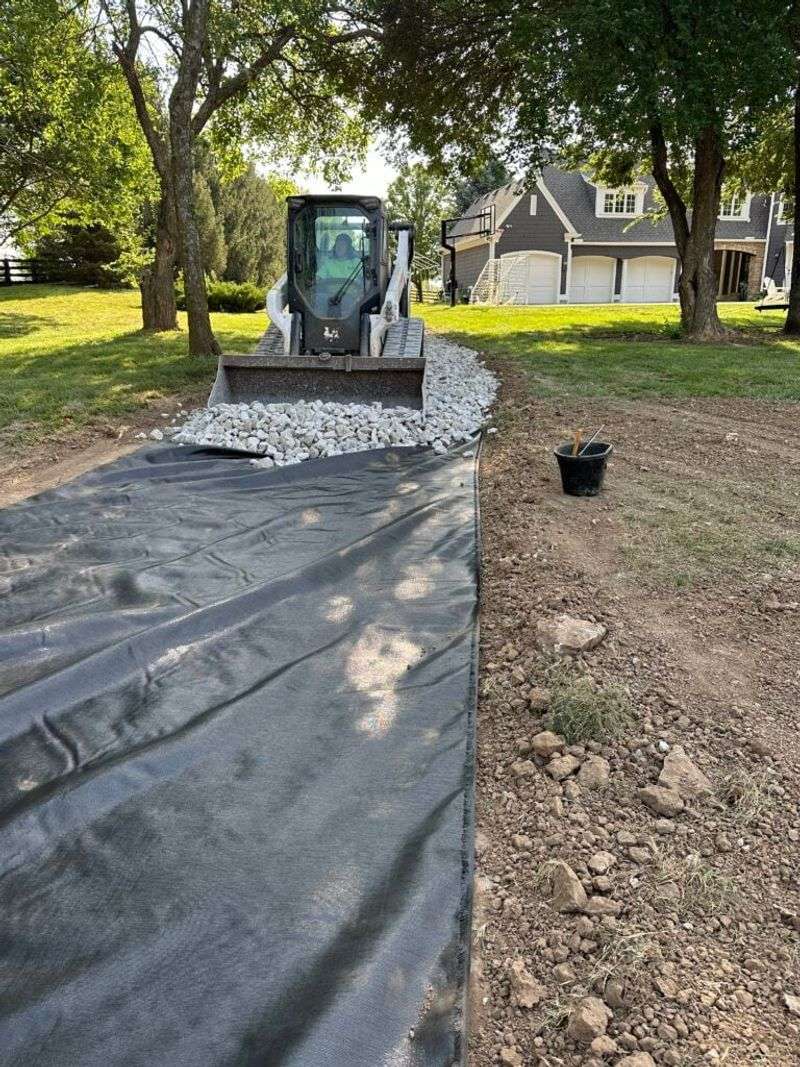
Landscape fabric sold at garden centers and driveway-grade separation geotextile are not the same product, and treating them as interchangeable leads to problems. A driveway-grade woven geotextile is designed to separate aggregate from the underlying soil, which helps keep the gravel from sinking into soft subgrade over time and reduces mixing between the stone layer and the dirt beneath it.
Lightweight landscape weed-barrier fabric is designed for garden beds and is not built to handle vehicle traffic, repeated flexing, or the drainage demands of a driveway surface.
Oregon State University Extension guidance on gravel systems in nursery restoration contexts describes a layered gravel approach that includes fabric as a separation layer, but that evidence comes from a nursery setting, not a residential driveway. The practical takeaway is indirect: a separation layer may reduce soil-to-gravel mixing during reconstruction, but it should not be marketed to yourself as a permanent weed-proof barrier.
The limits are real and worth understanding before installation. Seeds and organic debris that blow onto the driveway surface accumulate above the fabric, not below it, and those seeds can germinate in the material sitting on top of the geotextile just as readily as they would in soil.
Roots from established perennials can grow through or into the fabric over time, and once that happens, removing weeds without disturbing the fabric becomes difficult. Penn State Extension’s coverage of landscape fabric problems and Colorado State Extension’s mulching guidance both caution that fabric can clog, degrade, and interfere with future maintenance depending on the material quality and installation conditions.
If you decide to use a geotextile during reconstruction, choose a product rated for the traffic the driveway actually handles, install it on a prepared base rather than over existing debris, and understand that it is a construction aid for aggregate stability – not a replacement for the monitoring and maintenance routine the surface will still require.
Match the control method to the weed’s stage
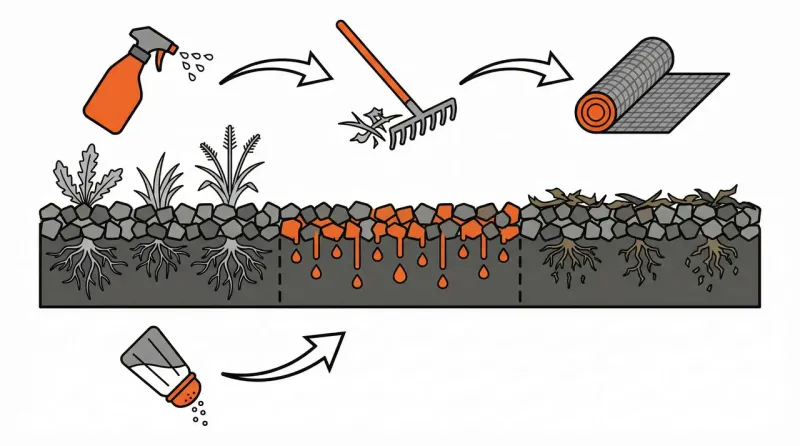
Established weeds and seedlings that have not yet emerged require completely different responses, and mixing up the approach wastes time and money while leaving the real problem in place. Hand-pulling or digging is the right first move when roots can actually be removed.
For young annual weeds with shallow roots, a firm pull after rain is often enough. For perennial species with deep or spreading root systems, digging out as much of the root as possible during the renovation phase reduces how aggressively they regrow.
Utah State Extension’s weed control guidance is clear that nonselective foliar herbicides such as glyphosate act on emerged foliage – they do not provide soil activity against later flushes of seedlings. Killing the weeds you can see today does not prevent the next batch from germinating.
Perennial weeds or new annual flushes may also require repeat treatments because the first application addresses the visible growth but not roots that survive underground. EPA’s glyphosate information confirms it is registered for some residential and non-crop uses when applied according to the product label, but it is broad-spectrum and can injure desirable plants through drift or accidental contact.
Preemergence herbicides serve a different function. They are intended to prevent germinating seedlings from establishing, not to kill weeds that are already growing.
They work for a limited, label-directed period and need to be applied before the target weeds emerge, often with watering-in or incorporation as the label specifies. A preemergence product does not render a driveway permanently sterile; it reduces germination pressure for a defined window and then needs to be reapplied according to label directions.
Spot treatment is almost always preferable to broadcast spraying when infestations are scattered or when desirable plants grow near the driveway edge. University of Minnesota Extension’s home garden weed guidance reinforces removing weeds before they set seed and targeting the root system where possible.
Keeping the spray on the weed rather than the surrounding area protects native plants, wildflowers, and garden beds that may be close to the driveway edge in a typical Central Texas yard.
Use Central Texas conditions as signals, not a magic calendar
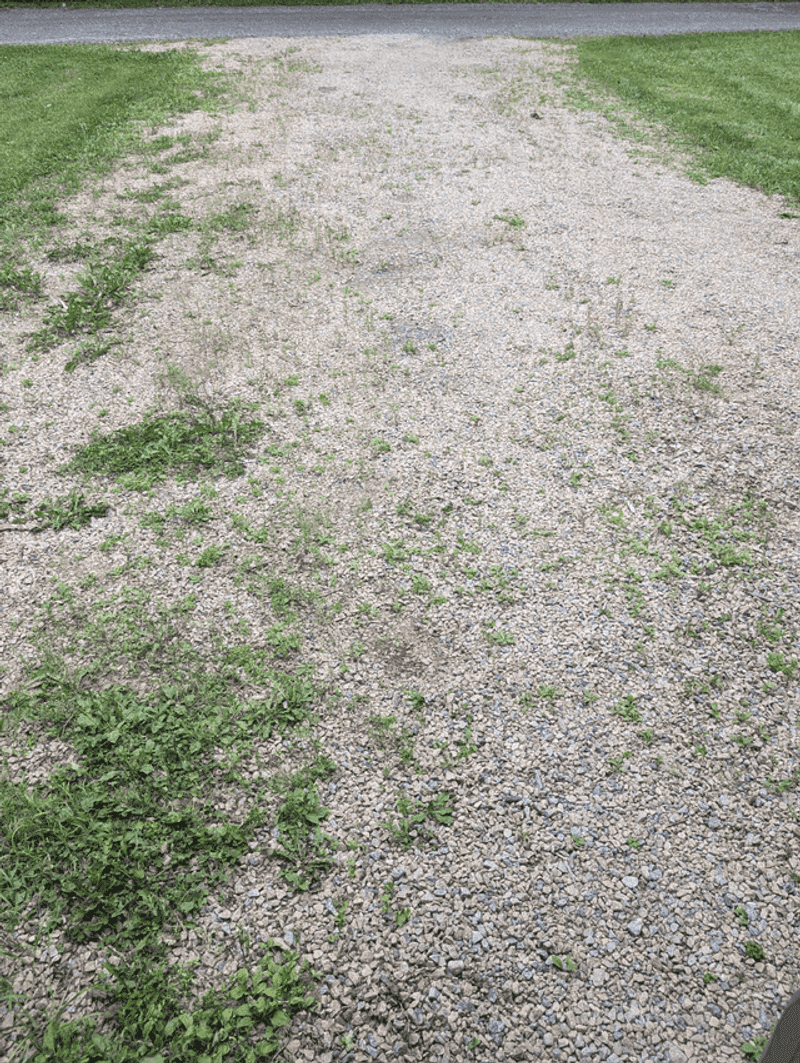
Weed germination in Central Texas does not follow a single predictable date. Soil temperature, rainfall, irrigation, species, and microclimate all shift the timing, which means a fixed annual treatment schedule is less useful than a routine built around observation.
The practical habit is to check the driveway after rainfall events and irrigation cycles, since moist warm soil is exactly the condition that triggers germination for most common Texas weeds.
Texas A&M AgriLife Extension guidance on warm-season turf management ties preemergence timing to soil temperatures and emphasizes that products must be watered in according to label directions – a principle that applies directly to gravel maintenance even though the source addresses turf. That guidance is an analogy for timing logic, not a driveway-specific recommendation, and the product label always governs rate, timing, and incorporation requirements for any specific herbicide you use.
The most reliable signal is what you can see. Seedlings that are removed before they flower never set seed, which reduces the next generation of weeds.
New organic debris – fallen leaves, blown-in grass clippings, wind-carried dust – should be cleared regularly rather than left to build up between stones, because that material is what converts a gravel surface back into a growing medium. Utah State Extension’s weed control guidance emphasizes this cycle: seeds arrive continuously, and removing them before they mature breaks the chain.
Treat the inspection routine as part of driveway maintenance rather than as a failure of the initial renovation.
Reject shortcuts that can damage the surrounding yard
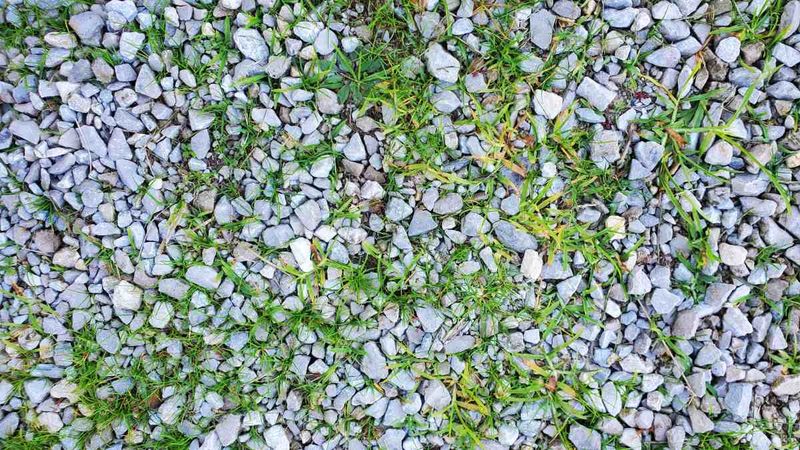
Salt is a common suggestion for gravel weed control, and it does kill plants – but Utah State Extension’s guide on home remedies for weed control groups it with treatments that carry real environmental hazards. Salt moves with runoff, damages soil structure, and can injure nearby trees, shrubs, and lawn grass over time.
A Central Texas yard with garden beds, native plantings, or a lawn near the driveway edge is exactly the situation where salt runoff causes collateral damage that outlasts any weed it kills.
Soil sterilants and industrial bare-ground herbicides present even greater risks in a residential setting. Utah State Extension warns explicitly that some sterilant herbicides can move through soil with precipitation or irrigation, remain active for years, and injure nearby vegetation – and that they should not be used in residential areas.
Using a product not labeled for your specific site type is also a legal issue, not just a safety one.
Vinegar and flame treatment are often presented as natural alternatives, but both have real limits against established perennials. University of New Hampshire Extension’s weed management Q&A notes that horticultural vinegar works best on annual weeds and very young perennials; mature perennials with established root systems often regrow after top-kill.
Flame treatment carries a fire risk that is especially serious in dry Texas weather. Penn State Extension’s weed control guidance warns that dry leaves, mulch, fencing, and surrounding vegetation can ignite from a flame weeder.
Avoid flame treatment in dry or windy conditions, and check local fire restrictions before using one.
EPA pesticide safety guidance is clear that homeowners must follow the exact product label for site eligibility, rate, timing, weather conditions, drift control, and reentry intervals for children and pets. Keep any herbicide application away from storm drains, creeks, ponds, and neighboring property.
When weeds grow close to desirable plants or sensitive areas, spot treatment or physical removal is the safer choice every time.
Maintain the reset before weeds take over again
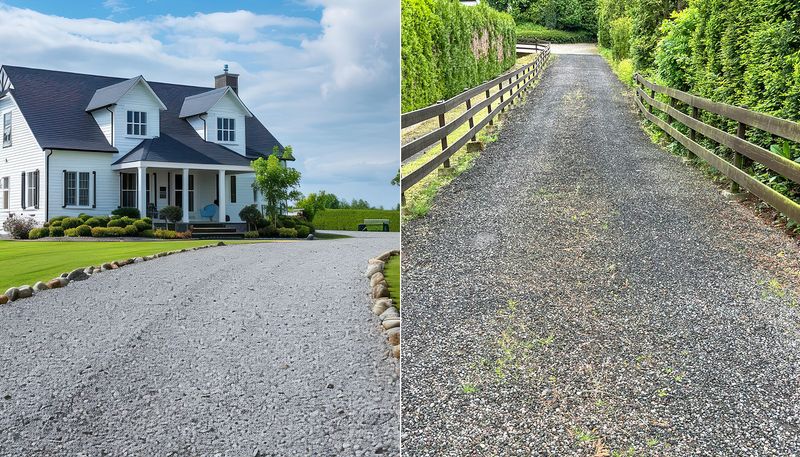
A renovated driveway is a reset, not a finish line. The maintenance routine that follows the rebuild is what determines how long the results last.
Penn State Extension’s guidance on healthy soil and weed management reinforces that seeds arrive continuously from wind, birds, and adjacent vegetation – a clean surface will receive new ones regardless of what was done during renovation.
The repeatable checklist is short. Remove roots and debris during and after renovation.
Rebuild the surface to match actual driveway traffic and drainage conditions. Use only herbicides labeled for your specific site, applied at the stated rate and timing.
Inspect after rainfall, irrigation, and any event that triggers visible emergence. Pull or treat seedlings before they flower and set seed.
Clear new organic debris before it accumulates into a growing medium.
That system reduces weed pressure and cuts repeat labor compared to spraying an infested surface with no preparation, but it does not eliminate new arrivals. Success looks like a cleaner, more stable driveway that you monitor on a regular schedule – not a surface you treat once and forget.