
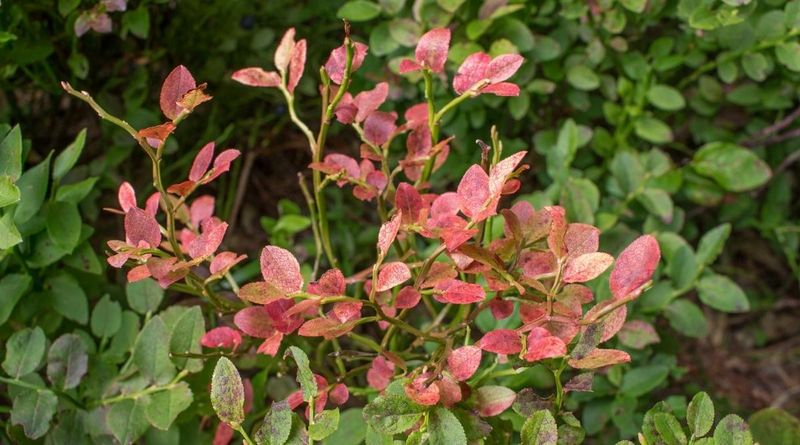
Seeing red leaves on your blueberry bushes in the middle of summer can stop you in your tracks. Before you assume it’s just early fall color, those leaves are telling you something worth paying attention to. Summer reddening can signal several different problems, and figuring out which one is actually happening makes the difference between a real fix and a wasted effort.
Summer red leaves are a symptom, not a diagnosis
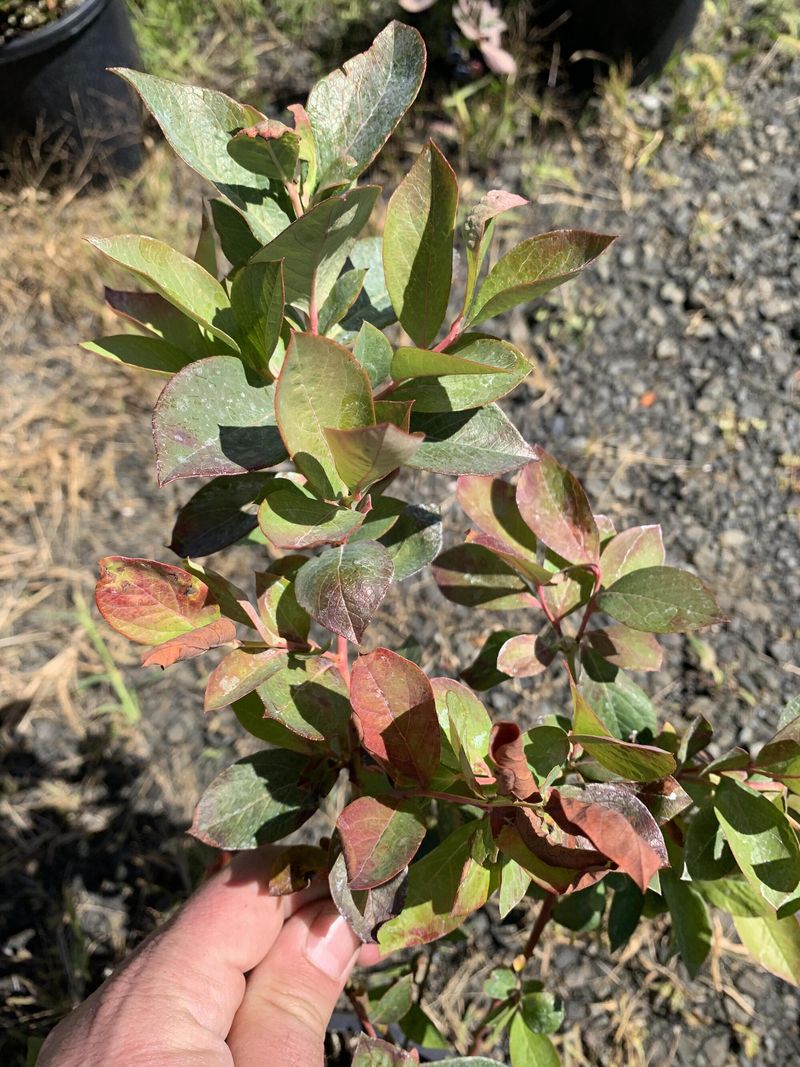
Healthy blueberry leaves generally stay green all summer long, then shift to red or orange as fall approaches. That color change is normal and expected – but when leaves start going red in July or August, before the season turns, the plant is probably reacting to some kind of stress. The timing alone, though, does not prove what that stress actually is.
Cultivar matters here. Some varieties naturally shift color a little earlier than others, and an unusually warm or dry stretch can nudge the calendar in either direction. OSU Extension’s home garden blueberry guide describes healthy summer foliage as green that turns red in fall, and groups early reddening with a range of possible plant stressors rather than pinning it to one cause.
Those causes include soil pH that has drifted too high, nitrogen deficiency, drought, excess water, root disease, powdery mildew, viral infection, herbicide drift, salt stress, and other nutrient imbalances. University of Minnesota Extension notes that light green, red, or pink summer foliage can point to either a pH problem or a nitrogen shortfall, which is why the visual symptom alone cannot close the case.
Reaching for a bag of sulfur or a fertilizer scoop before investigating can treat the wrong problem entirely, or make conditions worse. Think of the red leaves as a signal worth following up on, not a confirmed verdict waiting for a treatment.
Why pH remains a credible suspect
Soil chemistry sits near the top of the list when blueberry leaves start looking wrong in summer, and for good reason. Blueberries are unusually demanding about acidity. Most other garden plants tolerate a wide pH range, but blueberries genuinely struggle when conditions drift outside their preferred window.
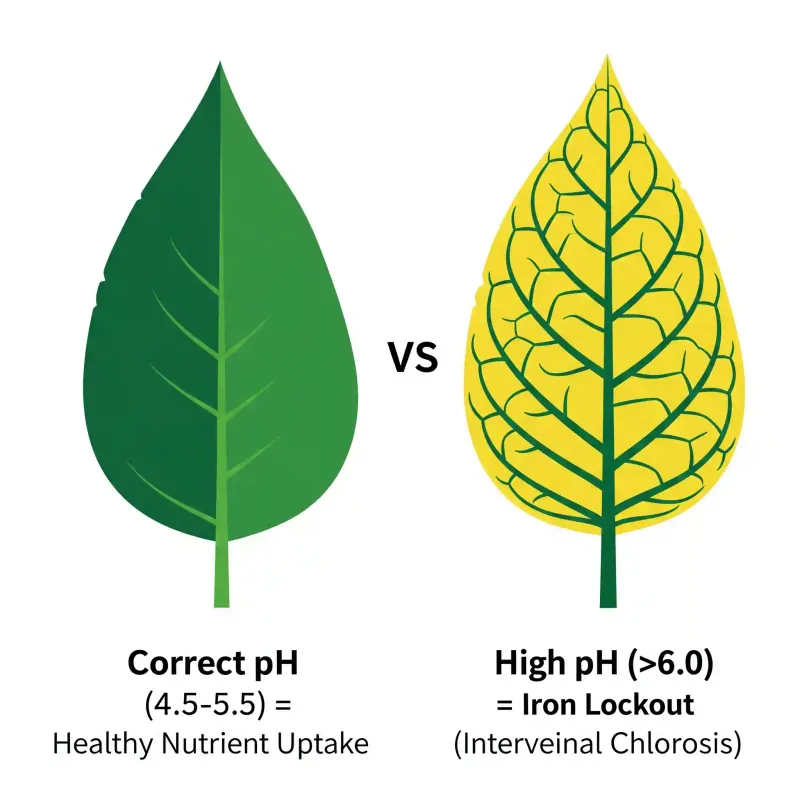
University of Minnesota Extension recommends a soil pH between roughly 4.5 and 5.5 for home garden blueberries, with many highbush varieties performing best closer to 4.5 to 5.0. The University of Georgia Cooperative Extension echoes a similar range for home plantings, and notes that targets can shift slightly depending on species, cultivar, soil type, and regional conditions. Rabbiteye blueberries, for example, may have a somewhat different sweet spot than highbush types.
When pH climbs above about 5.5 to 5.8, nutrient availability starts to decline. Iron is especially sensitive to this shift. UMN’s commercial blueberry production guide explains that elevated pH can interfere with iron uptake and reduce overall vigor and fruit production, not just leaf color.
That said, red leaves are not the classic sign of iron chlorosis. Iron deficiency typically shows up as yellowing between green veins, especially on newer leaves near the shoot tips. Broad reddening across the plant fits other possibilities more closely, which is exactly why pH is a credible suspect worth testing – not a confirmed answer based on leaf color alone.
Read the whole leaf pattern before treating
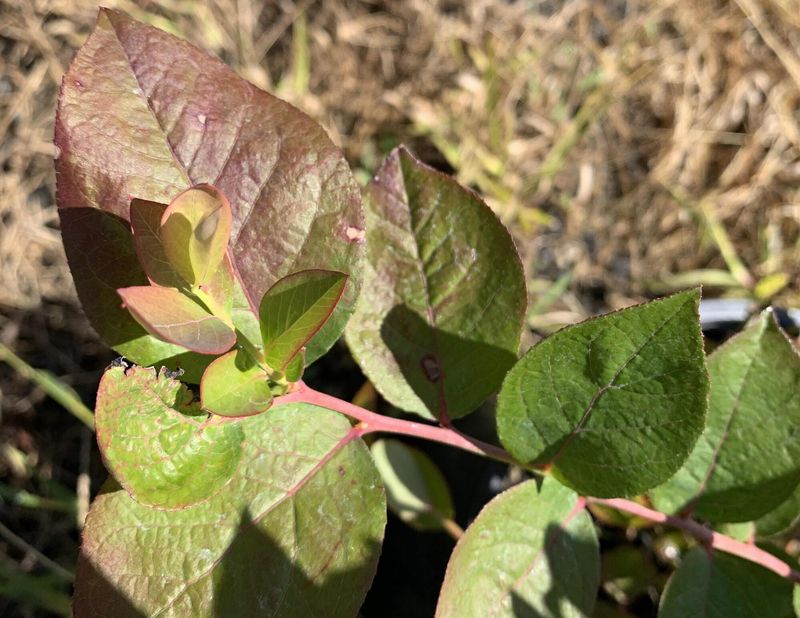
Before settling on any treatment, take a few minutes to look at the whole plant carefully. The pattern of discoloration – which leaves are affected, where the color shows up on each leaf, and what else the plant is doing – gives you real clues about what might be going wrong.
Yellow leaves with green veins, particularly on the newest growth near shoot tips, fit iron chlorosis more closely than most other problems. That pattern is associated with high pH reducing iron availability. Uniform reddish or purplish foliage paired with short, weak new shoots points more toward nitrogen deficiency or a broader nutrient shortfall. OSU Extension groups red or pink-tinted foliage with out-of-range pH, nutrient problems, root disease, and excess water as a cluster of related possibilities rather than one obvious answer.
Brown leaf margins, scorched tips, or wilting along with reddening suggest drought, salt stress, or fertilizer injury rather than a pH issue. Those patterns tend to start at leaf edges and work inward. Discrete red or brown spots, mottling, or a powdery coating on leaf surfaces can indicate disease. Penn State Extension notes that blueberry powdery mildew can produce symptoms that look different from what most growers expect, including reddish or distorted foliage.
If you recently applied herbicide near the planting, that is worth factoring in too. OSU’s herbicide injury identification guide for blueberries describes several symptom patterns that can mimic nutrient or pH stress. Review your watering schedule, fertilizer history, any sprays applied nearby, and recent weather before reaching any conclusions.
Test soil and water before reaching for amendments
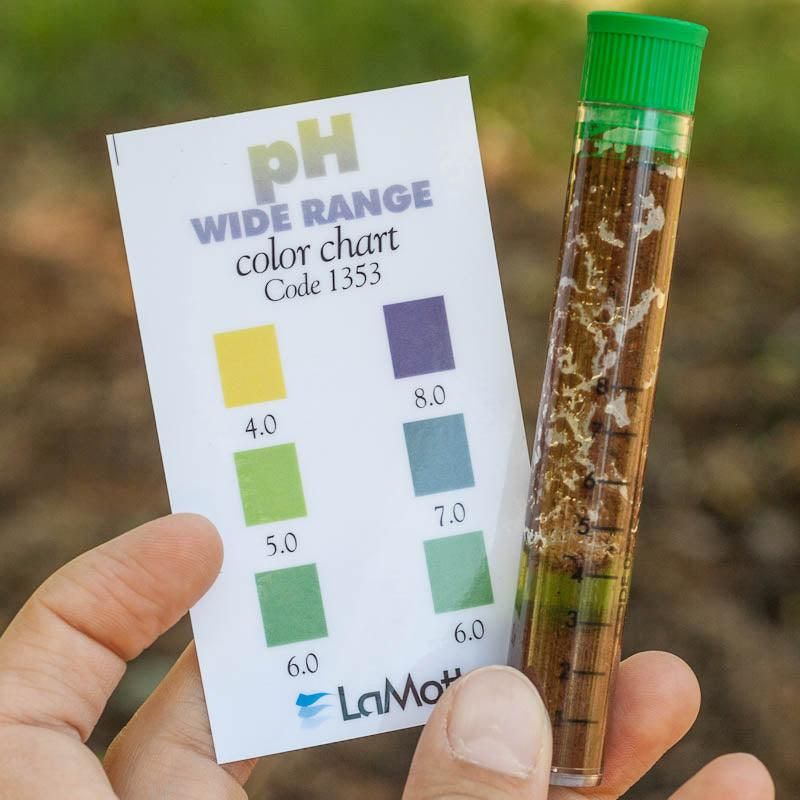
A soil test is the single most useful step you can take when blueberry leaves look wrong in summer. Without one, you are essentially guessing – and a wrong guess can push conditions in the wrong direction. Applying sulfur to soil that is already acidic enough, or adding nitrogen to soil that already has plenty, can cause new problems rather than solve the one you started with.
Look for a test that reports pH along with nutrient levels interpreted specifically for blueberries, since general garden interpretations may not flag the same concerns. Many state university extension services offer affordable soil testing with crop-specific recommendations. University of Minnesota Extension recommends soil testing as the first practical step before applying any amendment to blueberry plantings.
Irrigation water is worth considering as a secondary factor, particularly if your soil pH keeps drifting upward after corrections. Water that is alkaline or high in bicarbonates can gradually push root-zone pH higher over time. A UMN fruit IPM update identifies alkaline irrigation water as a plausible contributor to pH drift in some blueberry plantings. The University of Georgia’s blueberry irrigation water quality guide covers how to evaluate and address water chemistry if repeated pH corrections are not holding.
Water quality is not the explanation for every pH problem, but if your soil keeps climbing back up after treatment, it is a reasonable next thing to investigate. Test first, then decide what, if anything, actually needs to change.
Choose a pH correction that fits the planting
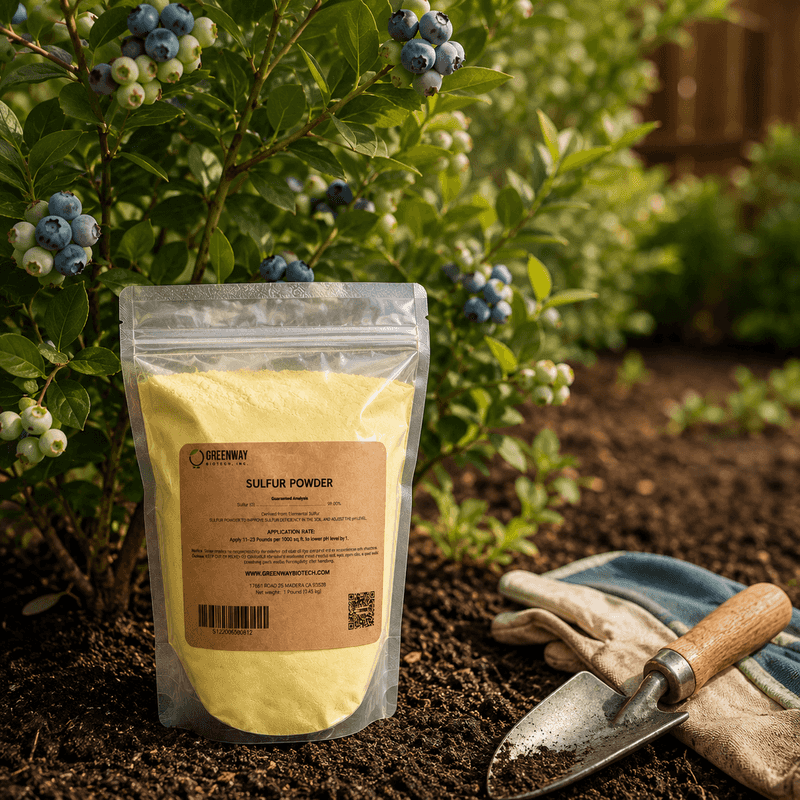
Elemental sulfur is the amendment most commonly recommended when a soil test confirms that pH is too high for blueberries. The key phrase there is “soil test confirms.” Sulfur applied without testing can push pH too low, and going too acidic creates its own set of problems for plant health and nutrient availability.
The right amount of sulfur depends on your starting pH, your target pH, your soil texture, and how much organic matter the soil contains. Clay soils require more sulfur to shift pH than sandy soils do, and the gap between current and target pH matters a great deal. UMN’s commercial blueberry production guide identifies these variables as reasons why generic rates are not safe to apply across different situations. Follow the rate on your soil-test report, your product label, and local extension guidance rather than a number from an article or a neighbor.
Sulfur does not work like a liquid fertilizer that roots absorb right away. Soil microorganisms have to convert it into acidifying compounds first, and that biological process takes time. Warm, biologically active soil speeds things up, but meaningful pH change may still take several months or longer, especially in heavy or alkaline soils.
Penn State Extension cautions that sulfur does not move readily through soil, which means surface applications in established plantings may not reach the root zone effectively. Penn State’s establishment guide emphasizes that pre-plant incorporation is the most reliable method, while post-planting corrections require careful management and realistic expectations. Your local extension office can advise on what approach makes sense for your specific situation.
Stabilize the shallow root zone
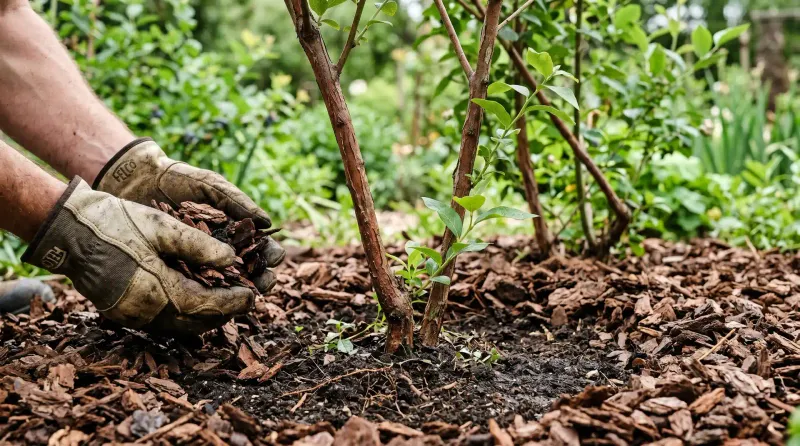
Blueberry roots are remarkably shallow compared to most fruit plants. The bulk of the root system sits in the top several inches of soil, which makes it quick to dry out in hot weather, easy to drown if drainage is poor, and sensitive to anything that disrupts the immediate root zone environment.
During summer heat, check soil moisture at the root zone regularly rather than watering on a fixed schedule. The goal is to keep the soil consistently moist without letting it stay saturated. UMN’s commercial production guide describes blueberries as particularly sensitive to both drought stress and prolonged waterlogging, either of which can produce symptoms that look like nutrient or pH problems.
Mulch plays a real supporting role here. A layer of aged sawdust, pine bark, pine needles, or a suitable wood mulch helps slow moisture loss from the soil surface, moderates soil temperature, and can support the kind of root-zone environment blueberries prefer. University of Minnesota Extension recommends keeping a mulch layer around blueberry plantings for these reasons.
Mulch does not rapidly lower soil pH, and it should not be treated as a substitute for a tested amendment when pH is genuinely too high. Think of it as a way to reduce additional stress while you work through the investigation and any correction that follows, not as the correction itself.
Avoid fertilizer reactions that add new stress
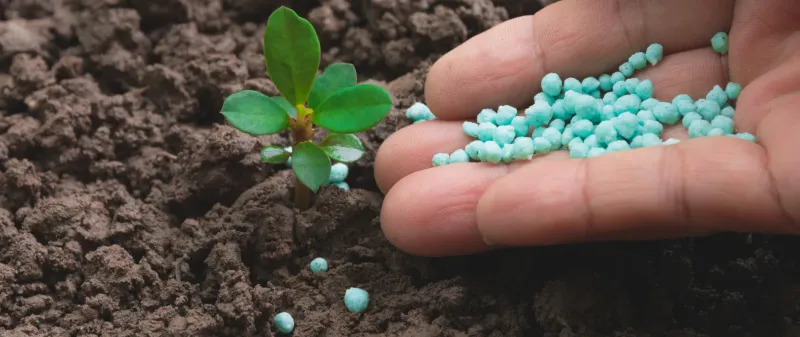
Red or pale leaves can tempt growers to reach for a nitrogen fertilizer to green things up quickly. The problem is that applying nitrogen without knowing what the soil already contains can cause more harm than the original symptom. Salt injury from excess fertilizer can scorch roots and margins in ways that look surprisingly similar to the stress you were trying to fix.
Fertilizer decisions for blueberries should follow soil-test results, observed plant symptoms, and the timing guidance appropriate for your region. OSU Extension notes that blueberries generally take up ammonium-form nitrogen more effectively than nitrate-form nitrogen, which is why ammonium sulfate appears on many recommended product lists. That said, ammonium sulfate is an example of a suitable product when testing and guidance support its use, not a universal prescription for any blueberry showing red leaves.
Late-season nitrogen applications carry a particular risk in cooler climates. Pushing new soft growth in late summer can delay the natural hardening process that protects canes through winter. UMN’s commercial blueberry guide warns that nitrogen applied after July 1 can increase winter-injury risk in Minnesota, though the exact cutoff varies by region, cultivar, and local conditions.
If a soil test does confirm a nitrogen shortfall, follow the report’s rate recommendation and apply during the window your extension service considers safe for your area. Greening up the leaves is not worth setting the plant up for cold-weather damage in the months ahead.
Monitor new growth and recheck the diagnosis
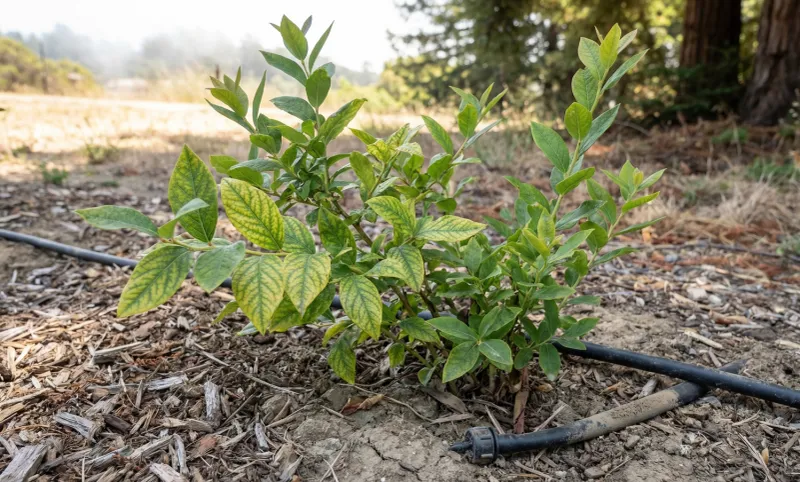
After applying a confirmed, test-guided pH amendment, the hardest part is waiting. Existing red or discolored leaves are not going to turn green again – those cells are already affected. What you are watching for is new growth that emerges with better color and stronger shoots over the following weeks and months.
Recheck soil pH according to local guidance rather than assuming the correction worked. UMN Extension recommends retesting to confirm that pH has actually moved toward the target range, since sulfur conversion can be uneven and slow. The commercial production guide reinforces that correction may take a season or longer, especially in heavier or more alkaline soils.
Improved pH may support better vigor and fruit production over time, but it cannot guarantee the next crop or reverse symptoms caused by disease, water stress, or a different deficiency. Summer reddening is a warning sign worth taking seriously – and a soil test is how you find out whether pH is actually part of the answer.